


A minimum bend radius is the smallest inside radius a strip can take at a corner before the outer surface cracks. On a roll forming line the minimum bend radius depends on grade, temper and gauge. For coil from 0.4 to 3.0 mm, it runs from 0.5 times thickness to 3 times thickness.
That spread breaks drawings. A corner that forms cleanly in 1.0 mm mild steel can split in 1.5 mm 6061-T6 aluminium. Set the value before the rolls are cut.
This guide gives six minimum bend radius values by material and gauge. It shows the millimetre callout, the standards behind the figures, and the first article checks. The equipment that holds those numbers is covered here.
What the Minimum Bend Radius Means on a Roll Forming Line
The minimum bend radius is an inside radius, measured from the centre of the bend arc to the inner face of the strip. It is written as R and compared with thickness t. A callout of 1t on 1.5 mm coil means an inside radius of 1.5 mm.
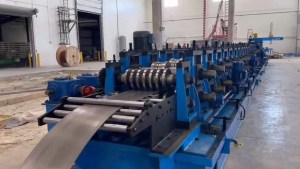
Roll forming differs from a press brake bend. The strip passes through 8 to 26 stands. Each adds a small part of the angle. Strain builds in steps along the whole length, so a well designed line holds a smaller inside radius than one hit on hard tooling.
The limit is still strain. The outer surface stretches by roughly t / (2R + t). At R = 1t that is 33 per cent. At R = 3t it falls to 14 per cent. A coil with 8 per cent elongation cannot survive the first case.
Grain direction matters less here, since the bend line runs along the rolling direction on most profiles. Hard temper and a rough sheared edge still crack first. Deburr the edge in the bend zone.
Put grade, temper, thickness and the minimum bend radius on the drawing. A note that says only R1.5 leaves the shop to guess.

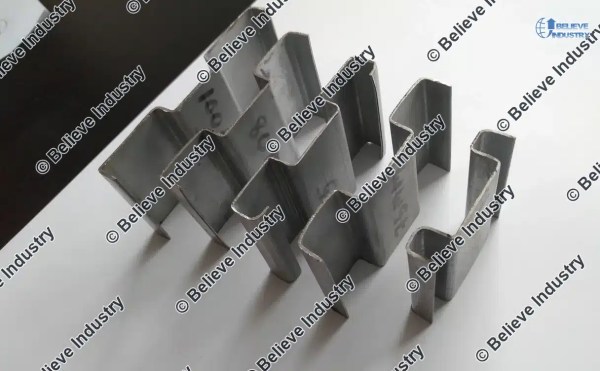
A profile drawing puts the inside radius, thickness and tolerance on one sheet before the rolls are cut.
Six Minimum Bend Radius Values by Grade and Gauge
The table gives starting minimum bend radius values for a 90 degree corner formed at room temperature. They are not material specifications. Confirm the figure with a test bend using your coil.
| Material and temper | Gauge (mm) | Yield (MPa) | Minimum inside radius | At 1.5 mm (mm) | Standard |
|---|---|---|---|---|---|
| Cold rolled mild steel, DC01 or A1008 CS | 0.6 to 2.0 | 140 to 280 | 0.5t to 1t | 0.8 to 1.5 | ASTM A1008, EN 10130 |
| Hot dip galvanized, A653 G90 or Z275 | 0.4 to 1.2 | 230 to 350 | 1t to 1.5t | 1.5 to 2.3 | ASTM A653 / A653M, EN 10346 |
| HSLA 350 and DP 590 | 1.0 to 2.0 | 350 to 590 | 2t to 3t | 3.0 to 4.5 | ASTM A1011, SAE J2340 |
| Stainless 304, annealed | 0.5 to 1.5 | 205 to 310 | 1t to 1.5t | 1.5 to 2.3 | ASTM A240 / A240M |
| Aluminium 3003-H14 and 5052-H32 | 0.8 to 2.0 | 150 to 230 | 0.5t to 1t | 0.8 to 1.5 | ASTM B209 |
| Aluminium 6061-T6 | 1.5 to 3.0 | 276 | 2.5t to 3t | 3.8 to 4.5 | ASTM B209 |
Two rows need a comment. Galvanized and Galvalume coil carries a coating that can crack before the steel does. Coil rated 1T or 2T in a T-bend test will not follow a 0T corner. A minimum bend radius of 2.5t to 3t is the other trap: 6061-T6 has 8 to 10 per cent elongation, while the same alloy in O temper forms at 0t to 1t.
AISI S100-16 uses an inside corner radius of 1.5t for section properties. EN 10162 sets dimensional delivery conditions, EN 1993-1-3 covers cold formed member design, and GB/T 6725-2008 covers cold formed sections in China. Quote the edition, not just the number.
Aluminium bend data is published by alloy and temper, not by gauge alone.
Aluminum Association design data
North American cold formed steel design resources sit with the industry association.
Metal Construction Association technical resources
Aluminium grades behave differently from steel at the same gauge.
See seven differences between aluminium and steel roll forming
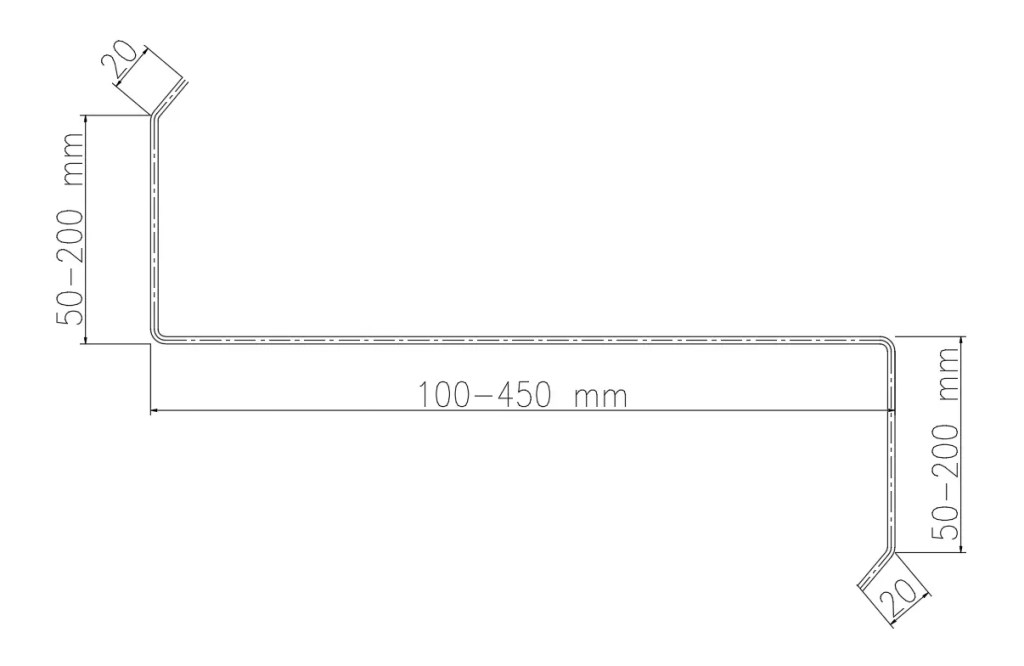
Corner radii are specified with the section dimensions, not left to the tooling shop.
How Thickness and Temper Move the Minimum Bend Radius
The minimum bend radius is not a fixed property of a grade. It moves with thickness, temper and the strain the corner asks for.
| Inside radius | Outer fibre strain | Where the value works |
|---|---|---|
| 0.5t | 50% | Annealed aluminium and dead soft copper only |
| 1t | 33% | 3003-H14, 5052-H32, cold rolled mild steel |
| 2t | 20% | Galvanized coil, stainless 304, thin HSLA |
| 3t | 14% | HSLA 350, DP 590, thin 6061-T6 |
| 4t | 11% | 6061-T6 at heavier gauge, hard tempers |
Hard tempers buy strength with ductility. A DP 590 coil at 590 MPa springs back 3 to 6 degrees on a 90 degree corner. Mild steel springs back 1 to 3 degrees. The last stand overbends by that amount. A 0.20 mm thickness shift can change the angle by 1 to 2 degrees.
High strength grades have their own forming limit data.
AHSS Insights forming guidelines
Coated coil adds a second limit. A corner safe for the base steel can still crack the zinc or paint.
Galvanized coating formability is documented by the zinc industry.
Galvanized coating formability guidance
Keep hole centres at least 2.5 times thickness from the bend line. Allow a flange of at least 2.5 times thickness plus the inside radius.
Springback changes both angle and radius after the last stand, so measure the minimum bend radius on the finished part.
Read the springback in roll forming guide
Tight corners on coated coil have a separate failure chain.
Roll Tooling and Line Settings That Hold the Radius
A minimum bend radius on the drawing only survives if the tooling holds it. Forming rolls carry the corner in their profile. Sharper noses wear faster and mark the strip. A minimum bend radius below 0.5t usually means the grade should change, not the tool steel.
Spread the bend over six to ten stands for a 90 degree corner. Taking 45 degrees in one stand concentrates strain and leaves a crease. Add a finishing stand when a tight corner sits next to a wide flat.
Set roll gap to measured strip thickness plus 0.05 to 0.10 mm. Too tight a gap work hardens the corner. Too loose a gap lets the strip wander. Line speed of 10 to 20 m/min gives the operator time to see a drift.
The radius changes section strength. A lipped channel with an inside corner up to R = 2t has more bearing area at the web to flange corner than one with an oversized radius.
Check the six strength calculations for lipped channels
Gap settings depend on the coil in the machine, not on a catalogue value.
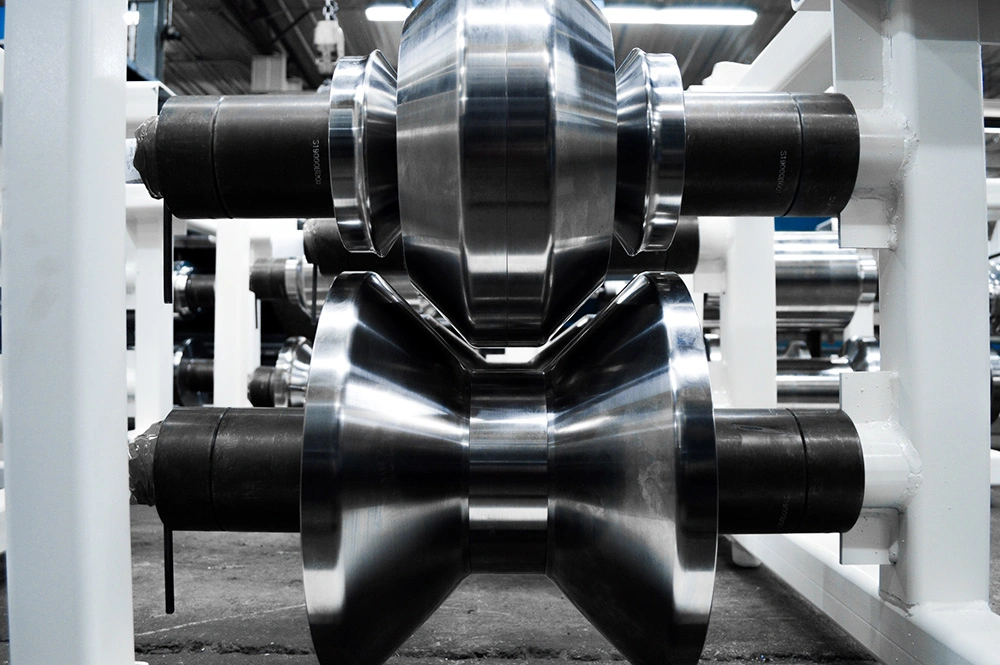
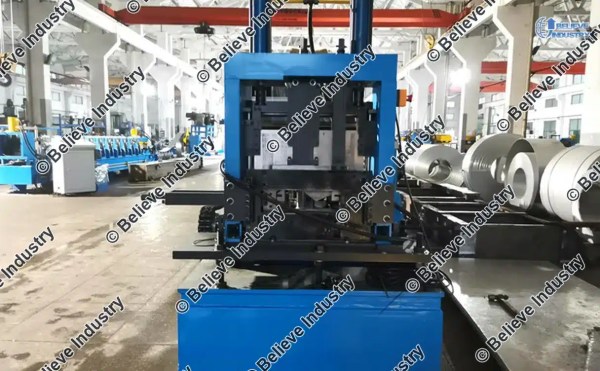
Forming rolls carry the corner radius in their profile, so a sharper nose wears faster.
Measuring the Minimum Bend Radius on the First Article
The first article is where a minimum bend radius becomes an acceptance criterion. Measure the part, not the roll drawing.
| Check | Target on 1.5 mm coil | Method |
|---|---|---|
| Inside radius | Drawing value, +0.2 / minus 0 mm | Radius gauge or optical comparator |
| Bend angle after springback | 90 degrees, within 1 degree | Digital protractor |
| Overbend at the last stand | 2 to 4 degrees mild steel, 3 to 6 degrees HSLA | Roll setting sheet |
| Roll gap | Thickness plus 0.05 to 0.10 mm | Feeler gauge at each stand |
| Hole to bend line | At least 2.5 times thickness | Calliper |
| Coating at the corner | No crack at the rated T-bend | T-bend test, ASTM A755 / A755M |
Record radius, angle, gap and line speed on the setting sheet. Keep three parts from the start, middle and end of the coil. If the radius drifts, compare the three before adjusting a stand.
Look at the outside of the corner under good light. Hairline cracks mean the minimum bend radius is too small for that heat, even if the angle passes. Check the coating separately.
Sheet metal construction standards cover gauge, radius and fabrication tolerances.
First article inspection belongs in the handover. Ask for the measurement sheet.
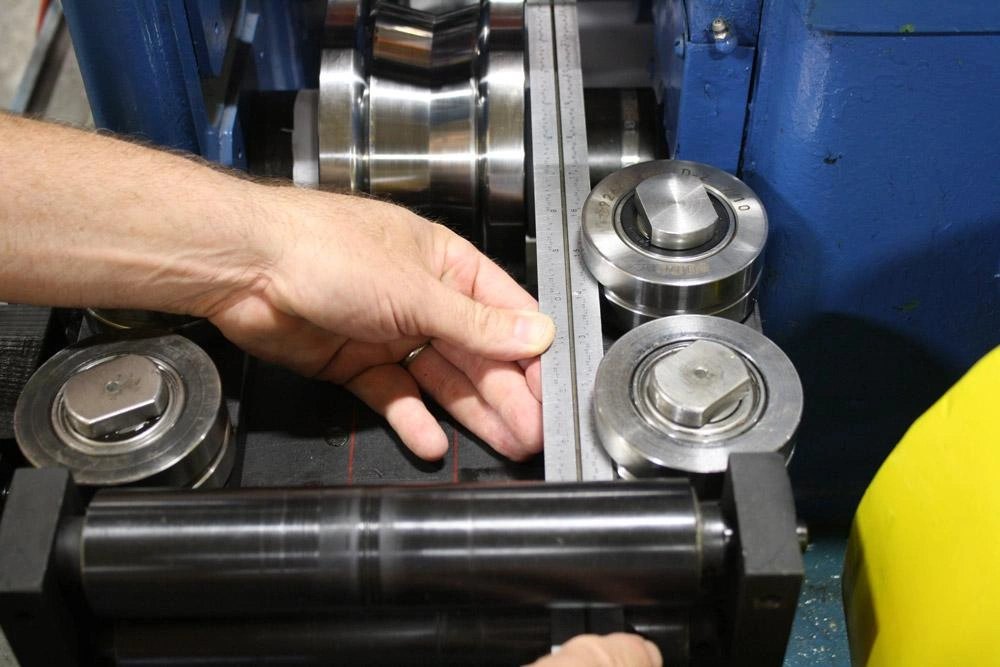
First article inspection records the measured radius, angle and roll gap.
Frequently Asked Questions
1. What is the minimum bend radius in roll forming? It is the smallest inside radius a strip can take before the outer surface cracks. For 0.4 to 3.0 mm coil it runs from 0.5t to 3t, set by grade, temper and gauge.
2. How do I convert a minimum bend radius ratio into millimetres? Multiply the ratio by the strip thickness. A 1t value on 1.5 mm coil is 1.5 mm inside radius. A 3t limit on the same coil is 4.5 mm.
3. Can roll forming hold a tighter radius than a press brake? Often yes. The strip passes through 8 to 26 stands and bends in steps. The gain disappears on hard tempers with low elongation, where the material limit still governs.
4. Which standard sets the minimum bend radius for cold formed steel? AISI S100-16 uses 1.5t for section property calculations. EN 10162 covers delivery conditions, EN 1993-1-3 covers member design, and GB/T 6725-2008 covers cold formed sections in China.
5. What is the minimum bend radius for 6061-T6 aluminium? Plan on 2.5t to 3t at 1.5 to 3.0 mm gauge. The T6 temper has 8 to 10 per cent elongation. Form in O or T4 temper and age afterwards if the drawing needs a tighter corner.
6. Does galvanized coil need a larger minimum bend radius than bare steel? Usually 1t to 1.5t instead of 0.5t to 1t. Zinc and any paint have their own T-bend limit. Buy coil rated for the tightest corner on the profile.
7. How does springback affect the minimum bend radius? The strip relaxes after the last stand. Mild steel springs back 1 to 3 degrees and HSLA 3 to 6 degrees on a 90 degree bend. Overbend by that amount and measure the finished part.
8. How far should a hole sit from the bend line? Keep hole centres at least 2.5 times strip thickness away. Closer holes ovalise as metal flows. Add a bend relief when a flange ends at the corner.
9. What should the first article record for the minimum bend radius? Measured inside radius, bend angle, roll gap, line speed and a coating check. Keep three parts from the start, middle and end of the coil, and accept within +0.2 mm of the drawing value.
10. Can I specify one radius for every corner on a profile? Yes, and it saves tooling. Pick the value the least ductile material and the thickest gauge can hold, then use it across the section. Every different radius adds a roll change.
Conclusion
Minimum bend radius is a material limit, not a tooling preference. It comes from elongation, temper and gauge. Roll forming bends in steps, which helps, but it does not repeal the strain limit at the outer fibre.
Put grade, temper, thickness and the minimum bend radius on the profile drawing. Confirm it with a test bend using your coil. Record the measured radius on the first article.
Beli Rollforming has built roll forming machines since 2005. We have delivered 500+ machines to 50+ countries from a 15,000 m² plant, with 80+ engineers and technicians. Every machine carries a 24-month warranty on the complete machine. Send us your profile drawing and coil grade, and we will tell you the inside radius the line can hold.
Last updated: 2026-11-13
Article Changelog
- 2026-11-13: First publication. Six grade and gauge values, an R/t strain table, tooling and first article checks, and ten FAQ entries.
Next Review Triggers
- A revision to AISI S100, EN 10162, ASTM B209 or EN 10346 that changes bend radius or tolerance criteria
- New in house measurement data for a grade outside the 0.4 to 3.0 mm gauge band
- A customer drawing that calls for an inside radius below 0.5 times thickness

 English