3 Materials and Applications in Modern Industry.
4 Roll Design and Process Optimization
3.1 Material Selection Considerations for Roll Forming Machine
The effectiveness of roll forming depends significantly on appropriate material selection, with different metals offering distinct advantages for specific applications. Key considerations include the material’s mechanical properties (yield strength, tensile strength, elongation), formability characteristics, surface conditions, and intended service environment:
Low-carbon steels represent the most commonly roll-formed materials due to their excellent ductility, favorable strength characteristics, and cost-effectiveness. These materials typically have yield strengths ranging from 30,000 to 50,000 psi and can be formed into complex shapes without cracking or excessive springback.
High-strength low-alloy (HSLA) steels offer enhanced mechanical properties with yield strengths ranging from 50,000 to 70,000 psi, providing greater load-bearing capacity in structural applications while potentially requiring more powerful forming equipment and careful roll design.
Stainless steels are selected for their corrosion resistance and aesthetic appeal, though their higher work hardening rates necessitate specialized forming approaches.
Aluminum alloys are valued for their light weight and corrosion resistance, with various tempers offering different balances of formability and strength. The 5000 and 6000 series aluminum alloys are most commonly roll-formed, with the former providing superior formability and the latter offering better strength characteristics after forming.
Material thickness significantly influences the roll forming process, with most applications falling between 0.012 inches (0.3 mm) and 0.125 inches (3.2 mm). Thinner materials require more forming stations and careful tension control to prevent wrinkling or distortion, while thicker materials demand greater forming power and robust machinery. The material’s surface condition must also be considered, as pre-painted, pre-plated, or polished surfaces require special roll designs and handling procedures to prevent damage during forming. Additionally, the anisotropic nature of rolled sheet metals (exhibiting different properties in different directions) must be accounted for in the roll design, particularly for high-strength materials where directional properties are more pronounced.
3.2 Industrial Applications and Sector-Specific Implementations
Roll forming technology serves a diverse range of industries through its ability to produce customized profiles with consistent quality and dimensional accuracy. Each application sector imposes unique requirements on the roll forming process, influencing material selection, profile design, and production parameters:
Construction and Steel Structure: Roll forming produces structural components including steel framing (studs and tracks), roofing and siding panels, floor decking, window and door frames, and structural sections (C-purlins, Z-purlins, U-channels). The construction sector values roll forming for its ability to create long, consistent lengths that simplify installation and enhance structural integrity. The process efficiently produces profiles with integrated features such as drainage channels, connection details, and aesthetic elements.
Automotive Industry: Automotive applications include seat tracks, door beams, bumper reinforcements, sunroof guides, structural reinforcements, exhaust components, and window channels. The industry increasingly utilizes advanced high-strength steels (AHSS) to reduce vehicle weight while maintaining safety standards. Roll forming’s capability to produce high-strength, lightweight components with tight tolerances makes it indispensable for modern automotive manufacturing.
Logistic Profile : This sector utilizes roll forming for bolted upright column, welded upright frame, supermaket shelving panel, box beam, step beam, bracing, steel board. The process provides the consistency and aesthetic quality required for consumer products while offering cost advantages for high-volume production.
- Energy and Electric: Solar energy systems rely on roll-formed module mounting rails, solar tracking components, and support structures. The wind energy sector uses roll-formed tower sections and internal components. The efficiency and cost-effectiveness of roll forming contribute to renewable energy affordability. A cable tray system is a structured assembly used to securely support, organize, and protect electrical and data cables in commercial, industrial, and residential buildings, and the profiles include strut channel, cable tray, cover, cable ladder, truking, wire mesh, and joints.
Rain Gutter System: The metal strip is gradually shaped into specific gutter profiles, such as half-round, square, or rectangular. downspout profiles, such as round, square and rectangular, fascia board.
- Door and Window Profile: Roll Forming Machine produces door and window profiles include door frame, window frame, shutter door guider, shutter door slats, shutter door bottom, garage door panel, garage door guide rail.
3.3 Advantages and Limitations in Industrial Applications
Roll forming Machine offers numerous advantages that explain its widespread adoption across industries. The process provides exceptional production efficiency,
with linear speeds typically ranging from 30 to 300 feet per minute (approximately 10 to 100 meters per minute), significantly exceeding alternative forming methods for long parts. This high-speed continuous production translates to lower per-part costs in high-volume applications. The minimal material waste inherent in the process (typically limited to lead and tail ends of coils) offers both economic and environmental benefits compared to competitive processes like stamping that generate significant scrap
The superior dimensional consistency achieved through roll forming machine ensures uniform cross-sections along the entire product length, facilitating assembly and improving end-product quality. The cold-working effect of progressive forming can enhance material strength along bend lines through work hardening. Additionally, the ability to integrate multiple operations (punching, notching, embossing) inline further enhances efficiency.
However, roll forming also presents certain limitations, including substantial initial tooling investment that may be difficult to justify for low-volume production. The process is primarily suited for constant-cross-section profiles, with limited capacity for varying sections along the length (though specialized techniques like variable-depth forming are developing).
Additionally, the setup times for changeovers between different profiles, while improving with quick-change tooling systems, can still present challenges for operations requiring frequent product transitions.
4.1 Fundamental Principles of Roll Design
The heart of successful roll forming machine lies in the precise design of the roll tools that gradually shape the flat material into the desired profile. Roll design represents a specialized engineering discipline that balances material behavior, mechanical principles, and production requirements.
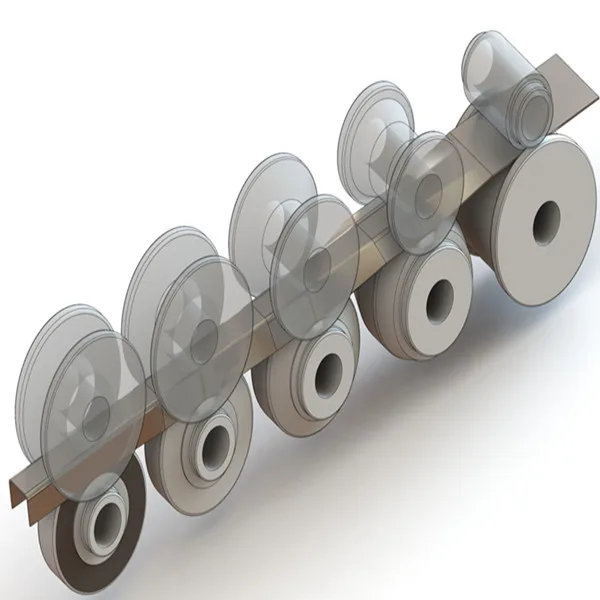
The process typically begins with the creation of a flower pattern (also known as a form sequence or bend progression), which visually represents the cross-sectional shape at each stage of deformation as the material passes through the forming mills. This diagram serves as the foundational blueprint for designing the contour of each roll set and determining the optimal number of forming stations required.
A key principle in roll design is distributing the deformation evenly across the forming stations to prevent excessive strain at any single point. Each station should introduce only incremental bends, typically not exceeding 10-30 degrees per station depending on material properties and thickness.
This gradual approach minimizes springback, reduces residual stresses, and prevents edge waving, buckling, or other defects. The design must also consider the natural forming limits of the material, including minimum bend radii (which varies with material type and thickness), and the interaction between adjacent bends in complex profiles.
While experienced roll designers may develop different solutions for the same profile, successful designs share common characteristics including smooth material flow, balanced forming forces, and controlled strain distribution.
Modern roll design heavily relies on computer-aided engineering (CAE) tools that simulate the forming process, predicting potential issues like overstressing, buckling, or dimensional inaccuracies before manufacturing the physical tooling.
These advanced software applications employ finite element analysis (FEA) to model material behavior under the specific forming conditions, allowing designers to optimize the flower pattern, roll geometries, and forming sequences virtually. This digital approach significantly reduces the traditional trial-and-error method, shortening development time and minimizing costly modifications to hardened tooling.
4.2 Bend Sequencing and Profile Optimization
The sequence in which bends are introduced critically influences the success of the roll forming machine process. Bend sequencing determines the order of formation for each feature in the cross-section, affecting both the forming mechanics and the final product quality.
General guidelines recommend forming the easiest bends first, typically those closest to the center of the strip, before progressing to more complex peripheral bends. This approach maintains better control over the material and reduces the likelihood of distortion in already-formed sections. The sequencing must also consider practical tooling constraints, ensuring adequate clearance for rolls and support tools throughout the forming process.
Profile optimization represents another critical aspect of roll forming machine efficiency. Minor modifications to cross-sectional geometry can significantly impact tooling complexity, production speed, and product quality. Design for manufacturability (DFM) principles specific to roll forming machine include:
Minimizing the number of bends where possible to reduce tooling stations
Maintaining consistent bend radii throughout the profile to simplify tooling
Avoiding extremely tight tolerances unless absolutely necessary for function
Considering the material grain direction when specifying bend locations
Incorporating adequate relief notches for adjacent bends in complex profiles
These optimization strategies can reduce production costs by 10-20% while maintaining or even improving product functionality. Additionally, the orientation of the profile during forming affects residual stress distribution and subsequent springback behavior. Through careful planning and simulation, designers can sequence bends to balance internal stresses, minimizing distortion and improving the straightness of the final product.
4.3 Computational Aids and Advanced Design Techniques
Contemporary roll forming machine design has been revolutionized by computational technologies that enhance precision and efficiency. Computer-aided design (CAD) systems enable the creation of detailed 3D models of rolls and forming sequences, facilitating accurate tool manufacturing and assembly.
These digital models can be directly used to program computer numerical control (CNC) machines that manufacture the roll tools with exceptional precision, often within tolerances of 0.0005 inches (0.013 mm) or better.
Beyond geometric modeling, advanced simulation software performs virtual roll forming machine, analyzing material flow, stress distribution, and potential defect formation. These programs model the elastoplastic behavior of materials under specific forming conditions, predicting issues such as longitudinal strain, edge compression, bowing, and twisting.
The simulations help designers optimize key parameters including:
Number of forming stations required for a specific profile
Optimal roll diameters and geometries for each station
Adequate roll gaps to accommodate material thickness variations
Proper alignment of upper and lower rolls
Necessary side roll applications for controlling springback
The integration of these computational aids has significantly reduced the traditional empirical approach to roll design, replacing it with a more scientific, predictive methodology. This digital transformation continues to advance with the incorporation of artificial intelligence and machine learning algorithms that can potentially automate aspects of the design optimization process, further enhancing efficiency and outcomes
5 Advanced Technologies and Emerging Trends
5.1 Innovative Roll Forming Variations and Hybrid Processes
The fundamental roll forming machine process has evolved to incorporate several advanced variations that extend its capabilities to meet specialized requirements. Tension roll forming machine applies significant longitudinal tension to the strip (exceeding the material’s yield strength) during forming, which reduces the number of passes required by up to 50% and improves the straightness of the final product. This method requires specialized equipment including caterpillar pullers and brake rolls to maintain precise tension control throughout the process. Another significant innovation, hot roll forming machine, forms high-strength materials like titanium alloys at elevated temperatures, enabling thicknesses up to 50 mm that would be impossible with conventional cold forming. Hot roll forming systems incorporate heating furnaces and specialized mill designs to operate at temperatures up to 900°C.
3D roll forming machine represents a more recent development that challenges the traditional limitation of constant cross-sections by allowing controlled variation in the profile geometry along the length. This is achieved through computer-controlled adjustments to the roll positions during operation, enabling the production of profiles with variable depths or geometries. Similarly, flexible roll forming machine systems utilize universal roll tools that can be quickly reconfigured to produce different profiles, significantly reducing changeover times and enhancing production flexibility for low to medium volume applications. These systems are particularly valuable in automotive applications where customized components are increasingly required.
Other specialized variations include pull-through mills where the forming rolls are not driven but instead the material is pulled through by an external force, used for applications like ceiling T-bars and small tubes where minimal surface marking is critical. Integrated roll forming machine systems combine the forming process with other operations such as welding (for creating closed sections), punching, notching, and bending in a single continuous line, maximizing efficiency for complex components. These hybrid approaches eliminate secondary operations, reduce handling, and improve overall production economy.
5.2 Automation, Control Systems, and Industry 4.0 Integration
Modern roll forming machine operations increasingly incorporate advanced control systems and automation technologies that enhance precision, efficiency, and responsiveness. Programmable Logic Controllers (PLCs) form the core of these systems, coordinating the various components of the roll forming machine including the uncoiler, roll stations, punching units, and cutoff press. These controllers maintain precise synchronization between operations, ensuring accurate feature placement and consistent product quality. Modern PLCs also provide comprehensive data collection capabilities, enabling real-time monitoring of production parameters and facilitating quick adjustments when deviations occur.
The integration of computer numerical control (CNC) technology allows for programmable control of roll positions and other parameters, enabling quick changeovers between different profiles. CNC systems store settings for various products, allowing operators to recall established parameters with minimal setup time. This capability is particularly valuable for manufacturers producing a diverse range of profiles in smaller batch sizes. Advanced systems may incorporate servo-electric adjustments that position rolls with precision exceeding 0.001 inches (0.025 mm), ensuring consistent quality across production runs.
The emerging Industry 4.0 framework introduces additional capabilities through the Internet of Things (IoT), big data analytics, and artificial intelligence. Smart roll forming machine systems can incorporate sensors that monitor critical parameters including roll pressure, temperature, alignment, and vibration. This data enables predictive maintenance strategies where potential issues are identified before they cause unplanned downtime. AI algorithms can optimize process parameters in real-time based on material variations or other changing conditions, while digital twin technology creates virtual replicas of the physical process for simulation and optimization. These advancements collectively contribute to what manufacturers term the “smart factory,” where roll forming lines operate with minimal human intervention while maintaining peak efficiency and quality.
5.3 Future Trends and Developmental Directions
The roll forming machine industry continues to evolve in response to changing market demands and technological possibilities. Several key trends are likely to shape its future development. Sustainability initiatives are driving efforts to reduce energy consumption through more efficient drive systems, recovery mechanisms, and the use of recyclable materials. Environmental considerations also encourage the development of dry forming processes that minimize or eliminate lubricants, reducing both consumption and waste treatment requirements. Additionally, the industry shows growing interest in thickness customization along the product length, allowing material to be placed only where needed for structural requirements, thereby reducing weight and material usage.
Advanced materials including ultra-high-strength steels, new aluminum alloys, and composite materials present both challenges and opportunities for roll forming machine technology. These materials often require modified approaches to overcome forming difficulties while leveraging their unique properties. The integration of real-time quality control systems using laser scanning, vision systems, and other non-contact measurement technologies enables immediate detection and correction of deviations, ensuring consistent quality while reducing inspection requirements. Additive manufacturing (3D printing) is also beginning to influence the industry, particularly for producing prototype roll tools quickly and economically, though material limitations currently restrict production applications.
Perhaps the most significant trend involves the increasing digitalization and connectivity of roll forming machine operations. Cloud-based platforms allow remote monitoring and control of production lines, while data analytics provide insights for continuous improvement. The integration of artificial intelligence and machine learning algorithms enables increasingly autonomous operation and optimization, potentially leading to self-adjusting systems that maintain optimal performance with minimal human intervention. These technologies collectively promise to enhance the capabilities, efficiency, and accessibility of roll forming machine, ensuring its continued relevance in advanced manufacturing.
6 Quality Control and Defect Prevention in Roll Forming Machine
6.1 Common Defects and Their Root Causes
Maintaining consistent quality in roll formed products requires understanding and addressing potential defects that may arise during the process. One of the most common issues is edge waving, a waviness or rippling along the edges of the formed profile typically caused by excessive compressive stresses during forming. This defect often results from incorrect bend sequencing, improper roll design, or attempting to form too much material in a single station. Similarly, longitudinal bow (curvature along the length of the part) and twist (rotational distortion around the longitudinal axis) frequently occur due to unbalanced residual stresses caused by uneven material flow through the forming stations.
Springback, where the formed material attempts to return partially to its original shape after leaving the constraints of the rolls, represents another significant challenge. The amount of springback varies with material properties, particularly yield strength and work hardening characteristics. Insufficient compensation for springback in the roll design leads to dimensional inaccuracies in the final product.Oil canning (a waviness or buckling in flat sections between bends) typically results from incorrect tension control or inadequate support during forming. Other common defects include surface marks from the rolls (often due to improper roll surface finish or inadequate lubrication), dimensional variations (caused by roll wear or misalignment), and cracking at bend radii (resulting from attempting bends too sharp for the material thickness and properties).
Identifying the root causes of these defects requires systematic investigation of multiple factors including material properties, roll design, machine setup, and process parameters. For instance, edge waving might be addressed by modifying the flower pattern to distribute strain more evenly, adjusting line tensions, or in some cases, modifying the profile design to incorporate relieving notches. Similarly, bow and twist often require careful analysis of the forming sequence to ensure symmetrical strain distribution and may necessitate the addition of straightening stations or the implementation of strategic overbending to compensate for residual stresses.
6.2 Quality Assurance Methods and Inspection Techniques
Effective quality control in roll forming machine employs a combination of preventive measures and verification techniques to ensure consistent product quality. The process begins with incoming material inspection to verify chemical composition, mechanical properties, thickness consistency, and surface condition. Material certification from suppliers provides essential data, but prudent manufacturers perform periodic audits to confirm compliance with specifications. During production, process monitoring tracks critical parameters including line speed, roll pressures, and tension levels, with automated systems flagging deviations from established norms.
Dimensional verification employs various metrology tools ranging from simple calipers and micrometers for basic measurements to advanced non-contact systems like laser scanners and optical comparators for complex profiles. Critical dimensions typically include cross-sectional geometry (monitored using custom go/no-go gauges or CMMs), length accuracy, and feature placement (holes, notches, etc.). For high-volume production, automated vision systems can perform 100% inspection at line speeds, dramatically improving quality assurance while reducing labor requirements. Surface quality assessment examines for scratches, marks, or other imperfections, with standards often defined using reference samples.
Statistical process control (SPC) methodologies analyze measurement data to identify trends and potential issues before they result in non-conforming products. Control charts track key characteristics over time, with established control limits triggering alerts when processes approach tolerance boundaries. Modern quality systems also incorporate traceability protocols that link finished products to specific production batches, material certifications, and process parameters. This capability is particularly valuable in regulated industries like automotive and aerospace where comprehensive documentation is required. The integration of these quality assurance methods creates a robust system that minimizes defects and ensures consistent product quality.
6.3 Maintenance Protocols for Consistent Quality
Consistent quality in roll forming machine depends heavily on regular, systematic maintenance of equipment and tooling. Preventive maintenance schedules should address all critical components including rolls, bearings, drives, and cutting systems. Roll inspection should check for wear, damage, and surface condition, with documentation of measurements to track wear rates over time. Proper lubrication management ensures that all moving components operate smoothly, reducing wear and preventing premature failure. Bearing maintenance is particularly critical, as failures can lead to significant downtime and potential damage to precision roll tools.
Alignment verification represents another essential maintenance activity, as misalignment between stations can cause various defects including bow, twist, and dimensional inaccuracies. Regular checks should confirm proper alignment of rolls both horizontally and vertically, with corrections made as necessary. Drive system maintenance ensures consistent power transmission, while cutoff system upkeep maintains length accuracy and cut quality. Modern maintenance practices increasingly utilize predictive technologies including vibration analysis, thermography, and oil analysis to identify potential issues before they result in unplanned downtime.
Comprehensive documentation of maintenance activities, including measurements, replacements, and adjustments, creates a valuable historical record for troubleshooting and planning. This data can inform decisions regarding tooling refurbishment or replacement, and helps optimize maintenance intervals based on actual operating conditions rather than generic schedules. A well-structured maintenance program not only ensures consistent product quality but also extends equipment life, reduces unexpected downtime, and optimizes overall operational efficiency
7 Implementation Guidelines and Economic Considerations
7.1 Equipment Selection Criteria and Capacity Planning
Selecting appropriate roll forming equipment requires careful analysis of both current and anticipated future needs. Key considerations include the range of profiles to be produced (including dimensions, complexities, and materials), production volumes (determining the required speed and automation level), and flexibility requirements (frequency of changeovers between different profiles).
The physical dimensions of the products, particularly maximum material width and thickness, establish basic machine specifications, while material strength properties influence power requirements for the drive system. For manufacturers anticipating growth or product diversification, selecting equipment with capacity reserves (additional power, wider range, or quick-change capabilities) can provide valuable flexibility.
Line configuration decisions balance initial investment against operational efficiency. Basic systems may include only the essential forming mill and cutoff, while comprehensive lines incorporate uncoiling, leveling, pre-punching, in-line welding, and automated handling.
The appropriate level of integration depends on production volumes, with higher volumes justifying more extensive automation. Similarly, control system sophistication should match the operational requirements, with basic systems adequate for simple, long-production runs and advanced CNC systems providing advantages for frequent changeovers or complex profiles.
Table: Roll Forming Equipment Selection Considerations
Selection Factor | Key Considerations | Implementation Questions |
|---|
Profile Requirements | Cross-sectional dimensions, complexity, tolerances | What are the minimum and maximum dimensions? How complex is the geometry? What tolerances are required? |
Material Specifications | Type, thickness, strength, surface condition | What materials will be formed? What are their mechanical properties? Are surfaces pre-finished? |
Production Volume | Annual quantities, batch sizes, run lengths | What are the projected volumes? How frequently will changeovers be required? |
Secondary Operations | Punching, notching, welding, bending | What additional operations are needed? Should they be integrated inline? |
Future Requirements | Anticipated new products, capacity expansion | Is growth expected? Will new materials or profiles be added? |
Beyond the forming equipment itself, manufacturers must consider ancillary systems including material handling equipment for coil loading, scrap management systems, and finished product handling.
Adequate facility infrastructure must support the equipment, with appropriate power supplies, foundation requirements, and space for material storage and handling. Comprehensive planning at the selection stage prevents costly modifications or limitations after installation.
7.2 Cost Analysis and Justification Methodology
The economic justification for roll forming equipment requires thorough analysis of both costs and benefits across the equipment lifecycle. Initial investment includes not only the roll forming machine itself but also tooling for specific profiles, installation expenses, and any facility modifications required.
Tooling costs vary significantly with profile complexity, with simple shapes requiring as few as 6-10 sets of rolls while complex profiles may need 20 or more stations.
These initial costs must be evaluated against the operational benefits including reduced labor content, improved material utilization, lower energy consumption compared to alternative processes, and reduced scrap generation.
A comprehensive cost analysis should consider the total cost per part, incorporating all relevant factors:
Tooling amortization spread across the expected production volume
Direct labor requirements for operation and supervision
Material costs including utilization efficiency (ratio of finished product to raw material)
Energy consumption for operation
Maintenance and consumables (lubricants, tool refurbishment)
Overhead allocation for space, administration, and indirect support
This analysis typically reveals that roll forming becomes increasingly economical at higher production volumes, where the initial tooling investment can be spread across more parts. The break-even point compared to alternative processes like press braking depends on the specific application, but generally falls in the range of hundreds to thousands of feet for a given profile. Additionally, qualitative benefits such as improved quality consistency, faster throughput times, and reduced handling damage should be considered in the justification process.
For manufacturers producing multiple profiles, flexible systems with quick-change tooling may justify higher initial investments through reduced changeover times and increased production flexibility. Similarly, integrated lines that incorporate multiple operations may show favorable economics despite higher capital costs by eliminating secondary operations and reducing handling. Lifecycle cost analysis projecting costs over several years provides the most accurate picture of the investment value, accounting for both immediate and long-term operational factors.
Learn more about: How to buy a Roll Forming Machine? and What the hidden cost of roll forming machine?
7.3 Installation, Operator Training, and Safety Protocols
Proper installation establishes the foundation for successful roll forming operations. The process begins with facility preparation including reinforced foundations capable of supporting the equipment weight and resisting operational vibrations, adequate power supplies, and proper material handling paths. Equipment installation should follow manufacturer specifications precisely, with particular attention to alignment and leveling. Given that roll forming equipment often remains in service for decades (frequently exceeding 50 years with proper maintenance), careful planning for maintenance access and future expansion during installation prevents limitations later.
Comprehensive operator training ensures that personnel can operate equipment efficiently and safely. Training should cover several key areas:
Machine operation including startup, operation, shutdown, and changeover procedures
Basic troubleshooting for common issues and appropriate response procedures
Quality inspection techniques to identify defects and their likely causes
Preventive maintenance tasks assigned to operators
Safety protocols including emergency procedures and protective equipment requirements
Effective training combines classroom instruction with hands-on practice, gradually building operator competence and confidence. Documentation including operating manuals, troubleshooting guides, and setup procedures should be readily accessible. For organizations running multiple shifts, cross-training ensures consistent operation regardless of personnel.
Safety protocols must address the specific hazards associated with roll forming, including pinch points in the roll stations, the cutoff mechanism, and moving material that can travel at speeds up to 800 feet per minute (approximately 240 meters per minute). Essential safety measures include comprehensive guarding, emergency stop systems, lockout/tagout procedures for maintenance, and appropriate personal protective equipment. Regular safety audits and refresher training help maintain a safe working environment as equipment and procedures evolve. A strong safety culture not only protects personnel but typically improves overall operational consistency and productivity
8 Conclusion and Future Outlook
Roll forming machine technology has established itself as a cornerstone of modern industrial production, offering unparalleled efficiency, consistency, and cost-effectiveness for manufacturing continuous metal profiles. Its unique capability to produce complex cross-sections with minimal material waste makes it particularly valuable in an era of increasing resource consciousness and sustainability priorities. The process continues to evolve, incorporating advancements in materials science, digital technologies, and automation that expand its applications and improve its competitiveness against alternative forming methods.
The future development of roll forming will likely focus on several key areas. Increased flexibility through quick-change tooling and programmable systems will make the process economically viable for smaller production batches, expanding its application range. Advanced materials including higher-strength alloys and composites will demand continued process refinement to maintain formability while leveraging enhanced material properties. Digital integration will further connect roll forming operations with broader manufacturing systems, enabling real-time adjustments, predictive maintenance, and unprecedented levels of productivity and quality control.
Despite these advancements, the fundamental principles of gradual, progressive forming that define roll forming will continue to govern its application. The technology’s future success will depend on effectively balancing these timeless principles with innovative approaches that meet evolving manufacturing demands. As global industries face increasing pressure to improve efficiency, reduce environmental impact, and enhance product performance, roll forming stands poised to play an increasingly vital role in shaping the products and infrastructures of tomorrow. Its continued evolution will be essential for manufacturers seeking to maintain competitiveness in an increasingly challenging global marketplace.