










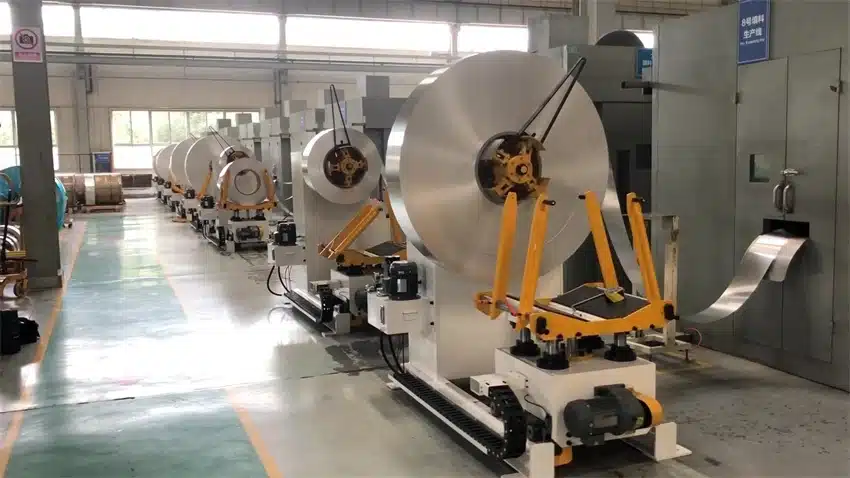
When optimizing your roll forming line, the roll forming machine uncoiler is a silent hero—without it, raw metal coil wouldn’t feed consistently into the forming rolls, and production would grind to a halt. But what exactly is this component, and why do its functional classifications matter for your business? Let’s break down everything you need to know to choose an uncoiler that aligns with your goals.
What’s a Roll Forming Machine Uncoiler?
A roll forming machine uncoiler is a mechanical system designed to hold, unwind, and feed large metal coils into the roll forming line. Its core job? Ensure the coil enters the machine with consistent tension and proper alignment—two factors that directly impact part quality, scrap rates, and downtime.
Think of it as the “starting gate” for your fabrication process: if the uncoiler fails to deliver coil smoothly, even the best roll forming dies will produce warped, inconsistent parts. Most uncoilers handle coils up to 1250 mm wide and weights ranging from 2000 – 15000 kgs—critical for industries like construction, automotive, and material storage, etc.
2 Key Functional Classifications of Roll Forming Machine Uncoilers
Manual/Gravity Uncoilers: Simple, Low-Cost, Low-Volume
Manual uncoilers are the entry-level option—perfect for small shops or businesses producing low-volume, non-critical parts. They consist of a stationary mandrel (where the coil is mounted) and a hand crank or lever to unwind the coil. Some include basic gravity-fed stands to reduce manual pulling.
Pros:
affordable (costs 50-70% less than motorized models).
easy to maintain—few moving parts.
Great for prototypes or one-off orders.
Cons:
Labor-intensive: Requires staff to manually adjust tension and feed coil.
Inconsistent feeding: Prone to wrinkles or loose edges, leading to scrap.
Limited capacity: Can’t handle heavy coils or high-speed lines.
When to use: Small-scale fabrication, hobbyist shops, or testing new coil materials.
Motorized/Automated Uncoilers: Precision, Efficiency, High-Volume
For businesses scaling production or handling tight-tolerance parts, motorized uncoilers are a game-changer. These systems use electric motors to unwind coil automatically, with built-in tension control (via magnetic particle brakes or servo motors) to maintain consistent feed rates. Many also include coil cars—automated platforms that transport heavy coils to the uncoiler, eliminating manual lifting.
Pros:
- Saves time: Reduces setup time by 50% (no more cranking or pulling coil).
- Consistent quality: Precision tension control prevents wrinkles or misalignment.
- High-volume ready: Handles coils up to 50,000 pounds at speeds up to 100 feet per minute.
Cons:
- Higher upfront cost (2-3x more than manual models).
- Requires basic maintenance (e.g., checking motor brushes, tension settings).
When to use: High-volume production (e.g., roofing sheets, automotive trim), precision parts (e.g., electronics enclosures), or businesses prioritizing worker safety (reducing manual lifting).
Pro Tip: Match Your Uncoiler to Your Needs
Choosing the right roll forming machine uncoiler boils down to three factors:
- Production volume: Manual for <500 meters/hour; motorized for >1000 meters/hour.
- Part precision: Tension-controlled uncoilers for parts with tight tolerances.
- Material type: Heavier coils (e.g., stainless steel) require motorized uncoilers with robust mandrels.
Final Thoughts: Invest in an Uncoiler That Grows With You
The roll forming machine uncoiler isn’t a “nice-to-have”—it’s a critical component that impacts every step of your fabrication line. While manual models work for small shops, motorized, tension-controlled uncoilers deliver the consistency and efficiency needed to scale.
In addition to standard uncoilers, BELI ROLLFORMING also supplies integrated uncoiler-levelers and 3-in-1 systems that combine an uncoiler, leveler, and feeder.
Ready to upgrade? Explore our guide to Choosing the Right Roll Forming Machine Components or contact our team for a free uncoiler audit or WhatsApp us now for quick response.Let’s make your line smoother, faster, and more profitable—with the right uncoiler by your side.
Related Products
-
Sale!
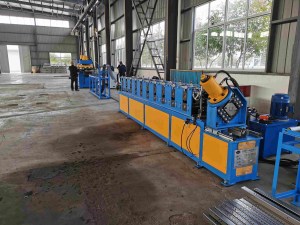
U Channel Roll Forming Machine
$35,000.00Original price was: $35,000.00.$32,500.00Current price is: $32,500.00. -
Sale!
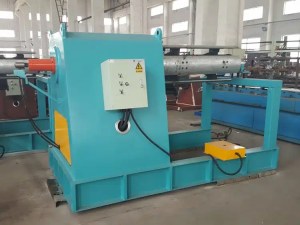
5 Ton Hydraulic Uncoiler
$7,000.00Original price was: $7,000.00.$6,500.00Current price is: $6,500.00.


