Kurze Zusammenfassung: A Doppellagen-Maschine (also called a Dual-Lagen-Maschine oder Doppelprofil-Maschine) combines two forming stations on a single frame, letting you switch between two profiles without buying a second line. Manufacturers worldwide are adopting this technology to cut capital cost by 30–50% and floor space by 40% compared to owning two separate lines. Read on to discover whether a double layer roll former is right for your factory. For the full process background, see our umfassenden Analyse der Rollformmaschinen-Technologie.
What Is a Double Layer Machine?
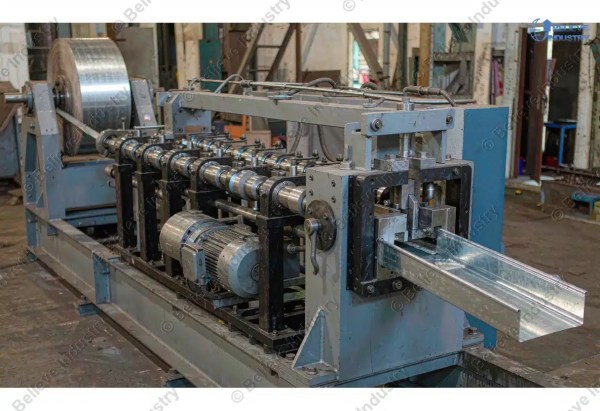
A Doppellagen-Maschine is a type of Walzprofiliermaschine that stacks two sets of forming stations — each capable of producing a completely different metal profile — onto a single base frame. The operator selects which layer runs via a PLC touchscreen, and the strip travels through one set of rollers while the other stands idle.
Unlike a Kassettenmühle that swaps modular tooling packs, a Dual-Lagen-Maschine keeps both tooling sets permanently mounted. Profile switching takes less than 5 minutes — simply adjust the material path and press a button.
Double layer machines are commonly used to produce:
- Roofing sheets (e.g., corrugated + IBR, or R-panel + trapezoidal)
- Wall panels (flat + ribbed)
- Decking profiles (B-deck + W-deck)
Double Layer Machine by the Numbers
| Spezifikation | Typischer Bereich |
|---|---|
| Materialdicke | 0.3 mm – 1.2 mm |
| Produktionsgeschwindigkeit | 8 – 25 m/min per layer |
| Forming stations per layer | 16 – 28stations |
| Profilwechselzeit | 3 – 8 minutes |
| Footprint saving vs. 2 separate lines | 35 – 50% |
| Capital cost saving vs. 2 separate lines | 30 – 45% |
| Material yield (steel/aluminium/PPGI) | 0.3 – 1.5 mm |
| Typical machine weight | 4,000 – 12,000 kg |
| Steuerungssystem | Siemens / Delta PLC + HMI |
| Schneidemethode | Hydraulic post-cut or servo flying shear |
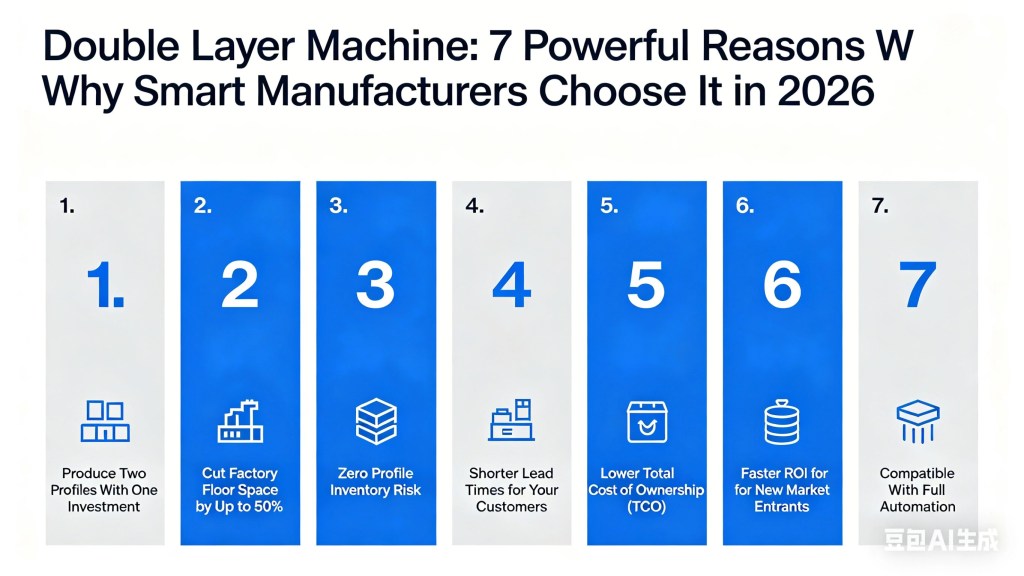
Why Manufacturers Choose a Double Layer Machine: 7 Proven Reasons
1. Zwei Profile mit einer Investition fertigen
Der überzeugendste Grund, warum Käufer eine Doppellagen-Maschine ist die Wirtschaftlichkeit. Anstatt zwei separate Rollformlinien zu kaufen und zu warten, bietet eine Dual-Lagen-Maschine dieselbe Produktionsflexibilität bei etwa 55–70% der kombinierten Kosten.
Ein mittelgroßer Dachhersteller in Südafrika berichtete von Einsparungen von USD 35,000 bei der Ausrüstungsinvestition, indem er anstelle von zwei Einzellinien eine Doppelprofil-Maschine wählte und dabei die Fähigkeit behielt, sowohl den Wellblech- als auch den IBR-Markt gleichzeitig zu bedienen.
2. Fabrikhallenfläche um bis zu 50% reduzieren
Hallenfläche ist teuer. Eine Standard-Rollformlinie für ein Profil belegt typischerweise 30–50 laufende Meter Hallenfläche einschließlich Haspel und Stapeler. Eine Dual-Lagen-Maschine die zwei dieser Linien ersetzt, belegt nur 32–55 laufende Meter insgesamt — etwa denselben Platzbedarf wie eine Linie.
Für Hersteller in Gewerbeparks mit begrenzten Mietflächen ist dies oft der entscheidende Faktor. Bei Believe Industry Company werden unsere Standard-Doppellagen-Maschinen mit einem kompakten Tandem-Rahmendesign konstruiert, um diesen Nutzen zu maximieren.
3. Null Risiko bei Profillagerbestand
Saisonale Nachfrageschwankungen bedeuten, dass Dachblechhersteller oft innerhalb derselben Produktionswoche von einem Profil auf ein anderes umsteuern müssen. Eine Doppellagen-Maschine macht das Lagern, Transportieren oder Neu-Konfigurieren separater Werkzeug-Sätze überflüssig. Beide Profile sind immer bereit — die Maschine muss nie für einen umfangreichen Werkzeugwechsel anhalten.
Diese Fähigkeit unterstützt direkt Rollformen in hohen Stückzahlen Strategien, die auf flexibler, schnell reagierender Produktionsplanung beruhen.
4. Kürzere Lieferzeiten für Ihre Kunden
Marktreaktionsfähigkeit ist ein Wettbewerbsvorteil. Da eine Dual-Lagen-Maschine beide Profile betriebsbereit hält, kann ein Auftrag für Profil A oder Profil B innerhalb von Minuten und nicht Tagen in die Produktion gehen. Händler und Dachdecker — insbesondere auf den US-amerikanischen, australischen und afrikanischen Märkten — fordern zunehmend Just-in-Time-Lieferfenster, die nur eine Dual-Lagen-Konfiguration unterstützen kann.
5. Niedrigere Total Cost of Ownership (TCO)
Der versteckte Kosten von Walzprofiliermaschinen laufen schnell zusammen: zwei Wartungsbudgets, zwei Sätze Ersatzwalzen, zwei elektrische Steuerpulte, zwei hydraulische Systeme. Eine Doppelprofil-Maschine fasst all dies zu einem einzigen Anlagegut zusammen und senkt die TCO über einen 10-Jahre-Maschinenlebenszyklus drastisch.
Geschätzter TCO-Vergleich über 10 Jahre (USD):
| Kostenkategorie | 2 × Einzelprofil-Linien | 1 × Doppellagen-Maschine |
|---|---|---|
| Kapitalausrüstung | $90,000 | $70,000 |
| Ersatzwalzensätze | $30,000 | $30,000 |
| Wartungsarbeit | $5,000 | $3,000 |
| Elektrische Nachrüstungen | $6,000 | $3,000 |
| Gesamt (geschätzt) | $131,000 | $100,600 |
Quelle: Bel Rollforming interne Daten, 2025. Werte sind indikativ und variieren je nach Profilkomplexität.
6. Schnellere Amortisation für neue Markteinsteiger
Wenn Sie das Rollformgeschäft zum ersten Mal betreten — oder in eine neue Produktkategorie expandieren — eine Doppellagen-Maschine ist eine der schnellsten Routen zur Amortisation. Sie können die Marktnachfrage für zwei verschiedene Profile gleichzeitig testen, die Produktionskapazität dynamisch zuteilen und den Break-even mit geringerer Vorabinvestition erreichen.
Vorteile einer Rollformmaschine sind gut dokumentiert: gleichbleibende Maßhaltigkeit, minimaler Materialverschnitt und hohe Wiederholgenauigkeit. Die Dual-Lagen-Maschine verstärkt diese Vorteile über zwei Produktlinien ab dem ersten Tag.
7. Kompatibel mit voller Automatisierung
Moderne double layer machines von Believe Industry Company integrieren sich nahtlos mit automatischen Haspeln, Servo-Fliegenschneidern und automatischen Stapelsystemen. Das PLC-Steuerungssystem verwaltet Materialpfadauswahl, Schnittlänge und Chargenzählung für beide Lagen von einem einzigen HMI-Bildschirm aus.
Dies macht die Doppelprofil-Maschine zur idealen Wahl für Rollform-Automatisierung Strategien und Industrie-4.0-Produktionsumgebungen, in denen datengetriebene Planung und Fernüberwachung Standard sind.
Double Layer Machine vs. Single Profile Machine vs. Cassette Mill: Full Comparison
This is the most important decision a buyer faces. The table below gives you a factual, side-by-side view across 14 dimensions.
| Merkmal | Double Layer Machine | Single Profile Machine | Cassette Mill |
|---|---|---|---|
| Anzahl der Profile | 2 (fest) | 1 | 2–8+ (interchangeable) |
| Profilwechselzeit | 3–8 minutes | N/A | 15–45 minutes |
| Capital cost (relative) | Mittel | Niedrig | Hoch |
| Floor space required | Mittel | Niedrig | Niedrig–Mittel |
| Werkzeuginvestitionen | 2 × dedicated sets (built-in) | 1 × dedicated set | Multiple cassette modules |
| Produktionsgeschwindigkeit | 8–25 m/min | 8–25 m/min | 8-25 m/min |
| Material thickness range | 0,3–1,2 mm | 0.2–6 mm+ | 0.3–3 mm |
| Profilkomplexität | Niedrig–Mittel | Low–Very High | Mittel–Hoch |
| Operator skill required | Niedrig | Niedrig | Mittel–Hoch |
| Wartungsaufwand | Mittel | Niedrig | Hoch |
| Kosten für Ersatzteile | Mittel | Niedrig | Hoch |
| Am besten geeignet für | 2 related profiles, roofing sheets, panels | Single dedicated high-volume profile | Frequent multi-profile switching |
| Scalability | Limited to 2 profiles | Add second machine | Add cassette modules |
| ROI timeline | Fast (12–24 months typical) | Fast | Slower (high initial cost) |
Zusammenfassung: A Doppellagen-Maschine is the optimal choice when you need exactly two profiles, want to minimize capital investment, and prioritize fast changeover over ultimate flexibility. A cassette mill is better when you need to produce five or more profiles regularly. A single profile machine wins only when you need one profile at extremely high speed or material thickness.
Who Should Buy a Double Layer Machine?
Ideal buyers include:
- Roofing sheet manufacturers targeting 2 popular local profiles (e.g., corrugated + IBR in Africa; R-panel + AG panel in the USA)
- Wall and ceiling panel producers with paired product lines
- Custom roll forming machine buyers entering the market with limited capital
- Decking manufacturers producing composite floor deck and roof deck
- Distributors who manufacture to order for multiple client specifications
A double layer machine is NOT recommended when:
- You need material thickness above 1.5 mm (single profile or cassette mill performs better)
- You produce more than 3 different profiles regularly
- Maximum production speed is the top priority
How a Double Layer Machine Works: Step-by-Step
- Coil Loading — Steel, aluminum, or PPGI coil is loaded onto the Abwickler. Typical coil weight: 3–8 tonnes.
- Nivellierung (Optinial and normally no need)— Strip passes through an integrated Nivelliermaschine (5–7 rollers) to remove coil set and ensure flatness.
- Pre-punching (optional) — A servo Stanzeinheit adds holes or slots before forming, if required by the profile.
- Layer Selection — The operator selects Layer 1 or Layer 2 via the PLC touchscreen. A manual or automatic guide directs the strip into the selected forming pass.
- Rollformen — The strip passes through 12–22 roll forming stations, each progressively bending the metal until the target profile is achieved.
- Schneiden — A hydraulic post-cut die or Servogetriebene fliegende Schere cuts the profile to the programmed length.
- Stacking/Collection — Finished panels are collected on a run-out table or automated stacker.
The entire process from coil to finished profile is continuous and fully automated. No operator intervention is required between pieces once the batch is running.
Double Layer Machine for Roofing: The Most Popular Application
Roofing is the dominant market for double layer machines globally. In markets where both corrugated and trapezoidal/IBR profiles are in demand — particularly Sub-Saharan Africa, Southeast Asia, and Latin America — a Dual-Lagen-Maschine is the standard configuration for new factory setups.
Popular roofing profile combinations for double layer machines:
| Layer 1 | Layer 2 | Hauptmarkt |
|---|---|---|
| Corrugated 762 | IBR / Superdek | Africa, South Asia |
| R-Panel | AG-Panel | USA, Americas |
| Trapezoidal 1000 | Corrugated 762 | Southeast Asia, Middle East |
| Stehfalz | Gewellt | Europe, Australia |
| B-Deck | W-Deck | USA Commercial Construction |
Believe Industry Company: Double Layer Machine Specifications
Believe Industry Company (Wuxi, China) has manufactured and exported double layer machines to more than 40 countries since 2005. Key standard specifications:
| Parameter | Spezifikation |
|---|---|
| Frame material | 350–400 mm H-beam welded steel |
| Rollenmaterial | GCr15 Wälzlagerstahl, HRC 58–62 |
| Wellendurchmesser | 70–90 mm, 40Cr heat-treated steel |
| Drive system | Geared motor + chain or direct drive |
| Kontrolle | Siemens S7-1200 PLC + 7″ HMI |
| Schneiden | Hydraulic post-cut (standard) or servo flying shear (optional) |
| Layer changeover | Manual guide bar + PLC switch |
| Längentoleranz | ± 1.5 mm |
| CE / ISO | ISO 9001:2015 certified; CE available |
| Lieferzeit | 45–75 days ex-works Wuxi |
| Gewährleistung | 12 months parts and labour |
View more>> Doppelschicht-Walzformmaschine
Video: Double Layer Machine in Action
Watch our double layer machine producing corrugated and R/PBR Panel profiles back-to-back at our Wuxi facility. The video demonstrates production process and the automated stacking system in operation.
Related Machines and Resources
If you are evaluating a Doppellagen-Maschine, these related Believe Industry resources will help you make a fully informed decision:
- Roll Forming Machine — Complete Overview
- Custom Roll Forming Machine — Global Market Guide 2026
- Roll Forming Machine Price — 7 Best 2026 Secrets
- Vorteile von Walzprofiliermaschinen
- Quick Change Roll Forming Machine (Cassette Mill)
- Hochvolumen-Walzformen
- Komponenten von Rollformmaschinen
- Roll Forming Tooling
- How to Buy a Roll Forming Machine — 2026 Buyer’s Guide
- Führende Hersteller von Rollformmaschinen in China
External authority references:
- The Fabricator — Roll Forming Design Principles — Industry standard reference for roll forming engineers and buyers
- Metal Construction News — Roofing & Cladding Profiles — US market data on popular panel profiles
- AISI — Steel Framing Standards — American Iron and Steel Institute design standards
- Rollforming Magazin — Dedicated trade publication for the roll forming industry
- Qualitätsmanagement nach ISO 9001:2015 — Certification standard followed by Believe Industry Company
Frequently Asked Questions: Double Layer Machine
A Doppellagen-Maschine is a roll forming line that houses two complete sets of forming stations on a single welded steel frame. Each set of rollers is tooled to produce a specific metal profile. The operator selects which profile to run via a PLC control system, and the coil strip is guided into the corresponding forming pass. The result is two production-ready profiles from one machine, one decoiler, and one operator.
Die Bedingungen Doppellagen-Maschine, Dual-Lagen-Maschine, Und Doppelprofil-Maschine all refer to the same equipment type. They are used interchangeably in the roll forming industry. Some manufacturers may use “dual layer” to emphasize the two-layer stacked frame design, while “double profile” highlights the output capability. There is no functional or technical difference between these names.
No. A Doppellagen-Maschine produces one profile at a time. The two forming stations share a single feed path, decoiler, and cutter. Simultaneous dual-profile production would require two independent material feeds and two cutting systems, which is not the standard configuration. The advantage is fast switching (3–8 minutes), not simultaneous output.
Production speed depends on the profile geometry, material thickness, and cutting method. For typical roofing sheet profiles (corrugated or trapezoidal), a Dual-Lagen-Maschine läuft bei 10–20 m/min. With a servo flying shear, speeds up to 25 m/min are achievable. Note that cutting-to-length operations are the primary speed limiter on shorter panel sizes.
Most double profile machines are designed for:
- Pre-painted galvanized steel (PPGI) — the most common
- Verzinkter Stahl (GI)
- Colour-coated aluminium
- Bare cold-rolled steel (CRS)
- Stainless steel (with upgraded roller hardness)
Standard material thickness range is 0.3 mm to 1.2 mm. For thicker materials (above 1.5 mm), a single-profile machine with heavier shaft and bearing specifications is recommended.
Profile changeover on a Doppellagen-Maschine takes 3 to 8 minutes in normal operation. The process involves:
- Stopping the machine and cutting off the current strip
- Threading the new coil (or re-threading the same coil) into the second forming pass
- Selecting the new profile on the PLC HMI
- Running a test panel to confirm length and profile accuracy
This compares favourably to a cassette mill (15–45 minutes per change) and is far faster than re-tooling a single-profile machine (4–24 hours).
Yes — a Doppellagen-Maschine costs more than a single-profile machine for the same profile complexity, because it includes two full sets of tooling and a more complex frame. However, it costs 30–45% less than purchasing two separate single-profile machines. The price differential depends on profile complexity, forming station count, and automation level. Contact Believe Industry Company for a detailed quotation based on your specific profile requirements.
| Double Layer Machine | Cassette Mill | |
|---|---|---|
| Tooling storage | Both sets permanently mounted | Removable cassette modules |
| Anzahl der Profile | Exactly 2 | 2 to 8+ |
| Changeover time | 3–8 minutes | 15–45 minutes |
| Capital cost | Mittel | Hoch |
| Am besten geeignet für | 2 fixed profiles | Multi-profile flexibility |
A Kassettenmühle (also called a Rollformmaschine mit Schnellwechsel) is the better choice when you need to switch among three or more profiles regularly. The Doppellagen-Maschine wins on price, simplicity, and speed for exactly two profiles.
No special foundation is required beyond what a standard roll forming line needs. The machine is mounted on a standard level concrete floor (minimum 200 mm thickness, 25 MPa compressive strength). Anchor bolts are recommended for machines above 6,000 kg. For detailed civil drawings, Believe Industry Company provides foundation layout documentation with every machine order.
Yes, this is one of the key design considerations. Most double profile machines are engineered to use the same coil width for both profiles, simplifying inventory management and decoiler setup. Where coil widths differ between the two profiles, an adjustable decoiler with edge guide is recommended. Believe Industry Company engineers your dual layer machine around your specific coil width requirements.
Belie Rollforming provides the following post-sale support for all double layer machines:
- 12-month parts warranty from date of commissioning
- Remote commissioning support via video call (standard)
- On-site installation and commissioning available in most countries (see Roll Forming Machine Installation)
- Spare parts supply via DHL/FedEx within 3–5 business days
- Bedienerschulung — on-site or remote, included in machine price
- PLC program backup — provided on USB with every machine
Ask yourself these four questions:
- Do you regularly produce (or plan to produce) exactly zwei verschiedene Profile?
- Is your target material thickness 1.2 mm or less?
- Is capital investment a primary constraint?
- Do you need fast changeover (under 10 minutes)?
If you answered yes to three or more of these, a Doppellagen-Maschine is very likely your best option. If your profiles require thicker steel, or you need more than two profiles, contact Believe Industry Company to explore cassette mill or multiple single-profile line configurations.
Conclusion: Is a Double Layer Machine Worth It in 2026?
For the right buyer — a roofing sheet manufacturer, wall panel producer, or roll forming entrepreneur entering a dual-profile market — the answer is a clear yes. A Doppellagen-Maschine delivers:
- 30–45% lower capital cost than two separate lines
- Up to 50% floor space saving
- 3–8 minute profile switching without major changeover
- Single maintenance budget and simplified spare parts inventory
- Full automation compatibility with modern PLC, servo, and IoT systems
Der Dual-Lagen-Maschine is not the right tool for every application. If you need to produce 5 profiles, process material above 1.5 mm, or run at speeds above 30 m/min, a different configuration will serve you better. But for focused, two-profile production — especially in the roofing, wall panel, and decking segments — the Doppelprofil-Maschine from Believe Industry Company represents one of the highest-ROI equipment investments available in 2026.
Ready to get a price? Contact Believe Industry Company via the Angebot anfordern page. Our engineering team will respond within 24 hours with a detailed proposal based on your specific profile requirements, material specifications, and production targets.
Änderungsprotokoll
| Version | Datum | Hinweise |
|---|---|---|
| 1.0 | 2026-05-04 | Initial publish |
| — | 2026-08-04 | Geplanter Überprüfungstermin |