

Resumo rápido: A máquina de dupla camada (also called a máquina de camada dupla ou máquina de perfil duplo) combines two forming stations on a single frame, letting you switch between two profiles without buying a second line. Manufacturers worldwide are adopting this technology to cut capital cost by 30–50% and floor space by 40% compared to owning two separate lines. Read on to discover whether a double layer roll former is right for your factory. For the full process background, see our análise abrangente da tecnologia de perfiladeiras.
What Is a Double Layer Machine?
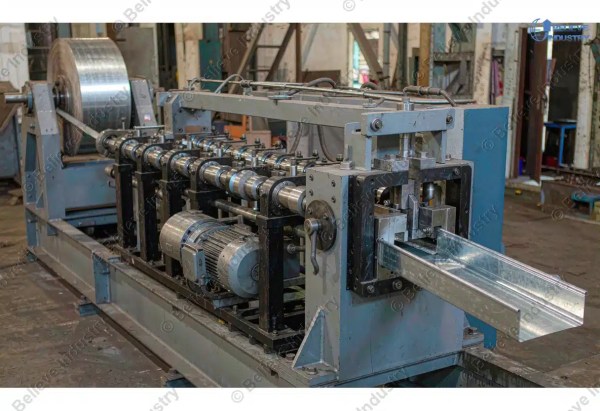
A máquina de dupla camada is a type of máquina de perfilagem de rolos that stacks two sets of forming stations — each capable of producing a completely different metal profile — onto a single base frame. The operator selects which layer runs via a PLC touchscreen, and the strip travels through one set of rollers while the other stands idle.
Unlike a Moinho de cassete that swaps modular tooling packs, a máquina de camada dupla keeps both tooling sets permanently mounted. Profile switching takes less than 5 minutes — simply adjust the material path and press a button.
Double layer machines are commonly used to produce:
- Roofing sheets (e.g., corrugated + IBR, or R-panel + trapezoidal)
- Wall panels (flat + ribbed)
- Decking profiles (B-deck + W-deck)
Double Layer Machine by the Numbers
| Especificação | Faixa típica |
|---|---|
| Espessura do material | 0,3 mm – 1,2 mm |
| Velocidade de produção | 8 – 25 m/min per layer |
| Forming stations per layer | 16 – 28stations |
| Tempo de troca de perfil | 3 – 8 minutes |
| Footprint saving vs. 2 separate lines | 35 – 50% |
| Capital cost saving vs. 2 separate lines | 30 – 45% |
| Material yield (steel/aluminium/PPGI) | 0.3 – 1.5 mm |
| Typical machine weight | 4,000 – 12,000 kg |
| Sistema de controle | PLC Siemens/Delta + IHM |
| Método de corte | Hydraulic post-cut or servo flying shear |
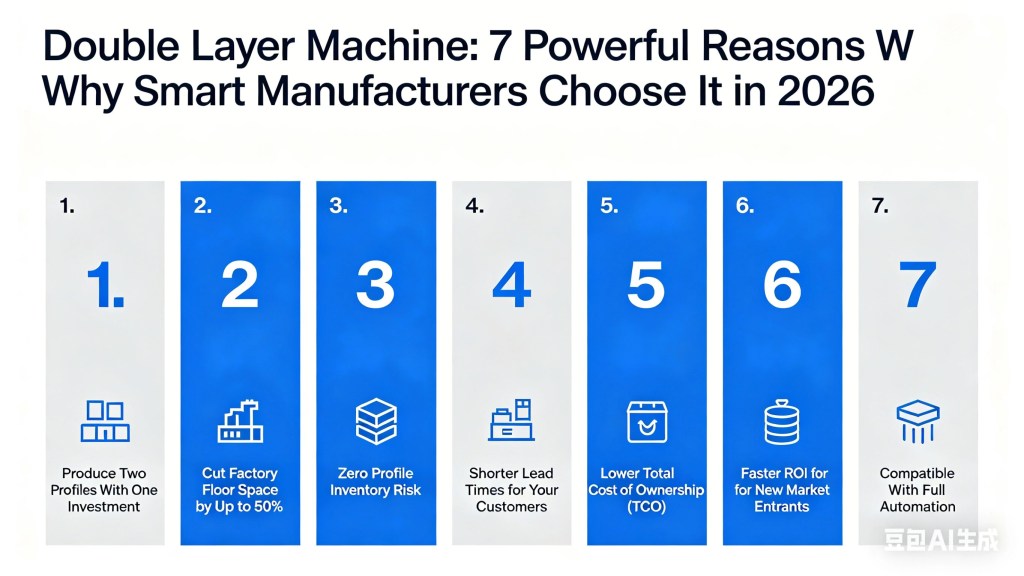
Why Manufacturers Choose a Double Layer Machine: 7 Proven Reasons
1. Produza Dois Perfis Com Um Só Investimento
A razão mais convincente pela qual os compradores escolhem uma máquina de dupla camada é a economia. Em vez de comprar e manter duas linhas de conformação separadas, uma máquina de camada dupla oferece a mesma flexibilidade de produção a cerca de 55–70% do custo combinado.
Um fabricante de coberturas de médio porte na África do Sul reportou economizar USD 35,000 em investimento em equipamentos ao escolher uma máquina de perfil duplo em vez de duas linhas simples, mantendo a capacidade de atender aos segmentos de mercado corrugado e IBR simultaneamente.
2. Reduza o Espaço de Chão de Fábrica em até 50%
O espaço de chão é caro. Uma linha de conformação de perfil único padrão normalmente ocupa 30–50 metros lineares de espaço de chão, incluindo desbobinador e empilhador. Uma máquina de camada dupla que substitui duas dessas linhas ocupa apenas 32–55 metros lineares no total — praticamente a mesma área de uma linha.
Para fabricantes que operam em parques industriais com áreas de locação limitadas, esse é frequentemente o fator decisivo. Na Believe Industry Company, nossas máquinas de dupla camada padrão são projetadas com um design de estrutura tandem compacta para maximizar esse benefício.
3. Risco Zero de Estoque de Perfis
Mudanças sazonais na demanda significam que os fabricantes de chapas para cobertura frequentemente precisam mudar de um perfil para outro na mesma semana de produção. Uma máquina de dupla camada elimina a necessidade de armazenar, transportar ou reconfigurar conjuntos de ferramentas separados. Ambos os perfis estão sempre prontos — a máquina nunca precisa parar para uma troca de ferramentas importante.
Essa capacidade apoia diretamente Roll forming de alto volume estratégias que dependem de agendamento de produção flexível e de resposta rápida.
4. Tempos de Entrega Mais Curtos para Seus Clientes
A capacidade de resposta ao mercado é uma vantagem competitiva. Como uma máquina de camada dupla mantém ambos os perfis prontos e disponíveis, um pedido de venda para o Perfil A ou Perfil B pode entrar em produção em minutos, não em dias. Distribuidores e empreiteiros de cobertura — particularmente nos mercados dos EUA, australiano e africano — exigem cada vez mais janelas de entrega just-in-time que apenas uma configuração de camada dupla pode suportar.
5. Menor Custo Total de Propriedade (TCO)
O custos ocultos de máquinas de conformação a frio aumentam rapidamente: dois orçamentos de manutenção, dois conjuntos de roletes sobressalentes, dois painéis de controle elétrico, dois sistemas hidráulicos. Uma máquina de perfil duplo consolida tudo isso em um único ativo, reduzindo drasticamente o TCO ao longo do ciclo de vida de 10 anos da máquina.
Comparação estimada de TCO ao longo de 10 anos (USD):
| Categoria de Custo | 2 × Linhas de Perfil Único | 1 × Máquina de Dupla Camada |
|---|---|---|
| Equipamento de capital | $90,000 | $70,000 |
| Conjuntos de roletes sobressalentes | $30,000 | $30,000 |
| Mão de obra de manutenção | $5,000 | $3,000 |
| Atualizações elétricas | $6,000 | $3,000 |
| Total (estimado) | $131,000 | $100,600 |
Fonte: dados internos da Bel Rollforming, 2025. Os valores são indicativos e variam conforme a complexidade do perfil.
6. ROI Mais Rápido para Novos Entrantes no Mercado
Se você está entrando no negócio de conformação pela primeira vez — ou expandindo para uma nova categoria de produto — uma máquina de dupla camada é uma das rotas mais rápidas para o ROI. Você pode testar a demanda de mercado para dois perfis diferentes simultaneamente, alocar capacidade de produção dinamicamente e atingir o ponto de equilíbrio com um investimento inicial menor.
Benefícios da máquina de perfilagem são bem documentados: precisão dimensional consistente, desperdício de material mínimo e alta repetibilidade. A máquina de camada dupla amplia esses benefícios em duas linhas de produto desde o primeiro dia.
7. Compatível Com Automação Completa
As double layer machines da Believe Industry Company integram-se perfeitamente com desbobinadores automatizados, tesouras voadoras servo e sistemas de empilhamento automático. O sistema de controle PLC gerencia a seleção do caminho do material, o comprimento de corte e a contagem de lotes para ambas as camadas a partir de uma única tela HMI.
Isso torna a máquina de perfil duplo uma escolha natural para automação de conformação a frio estratégias e ambientes de produção da Indústria 4.0, onde o agendamento orientado por dados e o monitoramento remoto são expectativas padrão.
Double Layer Machine vs. Single Profile Machine vs. Cassette Mill: Full Comparison
This is the most important decision a buyer faces. The table below gives you a factual, side-by-side view across 14 dimensions.
| Recurso | Double Layer Machine | Single Profile Machine | Cassette Mill |
|---|---|---|---|
| Number of profiles | 2 (fixed) | 1 | 2–8+ (interchangeable) |
| Tempo de troca de perfil | 3–8 minutes | N/A | 15–45 minutes |
| Capital cost (relative) | Média | Baixa | Alta |
| Floor space required | Média | Baixa | Baixo–Médio |
| Tooling investment | 2 × dedicated sets (built-in) | 1 × dedicated set | Multiple cassette modules |
| Velocidade de produção | 8–25 m/min | 8–25 m/min | 8-25 m/min |
| Material thickness range | 0,3–1,2 mm | 0.2–6 mm+ | 0.3–3 mm |
| Complexidade do perfil | Baixo–Médio | Low–Very High | Médio–Alto |
| Operator skill required | Baixa | Baixa | Médio–Alto |
| Complexidade de manutenção | Média | Baixa | Alta |
| Custo das peças de reposição | Média | Baixa | Alta |
| Ideal para | 2 related profiles, roofing sheets, panels | Single dedicated high-volume profile | Frequent multi-profile switching |
| Scalability | Limited to 2 profiles | Add second machine | Add cassette modules |
| ROI timeline | Fast (12–24 months typical) | Fast | Slower (high initial cost) |
Resumo: A máquina de dupla camada is the optimal choice when you need exactly two profiles, want to minimize capital investment, and prioritize fast changeover over ultimate flexibility. A cassette mill is better when you need to produce five or more profiles regularly. A single profile machine wins only when you need one profile at extremely high speed or material thickness.
Who Should Buy a Double Layer Machine?
Ideal buyers include:
- Roofing sheet manufacturers targeting 2 popular local profiles (e.g., corrugated + IBR in Africa; R-panel + AG panel in the USA)
- Wall and ceiling panel producers with paired product lines
- Custom roll forming machine buyers entering the market with limited capital
- Decking manufacturers producing composite floor deck and roof deck
- Distributors who manufacture to order for multiple client specifications
A double layer machine is NOT recommended when:
- You need material thickness above 1.5 mm (single profile or cassette mill performs better)
- You produce more than 3 different profiles regularly
- Maximum production speed is the top priority
How a Double Layer Machine Works: Step-by-Step
- Coil Loading — Steel, aluminum, or PPGI coil is loaded onto the desenrolador. Typical coil weight: 3–8 tonnes.
- Nivelamento (Optinial and normally no need)— Strip passes through an integrated máquina de nivelamento (5–7 rollers) to remove coil set and ensure flatness.
- Pre-punching (optional) — A servo unidade de perfuração adds holes or slots before forming, if required by the profile.
- Layer Selection — The operator selects Layer 1 or Layer 2 via the PLC touchscreen. A manual or automatic guide directs the strip into the selected forming pass.
- Roll forming — The strip passes through 12–22 roll forming stations, each progressively bending the metal until the target profile is achieved.
- Corte — A hydraulic post-cut die or Tesoura voadora servo cuts the profile to the programmed length.
- Stacking/Collection — Finished panels are collected on a run-out table or automated stacker.
The entire process from coil to finished profile is continuous and fully automated. No operator intervention is required between pieces once the batch is running.
Double Layer Machine for Roofing: The Most Popular Application
Roofing is the dominant market for double layer machines globally. In markets where both corrugated and trapezoidal/IBR profiles are in demand — particularly Sub-Saharan Africa, Southeast Asia, and Latin America — a máquina de camada dupla is the standard configuration for new factory setups.
Popular roofing profile combinations for double layer machines:
| Layer 1 | Layer 2 | Mercado principal |
|---|---|---|
| Corrugated 762 | IBR / Superdek | Africa, South Asia |
| R-Panel | Painel AG | USA, Americas |
| Trapezoidal 1000 | Corrugated 762 | Southeast Asia, Middle East |
| Standing seam | Ondulado | Europe, Australia |
| B-deck | W-Deck | USA Commercial Construction |
Believe Industry Company: Double Layer Machine Specifications
Believe Industry Company (Wuxi, China) has manufactured and exported double layer machines to more than 40 countries since 2005. Key standard specifications:
| Parâmetro | Especificação |
|---|---|
| Frame material | 350–400 mm H-beam welded steel |
| Material do rolo | GCr15 bearing steel, HRC 58–62 |
| Diâmetro do eixo | 70–90 mm, 40Cr heat-treated steel |
| Drive system | Geared motor + chain or direct drive |
| Controlar | Siemens S7-1200 PLC + 7″ HMI |
| Corte | Hydraulic post-cut (standard) or servo flying shear (optional) |
| Layer changeover | Manual guide bar + PLC switch |
| Tolerância de comprimento | ± 1.5 mm |
| CE / ISO | ISO 9001:2015 certified; CE available |
| Tempo de espera | 45–75 days ex-works Wuxi |
| Garantia | 12 months parts and labour |
View more>> Máquina de perfilagem de rolos de dupla camada
Video: Double Layer Machine in Action
Watch our double layer machine producing corrugated and R/PBR Panel profiles back-to-back at our Wuxi facility. The video demonstrates production process and the automated stacking system in operation.
Related Machines and Resources
If you are evaluating a máquina de dupla camada, these related Believe Industry resources will help you make a fully informed decision:
- Roll Forming Machine — Complete Overview
- Custom Roll Forming Machine — Global Market Guide 2026
- Roll Forming Machine Price — 7 Best 2026 Secrets
- Benefícios da máquina de perfilagem
- Quick Change Roll Forming Machine (Cassette Mill)
- Conformação de rolos em alto volume
- componentes de perfiladeira
- Roll Forming Tooling
- How to Buy a Roll Forming Machine — 2026 Buyer’s Guide
- Principais fabricantes de máquinas de perfilagem na China
External authority references:
- The Fabricator — Roll Forming Design Principles — Industry standard reference for roll forming engineers and buyers
- Metal Construction News — Roofing & Cladding Profiles — US market data on popular panel profiles
- AISI — Steel Framing Standards — American Iron and Steel Institute design standards
- Rollforming Magazine — Dedicated trade publication for the roll forming industry
- ISO 9001:2015 Gestão da Qualidade — Certification standard followed by Believe Industry Company
Frequently Asked Questions: Double Layer Machine
A máquina de dupla camada is a roll forming line that houses two complete sets of forming stations on a single welded steel frame. Each set of rollers is tooled to produce a specific metal profile. The operator selects which profile to run via a PLC control system, and the coil strip is guided into the corresponding forming pass. The result is two production-ready profiles from one machine, one decoiler, and one operator.
Os termos máquina de dupla camada, máquina de camada dupla, e máquina de perfil duplo all refer to the same equipment type. They are used interchangeably in the roll forming industry. Some manufacturers may use “dual layer” to emphasize the two-layer stacked frame design, while “double profile” highlights the output capability. There is no functional or technical difference between these names.
No. A máquina de dupla camada produces one profile at a time. The two forming stations share a single feed path, decoiler, and cutter. Simultaneous dual-profile production would require two independent material feeds and two cutting systems, which is not the standard configuration. The advantage is fast switching (3–8 minutes), not simultaneous output.
Production speed depends on the profile geometry, material thickness, and cutting method. For typical roofing sheet profiles (corrugated or trapezoidal), a máquina de camada dupla corre em 10–20 m/min. With a servo flying shear, speeds up to 25 m/min are achievable. Note that cutting-to-length operations are the primary speed limiter on shorter panel sizes.
Most double profile machines are designed for:
- Pre-painted galvanized steel (PPGI) — the most common
- Aço galvanizado (GI)
- Colour-coated aluminium
- Bare cold-rolled steel (CRS)
- Stainless steel (with upgraded roller hardness)
Standard material thickness range is 0.3 mm to 1.2 mm. For thicker materials (above 1.5 mm), a single-profile machine with heavier shaft and bearing specifications is recommended.
Profile changeover on a máquina de dupla camada takes 3 to 8 minutes in normal operation. The process involves:
- Stopping the machine and cutting off the current strip
- Threading the new coil (or re-threading the same coil) into the second forming pass
- Selecting the new profile on the PLC HMI
- Running a test panel to confirm length and profile accuracy
This compares favourably to a cassette mill (15–45 minutes per change) and is far faster than re-tooling a single-profile machine (4–24 hours).
Yes — a máquina de dupla camada costs more than a single-profile machine for the same profile complexity, because it includes two full sets of tooling and a more complex frame. However, it costs 30–45% less than purchasing two separate single-profile machines. The price differential depends on profile complexity, forming station count, and automation level. Contact Believe Industry Company for a detailed quotation based on your specific profile requirements.
| Double Layer Machine | Cassette Mill | |
|---|---|---|
| Tooling storage | Both sets permanently mounted | Removable cassette modules |
| Number of profiles | Exactly 2 | 2 to 8+ |
| Changeover time | 3–8 minutes | 15–45 minutes |
| Capital cost | Média | Alta |
| Ideal para | 2 fixed profiles | Multi-profile flexibility |
A Moinho de cassete (also called a máquina de roll forming de troca rápida) is the better choice when you need to switch among three or more profiles regularly. The máquina de dupla camada wins on price, simplicity, and speed for exactly two profiles.
No special foundation is required beyond what a standard roll forming line needs. The machine is mounted on a standard level concrete floor (minimum 200 mm thickness, 25 MPa compressive strength). Anchor bolts are recommended for machines above 6,000 kg. For detailed civil drawings, Believe Industry Company provides foundation layout documentation with every machine order.
Yes, this is one of the key design considerations. Most double profile machines are engineered to use the same coil width for both profiles, simplifying inventory management and decoiler setup. Where coil widths differ between the two profiles, an adjustable decoiler with edge guide is recommended. Believe Industry Company engineers your dual layer machine around your specific coil width requirements.
Belie Rollforming provides the following post-sale support for all double layer machines:
- 12-month parts warranty from date of commissioning
- Remote commissioning support via video call (standard)
- On-site installation and commissioning available in most countries (see Roll Forming Machine Installation)
- Spare parts supply via DHL/FedEx within 3–5 business days
- Treinamento de operadores — on-site or remote, included in machine price
- PLC program backup — provided on USB with every machine
Ask yourself these four questions:
- Do you regularly produce (or plan to produce) exactly dois perfis diferentes?
- Is your target material thickness 1.2 mm or less?
- Is capital investment a primary constraint?
- Do you need fast changeover (under 10 minutes)?
If you answered yes to three or more of these, a máquina de dupla camada is very likely your best option. If your profiles require thicker steel, or you need more than two profiles, contact Believe Industry Company to explore cassette mill or multiple single-profile line configurations.
Conclusion: Is a Double Layer Machine Worth It in 2026?
For the right buyer — a roofing sheet manufacturer, wall panel producer, or roll forming entrepreneur entering a dual-profile market — the answer is a clear yes. A máquina de dupla camada delivers:
- 30–45% lower capital cost than two separate lines
- Up to 50% floor space saving
- 3–8 minute profile switching without major changeover
- Single maintenance budget and simplified spare parts inventory
- Full automation compatibility with modern PLC, servo, and IoT systems
O máquina de camada dupla is not the right tool for every application. If you need to produce 5 profiles, process material above 1.5 mm, or run at speeds above 30 m/min, a different configuration will serve you better. But for focused, two-profile production — especially in the roofing, wall panel, and decking segments — the máquina de perfil duplo from Believe Industry Company represents one of the highest-ROI equipment investments available in 2026.
Ready to get a price? Contact Believe Industry Company via the Solicite um orçamento page. Our engineering team will respond within 24 hours with a detailed proposal based on your specific profile requirements, material specifications, and production targets.
Registro de alterações
| Versão | Data | Observações |
|---|---|---|
| 1.0 | 2026-05-04 | Initial publish |
| — | 2026-08-04 | Data de revisão agendada |