
สรุปสั้นๆ: A เครื่องจักรสองชั้น (also called a เครื่องสองชั้น หรือ เครื่องตัดโปรไฟล์คู่) combines two forming stations on a single frame, letting you switch between two profiles without buying a second line. Manufacturers worldwide are adopting this technology to cut capital cost by 30–50% and floor space by 40% compared to owning two separate lines. Read on to discover whether a double layer roll former is right for your factory. For the full process background, see our การวิเคราะห์อย่างครอบคลุมของเทคโนโลยีเครื่องขึ้นรูปม้วน.
What Is a Double Layer Machine?
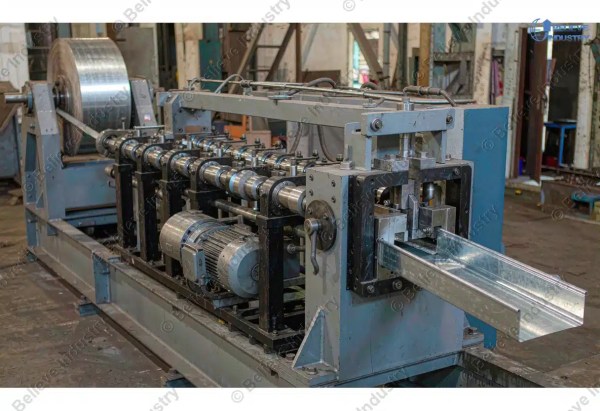
A เครื่องจักรสองชั้น is a type of เครื่องขึ้นรูปม้วน that stacks two sets of forming stations — each capable of producing a completely different metal profile — onto a single base frame. The operator selects which layer runs via a PLC touchscreen, and the strip travels through one set of rollers while the other stands idle.
Unlike a โรงโม่แบบเทป that swaps modular tooling packs, a เครื่องสองชั้น keeps both tooling sets permanently mounted. Profile switching takes less than 5 minutes — simply adjust the material path and press a button.
Double layer machines are commonly used to produce:
- Roofing sheets (e.g., corrugated + IBR, or R-panel + trapezoidal)
- Wall panels (flat + ribbed)
- Decking profiles (B-deck + W-deck)
Double Layer Machine by the Numbers
| ข้อมูลจำเพาะ | ช่วงที่พบบ่อย |
|---|---|
| ความหนาของวัสดุ | 0.3 mm – 1.2 mm |
| ความเร็วในการผลิต | 8 – 25 m/min per layer |
| Forming stations per layer | 16 – 28stations |
| เวลาในการเปลี่ยนโปรไฟล์ | 3 – 8 minutes |
| Footprint saving vs. 2 separate lines | 35 – 50% |
| Capital cost saving vs. 2 separate lines | 30 – 45% |
| Material yield (steel/aluminium/PPGI) | 0.3 – 1.5 mm |
| Typical machine weight | 4,000 – 12,000 kg |
| ระบบควบคุม | PLC + HMI ของ Siemens / Delta |
| วิธีการตัด | Hydraulic post-cut or servo flying shear |
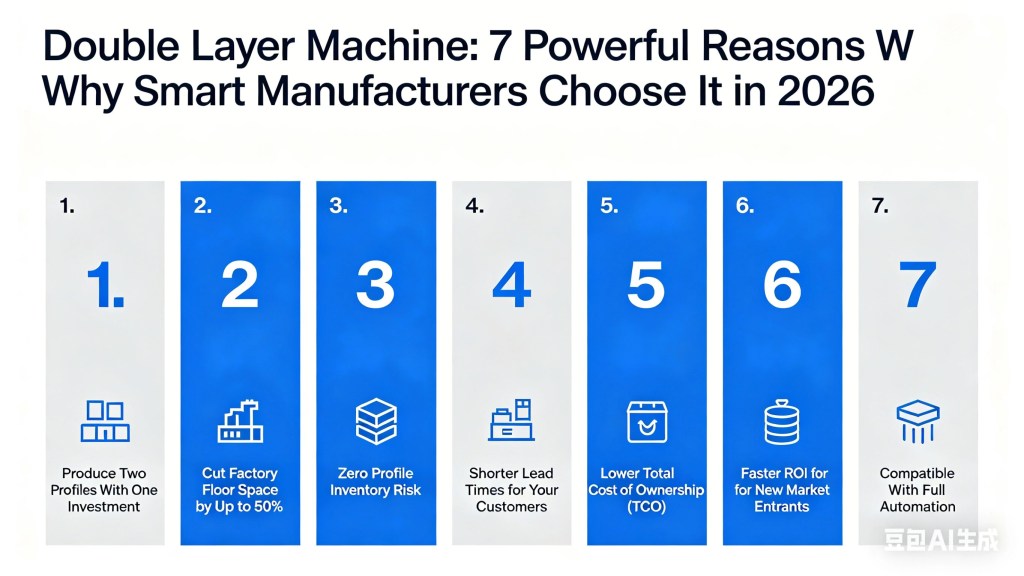
Why Manufacturers Choose a Double Layer Machine: 7 Proven Reasons
1. Produce Two Profiles With One Investment
The most compelling reason buyers choose a เครื่องจักรสองชั้น is economics. Instead of purchasing and maintaining two separate roll forming lines, one dual layer machine delivers the same production flexibility at roughly 55–70% of the combined cost.
A mid-size roofing manufacturer in South Africa reported saving USD 35,000 in equipment investment by choosing a double profile machine over two single lines, while maintaining the ability to serve both corrugated and IBR market segments simultaneously.
2. Cut Factory Floor Space by Up to 50%
Floor space is expensive. A standard single-profile roll forming line typically occupies 30–50 linear metres of floor space including decoiler and stacker. A เครื่องสองชั้น that replaces two of those lines occupies only 32–55 linear metres total — roughly the same footprint as one line.
For manufacturers operating in industrial parks with limited lease areas, this is often the decisive factor. At Believe Industry Company, our standard double layer machines are engineered with a compact tandem frame design to maximize this benefit.
3. Zero Profile Inventory Risk
Seasonal demand shifts mean that roofing sheet manufacturers often need to pivot from one profile to another within the same production week. A เครื่องจักรสองชั้น eliminates the need to store, transport, or re-configure separate tooling sets. Both profiles are always ready — the machine never needs to stop for a major tooling changeover.
This capability directly supports การขึ้นรูปม้วนปริมาณสูง strategies that depend on flexible, fast-response production scheduling.
4. Shorter Lead Times for Your Customers
Market responsiveness is a competitive advantage. Because a เครื่องสองชั้น keeps both profiles hot and ready, a sales order for Profile A or Profile B can enter production within minutes, not days. Distributors and roofing contractors — particularly in the US, Australian, and African markets — increasingly demand just-in-time delivery windows that only a dual-layer configuration can support.
5. Lower Total Cost of Ownership (TCO)
ส่วน ต้นทุนแฝงของเครื่องจักรขึ้นรูปโลหะแบบม้วน add up fast: two maintenance budgets, two sets of spare rollers, two electrical control panels, two hydraulic systems. A เครื่องตัดโปรไฟล์คู่ consolidates all of these into a single asset, dramatically reducing TCO over a 10-year machine lifecycle.
Estimated TCO comparison over 10 years (USD):
| Cost Category | 2 × Single Profile Lines | 1 × Double Layer Machine |
|---|---|---|
| Capital equipment | $90,000 | $70,000 |
| Spare roller sets | $30,000 | $30,000 |
| Maintenance labour | $5,000 | $3,000 |
| การปรับปรุงระบบไฟฟ้า | $6,000 | $3,000 |
| Total (estimated) | $131,000 | $100,600 |
Source: Bel Rollforming internal data, 2025. Values are indicative and vary by profile complexity.
6. Faster ROI for New Market Entrants
If you are entering the roll forming business for the first time — or expanding into a new product category — a เครื่องจักรสองชั้น is one of the fastest routes to ROI. You can test market demand for two different profiles simultaneously, allocate production capacity dynamically, and reach break-even with a smaller upfront investment.
ข้อดีของเครื่องขึ้นรูปม้วน are well documented: consistent dimensional accuracy, minimal material waste, and high repeatability. The เครื่องสองชั้น amplifies those benefits across two product lines from day one.
7. Compatible With Full Automation
ทันสมัย เครื่องจักรสองชั้น from Believe Industry Company integrate seamlessly with automated decoilers, servo flying shears, and auto-stacking systems. The PLC control system manages material path selection, cutting length, and batch counting for both layers from a single HMI screen.
This makes the เครื่องตัดโปรไฟล์คู่ a natural fit for ระบบอัตโนมัติในการขึ้นรูปม้วน strategies and Industry 4.0 production environments, where data-driven scheduling and remote monitoring are standard expectations.
Double Layer Machine vs. Single Profile Machine vs. Cassette Mill: Full Comparison
This is the most important decision a buyer faces. The table below gives you a factual, side-by-side view across 14 dimensions.
| คุณสมบัติ | Double Layer Machine | Single Profile Machine | Cassette Mill |
|---|---|---|---|
| Number of profiles | 2 (fixed) | 1 | 2–8+ (interchangeable) |
| เวลาในการเปลี่ยนโปรไฟล์ | 3–8 minutes | N/A | 15–45 minutes |
| Capital cost (relative) | ปานกลาง | ต่ำ | สูง |
| Floor space required | ปานกลาง | ต่ำ | ต่ำ–ปานกลาง |
| Tooling investment | 2 × dedicated sets (built-in) | 1 × dedicated set | Multiple cassette modules |
| ความเร็วในการผลิต | 8–25 m/min | 8–25 m/min | 8-25 m/min |
| Material thickness range | 0.3–1.2 มม. | 0.2–6 mm+ | 0.3–3 mm |
| ความซับซ้อนของโปรไฟล์ | ต่ำ–ปานกลาง | Low–Very High | ปานกลาง–สูง |
| Operator skill required | ต่ำ | ต่ำ | ปานกลาง–สูง |
| ความซับซ้อนของการบำรุงรักษา | ปานกลาง | ต่ำ | สูง |
| ต้นทุนอะไหล่ | ปานกลาง | ต่ำ | สูง |
| เหมาะที่สุดสำหรับ | 2 related profiles, roofing sheets, panels | Single dedicated high-volume profile | Frequent multi-profile switching |
| Scalability | Limited to 2 profiles | Add second machine | Add cassette modules |
| ROI timeline | Fast (12–24 months typical) | Fast | Slower (high initial cost) |
สรุป: A เครื่องจักรสองชั้น is the optimal choice when you need exactly two profiles, want to minimize capital investment, and prioritize fast changeover over ultimate flexibility. A cassette mill is better when you need to produce five or more profiles regularly. A single profile machine wins only when you need one profile at extremely high speed or material thickness.
Who Should Buy a Double Layer Machine?
Ideal buyers include:
- Roofing sheet manufacturers targeting 2 popular local profiles (e.g., corrugated + IBR in Africa; R-panel + AG panel in the USA)
- Wall and ceiling panel producers with paired product lines
- Custom roll forming machine buyers entering the market with limited capital
- Decking manufacturers producing composite floor deck and roof deck
- Distributors who manufacture to order for multiple client specifications
A double layer machine is NOT recommended when:
- You need material thickness above 1.5 mm (single profile or cassette mill performs better)
- You produce more than 3 different profiles regularly
- Maximum production speed is the top priority
How a Double Layer Machine Works: Step-by-Step
- Coil Loading — Steel, aluminum, or PPGI coil is loaded onto the เครื่องคลายขด. Typical coil weight: 3–8 tonnes.
- Leveling (Optinial and normally no need)— Strip passes through an integrated เครื่องปรับระดับ (5–7 rollers) to remove coil set and ensure flatness.
- Pre-punching (optional) — A servo หน่วยเจาะรู adds holes or slots before forming, if required by the profile.
- Layer Selection — The operator selects Layer 1 or Layer 2 via the PLC touchscreen. A manual or automatic guide directs the strip into the selected forming pass.
- Roll forming — The strip passes through 12–22 roll forming stations, each progressively bending the metal until the target profile is achieved.
- การตัด — A hydraulic post-cut die or เซอร์โวฟลายอิ้งชีท cuts the profile to the programmed length.
- Stacking/Collection — Finished panels are collected on a run-out table or automated stacker.
The entire process from coil to finished profile is continuous and fully automated. No operator intervention is required between pieces once the batch is running.
Double Layer Machine for Roofing: The Most Popular Application
Roofing is the dominant market for เครื่องจักรสองชั้น globally. In markets where both corrugated and trapezoidal/IBR profiles are in demand — particularly Sub-Saharan Africa, Southeast Asia, and Latin America — a เครื่องสองชั้น is the standard configuration for new factory setups.
Popular roofing profile combinations for double layer machines:
| Layer 1 | Layer 2 | Primary Market |
|---|---|---|
| Corrugated 762 | ไอบีอาร์ / Superdek | Africa, South Asia |
| R-Panel | แผง AG | USA, Americas |
| Trapezoidal 1000 | Corrugated 762 | Southeast Asia, Middle East |
| Standing Seam | กระดาษลูกฟูก | Europe, Australia |
| B-deck | W-Deck | USA Commercial Construction |
Believe Industry Company: Double Layer Machine Specifications
Believe Industry Company (Wuxi, China) has manufactured and exported เครื่องจักรสองชั้น to more than 40 countries since 2005. Key standard specifications:
| พารามิเตอร์ | ข้อมูลจำเพาะ |
|---|---|
| Frame material | 350–400 mm H-beam welded steel |
| วัสดุลูกกลิ้ง | GCr15 bearing steel, HRC 58–62 |
| เส้นผ่านศูนย์กลางเพลา | 70–90 mm, 40Cr heat-treated steel |
| Drive system | Geared motor + chain or direct drive |
| Control | Siemens S7-1200 PLC + 7″ HMI |
| การตัด | Hydraulic post-cut (standard) or servo flying shear (optional) |
| Layer changeover | Manual guide bar + PLC switch |
| ความคลาดเคลื่อนของความยาว | ± 1.5 mm |
| ซีอี / ไอเอสโอ | ISO 9001:2015 certified; CE available |
| เวลาส่งมอบ | 45–75 days ex-works Wuxi |
| การรับประกันสินค้า | 12 months parts and labour |
View more>> เครื่องขึ้นรูปม้วนสองชั้น
Video: Double Layer Machine in Action
Watch our double layer machine producing corrugated and R/PBR Panel profiles back-to-back at our Wuxi facility. The video demonstrates production process and the automated stacking system in operation.
Related Machines and Resources
If you are evaluating a เครื่องจักรสองชั้น, these related Believe Industry resources will help you make a fully informed decision:
- Roll Forming Machine — Complete Overview
- Custom Roll Forming Machine — Global Market Guide 2026
- Roll Forming Machine Price — 7 Best 2026 Secrets
- ข้อดีของเครื่องขึ้นรูปม้วน
- Quick Change Roll Forming Machine (Cassette Mill)
- การขึ้นรูปม้วนปริมาณสูง
- ส่วนประกอบของเครื่องรีดเยื้อง
- Roll Forming Tooling
- How to Buy a Roll Forming Machine — 2026 Buyer’s Guide
- ผู้ผลิตเครื่องขึ้นรูปม้วนชั้นนำในประเทศจีน
External authority references:
- The Fabricator — Roll Forming Design Principles — Industry standard reference for roll forming engineers and buyers
- Metal Construction News — Roofing & Cladding Profiles — US market data on popular panel profiles
- AISI — Steel Framing Standards — American Iron and Steel Institute design standards
- Rollforming Magazine — Dedicated trade publication for the roll forming industry
- ISO 9001:2015 Quality Management — Certification standard followed by Believe Industry Company
Frequently Asked Questions: Double Layer Machine
A เครื่องจักรสองชั้น is a roll forming line that houses two complete sets of forming stations on a single welded steel frame. Each set of rollers is tooled to produce a specific metal profile. The operator selects which profile to run via a PLC control system, and the coil strip is guided into the corresponding forming pass. The result is two production-ready profiles from one machine, one decoiler, and one operator.
The terms เครื่องจักรสองชั้น, เครื่องสองชั้น, และ เครื่องตัดโปรไฟล์คู่ all refer to the same equipment type. They are used interchangeably in the roll forming industry. Some manufacturers may use “dual layer” to emphasize the two-layer stacked frame design, while “double profile” highlights the output capability. There is no functional or technical difference between these names.
No. A เครื่องจักรสองชั้น produces one profile at a time. The two forming stations share a single feed path, decoiler, and cutter. Simultaneous dual-profile production would require two independent material feeds and two cutting systems, which is not the standard configuration. The advantage is fast switching (3–8 minutes), not simultaneous output.
Production speed depends on the profile geometry, material thickness, and cutting method. For typical roofing sheet profiles (corrugated or trapezoidal), a เครื่องสองชั้น runs at 10–20 m/min. With a servo flying shear, speeds up to 25 m/min are achievable. Note that cutting-to-length operations are the primary speed limiter on shorter panel sizes.
Most double profile machines are designed for:
- Pre-painted galvanized steel (PPGI) — the most common
- เหล็กชุบสังกะสี (GI)
- Colour-coated aluminium
- Bare cold-rolled steel (CRS)
- Stainless steel (with upgraded roller hardness)
Standard material thickness range is 0.3 mm to 1.2 mm. For thicker materials (above 1.5 mm), a single-profile machine with heavier shaft and bearing specifications is recommended.
Profile changeover on a เครื่องจักรสองชั้น takes 3 to 8 minutes in normal operation. The process involves:
- Stopping the machine and cutting off the current strip
- Threading the new coil (or re-threading the same coil) into the second forming pass
- Selecting the new profile on the PLC HMI
- Running a test panel to confirm length and profile accuracy
This compares favourably to a cassette mill (15–45 minutes per change) and is far faster than re-tooling a single-profile machine (4–24 hours).
Yes — a เครื่องจักรสองชั้น costs more than a single-profile machine for the same profile complexity, because it includes two full sets of tooling and a more complex frame. However, it costs 30–45% less than purchasing two separate single-profile machines. The price differential depends on profile complexity, forming station count, and automation level. Contact Believe Industry Company for a detailed quotation based on your specific profile requirements.
| Double Layer Machine | Cassette Mill | |
|---|---|---|
| Tooling storage | Both sets permanently mounted | Removable cassette modules |
| Number of profiles | Exactly 2 | 2 to 8+ |
| Changeover time | 3–8 minutes | 15–45 minutes |
| Capital cost | ปานกลาง | สูง |
| เหมาะที่สุดสำหรับ | 2 fixed profiles | Multi-profile flexibility |
A โรงโม่แบบเทป (also called a เครื่อง roll forming เปลี่ยนโปรไฟล์เร็ว) is the better choice when you need to switch among three or more profiles regularly. The เครื่องจักรสองชั้น wins on price, simplicity, and speed for exactly two profiles.
No special foundation is required beyond what a standard roll forming line needs. The machine is mounted on a standard level concrete floor (minimum 200 mm thickness, 25 MPa compressive strength). Anchor bolts are recommended for machines above 6,000 kg. For detailed civil drawings, Believe Industry Company provides foundation layout documentation with every machine order.
Yes, this is one of the key design considerations. Most double profile machines are engineered to use the same coil width for both profiles, simplifying inventory management and decoiler setup. Where coil widths differ between the two profiles, an adjustable decoiler with edge guide is recommended. Believe Industry Company engineers your dual layer machine around your specific coil width requirements.
บริษัท Belie Rollforming ให้การสนับสนุนหลังการขายดังต่อไปนี้สำหรับลูกค้าทุกราย เครื่องจักรสองชั้น:
- รับประกันอะไหล่ 12 เดือน นับตั้งแต่วันที่เริ่มใช้งาน
- การสนับสนุนการติดตั้งระบบจากระยะไกล ผ่านการสนทนาทางวิดีโอ (แบบมาตรฐาน)
- การติดตั้งและทดสอบระบบ ณ สถานที่ปฏิบัติงาน มีจำหน่ายในประเทศส่วนใหญ่ (ดูเพิ่มเติม) การติดตั้งเครื่องรีดขึ้นรูป)
- การจัดหาชิ้นส่วนอะไหล่ จัดส่งโดย DHL/FedEx ภายใน 3-5 วันทำการ
- การฝึกอบรมผู้ปฏิบัติงาน — บริการในสถานที่หรือบริการระยะไกล รวมอยู่ในราคาเครื่องแล้ว
- การสำรองข้อมูลโปรแกรม PLC — มีให้ในรูปแบบ USB สำหรับทุกเครื่อง
Ask yourself these four questions:
- Do you regularly produce (or plan to produce) exactly โปรไฟล์สองแบบที่แตกต่างกัน?
- Is your target material thickness 1.2 mm or less?
- Is capital investment a primary constraint?
- Do you need fast changeover (under 10 minutes)?
If you answered yes to three or more of these, a เครื่องจักรสองชั้น is very likely your best option. If your profiles require thicker steel, or you need more than two profiles, contact Believe Industry Company to explore cassette mill or multiple single-profile line configurations.
Conclusion: Is a Double Layer Machine Worth It in 2026?
For the right buyer — a roofing sheet manufacturer, wall panel producer, or roll forming entrepreneur entering a dual-profile market — the answer is a clear yes. A เครื่องจักรสองชั้น delivers:
- 30–45% lower capital cost than two separate lines
- Up to 50% floor space saving
- 3–8 minute profile switching without major changeover
- Single maintenance budget and simplified spare parts inventory
- Full automation compatibility with modern PLC, servo, and IoT systems
ส่วน เครื่องสองชั้น is not the right tool for every application. If you need to produce 5 profiles, process material above 1.5 mm, or run at speeds above 30 m/min, a different configuration will serve you better. But for focused, two-profile production — especially in the roofing, wall panel, and decking segments — the เครื่องตัดโปรไฟล์คู่ from Believe Industry Company represents one of the highest-ROI equipment investments available in 2026.
Ready to get a price? Contact Believe Industry Company via the ขอใบเสนอราคา page. Our engineering team will respond within 24 hours with a detailed proposal based on your specific profile requirements, material specifications, and production targets.
บันทึกการเปลี่ยนแปลง
| เวอร์ชั่น | วันที่ | หมายเหตุ |
|---|---|---|
| 1.0 | 2026-05-04 | Initial publish |
| — | 2026-08-04 | Scheduled review date |