ملخص سريع: A آلة طبقة مزدوجة (also called a آلة طبقة مزدوجة أو آلة ملفّ مزدوج) combines two forming stations on a single frame, letting you switch between two profiles without buying a second line. Manufacturers worldwide are adopting this technology to cut capital cost by 30–50% and floor space by 40% compared to owning two separate lines. Read on to discover whether a double layer roll former is right for your factory. For the full process background, see our تحليل شامل لتقنية آلات التشكيل بالدرفلة.
What Is a Double Layer Machine?
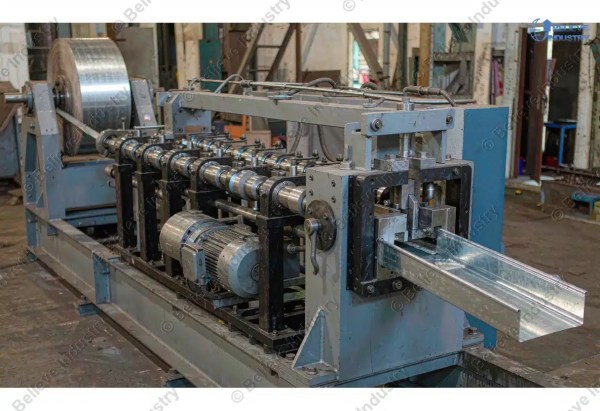
A آلة طبقة مزدوجة is a type of آلة تشكيل اللفائف that stacks two sets of forming stations — each capable of producing a completely different metal profile — onto a single base frame. The operator selects which layer runs via a PLC touchscreen, and the strip travels through one set of rollers while the other stands idle.
Unlike a طاحونة شريطية that swaps modular tooling packs, a آلة طبقة مزدوجة keeps both tooling sets permanently mounted. Profile switching takes less than 5 minutes — simply adjust the material path and press a button.
Double layer machines are commonly used to produce:
- Roofing sheets (e.g., corrugated + IBR, or R-panel + trapezoidal)
- Wall panels (flat + ribbed)
- Decking profiles (B-deck + W-deck)
Double Layer Machine by the Numbers
| المواصفة | النطاق النموذجي |
|---|---|
| سمك المادة | 0.3 مم – 1.2 مم |
| سرعة الإنتاج | 8 – 25 m/min per layer |
| Forming stations per layer | 16 – 28stations |
| Profile changeover time | 3 – 8 minutes |
| Footprint saving vs. 2 separate lines | 35 – 50% |
| Capital cost saving vs. 2 separate lines | 30 – 45% |
| Material yield (steel/aluminium/PPGI) | 0.3 – 1.5 mm |
| Typical machine weight | 4,000 – 12,000 kg |
| نظام التحكم | سيمنز / دلتا PLC + HMI |
| طريقة القطع | Hydraulic post-cut or servo flying shear |
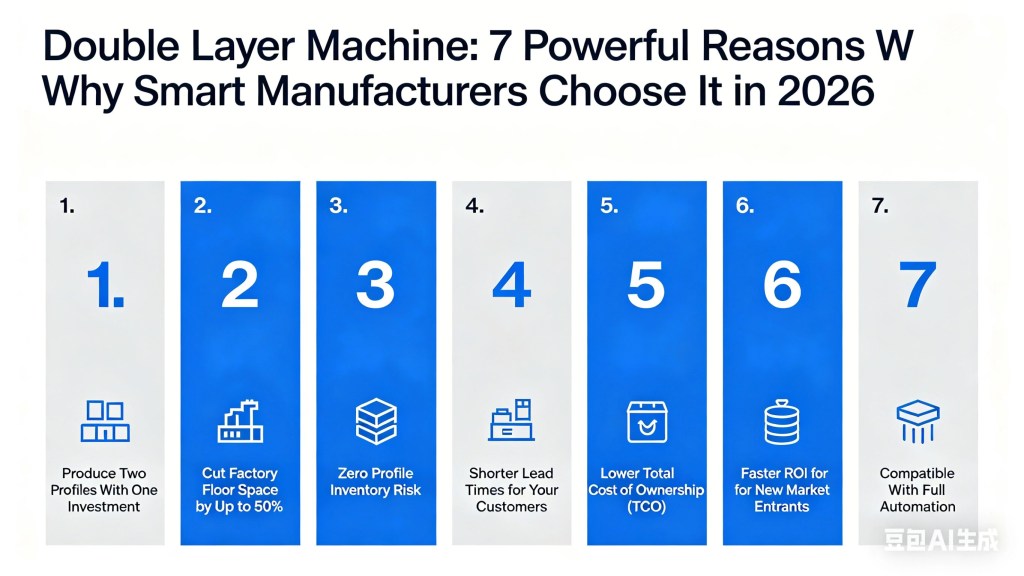
Why Manufacturers Choose a Double Layer Machine: 7 Proven Reasons
1. إنتاج ملفّين باستثمار واحد
السبب الأكثر إقناعاً الذي يجعل المشترين يختارون آلة طبقة مزدوجة هو الاقتصاد. بدلاً من شراء وصيانة خطّي تشكيل بالدلفنة منفصلين، توفّر آلة طبقة مزدوجة واحدة نفس المرونة الإنتاجية بحوالي 55–70% من التكلفة الإجمالية.
أبلغ مصنّع أسقف متوسط الحجم في جنوب إفريقيا عن توفير USD 35,000 في استثمار المعدات باختيار آلة ملفّ مزدوج بدلاً من خطّين أحاديين، مع الحفاظ على القدرة على خدمة قطاعي الأسواق المتموّجة وIBR في آن واحد.
2. خفض مساحة أرضية المصنع بنسبة تصل إلى 50%
المساحة الأرضية مكلفة. يشغل خط تشكيل بالدلفنة أحادي الملفّ القياسي عادةً 30–50 متراً خطياً من المساحة الأرضية بما في ذلك فكّ اللفائف والمكدّس. و آلة طبقة مزدوجة التي تحلّ محل اثنين من تلك الخطوط تشغل فقط 32–55 متراً خطياً إجمالاً — تقريباً نفس المساحة كخط واحد.
بالنسبة للمصنّعين العاملين في مدن صناعية بمساحات إيجار محدودة، يمثّل هذا غالباً العامل الحاسم. في شركة Believe Industry، صُمّمت آلات الطبقة المزدوجة القياسية لدينا بهيكل مزدوج مدمج لتعظيم هذه الميزة.
3. صفر مخاطر مخزون الملفّات
تعني تحوّلات الطلب الموسمي أن مصنّعي ألواح الأسقف غالباً ما يحتاجون إلى التحوّل من ملفّ إلى آخر ضمن نفس أسبوع الإنتاج. و آلة طبقة مزدوجة تلغي الحاجة إلى تخزين أو نقل أو إعادة ضبط مجموعات الأدوات المنفصلة. كلا الملفّين جاهزان دائماً — ولا تحتاج الآلة إلى التوقف لتبديل أدوات كبير.
تدعم هذه القدرة مباشرةً التشكيل بالدلفلة عالي الحجم الاستراتيجيات التي تعتمد على جدولة إنتاج مرنة وسريعة الاستجابة.
4. أوقات تسليم أقصر لعملائك
الاستجابة للسوق ميزة تنافسية. لأن آلة طبقة مزدوجة تُبقي كلا الملفّين جاهزين، يمكن لأمر بيع للملفّ A أو الملفّ B الدخول إلى الإنتاج خلال دقائق لا أيام. يطالب الموزّعون ومقاولو الأسقف — خاصة في أسواق الولايات المتحدة وأستراليا وإفريقيا — بشكل متزايد بنوافذ تسليم في الوقت المناسب التي لا يدعمها إلا تكوين طبقة مزدوجة.
5. خفض إجمالي تكلفة الملكية (TCO)
مختبر التكاليف الخفية لآلات التشكيل بالدرفلة تتراكم بسرعة: ميزانيتا صيانة، ومجموعتا أسطوانات احتياطية، ولوحتا تحكم كهربائيتان، ونظامان هيدروليكيان. و آلة ملفّ مزدوج تدمج كل ذلك في أصل واحد، مما يقلّل بشكل كبير من TCO على مدى دورة حياة الآلة البالغة 10 سنوات.
مقارنة TCO المقدّرة على مدى 10 سنوات (USD):
| فئة التكلفة | 2 × خطوط ملفّ أحادي | 1 × آلة طبقة مزدوجة |
|---|---|---|
| المعدات الرأسمالية | $90,000 | $70,000 |
| مجموعات الأسطوانات الاحتياطية | $30,000 | $30,000 |
| عمالة الصيانة | $5,000 | $3,000 |
| ترقيات كهربائية | $6,000 | $3,000 |
| الإجمالي (تقديري) | $131,000 | $100,600 |
المصدر: بيانات Bel Rollforming الداخلية، 2025. القيم إرشادية وتختلف حسب تعقيد الملفّ.
6. عائد استثمار أسرع للداخلين الجدد إلى السوق
إذا كنت تدخل مجال التشكيل بالدلفنة للمرة الأولى — أو تتوسّع في فئة منتجات جديدة — فإن آلة طبقة مزدوجة هي من أسرع الطرق إلى ROI. يمكنك اختبار الطلب في السوق لملفّين مختلفين في آن واحد، وتخصيص القدرة الإنتاجية ديناميكياً، والوصول إلى نقطة التعادل باستثمار مقدّم أصغر.
فوائد آلة تشكيل اللفة موثّقة جيداً: دقة أبعاد متسقة، وهدر مواد ضئيل، وتكرارية عالية. و آلة طبقة مزدوجة تضاعف تلك الفوائد عبر خطّي منتجات منذ اليوم الأول.
7. متوافقة مع الأتمتة الكاملة
الحديثة آلات ذات طبقتين من شركة Believe Industry تندمج بسلاسة مع فكّات لفائف آلية، ومقصّات طيران مؤازرة، وأنظمة تكديس آلية. يدير نظام التحكم PLC اختيار مسار المادة، وطول القطع، وعدّ الدفعات لكلا الطبقتين من شاشة HMI واحدة.
يصنع هذا آلة ملفّ مزدوج ملاءمة طبيعية لـ أتمتة التشكيل بالدرفلة الاستراتيجيات وبيئات الإنتاج الصناعة 4.0، حيث تعدّ الجدولة المدفوعة بالبيانات والمراقبة عن بُعد توقعات معيارية.
Double Layer Machine vs. Single Profile Machine vs. Cassette Mill: Full Comparison
This is the most important decision a buyer faces. The table below gives you a factual, side-by-side view across 14 dimensions.
| الميزة | Double Layer Machine | Single Profile Machine | Cassette Mill |
|---|---|---|---|
| Number of profiles | 2 (fixed) | 1 | 2–8+ (interchangeable) |
| Profile changeover time | 3–8 minutes | N/A | 15–45 minutes |
| Capital cost (relative) | متوسطة | منخفضة | عالية |
| Floor space required | متوسطة | منخفضة | منخفضة–متوسطة |
| Tooling investment | 2 × dedicated sets (built-in) | 1 × dedicated set | Multiple cassette modules |
| سرعة الإنتاج | 8–25 m/min | 8–25 m/min | 8-25 م/دقيقة |
| Material thickness range | 0.3–1.2 مم | 0.2–6 mm+ | 0.3–3 mm |
| Profile complexity | منخفضة–متوسطة | Low–Very High | متوسط–عالٍ |
| Operator skill required | منخفضة | منخفضة | متوسط–عالٍ |
| تعقيد الصيانة | متوسطة | منخفضة | عالية |
| تكلفة قطع الغيار | متوسطة | منخفضة | عالية |
| الأفضل لـ | 2 related profiles, roofing sheets, panels | Single dedicated high-volume profile | Frequent multi-profile switching |
| Scalability | Limited to 2 profiles | Add second machine | Add cassette modules |
| ROI timeline | Fast (12–24 months typical) | Fast | Slower (high initial cost) |
Summary: A آلة طبقة مزدوجة is the optimal choice when you need exactly two profiles, want to minimize capital investment, and prioritize fast changeover over ultimate flexibility. A cassette mill is better when you need to produce five or more profiles regularly. A single profile machine wins only when you need one profile at extremely high speed or material thickness.
Who Should Buy a Double Layer Machine?
Ideal buyers include:
- Roofing sheet manufacturers targeting 2 popular local profiles (e.g., corrugated + IBR in Africa; R-panel + AG panel in the USA)
- Wall and ceiling panel producers with paired product lines
- Custom roll forming machine buyers entering the market with limited capital
- Decking manufacturers producing composite floor deck and roof deck
- Distributors who manufacture to order for multiple client specifications
A double layer machine is NOT recommended when:
- You need material thickness above 1.5 mm (single profile or cassette mill performs better)
- You produce more than 3 different profiles regularly
- Maximum production speed is the top priority
How a Double Layer Machine Works: Step-by-Step
- Coil Loading — Steel, aluminum, or PPGI coil is loaded onto the فك اللفائف. Typical coil weight: 3–8 tonnes.
- التسوية (Optinial and normally no need)— Strip passes through an integrated آلة التسوية (5–7 rollers) to remove coil set and ensure flatness.
- Pre-punching (optional) — A servo وحدة التثقيب adds holes or slots before forming, if required by the profile.
- Layer Selection — The operator selects Layer 1 or Layer 2 via the PLC touchscreen. A manual or automatic guide directs the strip into the selected forming pass.
- التشكيل بالدلفلة — The strip passes through 12–22 roll forming stations, each progressively bending the metal until the target profile is achieved.
- القطع — A hydraulic post-cut die or مقص طائر بسيرفو cuts the profile to the programmed length.
- Stacking/Collection — Finished panels are collected on a run-out table or automated stacker.
The entire process from coil to finished profile is continuous and fully automated. No operator intervention is required between pieces once the batch is running.
Double Layer Machine for Roofing: The Most Popular Application
Roofing is the dominant market for آلات ذات طبقتين globally. In markets where both corrugated and trapezoidal/IBR profiles are in demand — particularly Sub-Saharan Africa, Southeast Asia, and Latin America — a آلة طبقة مزدوجة is the standard configuration for new factory setups.
Popular roofing profile combinations for double layer machines:
| Layer 1 | Layer 2 | السوق الأساسي |
|---|---|---|
| Corrugated 762 | آي بي آر / Superdek | Africa, South Asia |
| R-Panel | لوح AG | USA, Americas |
| Trapezoidal 1000 | Corrugated 762 | Southeast Asia, Middle East |
| Standing seam | المموج | Europe, Australia |
| B-deck | W-Deck | USA Commercial Construction |
Believe Industry Company: Double Layer Machine Specifications
Believe Industry Company (Wuxi, China) has manufactured and exported آلات ذات طبقتين to more than 40 countries since 2005. Key standard specifications:
| المعامل | المواصفة |
|---|---|
| Frame material | 350–400 mm H-beam welded steel |
| مادة الأسطوانة | GCr15 bearing steel, HRC 58–62 |
| قطر العمود | 70–90 mm, 40Cr heat-treated steel |
| نظام الدفع | Geared motor + chain or direct drive |
| يتحكم | Siemens S7-1200 PLC + 7″ HMI |
| القطع | Hydraulic post-cut (standard) or servo flying shear (optional) |
| Layer changeover | Manual guide bar + PLC switch |
| التفاوت المسموح به في الطول | ± 1.5 mm |
| CE / ISO | ISO 9001:2015 certified; CE available |
| مهلة | 45–75 days ex-works Wuxi |
| الضمان | 12 months parts and labour |
View more>> آلة تشكيل اللفة ذات الطبقة المزدوجة
Video: Double Layer Machine in Action
Watch our double layer machine producing corrugated and R/PBR Panel profiles back-to-back at our Wuxi facility. The video demonstrates production process and the automated stacking system in operation.
Related Machines and Resources
If you are evaluating a آلة طبقة مزدوجة, these related Believe Industry resources will help you make a fully informed decision:
- Roll Forming Machine — Complete Overview
- Custom Roll Forming Machine — Global Market Guide 2026
- Roll Forming Machine Price — 7 Best 2026 Secrets
- فوائد آلة تشكيل اللفائف
- Quick Change Roll Forming Machine (Cassette Mill)
- تشكيل اللفائف بكميات كبيرة
- مكونات آلة التشكيل بالدرفلة
- Roll Forming Tooling
- How to Buy a Roll Forming Machine — 2026 Buyer’s Guide
- أفضل مصنعي آلات تشكيل اللفائف في الصين
External authority references:
- The Fabricator — Roll Forming Design Principles — Industry standard reference for roll forming engineers and buyers
- Metal Construction News — Roofing & Cladding Profiles — US market data on popular panel profiles
- AISI — Steel Framing Standards — American Iron and Steel Institute design standards
- Rollforming Magazine — Dedicated trade publication for the roll forming industry
- إدارة الجودة ISO 9001:2015 — Certification standard followed by Believe Industry Company
Frequently Asked Questions: Double Layer Machine
A آلة طبقة مزدوجة is a roll forming line that houses two complete sets of forming stations on a single welded steel frame. Each set of rollers is tooled to produce a specific metal profile. The operator selects which profile to run via a PLC control system, and the coil strip is guided into the corresponding forming pass. The result is two production-ready profiles from one machine, one decoiler, and one operator.
الشروط آلة طبقة مزدوجة, آلة طبقة مزدوجة, و آلة ملفّ مزدوج all refer to the same equipment type. They are used interchangeably in the roll forming industry. Some manufacturers may use “dual layer” to emphasize the two-layer stacked frame design, while “double profile” highlights the output capability. There is no functional or technical difference between these names.
No. A آلة طبقة مزدوجة produces one profile at a time. The two forming stations share a single feed path, decoiler, and cutter. Simultaneous dual-profile production would require two independent material feeds and two cutting systems, which is not the standard configuration. The advantage is fast switching (3–8 minutes), not simultaneous output.
Production speed depends on the profile geometry, material thickness, and cutting method. For typical roofing sheet profiles (corrugated or trapezoidal), a آلة طبقة مزدوجة يعمل في 10–20 m/min. With a servo flying shear, speeds up to 25 m/min are achievable. Note that cutting-to-length operations are the primary speed limiter on shorter panel sizes.
Most double profile machines are designed for:
- Pre-painted galvanized steel (PPGI) — the most common
- الفولاذ المجلفن (GI)
- Colour-coated aluminium
- Bare cold-rolled steel (CRS)
- Stainless steel (with upgraded roller hardness)
Standard material thickness range is 0.3 mm to 1.2 mm. For thicker materials (above 1.5 mm), a single-profile machine with heavier shaft and bearing specifications is recommended.
Profile changeover on a آلة طبقة مزدوجة takes 3 to 8 minutes in normal operation. The process involves:
- Stopping the machine and cutting off the current strip
- Threading the new coil (or re-threading the same coil) into the second forming pass
- Selecting the new profile on the PLC HMI
- Running a test panel to confirm length and profile accuracy
This compares favourably to a cassette mill (15–45 minutes per change) and is far faster than re-tooling a single-profile machine (4–24 hours).
Yes — a آلة طبقة مزدوجة costs more than a single-profile machine for the same profile complexity, because it includes two full sets of tooling and a more complex frame. However, it costs 30–45% less than purchasing two separate single-profile machines. The price differential depends on profile complexity, forming station count, and automation level. Contact Believe Industry Company for a detailed quotation based on your specific profile requirements.
| Double Layer Machine | Cassette Mill | |
|---|---|---|
| Tooling storage | Both sets permanently mounted | Removable cassette modules |
| Number of profiles | Exactly 2 | 2 to 8+ |
| Changeover time | 3–8 minutes | 15–45 minutes |
| Capital cost | متوسطة | عالية |
| الأفضل لـ | 2 fixed profiles | Multi-profile flexibility |
A طاحونة شريطية (also called a آلة التشكيل بالدلفلة سريعة التغيير) is the better choice when you need to switch among three or more profiles regularly. The آلة طبقة مزدوجة wins on price, simplicity, and speed for exactly two profiles.
No special foundation is required beyond what a standard roll forming line needs. The machine is mounted on a standard level concrete floor (minimum 200 mm thickness, 25 MPa compressive strength). Anchor bolts are recommended for machines above 6,000 kg. For detailed civil drawings, Believe Industry Company provides foundation layout documentation with every machine order.
Yes, this is one of the key design considerations. Most double profile machines are engineered to use the same coil width for both profiles, simplifying inventory management and decoiler setup. Where coil widths differ between the two profiles, an adjustable decoiler with edge guide is recommended. Believe Industry Company engineers your dual layer machine around your specific coil width requirements.
Belie Rollforming provides the following post-sale support for all آلات ذات طبقتين:
- 12-month parts warranty from date of commissioning
- Remote commissioning support via video call (standard)
- On-site installation and commissioning available in most countries (see Roll Forming Machine Installation)
- Spare parts supply via DHL/FedEx within 3–5 business days
- تدريب المشغلين — on-site or remote, included in machine price
- PLC program backup — provided on USB with every machine
Ask yourself these four questions:
- Do you regularly produce (or plan to produce) exactly two different profiles?
- Is your target material thickness 1.2 mm or less?
- Is capital investment a primary constraint?
- Do you need fast changeover (under 10 minutes)?
If you answered yes to three or more of these, a آلة طبقة مزدوجة is very likely your best option. If your profiles require thicker steel, or you need more than two profiles, contact Believe Industry Company to explore cassette mill or multiple single-profile line configurations.
Conclusion: Is a Double Layer Machine Worth It in 2026?
For the right buyer — a roofing sheet manufacturer, wall panel producer, or roll forming entrepreneur entering a dual-profile market — the answer is a clear yes. A آلة طبقة مزدوجة delivers:
- 30–45% lower capital cost than two separate lines
- Up to 50% floor space saving
- 3–8 minute profile switching without major changeover
- Single maintenance budget and simplified spare parts inventory
- Full automation compatibility with modern PLC, servo, and IoT systems
مختبر آلة طبقة مزدوجة is not the right tool for every application. If you need to produce 5 profiles, process material above 1.5 mm, or run at speeds above 30 m/min, a different configuration will serve you better. But for focused, two-profile production — especially in the roofing, wall panel, and decking segments — the آلة ملفّ مزدوج from Believe Industry Company represents one of the highest-ROI equipment investments available in 2026.
Ready to get a price? Contact Believe Industry Company via the طلب عرض أسعار page. Our engineering team will respond within 24 hours with a detailed proposal based on your specific profile requirements, material specifications, and production targets.
سجل التغييرات
| الإصدار | التاريخ | ملاحظات |
|---|---|---|
| 1.0 | 2026-05-04 | Initial publish |
| — | 2026-08-04 | Scheduled review date |