


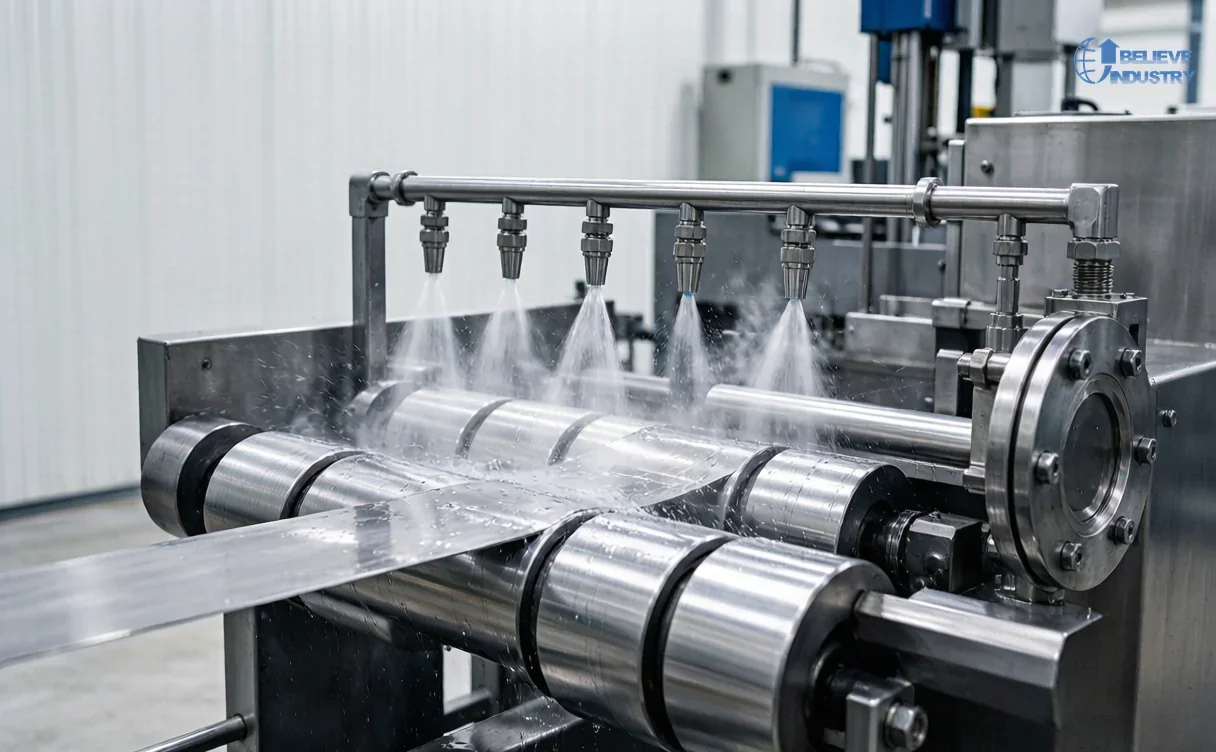
Roll forming lubrication is a forming variable, not a consumable that someone tops up when the pump looks low. It sets friction, heat, surface finish and whether paint or adhesive will bond later.
Dry steel on steel runs at a friction coefficient of 0.4 to 0.6. A working film brings that down to 0.08 to 0.15. Inside that band the strip still grips the rolls, the material flows instead of tearing, and the surface reaches the stacker intact.
Move outside the band and the line reports it. Too little film shows as pick-up, scoring and heat. Too much shows as slip, roll marking and a residue that will not come off.
What the Film Actually Does
A roll forming lubricant does five jobs at once. It lowers friction, carries heat out of the forming zone, flushes metal fines, leaves a temporary corrosion barrier and extends roll and punch life. The Fabricator’s review of roll forming lubrication lists the same five functions.
Heat is the function most plants ignore. A mill running 30 m/min without coolant can lift strip temperature by 20 to 40 °C from entry to last stand. That heat thins the film and drops viscosity exactly where strain is highest.
Friction also decides shape. Every angle on the line is set against an assumed friction value, so a lubricant change moves springback, length and bow.
Rule 1: Match the Chemistry to the Surface
The material decides the lubricant, not the pump or the purchasing contract. Cold rolled and hot rolled steel are inactive surfaces and accept most ferrous lubricants. Coated, painted and non ferrous surfaces are active, and the wrong additive attacks them.
On galvanized and Galvalume stock, aggressive extreme pressure additives can stain the coating and start white rust in storage. On aluminum, a fluid above pH 9 attacks the surface and leaves a dark stain. On prepainted coil, silicone and heavy wax block paint, adhesive and weld.
| Surface | Main risk | Choose | Avoid |
|---|---|---|---|
| Cold rolled steel | Wear, pick-up | General ferrous neat oil or emulsion | Nothing specific, keep it filtered |
| Galvanized, Galvalume | White rust, staining | Stable, mild EP, chlorine free | Acidic or chlorinated EP packs |
| Aluminum | Staining, darkening | pH 7 to 9, aluminum safe | Alkaline fluids above pH 9 |
| Prepainted coil | Paint lift, bond failure | Light vanishing oil, 0.3 to 0.5 g/m² | Silicone, heavy wax, solvent attack |
| Stainless steel | Galling, high pressure | High film strength, chlorine free | Chlorinated additives |
Stainless and high strength grades need more film strength, not more volume. The tooling side of that trade is covered in stainless steel roll forming tooling.
A compatibility test is cheap. Soak three coupons of the actual coil in the candidate lubricant for 24 hours at 40 °C, then check for staining, blistering and adhesion loss.
Rule 2: Set Film Weight, Not a Squirt
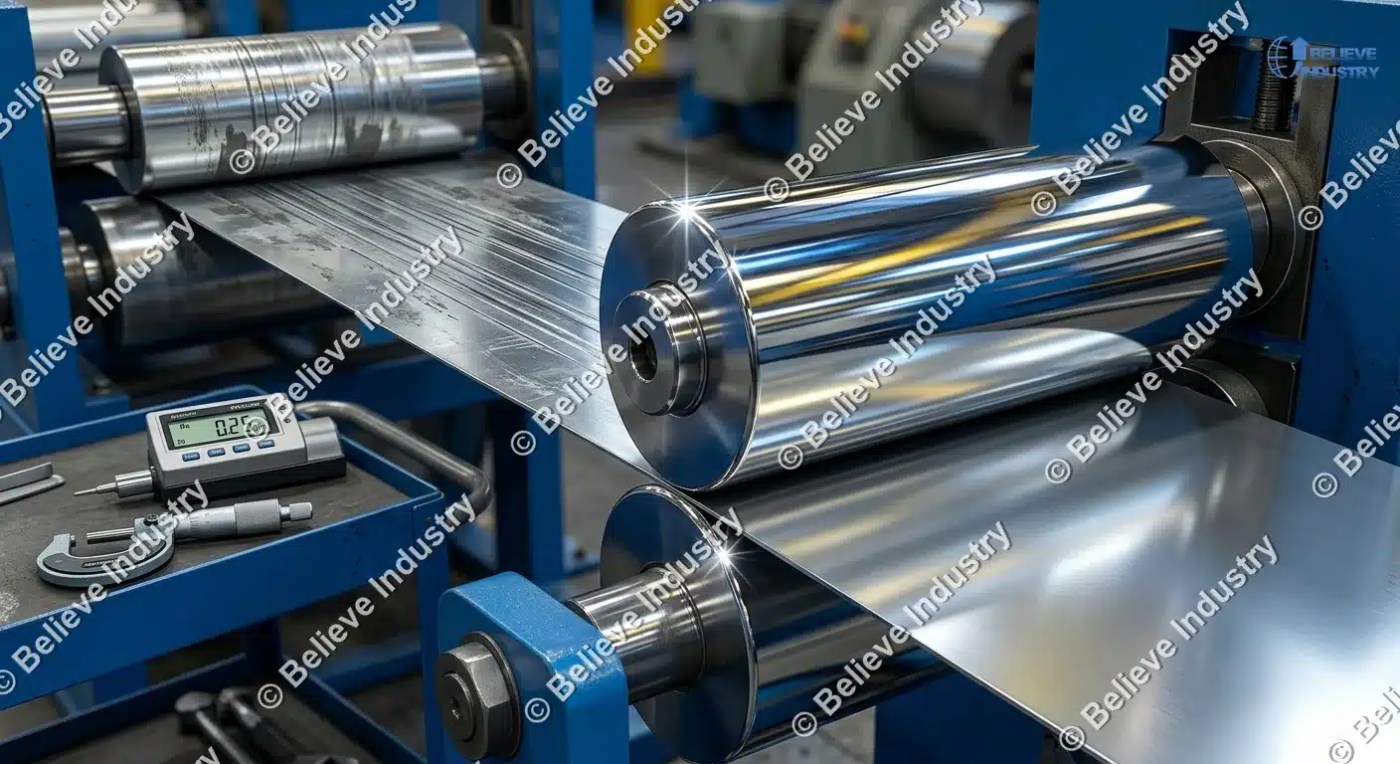
Film weight is the only number that makes lubrication repeatable. It is grams per square metre on the strip, set per product, not per shift.
A vanishing oil on prepainted panel runs at 0.3 to 0.5 g/m². General galvanized and cold rolled work sits at 0.8 to 2 g/m². Heavy gauge, high strength or tight radius work needs 2 to 5 g/m², because the film must survive higher contact pressure and more strain.
Application sets how well that number holds. A felt wiper from a reservoir is even and cheap, and needs felt changes. A metered roller coater holds about ±10 percent. Airless spray is flexible, but nozzles drift. Drip and brush depend on the operator and tend to flood.
Measure the film instead of trusting the setting. Cut a 100 cm² coupon before and after the applicator, weigh on a 0.1 mg balance, and convert to g/m². Do it once per shift and after every lubricant change.
Too much film is a defect source, not insurance. Excess oil fills the roll gap, lets the strip skate and prints roll marks on the face. It loads the shear and the floor with fluid.
Rule 3: Clean Strip Beats Extra Oil
Most scratches blamed on lubricant start as particles carried in the film. Slitter burr, scale, edge dust and metal fines all travel with the strip, and a 50 µm particle trapped between roll and strip leaves a scratch 5 to 20 µm deep.
Filtration is the first control. A 25 µm absolute filter on the recirculation loop, a magnetic separator and a settling tank remove most of the load. A 100 µm strainer is a chip guard, not a filter, and it passes exactly the fines that cause surface scratch defects.
The second control is the coil. Condensation between wraps, white rust from a cold coil moved into a warm plant, and dirt from outdoor storage all enter the line before the first stand. Coil handling is covered in this guide to coil storage rack systems.
Wiper felts at the entry and after the applicator do two jobs. They spread the film evenly and wipe contamination off the back face, the one nobody lubricates.
Rule 4: Contain and Remove the Fluid
Lubricant that leaves the mill becomes a cost, a slip hazard and a coating defect. Containment starts with a drip tray under each stand and a wiper before the shear, and it ends at the stacker with dry parts.
Mist is the part plants underestimate. NIOSH recommends keeping metalworking fluid mist below 0.4 mg/m³ as thoracic particulate. A line with visible haze at the entry is above that, and the fix is nozzle direction, lower pressure and local extraction.
Residual film decides the next process. Painting needs under 0.2 g/m² of residue after washing. Adhesive bonding and inline welding need less, and chlorine free fluids make both easier. Water extendable lubricants left on nested parts trap moisture and cause rust, so parts must drain before stacking.
A worn or glazed wiper passes fluid straight through. Check it every shift, the same way you check the roll gap.

Rule 5: Control the Fluid, Not Just the Top-Up
Roll forming lubrication is only as reliable as the fluid in the tank, and a recirculating system drifts every day. Water evaporates, tramp oil accumulates and concentration climbs. Top-up without testing turns a good fluid into a variable.
Measure four things on a fixed schedule: concentration by refractometer with the supplier’s Brix factor, pH, tramp oil and temperature. Add bacteria dipslides and conductivity weekly. Most hydraulic leaks end up in the coolant tank, which is why a hydraulic system check belongs in the same walk as the lubricant log.
| Parameter | Target | Test | Frequency |
|---|---|---|---|
| Concentration | 5 to 10 percent, per supplier | Refractometer | Daily |
| pH | 8.5 to 9.5 | pH meter or strips | Daily |
| Tramp oil | Under 2 percent | Skim test or sight glass | Daily |
| Fluid temperature | 20 to 40 °C | Tank thermometer | Daily |
| Metal fines | Under 25 µm | Filter inspection | Weekly |
| Bacteria | Under 10⁴ CFU/ml | Dipslide | Weekly |
Two failures follow a neglected tank. Bacteria break the emulsion, so the fluid stops lubricating even when concentration reads correct. Tramp oil floats, starves the pick-up and deposits on the strip as a film that shows after painting.
Rule 6: Write the Spec Into the Line Record
Roll forming lubrication fails quietly when it lives in one operator’s memory. Put one page in the line record and treat it like a roll setting: product, lubricant and supplier code, concentration or film weight, application point, test method, acceptance limit and signature.
Change control matters more than the paperwork. A new lubricant alters friction, so it alters springback, length and bow. After any change, run 30 parts and check length, angle and surface before the rest of the order runs. The same rule applies after a roll change, when roll gap clearance is reset.
Link the record to the defect log. When a worn roll edge or a pick-up mark appears, the lubricant history tells you whether the film changed before the defect did. Without it, every investigation restarts from zero.
Acceptance Checks Before You Sign Off
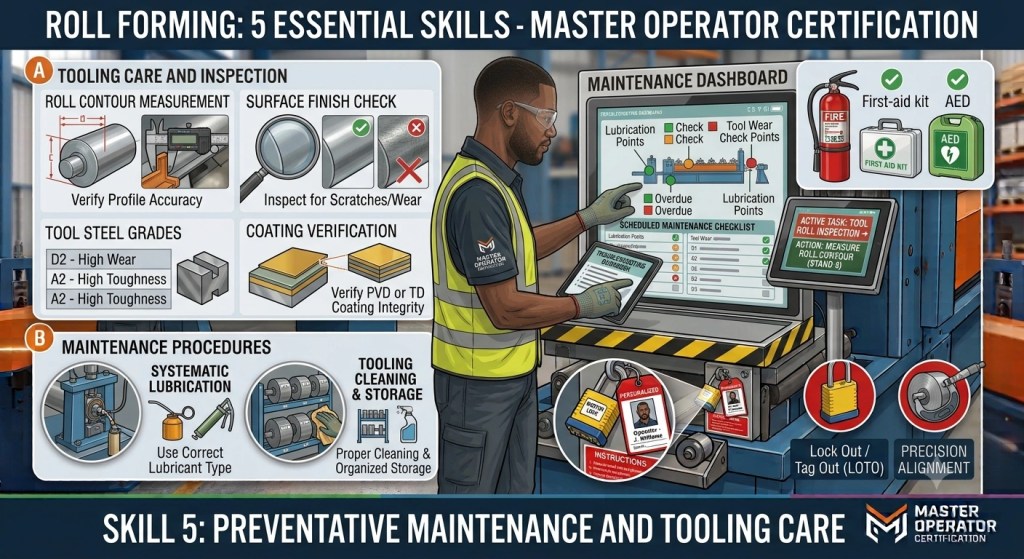
Run three checks on the first production run and keep the sheets with the coil number.
| Check | Method | What it catches |
|---|---|---|
| Film weight | 100 cm² coupon, 0.1 mg balance, g/m² | Under and over application |
| Film strength | Four ball wear test to ASTM D4172, 40 kg, 1,200 rpm, 75 °C, 60 min | Wear scar above 0.45 mm means the fluid is too weak for the strain |
| Corrosion | Humidity cabinet, 24 h at 40 °C and 95 percent RH | White rust or staining on galvanized stock |
For high pressure or stainless work, add the extreme pressure test to ASTM D2783 and record the load wear index. A fluid that passes the wear test but fails the EP test will gall on a tight radius at speed.
FAQ
1. Does prepainted coil need roll forming lubrication? Usually a light film, 0.3 to 0.5 g/m². Paint is softer than steel and forms with less friction, but a dry roll can still scuff the face. Use a vanishing oil, never a silicone based product.
2. Can one lubricant cover galvanized and cold rolled steel? Often yes, if it is a mild, stable, chlorine free product. Test both surfaces anyway. A fluid that suits cold rolled steel can stain a galvanized face in storage, and the defect shows up a week later.
3. How much lubricant should a roll forming line use? Set it by film weight, not litres per shift. Galvanized and cold rolled work runs at 0.8 to 2 g/m², prepainted at 0.3 to 0.5 g/m², heavy gauge at 2 to 5 g/m². Consumption follows the strip area you ran.
4. Water based fluid or neat oil? Water based fluids cool better, cost less per litre and suit high speed lines with recirculation. Neat oils give a stronger film and better rust protection on heavy sections. The choice follows the strain and the next process.
5. Why does the strip slip in the first stands? Usually too much film, worn rolls or a drive pulling rather than feeding. Check film weight, then roll condition, then entry grip. Adding oil to a slipping mill makes it worse.
6. Can lubricant cause white rust on galvanized coil? Yes. Acidic fluids, aggressive EP additives and water trapped between nested parts start white rust. Use a mild fluid, drain parts and keep the pack dry.
7. How often should concentration be tested? Daily, same time and same point in the tank. Evaporation can move concentration several points in a shift, and a reading taken after a top-up hides the drift.
8. Can the wrong lubricant cause a paint adhesion failure? It can. Silicone, wax and heavy residue sit between metal and coating, and no pretreatment removes them completely. If the part will be painted, use a lubricant the coater has approved.
9. Is lubrication different for high strength steel? Yes. Higher yield strength means higher contact pressure and more springback, so the film needs more strength, not just more volume. Expect 2 to 5 g/m² and a fluid that passes the EP test.
10. What is the cheapest way to control lubrication cost? Measure film weight and concentration. Most plants that audit both find they use 20 to 30 percent more lubricant than the job needs, and the excess causes defects.
Conclusion
Roll forming lubrication is a control loop: chemistry matched to the surface, film weight measured in grams, clean strip, contained fluid, a tank that is tested and a record that survives the shift.
Beli Rollforming builds roll forming machines and commissions lines for coated, painted and high strength stock for over 15 years, in more than 20 countries. When a surface defect appears, check the film before touching the tooling. The material side is covered in this guide to roll forming material selection.
Last updated: 2026-11-05
Article Changelog
- 2026-11-05: First publication. Six rules covering chemistry, film weight, strip cleaning, containment, fluid control and records, with film weight and fluid limit tables and three acceptance checks.
Next Review Triggers
- ASTM D4172 or D2783 revision that changes the wear or EP acceptance values
- A lubricant supplier reformulates a product used on coated or prepainted stock
- New field data linking a surface defect to film weight or fluid concentration



 English