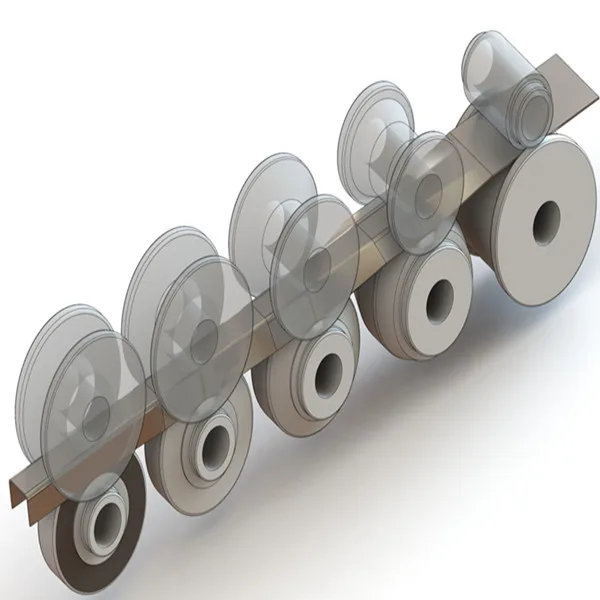
Raw coil enters the entry table. It exits as a finished, punched, cut-to-length profile. Between entry and exit sits the roll forming mill, and in most production lines, a set of secondary operations in the roll forming line determine whether the line produces a generic shape or a market-ready component.
Secondary operations in the roll forming line are the integrated processes that punch, notch, cut, bend, weld, or otherwise modify the strip خلال the roll forming cycle. They eliminate offline handling, reduce labor, and tighten tolerances. A line without them makes profiles. A line with them makes parts.
وفقا ل Precision Metalforming Association, integrating secondary operations is one of the highest-ROI upgrades for existing roll forming lines.
What Counts as a Secondary Operation?
If the roll forming mill gradually bends flat strip into a finished profile shape, secondary operations in the roll forming line are everything else that happens inline to make that profile usable in its final application.
Typical secondary operations in the roll forming line include:
| عملية | What it does | When it happens |
|---|
| Punching / Notching | Creates holes, slots, vents, cutouts | Pre-punch (before mill) or post-punch (after mill) |
| Cut-off | Cuts continuous profile to finished length | Post-cut (after final pass) |
| Bending | Adds tabs, hems, returns after forming | Post-forming station |
| Welding | Closes seams on tubular/complex profiles | Inline, after final pass |
| النقش | Adds stiffness ribs or surface patterns | Between forming stations or post-form |
| Perforating | Creates patterned hole arrays | Pre-punch or rotary inline |
| Curving / Sweeping | Adds radius to formed profile | Dedicated post-forming section |
The defining trait of secondary operations in the roll forming line: these operations run synchronously with the roll forming line. Material moves continuously (or stops briefly in a controlled loop), and the secondary operation executes without removing the part from the line.
Why Secondary Operations in the Roll Forming Line Matter
A standalone roll forming machine makes a profile. A line with integrated secondary operations in the roll forming line makes a finished part.
The difference shows up in three places where secondary operations in the roll forming line create value:
1. Labor cost. Every offline handling step is a labor hour. Punching holes at a separate press, cutting lengths on a cold saw, manual stacking—these add headcount. Inline secondary operations eliminate them.
2. Dimensional accuracy. When punching happens offline, you reference holes to cut ends, or cut ends to holes—and stack up cumulative tolerances. Inline punching references holes to the strip itself, using servo positioning. The hole pattern stays locked to the profile geometry at ±0.5 mm or better.
3. Throughput. A line producing 20 m/min of profile needs to also punch at 20 m/min. Offline batch processing can’t match that. Integrated operations in the secondary operations in the roll forming line let the line run at its designed speed without creating work-in-progress inventory.
Believe Industry’s مكبس الثقب لصناعة تشكيل اللفائف guide covers the equipment side in detail.
Pre-Cut vs. Post-Cut: The Foundational Decision
Every roll forming line with secondary operations in the roll forming line faces one structural question: do the cutting and punching operations happen قبل the strip enters the roll forming mill (pre-cut), or بعد the profile has been fully formed (post-cut)?
Pre-Cut Lines
In a pre-cut line, the coil is first decoiled, then fed through a punch press or flying shear to cut blanks or add holes, and only then enters the roll forming mill.
Advantages:
- The strip is flat during punching. Tooling life is longer because the punch isn’t hitting a curved surface.
- Hole distortion is minimal—the flat strip doesn’t spring back the way a formed profile does.
- Pre-cut notching can remove material that would otherwise interfere with the roll forming process (relief notches, end notches).
Disadvantages:
- Each blank must be individually fed into the roll forming mill. This limits line speed or requires a loop accumulator.
- The leading and trailing ends of each blank have startup/shutdown effects in the mill, which can cause dimension variation.
Pre-cut is common in cable tray manufacturing process lines where perforated trays need precise hole patterns relative to the tray ends.
Post-Cut Lines
In a post-cut line, the strip passes through the entire roll forming mill continuously, and cutting/punching in secondary operations in the roll forming line happens after the profile is fully formed.
Advantages:
- True continuous production. The mill runs at steady state.
- Higher line speeds (40–80 m/min) are achievable.
- No lost material at starts and stops.
Disadvantages:
- Punching a formed profile requires custom die designs that match the profile contour.
- Hole distortion from springback must be managed with over-punching or proper die design.
- Flying cut-off must match mill speed precisely.
Most high-volume lines, solar strut channels, purlins, racking uprights, use post-cut configurations for secondary operations in the roll forming line. The strut channel roll forming machine at Beli’s facility runs post-cut with flying die punching at 40 m/min.
| عامل | Pre-Cut | Post-Cut |
|---|
| Line speed | Limited by feed cycle | Continuous, high speed |
| Tool life | Better (flat strip) | Shorter (formed profile) |
| Hole accuracy | Excellent | Good (requires servo sync) |
| Profile complexity | Handles complex notches | Best for standard holes/slots |
| Typical applications | Cable tray, perforated deck | Purlins, strut, racking, guards |
Punching: The Most Common Secondary Operation in the Roll Forming Line
If you are running a roll forming line that makes parts rather than profiles, you are probably punching holes inline. The question is how.
Tight Loop vs. Loose Loop
A tight-loop punching system mounts the press directly on the roll forming line. The strip never stops moving. The punching die is a flying die. It rides along with the strip, punches during the synchronization window (typically 100–200 mm of travel), and returns.
A loose-loop system creates a small loop of strip between the roll former and the punch press. The loop allows the strip to briefly stop under the press for punching, then acceleration resumes. Loose-loop systems are simpler mechanically but limit line speed.
Servo-driven flying dies have largely replaced mechanical linkages in new lines. The servo feeder technology that drives modern lines allows ±0.01 mm positioning accuracy.
Die Types for Roll Forming Lines
| Die type | طلب | Speed limit |
|---|
| Flying die (linear guide) | Standard holes, slots | 40–60 m/min |
| Rotary die | Small holes, repeating patterns | 100+ m/min |
| Stationary die (loose loop) | Complex shapes, notching | Limited by loop size |
| Gantry press | Large cutouts, heavy punching | 15–25 m/min |
Rotary dies deserve special mention in secondary operations in the roll forming line. They use rotating tooling to punch holes while the strip continues moving. Because there is no reciprocating mass, they run at speeds that would destroy a conventional press. The tradeoff is they only work for through-holes, not notches or complex shapes, and they are limited to thinner materials (typically <2 mm).
Cut-Off: Flying Shear vs. Stationary Shear in the Roll Forming Line
Every roll formed part has a cut end. The cut-off method in secondary operations in the roll forming line determines edge quality, length accuracy, and whether you can run at high speed.
Flying Shear (Moving Cut-Off)
The blade moves synchronously with the profile, cuts while moving, and returns. This is the standard for post-cut lines.
Modern lines use servo-driven flying shears with pneumatic or hydraulic clamping. The blade profile matches the contour of the formed shape—a simple straight blade would deform the profile during cutting.
Length accuracy depends on encoder feedback and servo tuning. Well-tuned lines hold ±0.5 mm on 6-meter lengths at 30 m/min.
Stationary Shear (Stop-and-Cut)
The line stops, the shear cuts, the line restarts. This is simpler and cheaper but limits throughput. It’s common on low-volume lines or profiles with thick material where flying shear forces become excessive.
Burr and Edge Quality
Cold saw cutting produces the cleanest edges but is slow. Flying shear with proper blade gap produces acceptable edges for most applications. The blade gap should be 5–10% of material thickness. Too tight and the blade wears rapidly; too loose and burr formation increases.
For architectural profiles where edge appearance matters, a secondary deburring operation may be justified. For structural profiles (purlins, racking), minor burrs are acceptable.
Welding: Closing the Seam Inline
Some profiles—structural tube, certain cable tray configurations, closed-section racking—require the profile to be welded closed after forming.
Inline welding systems integrate a welding station immediately after the final roll forming pass. This is one of the most critical secondary operations in the roll forming line. The most common approach is high-frequency (HF) induction welding for steel, or TIG/MIG for aluminum and stainless.
Why inline? If you form an open profile, remove it from the line, then weld it offline, you introduce alignment errors. The profile may twist or bow during handling. Inline welding keeps the profile under tension and alignment control through the critical welding step.
HF welding is standard for closed-section profiles running at speed. A آلة تشكيل شعاع الصندوق الأوتوماتيكية بالكامل integrates welding, punching, and cut-off in one continuous line.
Bending and Post-Forming Operations
Roll forming excels at gradual bends over many stations. It is poor at sharp bends, return flanges, or complex end geometries. That is where post-forming stations in secondary operations in the roll forming line come in.
A typical post-forming press adds hems, tabs, or return bends to a formed profile. The profile exits the roll former, enters a die station, gets the bend, and continues to cut-off.
The key constraint: the post-forming operation must be fast enough to match line speed, or the line must include an accumulator to buffer strip between the roll former and the bending station.
ل آلة تشكيل لفائف دعامات تثبيت الطاقة الشمسية lines, post-forming stations add mounting tabs and connection points that would be impossible to form gradually in the roll mill.
Embossing and Stiffening
Flat surfaces on roll formed profiles tend to oil-can (warp or ripple under load). Embossing adds localized deformation that increases sectional modulus without adding material.
Inline embossing uses patterned rolls (like small rolling mills) positioned before or within the roll forming mill. The embossing pattern must be designed so it doesn’t interfere with the subsequent bend sequences in the roll forming mill.
Floor deck profiles use embossing extensively. The embossments create mechanical lock with the concrete slab. Without them, the deck is just a form—with them, it’s structural.
Perforating: Patterned Holes at Production Speed
Perforated profiles—cable tray, some flooring products, decorative panels—need thousands of small, regularly-spaced holes.
Rotary perforating dies are the standard solution. Hardened punches mounted on a rotating cylinder punch holes as the strip moves through. The cylinder rotation synchronizes with line speed so hole spacing is consistent.
The alternative—punching holes one at a time with a flying die—is too slow for high-density perforation. Rotary dies run at 100+ m/min with hole spacing accuracy of ±0.1 mm.
Curving: Radius Bending After Forming
Roll forming makes straight profiles. If the application needs curved profiles (architectural cladding, curved purlins), a post-forming curving machine adds the radius.
The profile passes through a series of adjustable rolls that gradually bend it to the target radius. Multiple passes may be needed for tight radii to avoid kinking.
ل metal roof roll forming machine lines serving architectural markets, an integrated curving section enables radius roofing panels without a separate curving process.
Equipment Integration: Making It Work Together
A roll forming line with secondary operations in the roll forming line is a system, not a collection of machines. The integration challenges are real.
Synchronization. The punch press, cut-off, and roll former must all agree on where the strip is. This requires a common encoder reference and servo control system. PLC-based line control coordinates all line elements.
Tension control. Secondary operations in the roll forming line that stop or slow the strip create tension variations. An accumulator (loop tower) between the roll former and the secondary operation absorbs these variations so the roll former can run continuously.
Tooling changeover. Lines producing multiple profile widths need quick-change tooling not just in the roll former but also in the punch press and cut-off. Cassette-type roll forming machines extend this flexibility to secondary operations in the roll forming line.
Typical Line Configurations for Secondary Operations in the Roll Forming Line
| Profile type | Secondary operations in the roll forming line | Line speed | Notes |
|---|
| C/Z Purlin | Pre-punch holes, post-cut | 20–40 m/min | Quick-change for C/Z swap |
| Solar strut channel | Post-punch holes, flying cut-off | 30–60 m/min | Servo-driven flying die |
| صينية الكابلات | Pre-perforation, notching, cut-to-length | 15–25 m/min | Complex tooling |
| Highway guardrail | Post-punch beam holes, flying cut-off | 10–20 m/min | Thick material (3–4 mm) |
| Racking upright | Post-punch hole patterns, flying cut-off, inline welding | 20–30 m/min | High precision required |
| Floor deck | Embossing inline, post-cut | 15–25 m/min | Emboss pattern critical |
FAQ: Secondary Operations in Roll Forming
خاتمة
Secondary operations in the roll forming line transform a roll forming line from a profile maker into a parts producer. The specific operations depend on the profile and its application, but the pattern is consistent. Integrate the operation inline, synchronize it with the line, and eliminate offline handling.
For new line investments, the question is not whether to include secondary operations in the roll forming line, but which ones, and how to configure them for your specific profiles. The roll forming machine auxiliary equipment overview covers the supporting systems that make integrated lines reliable.
The next step is to define your part specifications, identify which operations must happen inline versus offline, and configure the line accordingly. A well-integrated line with secondary operations in the roll forming line runs faster, produces more accurate parts, and costs less to operate than the sum of its separated processes.
Related: Roll Forming Machine Price: 7 Best Ultimate 2026 Secrets | Custom Roll Forming Machine Global Markets 2026