


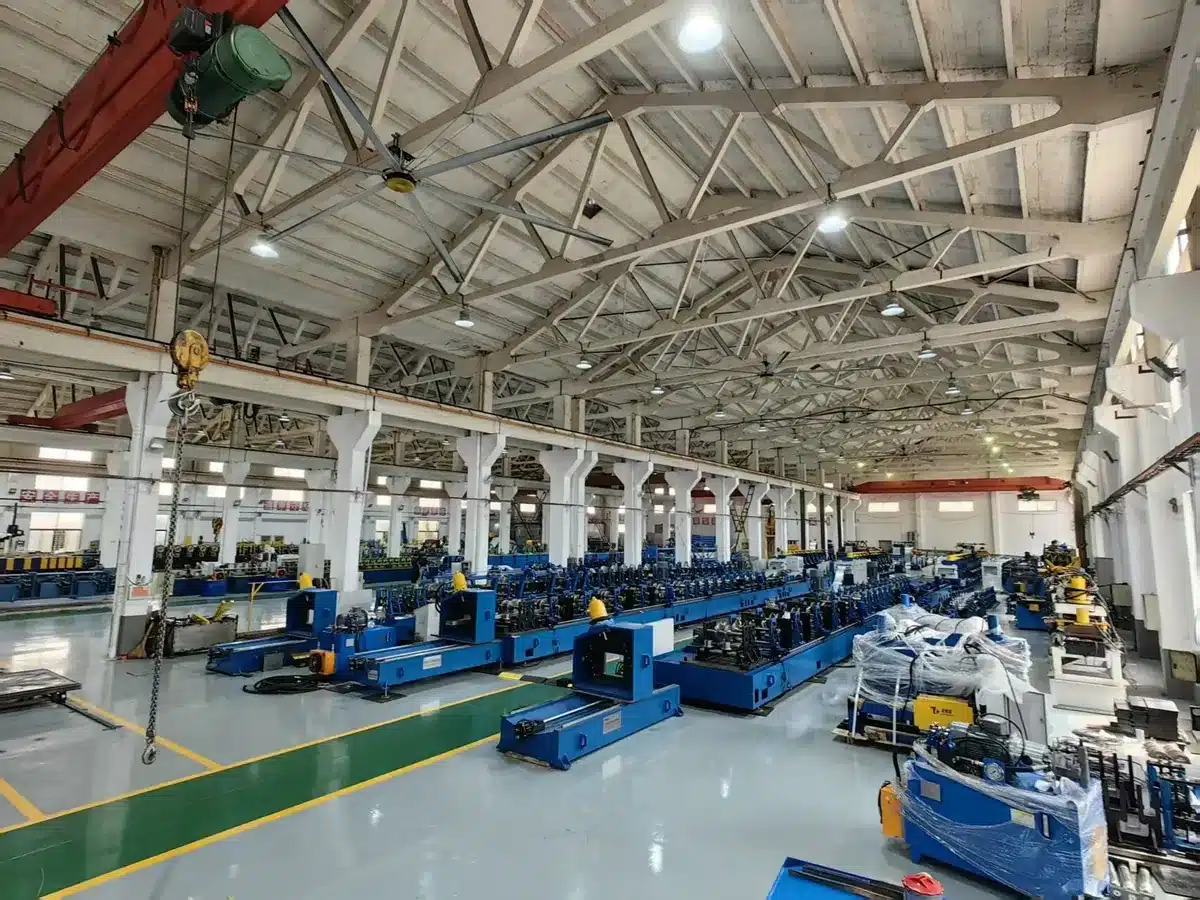
A roll forming bearing failure almost never announces itself. The roll keeps turning, the profile stays in tolerance, and the line runs until a bearing seizes and a forming stand goes down mid coil.
The cost is not the bearing. It is the scored shaft, the housing, the two lost days, and the scrap from the last hour of running that nobody noticed was drifting.
Five signals show up before that point. Each one is measurable with tools a plant already owns, and each one has a threshold.
Why Bearings Fail Before the Rolls Do
A 20 stand line carries 160 to 240 bearing positions. Every one of them takes the same radial load as the roll it supports, at a fraction of the roll’s visible wear. That is the asymmetry that makes roll forming bearing failure the first mechanical stop on most lines.
Rolls wear slowly and predictably, which is why roller wear patterns can be read and scheduled. Bearings fail in a curve: a long quiet period, then a rapid drop. Once a raceway starts to spall, the remaining life is measured in hours of running, not weeks.
The load itself is modest. A typical forming stand on 1.5 mm galvanized steel sees 3 to 8 kN per bearing. What kills these bearings is not load. It is temperature, contamination, and mounting error, and all three leave a record before they fail.
That record matters because the stop is expensive. One seized stand costs more in lost output than a year of operating cost per hour tracking, and the scrap goes unnoticed until the bundle is inspected.
Signal 1 and Signal 2: Heat and Sound
Heat is the earliest signal you can trust. Grease life halves for roughly every 15 °C above the reference temperature of the grease, so a bearing running 20 °C hotter than its neighbours is already consuming life at four times the rate.
Set the trigger at ambient plus 25 °C, or 70 °C absolute for lithium grease, whichever comes first. Measure at the housing with an infrared gun, or better, with a fixed thermocouple on the heaviest loaded stands.
A single hot bearing in a row of cool ones is a mounting or lubrication problem. A whole stand running hot points to over-tight roll gap, a blocked coolant line or a lubrication line that stopped delivering.
Sound tells you where in the bearing the damage sits. Use a vibration pen or an accelerometer in envelope mode, and read the characteristic frequencies rather than overall level. Outer race damage shows at BPFO, inner race at BPFI, and rolling element damage at roughly twice the cage frequency.
You do not need a full spectrum analyser. A handheld unit with an envelope or gE reading, taken monthly at the same point, catches the change. Anything above 4 gE or a 50 percent rise from the stand’s own baseline goes on the inspection list.
One more point on heat. A bearing that runs hot right after a rebuild is telling you about mounting. Run the first hour at reduced speed and log the temperature, because a misaligned housing will show 15 °C of excess in that window and never look abnormal again.
Signal 3 to 5: Grease, Play and Current
| Signal | What to measure | Trigger | First place to look |
|---|---|---|---|
| Heat | Housing temperature at a fixed point | Ambient + 25 °C, or 70 °C | Grease quantity, cooling, roll gap |
| Sound | Envelope acceleration, gE | 4 gE, or 50% above baseline | Raceway damage, lubrication starvation |
| Grease | Colour, texture, water content | Dark, gritty, milky, or leaking | Seal condition, relubrication interval |
| Axial play | Dial gauge, axial push | Above 0.10 mm, or a step change | Locknut, adapter sleeve, preload |
| Current | Drive amps at steady state | 8 to 12% above baseline | Preload, alignment, roll binding |
Grease condition is the cheapest test in the plant. Roll forming bearing failure rarely has one cause, and grease is where the other causes leave their trace. Take a sample from the relief port, not from the fitting. Dark, gritty grease means the additive package is spent. Milky grease means water is passing the seal, and no relubrication schedule recovers that.
Axial play shows up in the product before it shows up in the bearing. A bearing that has lost preload lets the roll walk, and the roll walk appears as thickness variation along the strip. If the cut off length starts wandering or one flange of the profile runs heavy, check axial play before you reset the roll gap clearance.
Drive current is the summary of everything else. Log amps at a steady state, same material, same speed. A rising trend on one stand means increased friction somewhere in that stand, and the bearing is one of three candidates. Rule out roll binding and guide friction first.

Match the Failure Mode to the Cause
The surface tells you what happened, and what happened tells you what to change.
| Failure mode | What the surface shows | Root cause | Fix |
|---|---|---|---|
| Fatigue spalling | Flaking on the loaded raceway zone | Load above rating, or life consumed | Larger bearing, or accept replacement interval |
| Fretting corrosion | Rust coloured bands on the bore or sleeve | Micro movement at the fit, loose locknut | Correct fit tolerance, retorque locknut |
| Contamination | Scoring, indentations, dull raceway | Seal failure, washdown ingress, dirty grease | Change seal type, review washdown practice |
| Lubrication starvation | Blue or discoloured steel, smeared rollers | Under-greasing, wrong grease, blocked line | Restore schedule, verify NLGI grade and base oil |
| Misalignment | Uneven wear across the raceway width | Housing out of square, shaft deflection | Shim the housing, check stand alignment |
Fretting catches most plants by surprise. It looks like rust, so it gets treated as a moisture problem, while the real cause is a bearing that was never seated on its sleeve.
Before you replace a bearing, check the roll it carries. A roll with a worn journal or a bent shaft will destroy a new bearing at the same rate as the old one, and the roller material grade tells you how much wear the journal can take before it needs grinding.
Do the L10 Math Before You Blame the Bearing
Basic rating life follows ISO 281, and the formula is short enough to run on a phone.
L10 = (C / P) to the power p, multiplied by one million revolutions. For ball bearings p is 3. For roller bearings p is 10/3.
Take a forming stand with a bearing rated at 25 kN dynamic load and a 5 kN actual load. The ratio is 5, and 5 cubed is 125, so the rating life is 125 million revolutions.
Convert that to hours. A 120 mm roll at 30 m/min runs at 79.6 rpm, so 125 million revolutions is about 26,000 running hours. On three shifts at 70 percent utilisation that is 17 months.
Now apply the corrections ISO 281 allows for. Grease at 90 °C instead of 70 °C roughly halves life, and water contamination can take another half. Two corrections turn 17 months into 4, which is why the same bearing lasts two years on one line and eight months on another.
Bearing selection data and mounting guidance from SKF follows the same logic. A supplier who quotes a bearing without asking for speed, load and temperature has not given you a life estimate.
An Inspection Schedule That Catches It Early
| Interval | Task | Tool | Record |
|---|---|---|---|
| Daily | Feel and listen at each stand during changeover | Hand, screwdriver to housing | Any change from yesterday |
| Weekly | Temperature scan of all stands | Infrared gun | Hot spot list |
| Monthly | Envelope vibration on loaded stands | Vibration pen | Trend per stand |
| Quarterly | Grease sample from 10% of bearings | Visual and water check | Colour and texture log |
| Annually | Axial play and locknut torque | Dial gauge, torque wrench | Play value per bearing |
Two rules make the schedule work. Read at the same point every time, and write the value down. The change matters, not the number.
For plants running multiple shifts, this sits naturally inside a wider maintenance plan for the hydraulic and drive systems that already tracks pressure and oil condition. Bearing data belongs in the same log, and the same log should be open during a factory acceptance inspection so that the baseline is recorded before the line ships.
FAQ
1. What temperature is too hot for a roll forming bearing? Above ambient plus 25 °C, or above 70 °C absolute for standard lithium grease, is the action point. Grease life halves for every 15 °C above the reference temperature, so a hot bearing is a short life bearing even before it fails.
2. How do I tell bearing noise from roll noise? Bearing damage changes with speed and repeats at the raceway frequencies. Roll noise follows the contact pattern and changes with material. If the sound survives a speed change without shifting pitch, suspect the bearing.
3. Is roll forming bearing failure always caused by overload? No. Load rarely causes it on forming stands. Mounting error, water ingress and under-lubrication explain most cases, and all three leave evidence on the surface.
4. How often should forming stand bearings be greased? Follow the bearing supplier’s interval, then shorten it if housing temperature is above 70 °C or washdown is present. Over-greasing is also a failure mode, so verify that the relief port is clear before adding volume.
5. Can I replace one bearing in a stand? Replace the pair on a shaft and inspect the housing bore while the shaft is out. A new bearing in a worn housing usually fails within weeks.
6. What does fretting corrosion look like? Rust coloured bands on the bore or adapter sleeve, with no damage to the raceway. It means the inner ring moved on the shaft, which is a fit or locknut problem, not a load problem.
7. Does roll gap affect bearing life? Yes. Closing the gap to correct an angle raises the separating force and the drive current. If current climbs after a gap adjustment, the bearing is carrying the correction.
8. When does roll forming bearing failure reach end of life? At the first spall, not at the first noise. Once flaking starts on a raceway, remaining life is measured in hours of running. Vibration trend and grease condition give you the window to plan the change.
9. What should a spare parts stock include? The bearings used on the most loaded stands, plus seals and adapter sleeves. A full spare parts inventory review once a year prevents a two day stop over a low cost item.
10. Does a hotter ambient reduce bearing life? It does, and it is often forgotten in tropical plants. A bearing running at 75 °C in a 35 °C plant has less margin than the same bearing at 60 °C in a 20 °C plant, even at identical load.
Conclusion
Roll forming bearing failure is a maintenance reading problem, not a mechanical mystery. Heat, sound, grease, play and current all move before the roll seizes, and each one is cheap to measure.
Set the five thresholds, read at fixed points, and write them down. The stand that fails next year is already telling you which one it is.
Beli Rollforming builds roll forming machines for prepainted, galvanized and high strength steel, with bearing selection matched to line speed and duty cycle. Since 2005 and across 50+ countries, the lines that last are the ones where the maintenance log started on day one.
Last updated: 2026-11-04
Article Changelog
- 2026-11-04: First publication. Five warning signals with thresholds, five failure modes with surface signatures, L10 worked example with temperature and contamination corrections, five interval inspection schedule.
Next Review Triggers
- ISO 281 revision that changes the life modification factors
- A bearing supplier changes its grease temperature reference
- New field data on fretting traced to adapter sleeve fits

 English