









A roll forming machine RFQ is the first step in every machine purchase. The quality of your request decides the quality of your quotes. A vague RFQ returns vague prices. A precise one returns numbers you can compare and defend.
This guide explains the 6 technical specifications that get accurate quotes from roll forming machine manufacturers. Put all six in your next roll forming machine RFQ and you will cut quote variance, shorten lead times, and avoid surprise costs.
What Is a Roll Forming Machine RFQ and Why It Matters
A request for quotation (RFQ) is a formal document a buyer sends to suppliers to ask for a firm price on specified equipment. A roll forming machine RFQ is that document written for a roll forming production line.
Roll forming is a continuous bending process that shapes metal coil into a profile through a series of roller stations. Every station adds one bend. The final shape only forms when every input is defined.
Suppliers price what you describe. Describe a profile name and they price their best guess. Describe drawings, grades, and output targets and they price the real machine. Incomplete RFQs often return quotes that differ by 15 to 25 percent for the same profile. That spread is not room to negotiate. It is uncertainty, and the buyer absorbs it.
A complete RFQ also shortens the quoting cycle. A good supplier answers a detailed roll forming machine RFQ in 3 to 5 working days. A vague one needs follow-up calls, site assumptions, and rework. Some buyers wait two weeks and still receive a guarded number.
Spec 1: Profile Drawing and Dimensional Tolerances
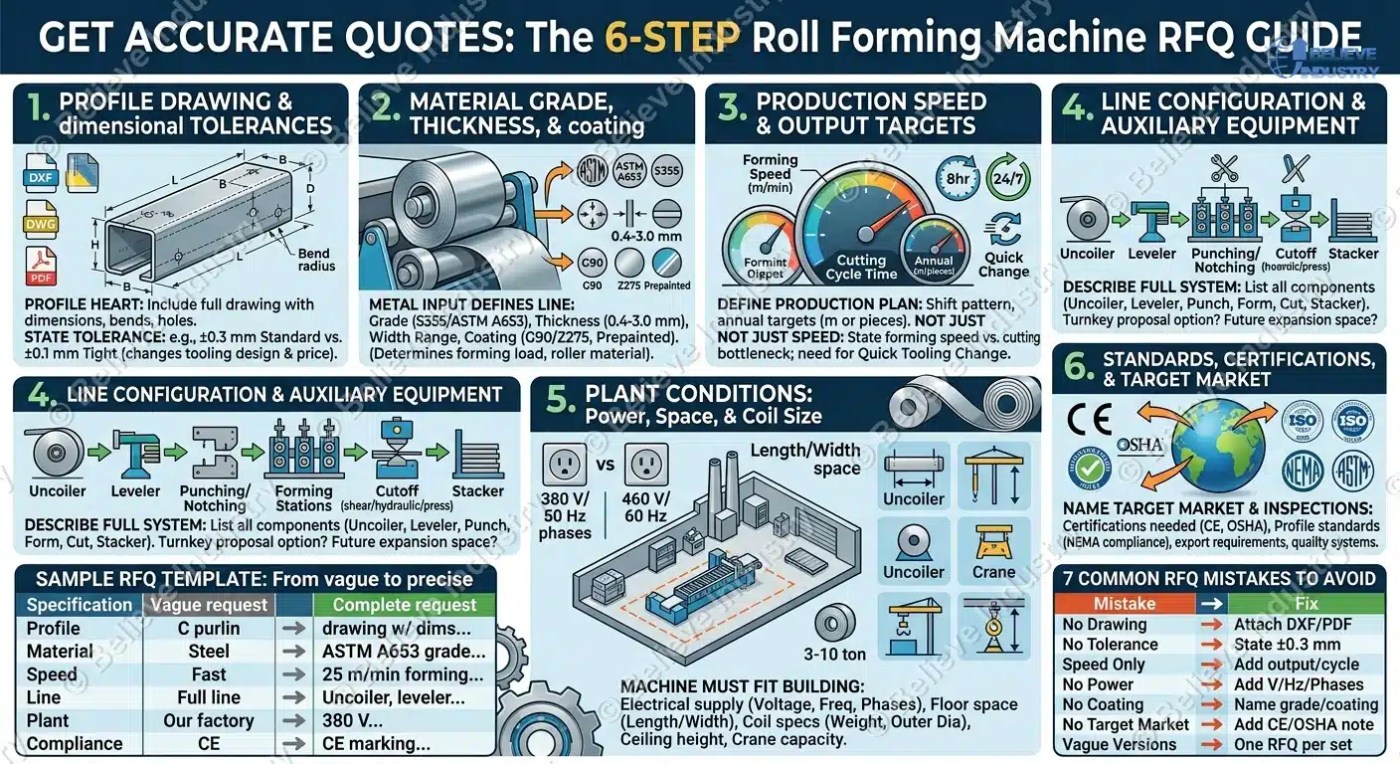
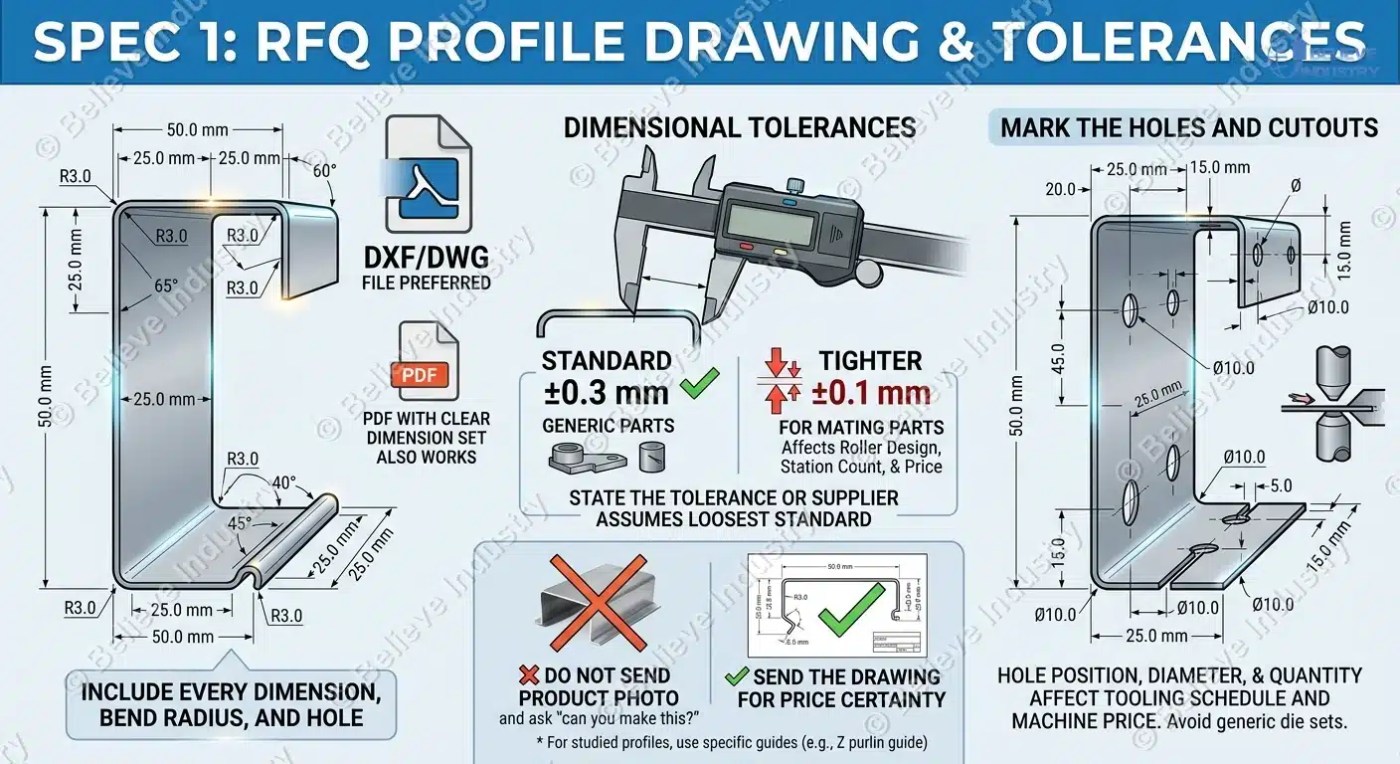
The profile is the heart of any roll forming machine RFQ. Include a drawing that shows every dimension, bend radius, and hole. A DXF or DWG file is best. A PDF with a clear dimension set also works.
State the tolerance you need. Standard roll forming holds ±0.3 mm on most dimensions. Some buyers need ±0.1 mm for mating parts. Tighter tolerances change roller design, station count, and price. Say it in the RFQ or the supplier assumes the loosest standard.
Mark the holes and cutouts. Punching happens inline on most lines. Hole position, diameter, and quantity affect the tooling schedule and the machine price. A roll forming machine RFQ that skips hole details forces the supplier to price a generic die set.
Do not send a product photo and ask, “can you make this?” Suppliers can guess, but they price the guess high. Send the drawing and let them price certainty. For profile families you already studied, pair your RFQ with a profile-specific guide such as the Z purlin roll forming machine buying guide.
Spec 2: Material Grade, Thickness, and Coating
Metal input defines the forming load, the roller material, and the final product. Give the supplier the full material spec in your roll forming machine RFQ.
Start with the grade. ASTM A653 covers galvanized steel sheet, and structural grades like S355 are common in construction profiles. Name the standard and the grade. The American Iron and Steel Institute publishes the design data suppliers use to calculate springback and roller gaps.
Add thickness and width. Most roll forming lines handle 0.4 to 3.0 mm material. Coil width depends on the developed width of your profile. Give the strip width range, not just the finished profile width.
State the coating and finish. Zinc coating weight, such as G90 or Z275, changes bending behavior slightly. Prepainted material needs different roller care. Call it out in the request for quotation.
Material grade also drives the material cost line in the quote. Roll formers that buy coil in volume pass on real prices. An accurate material spec in your roll forming machine RFQ gets a price you can compare across suppliers.
Strip shape matters too. Coil with edge waves or crossbow causes defects. Mention incoming coil quality, and ask whether a roll forming machine leveler is included in the line.

Spec 3: Production Speed and Output Targets
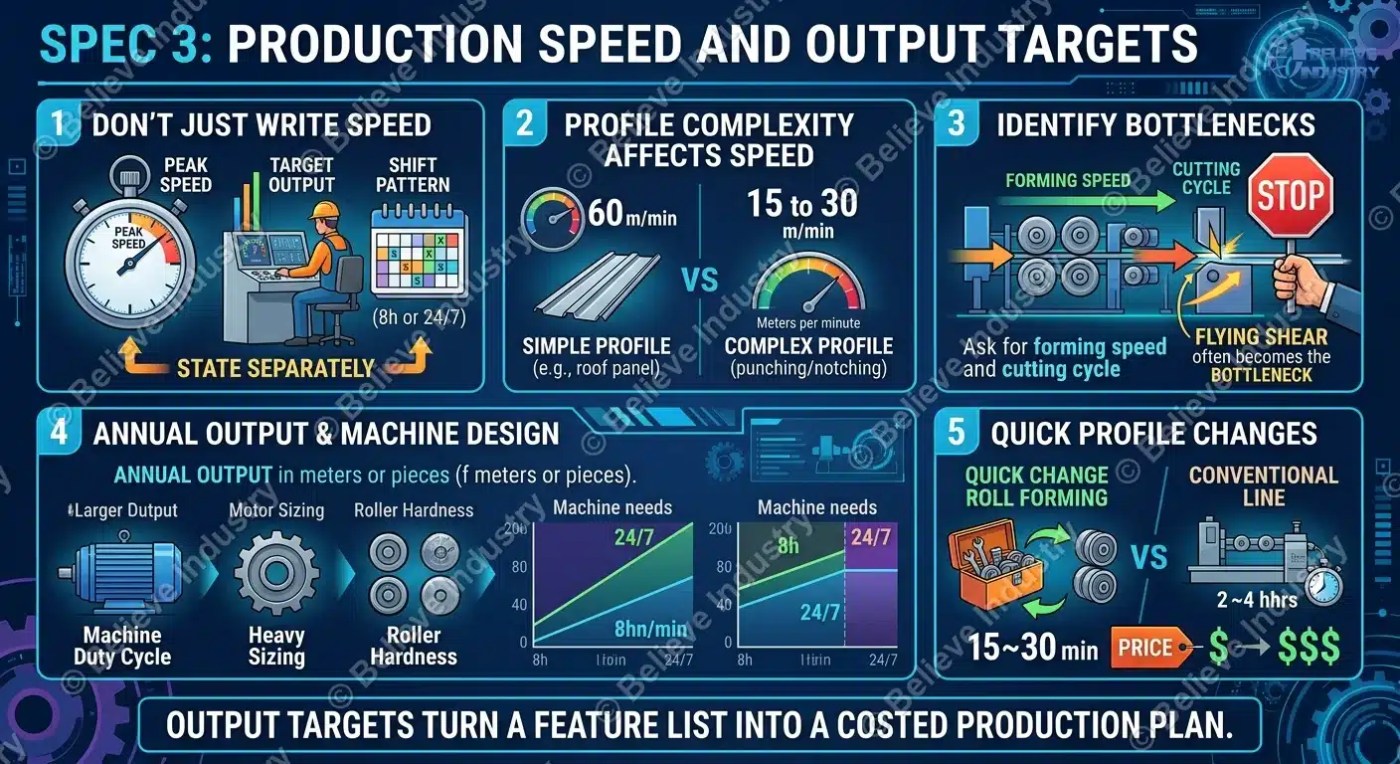
Speed is a number buyers love to write, but speed alone does not define a machine. State the target output, the shift pattern, and the peak speed separately.
Peak line speed on modern roll forming machines reaches 60 m/min for simple profiles. Complex profiles with punching and notching run 15 to 30 m/min. Ask for the forming speed and the cutting cycle, because the flying shear often becomes the bottleneck.
State your annual output in meters or pieces. A supplier converts that into a machine duty cycle, motor sizing, and roller hardness. Two buyers can both ask for 30 m/min and receive different machines, because one runs 8 hour shifts and the other runs 24/7.
If you need quick profile changes, say so. A quick change roll forming machine swaps tooling in 15 to 30 minutes. A conventional line takes 2 to 4 hours. That difference changes the quote by a meaningful margin. For a deeper look at changeover planning, read the 6 step quick swap guide.
Output targets belong in every roll forming machine RFQ. They turn a feature list into a production plan the supplier can cost.
Spec 4: Line Configuration and Auxiliary Equipment
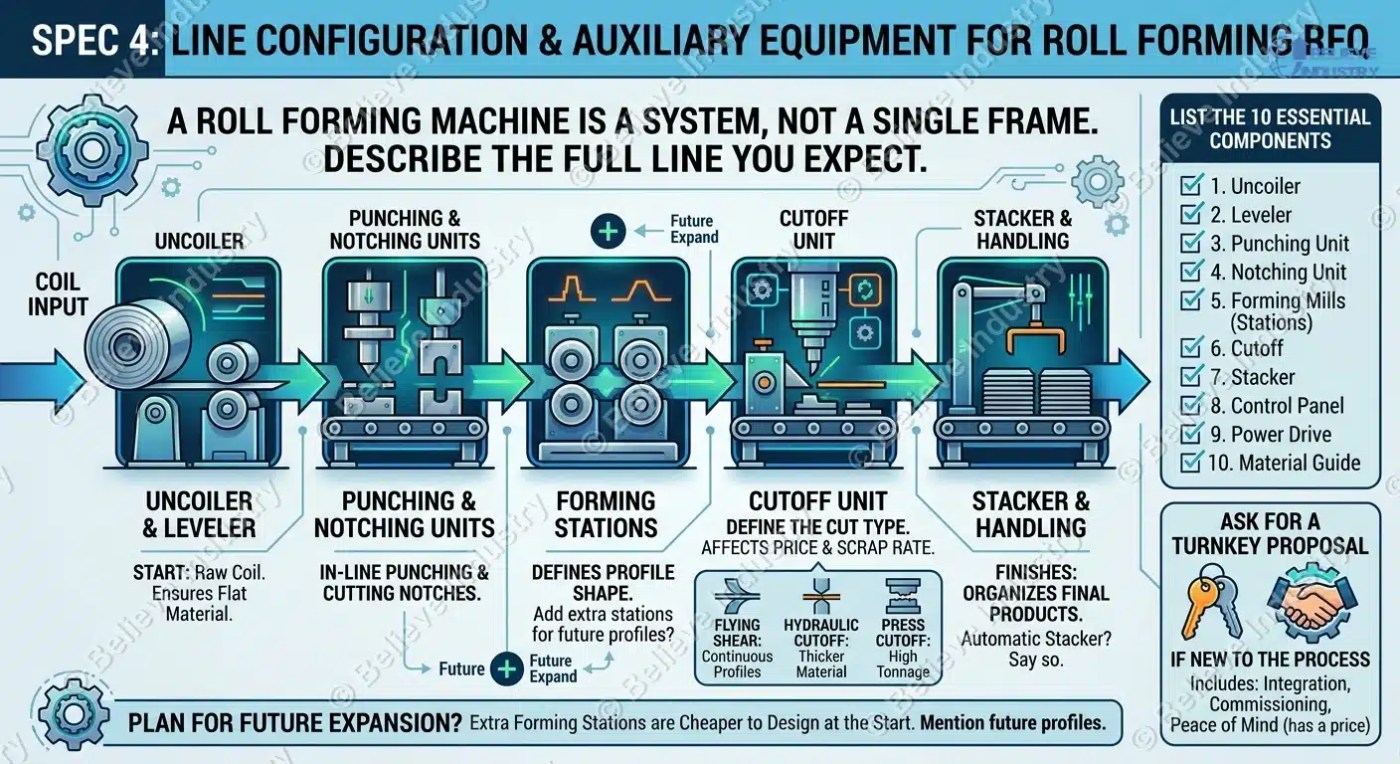
A roll forming machine is a system, not a single frame. Your RFQ should describe the full line you expect, from coil to stacked profile.
List the stations: uncoiler, leveler, punching and notching units, forming stations, cutoff, and stacker. If you want an automatic stacker, say so. The 10 essential roll forming machine components list shows what a complete line includes.
Ask for a turnkey proposal if you are new to the process. Turnkey suppliers take responsibility for integration and commissioning. That peace of mind has a price, and it belongs in the RFQ.
Define the cut type. Flying shear suits continuous profiles, hydraulic cutoff handles thicker material, and press cutoff covers high tonnage. Each affects price and scrap rate.
State if you plan to expand later. Extra forming stations are cheaper to design in at the start. Mention future profiles in your roll forming machine RFQ even if you only buy one tooling set now.
Spec 5: Plant Conditions: Power, Space, and Coil Size
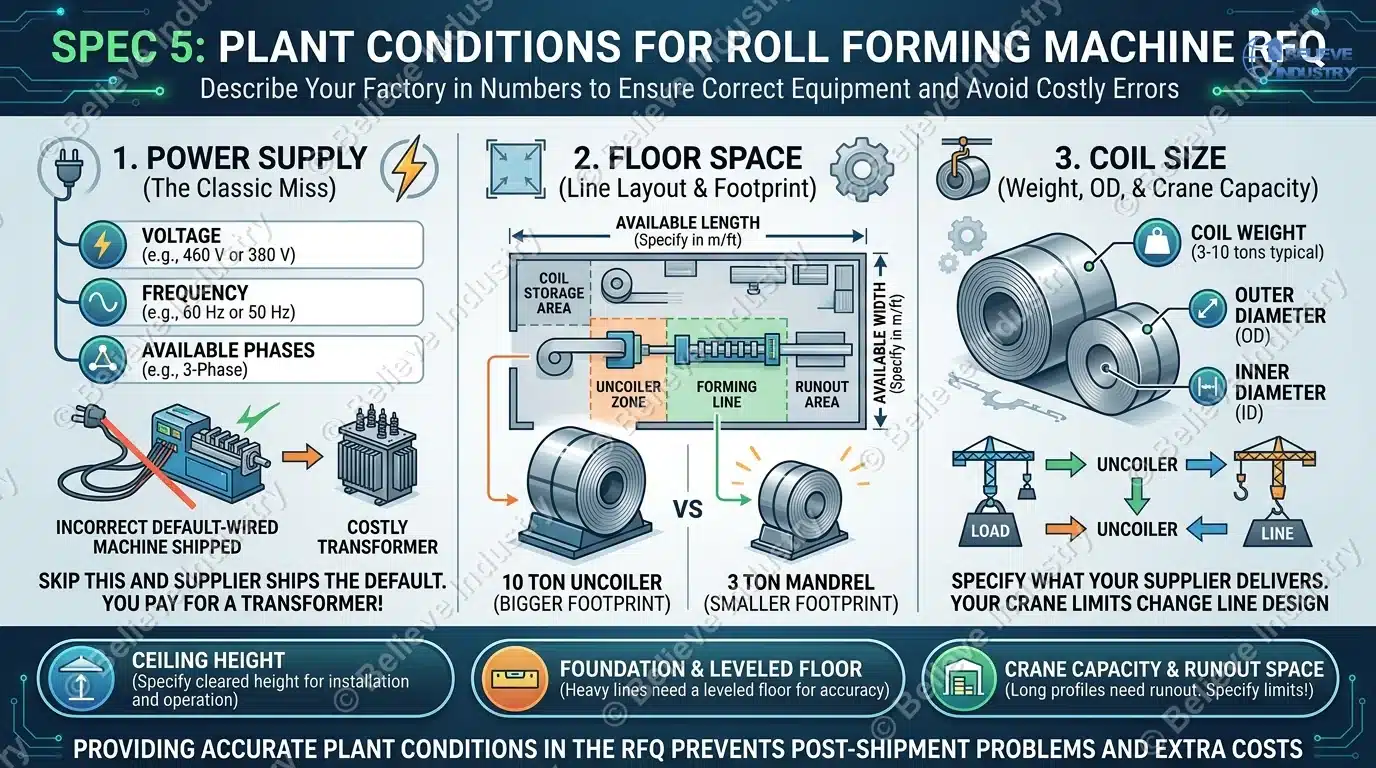
The machine must run in your factory. Your roll forming machine RFQ should describe that factory in numbers.
Power supply is the classic miss. Machines leave the factory wired for 380 V / 50 Hz or 460 V / 60 Hz. Skip this line and the supplier ships the default while you pay for a transformer. Give voltage, frequency, and available phases.
Floor space matters for line layout. State the available length and width, including the coil storage area. An uncoiler rated for a 10 ton coil needs a bigger footprint than a 3 ton mandrel.
Coil weight and outer diameter limit the uncoiler choice. Say what your supplier delivers. Coils of 3 to 10 tons are typical. If your crane handles only small coils, the line design changes.
Note ceiling height, foundation, and crane capacity. Long profiles need runout space. Heavy lines need a leveled floor. These details prevent a quote that fits the machine but not the building.
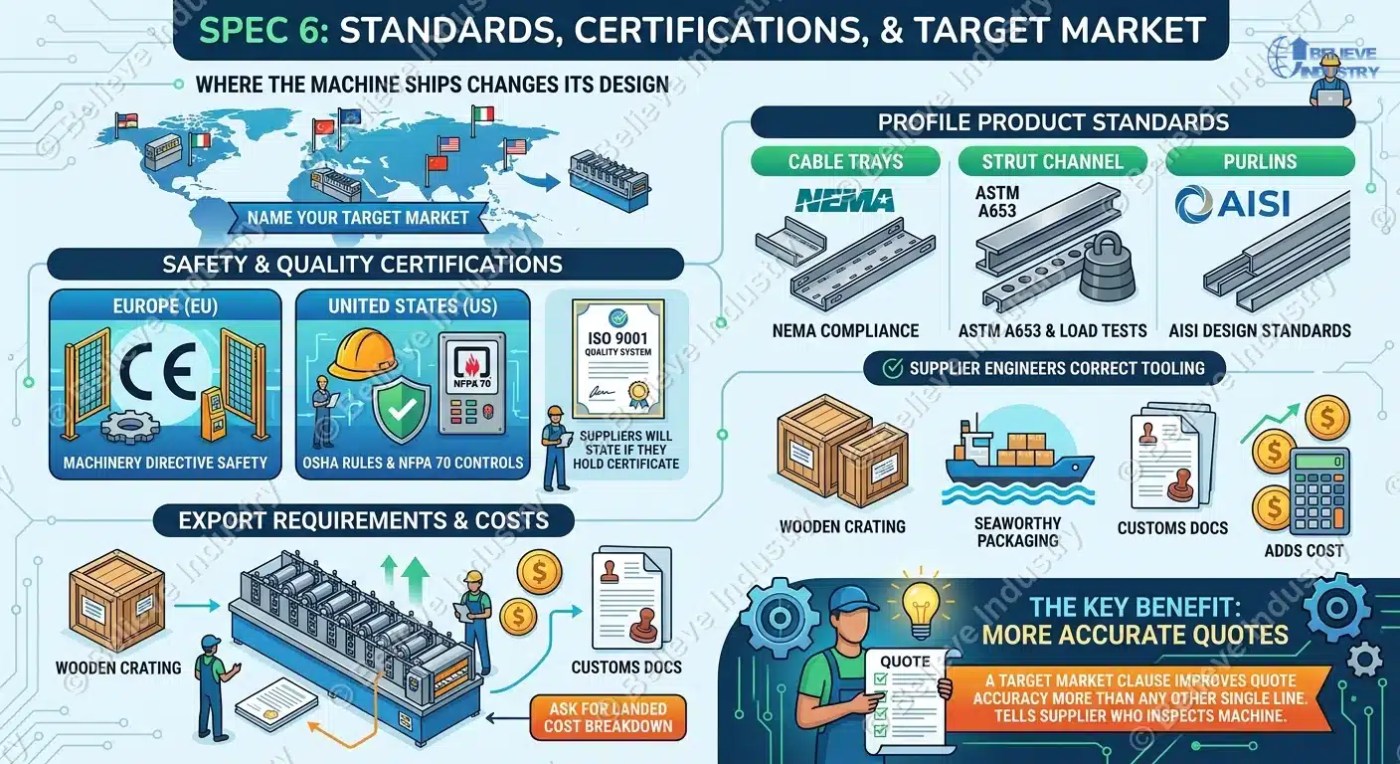
Spec 6: Standards, Certifications, and Target Market
Where the machine ships changes the machine itself. Name your target market in the RFQ.
European buyers expect CE marking and safety per the Machinery Directive. US buyers look at Occupational Safety and Health Administration (OSHA) rules and NFPA 70 for controls. If your end users require an ISO 9001 quality system, name it. Suppliers that hold the certificate will say so, and the rest will bid accordingly.
Standards for the profile matter too. Cable trays may need NEMA compliance. Strut channel profiles often follow ASTM A653 and specific load tests. Purlins follow AISI design standards. Name the standard in the request for quotation and the supplier engineers the correct tooling.
Export requirements belong here as well. Wooden crating, seaworthy packaging, and customs documentation add cost. Ask for a landed cost breakdown if you need one.
A target market clause in your roll forming machine RFQ tells the supplier who will inspect the machine. That focus improves quote accuracy more than any other single line.
Sample Roll Forming Machine RFQ Template
Use this checklist to build your next roll forming machine RFQ. Fill every row and suppliers can price the same machine.
| Specification | Vague request | Complete request | Why it matters |
|---|---|---|---|
| Profile | C purlin machine | Drawing with dimensions, bends, holes, ±0.3 mm tolerance | Prices the real tooling |
| Material | Steel | ASTM A653 grade, 1.5 mm, 200 mm strip, G90 coating | Correct rollers and material cost |
| Speed | Fast | 25 m/min forming, 12 m/min with punching, 40,000 m/month | Correct motor and duty cycle |
| Line | Full line | Uncoiler, leveler, punch, form, cut, stacker, turnkey | Complete system price |
| Plant | Our factory | 380 V / 50 Hz, 25 m length, 5 t coils, 4 m ceiling | Machine fits the building |
| Compliance | CE | CE marking, ISO 9001 supplier, ASTM A653 profile | Correct certification scope |
7 Common Roll Forming Machine RFQ Mistakes
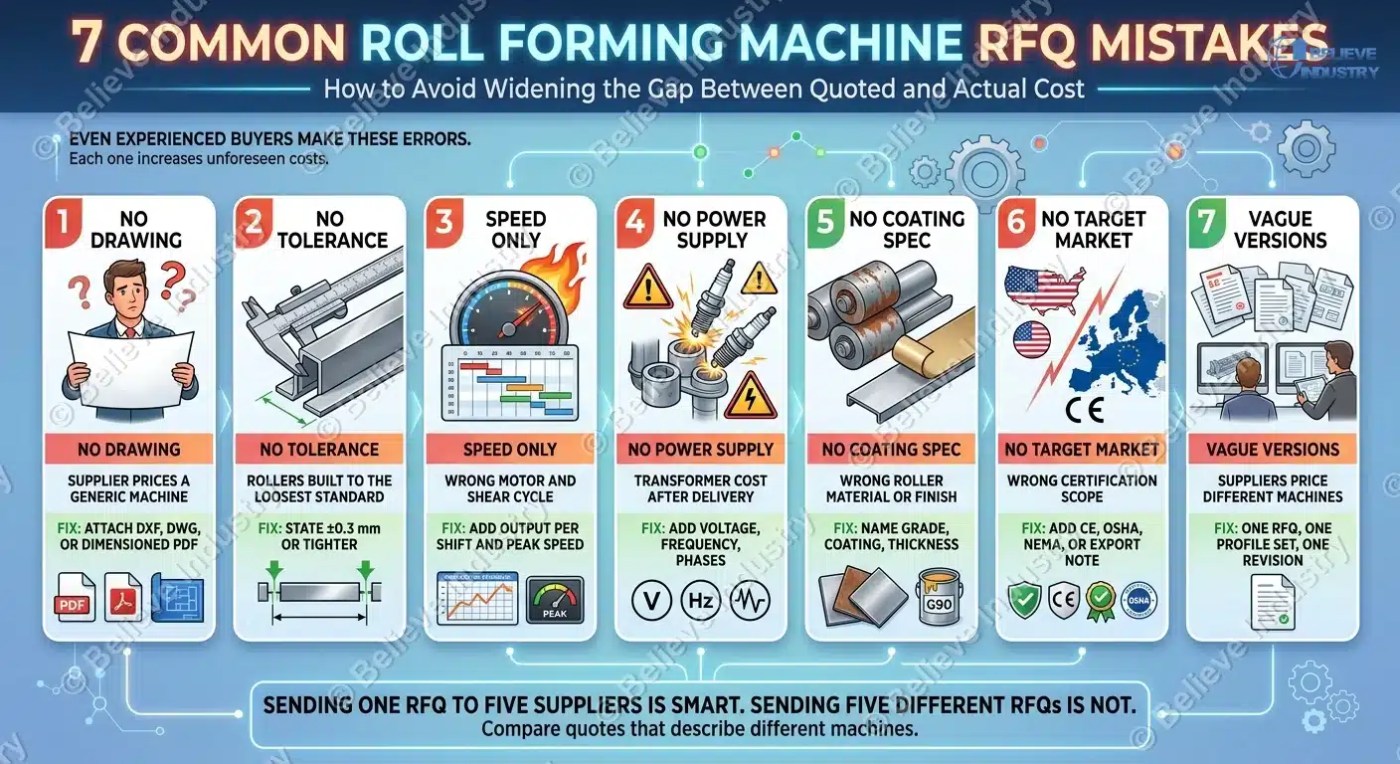
Even experienced buyers make these roll forming machine RFQ errors. Each one widens the gap between quoted and actual cost.
| Mistake | What happens | Fix |
|---|---|---|
| No drawing | Supplier prices a generic machine | Attach DXF, DWG, or dimensioned PDF |
| No tolerance | Rollers built to the loosest standard | State ±0.3 mm or tighter |
| Speed only | Wrong motor and shear cycle | Add output per shift and peak speed |
| No power supply | Transformer cost after delivery | Add voltage, frequency, phases |
| No coating spec | Wrong roller material or finish | Name grade, coating, thickness |
| No target market | Wrong certification scope | Add CE, OSHA, NEMA, or export note |
| Vague versions | Suppliers price different machines | One RFQ, one profile set, one revision |
Sending one RFQ to five suppliers is smart. Sending five different RFQs is not. You cannot compare quotes that describe different machines.