










What Is a Custom Roll Forming Machine?
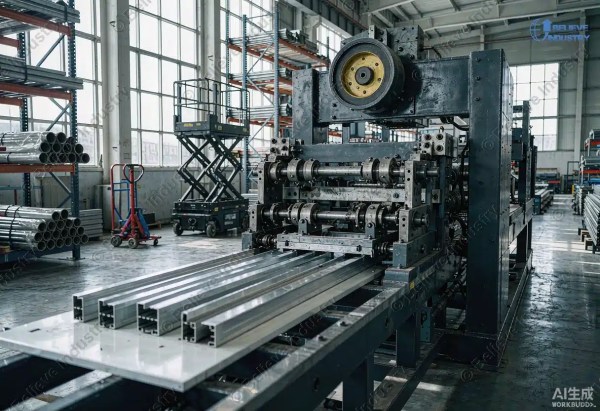
A custom roll forming machine is a metal forming system engineered to produce a specific cross-sectional profile by progressively bending a continuous metal strip through a series of precision-tooled roller stations. Unlike standard off-the-shelf roll formers, a custom machine is designed from the ground up to match a client’s exact profile geometry, material specifications (thickness, tensile strength, coating type), and production speed requirements.
Custom roll forming machines are widely used in:
- Construction: roofing panels (PBR, Orb, trapezoidal), purlins, decking
- Infrastructure: cable trays, ladder trays, conduit
- Energy: solar mounting struts, racking frames
- Automotive: structural tracks, seat rails, door reinforcements
- Logistics: racking uprights, shelf beams
The term “customized roll forming machine” refers to the same category of bespoke equipment; both terms are used interchangeably in global procurement.
Key Facts at a Glance
- The global roll forming machine market is projected to grow from USD 3.2 billion in 2023 to USD 4.8 billion by 2030, at a CAGR of approximately 5.9% (MarketsandMarkets, 2024).
- A custom roll forming machine can reduce material waste by up to 20% compared to traditional stamping methods.
- Profile changeover time has dropped from 2–4 hours on manual machines to under 15 minutes on smart PLC-controlled custom lines.
- Asia-Pacific accounts for over 48% of global roll forming machine demand, with China leading production.
- Beli RollForming has manufactured and exported roll forming systems to 40+ countries since 2005.
Why the Global Market is Shifting to Custom Solutions
1. Infrastructure Surge in Emerging Markets
Government infrastructure programs across Southeast Asia, the Middle East, and Sub-Saharan Africa are generating sustained demand for customized steel profiles. Projects specify profiles that differ by millimeter tolerances — standard machines simply cannot meet these tolerances.
2. Total Cost of Ownership Advantage
A custom roll forming machine optimized for a single product line typically achieves 15–25% lower per-unit material waste and runs at speeds of 20–60 meters per minute, compared to 8–15 m/min for conventional press-brake alternatives. Over a 10-year production lifecycle, this efficiency gap translates to significant ROI.
3. Smart Factory Integration
Modern custom machines now ship with IoT-enabled PLCs that log production data, predict bearing failures 72–96 hours in advance, and allow remote diagnostics. This predictive maintenance capability reduces unplanned downtime by up to 30%, according to equipment operators surveyed by Beli RollForming in 2024.
Data Note: Efficiency figures are based on comparative field data from Beli RollForming client installations (2022–2025). Individual results vary by material grade and profile complexity.
Key Innovations Driving the 2025–2026 Market
1. Smart PLC with Servo-Driven Profile Change
Modern custom roll forming machines integrate servo-driven adjustment systems controlled by a touchscreen HMI. Operators can switch between pre-programmed profiles in 8–12 minutes — a process that previously required 2–4 hours of manual roller replacement. This capability is essential for manufacturers serving multiple construction product SKUs from a single production line.
Key specification benchmark: Look for machines with Siemens S7 or Delta DVP series PLCs, which offer the widest compatibility with third-party automation systems.
2. High-Strength Steel Capability (UHSS Processing)
The construction and automotive industries are increasingly specifying Ultra-High-Strength Steel (UHSS) grades with yield strengths of 550–960 MPa. Standard roll formers cannot process these materials without causing cracking. Custom roll forming machines engineered for UHSS use hardened roller stations (HRC 58–62), increased shaft diameters (typically 70–90 mm), and precision pre-stressed frames to maintain tolerance under high-force conditions.
3. Inline Punching and Notching Integration
Integrated inline punching units eliminate secondary operations. A custom machine producing cable trays, for example, can punch ventilation slots and mount holes at production speed (up to 25 m/min) rather than requiring a separate press station. This reduces floor space requirements by 30–40% for integrated production cells.
High-Demand Custom Roll Forming Machines in 2025–2026
Comparison: Top 4 Machine Types by Application
| Machine Type | Primary Application | Typical Speed | Key Custom Feature | Market Driver |
|---|---|---|---|---|
| Cable Tray Roll Forming Machine | Data centers, industrial facilities | 15–25 m/min | Adjustable-width forming (100–900mm) with inline punch | Global data center construction boom |
| PBR Panel Roll Forming Machine | Industrial & commercial roofing | 20–45 m/min | Purlin bearing leg formation without sheet distortion | North American metal building market |
| Custom Orb Roll Forming Machine | Residential & commercial roofing | 25–50 m/min | Sinusoidal profile with ±0.1mm pitch accuracy | Australia, NZ, Africa markets |
| Double Layer Roll Forming Machine | Multi-profile manufacturers | 15–35 m/min | Two profile sets on single frame; shared drive system | SME market cost optimization |
The Cable Tray Roll Forming Machine
Infrastructure projects — from data centers to manufacturing facilities — require extensive cable management systems. The cable tray roll forming machine has become an essential production tool for tier-1 electrical contractors globally.
Key specifications to evaluate:
- Width adjustment range: 100 mm to 900 mm (single setup)
- Punching speed: minimum 20 strokes/min synchronized with forming speed
- Material compatibility: galvanized steel (DX51D), stainless steel (304/316), aluminum alloy
- Tray types: ladder tray, perforated tray, solid-bottom tray — from one machine
A cable tray machine producing 15 m/min can output approximately 900 meters of tray per shift, serving the output requirements of a mid-size electrical contractor.
The PBR Panel Roll Forming Machine
PBR (Purlin Bearing Rib) panels are the dominant roofing product in North American industrial and commercial construction. The PBR panel roll forming machine must accurately form the distinctive purlin-bearing leg — a structural protrusion that provides bearing support at roof purlins — without distorting the main panel web.
What makes PBR custom vs. standard:
- The bearing leg requires a dedicated roller station sequence that standard R-panel machines do not include
- Panel flatness tolerance: ±1.5 mm over 3 meters (ASTM A924 compliance)
- Typical material: Galvalume® ASTM A792, Grade 50, 0.40–0.70 mm thickness
Beli RollForming PBR machines have been deployed in the United States, Canada, and Mexico by steel building manufacturers producing 5,000–15,000 m² of panels per shift.
The Custom Orb (Corrugated) Roll Forming Machine
The corrugated (“Orb”) profile remains the world’s most-produced roofing sheet by volume. The custom orb roll forming machine is engineered to produce the sinusoidal wave profile with precise pitch and depth control.
Why “custom” matters for Orb profiles:
- Regional standards vary: Australian Orb profile pitch is 76.2 mm; African and South Asian markets use 63.5 mm and 83 mm pitch variants
- Sheet coverage width must be maintained to ±0.5 mm to ensure lap sealing
- High-volume Orb lines run at 40–60 m/min, requiring hardened chrome roller stations
The Double Layer Roll Forming Machine
For manufacturers seeking to produce two different profiles without purchasing two complete machines, the double layer roll forming machine mounts two independent forming trains on a single heavy-duty base frame.
Economics of double layer:
- Capital cost: approximately 60–70% of two separate machines
- Changeover: hydraulic lift switches between layers in 3–5 minutes
- Limitation: only one profile can run at a time; capacity is not doubled
- Best suited for: factories producing two roofing profiles with similar daily volumes
This machine type is the most cost-effective entry point for manufacturers entering new geographic markets with uncertain demand patterns.
Strategic Investment Checklist: What to Evaluate Before Buying
Purchasing a custom roll forming machine is a capital expenditure decision typically ranging from USD 40,000 to USD 500,000+ depending on complexity, output speed, and automation level. Use this checklist:
Profile Engineering
- Has the vendor performed CAD simulation of your specific profile?
- Are roller materials and hardness (HRC value) specified in the contract?
- Is dimensional tolerance (±mm) guaranteed and tested before shipment?
Production Requirements
- What is your target output in meters/shift? (Confirms minimum forming speed)
- What material grades do you process? (Determines roller hardness, shaft size)
- Do you require inline punching, notching, or cut-to-length?
Compliance & Standards
- Does the machine comply with CE marking (Europe) or ANSI/ASTM standards (North America)?
- Are electrical components UL-listed or CE-certified for your market?
After-Sales Support
- What is the spare parts lead time from the manufacturer?
- Is remote PLC diagnostic support included?
- What is the warranty period for roller stations specifically?
For a complete step-by-step purchasing framework, see: How to Buy a Roll Forming Machine: Complete Buyer’s Guide 2026
Maintaining Your Competitive Edge: Machine Maintenance Guide
A custom roll forming machine running at 30 m/min generates approximately 1.5 million roller contact cycles per 8-hour shift. Without systematic maintenance, roller wear causes profile drift, increasing scrap rates and customer complaints.
Critical maintenance intervals:
| Component | Check Frequency | Action |
|---|---|---|
| Roller station alignment | Weekly | Laser alignment check; adjust if deviation > 0.1 mm |
| Gearbox oil level | Monthly | Top up with ISO VG 220 gear oil |
| Bearing temperature | Daily | Investigate if > 70°C during operation |
| Hydraulic fluid (cut-off) | Every 500 hours | Replace if contaminated; check pressure (typically 12–16 MPa) |
| Roller chrome coating | Every 6 months | Inspect for pitting; replate if chrome < 0.02 mm |
| PLC backup | Monthly | Export parameter backup to USB; store off-machine |
For detailed maintenance protocols, refer to: Roll Forming Machine Maintenance: Complete Guide
The year 2025 marks a turning point. The manufacturers who succeed will be those who adopt flexible, high-efficiency technologies. A custom roll forming machine offers the agility to adapt to market trends—whether that’s a sudden spike in demand for PBR panels or a new requirement for specific cable trays.
At Beli RollForming, we are dedicated to helping you navigate this landscape. We don’t just sell machines; we build partnerships to ensure your production line is a success story.
Custom Roll Forming Machine vs. Standard Roll Former: Key Differences
| Comparison Factor | Standard Roll Former | Custom Roll Forming Machine |
|---|---|---|
| Profile flexibility | 1–3 fixed profiles | Unlimited profiles per design |
| Material grade | Up to 350 MPa | Up to 960 MPa (UHSS capable) |
| Tolerance | ±2–3 mm | ±0.5–1.0 mm |
| Forming speed | 8–20 m/min | 15–60 m/min |
| PLC integration | Basic on/off | Full servo + IoT |
| Tooling | Generic / shared | Precision-ground for profile |
| Scrap rate | 3–8% | 0.5–2% |
| Lead time | In-stock (weeks) | 60–120 days (custom build) |
| Price range (USD) | 15,000–15,000–80,000 | 40,000–40,000–500,000+ |
| Best for | Standard commodity profiles | Proprietary / high-spec profiles |
Frequently Asked Questions
A custom roll forming machine is a metal forming system built to produce a specific cross-sectional profile by bending a continuous metal coil through sequentially arranged roller stations. Unlike standard machines, it is engineered to a client’s exact profile geometry, material specification, and output speed requirement. Common applications include roofing panels, cable trays, solar strut channels, and automotive structural components.
Custom roll forming machine prices typically range from USD 40,000 to USD 500,000+, depending on the number of roller stations, forming speed, PLC automation level, and any integrated downstream equipment (punching, cutting, stacking). Simple single-profile lines for light-gauge steel may start around USD 40,000–80,000, while high-speed, multi-profile lines for UHSS materials can exceed USD 300,000.
Lead time for a custom roll forming machine is typically 60 to 120 days from order confirmation, including profile engineering, roller machining, assembly, and factory acceptance testing. Complex machines with integrated automation or UHSS capability may require 120–150 days.
A PBR (Purlin Bearing Rib) panel roll forming machine includes an additional roller station sequence that forms the purlin-bearing leg — a structural protrusion absent on standard R-panels. This leg provides load-bearing support at roof purlins and is required by North American steel building standards. A standard R-panel machine cannot produce compliant PBR panels without significant retooling.
Custom roll forming machines can process a wide range of materials including:
- Carbon steel (Grade 33–80, up to 960 MPa for UHSS-capable machines)
- Galvanized steel (DX51D, G90, AZ150 Galvalume®)
- Stainless steel (304, 316, 430)
- Aluminum alloy (3003, 5052, 6061)
- Pre-painted PPGI/PPGL coil (with urethane roller coating to prevent surface damage)
Material thickness capability typically ranges from 0.3 mm to 6.0 mm, depending on machine frame size and roller station design.
A double layer roll forming machine is a single-frame machine that incorporates two complete sets of forming rollers — one on the upper deck and one on the lower deck. The operator switches between the two profile sets using a hydraulic lift mechanism (changeover time: 3–5 minutes). The key benefit is capital efficiency: manufacturers get two profile capabilities at approximately 60–70% of the cost of two separate machines, sharing the same drive motor, electrical cabinet, and base frame.
A cable tray roll forming machine processes flat metal coil through a series of roller stations that progressively bend the strip into the sidewall and base geometry of a cable tray. Most machines include an inline servo-punch unit that creates the slot patterns (for ventilation or weight reduction) synchronized with the forming speed. Finished trays are cut to length by a flying cut-off or hydraulic shear. Width-adjustable machines can produce trays ranging from 100 mm to 900 mm wide from a single setup.
Yes. There are two approaches:
- Quick-change tooling systems allow operators to replace roller cassettes and switch profiles in 15–30 minutes on a single-frame machine;
- Double layer machines hold two permanent profile setups and switch between them in 3–5 minutes via hydraulic deck lift. For manufacturers requiring 3+ permanent profiles, a servo-adjustable roll former with position-memory profiles is recommended.
Key maintenance tasks include: weekly roller alignment checks (laser alignment; tolerance ±0.1 mm), monthly gearbox oil level inspection, daily bearing temperature monitoring (max. operating temperature 70°C), hydraulic fluid replacement every 500 operating hours, and roller chrome-coating inspection every 6 months. A machine running one 8-hour shift per day typically requires a full roller station overhaul every 3–5 years, depending on material abrasiveness.
Yes. Beli RollForming machines carry CE marking for sale into European markets, compliant with the EU Machinery Directive 2006/42/EC. Machines can also be supplied with ANSI/OSHA-compatible guarding configurations for North American deployment. All electrical components on CE-marked machines are sourced from EU-recognized suppliers (Siemens, Schneider Electric, or equivalent).
Conclusion: The Future of Metal Forming Is Custom
The 2025–2026 global market data is unambiguous: manufacturers who adopt custom roll forming machines are outperforming those relying on standard equipment across every measurable metric — waste reduction, production speed, product precision, and market responsiveness.
The four machine categories driving the current cycle — cable tray lines, PBR panel machines, custom Orb formers, and double-layer systems — each serve distinct and rapidly growing market segments. Whether you are entering a new geography, scaling an existing product line, or diversifying your profile catalog, a purpose-built custom machine delivers measurably better economics than retrofitting standard equipment.
At Beli RollForming, we have engineered and shipped custom roll forming systems to clients in 40+ countries over 20 years. Our process starts with your profile drawing and ends with a factory-tested, CE-certified machine ready for production.
Contact us: enquiry@belirollforming.com | WhatsApp: +86 186 1692 7760
Key Takeaways
- Custom beats standard on waste, speed, and precision — with data to prove it
- Material waste reduction: up to 20% vs. stamping; scrap rate as low as 0.5%
- Profile changeover: from 2–4 hours (manual) to 8–15 minutes (smart PLC)
- 4 high-demand machine types in 2026: Cable Tray, PBR Panel, Custom Orb, Double Layer
- Capital cost range: USD 40,000–500,000+ depending on complexity and automation
- Beli RollForming: 20+ years, 40+ countries, CE-certified, IoT-ready
Content Update Schedule
| Review Date | Scope | Status |
|---|---|---|
| November 2025 | Initial publication — 2025 market analysis | ✅ Published |
| February 2026 | IoT/PLC automation features update | ✅ Completed |
| April 2026 | Price benchmarks, UHSS materials section, full FAQ expansion | ✅ Completed |
| August 2026 | 2027 profile trend forecast (PBR, Orb, solar strut) | ⏳ Scheduled |