











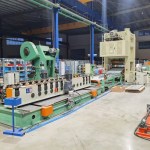
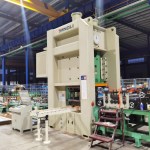
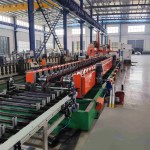

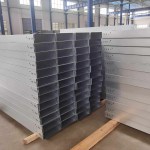
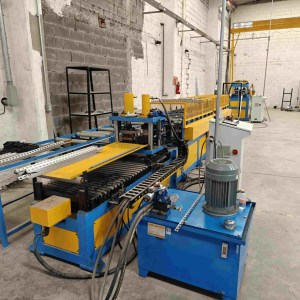
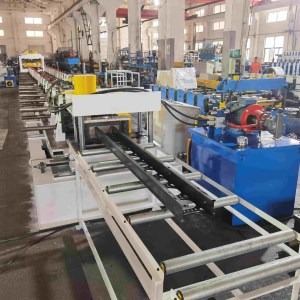
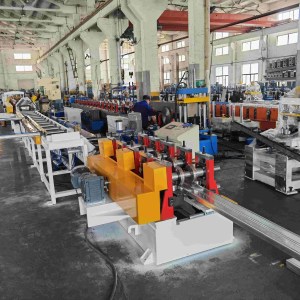
A cable tray roll forming machine is a fully automated production line that cold-forms metal strip into finished cable trays — perforated, ladder, solid-bottom, or Russian-type — in a single continuous pass. The line integrates decoiling, leveling, punching, forming, flying-shear cutting, and stacking. No secondary operations required.
Beli Rollforming has built and shipped cable tray lines to 50+ countries since 2005. Line speeds range from 8 m/min (with online punching) to 25 m/min (without punching). Forming width covers 50–600 mm, thickness 0.8–2.0 mm standard, up to 3.0 mm for heavy-duty.
☀️Type of Cable Tray Produced by BELI Cable tray Machine
Four main cable tray types run on a single configurable line:
| Tray Type | Width Range | Material | Typical Application |
|---|---|---|---|
| Perforated | 50–600 mm | Galvanized Steel | Commercial buildings, data centers |
| Ladder | 50–600 mm | Galvanized / SS | Power plants, heavy industrial |
| Solid Bottom (Trough) | 50–600 mm | Stainless Steel | Chemical plants, healthcare |
| Russian Perforated | 50–600 mm | Galvanized Steel | Eastern Europe market, lockable cover |
Profile changeover takes roughly 10 minutes with the quick-change tooling system.
For buyers sourcing a single machine that handles both trays and covers, see the Russian Popular Type Perforated Cable Tray Roll Forming Machine — it produces tray bodies and matching covers in a 2-in-1 configuration.
As the name might suggest, solid-bottom cable trays have a solid bottom that is free of any lattice, holes or perforations.

Perforated cable tray is the kind of cable tray designed with holes at the bottom to realize air circulation and water drainage.

Ladder Cable Tray systems consists of two longitudinal side members connected by individual transverse members, and is designed for use as a power cable or control cable support system

Channel cable trays are also known as trough cable trays and sport a narrow, U-shaped design that may have either a perforated or a solid bottom.

Russian-standard cable trays with perforations (for superior cable ventilation & routing), lockable covers (secure, tool-free maintenance access), and male-female overlap connections (rigid, long-lasting structural integrity

Comprehensive Cable Tray Applications
Cable trays produced by Believe Industry machines serve diverse industries worldwide:
🔌 Core Applications:
- Power & Electrical: Power plants, substations, transmission systems
- Construction: Commercial buildings, industrial facilities, residential projects
- Transportation: Railways, airports, highways, ports
- Data Centers: Server rooms, telecom facilities, cloud infrastructure
- Industrial: Manufacturing plants, chemical facilities, oil & gas
- Renewable Energy: Solar farms, wind turbines, hydroelectric plants
📊 Key Specifications by Application:
| Application | Typical Tray Type | Key Materials | Special Features |
|---|---|---|---|
| Data Centers | Ventilated | Aluminum | EMI shielding, Heat dissipation |
| Power Plants | Ladder | Galvanized Steel | Fire rated, Corrosion resistant |
| Industrial | Solid Bottom | Stainless Steel | Chemical resistant, Explosion proof |
| Outdoor | Channel | Aluminum | UV resistant, Weatherproof |
| Healthcare | Solid Bottom | Stainless Steel | Hygienic, Easy clean |
🌍 Global Standards Compliance:
- International: IEC 61537, BS EN 61537
- North America: NEMA VE 1, UL listed
- Europe: CE marking, EN standards
- Industry Specific: NEC, ATEX, RoHS compliance
🚀 Emerging Markets:
- Smart Cities: IoT infrastructure, 5G networks
- Renewable Energy: Solar/Wind farm installations
- EV Infrastructure: Charging station networks
- Edge Computing: Distributed data processing
All Believe Industry machines produce cable trays meeting international standards, with customization for specific project requirements.

Cable Tray Load & Type Engine
This Cable Tray Load & Type Engine is a professional-grade structural tool designed for the electrical and roll forming industries. It calculates the Safe Working Load (kg/m) and Deflection based on NEMA VE 1 standards, allowing users to switch between Ladder, Perforated, and Solid Bottom architectures.
By inputting specific side rail heights, tray widths, and material thicknesses, engineers can determine if a profile will support specific cable weights over a given span. It is an essential utility for optimizing material usage while ensuring compliance with industrial safety and structural integrity requirements.
Cable Tray Selection & Load Engine
Industrial Roll Forming Specification Tool
💡Key Components of a Cable Tray Roll Forming Machine
The production line ships as 7 integrated modules:
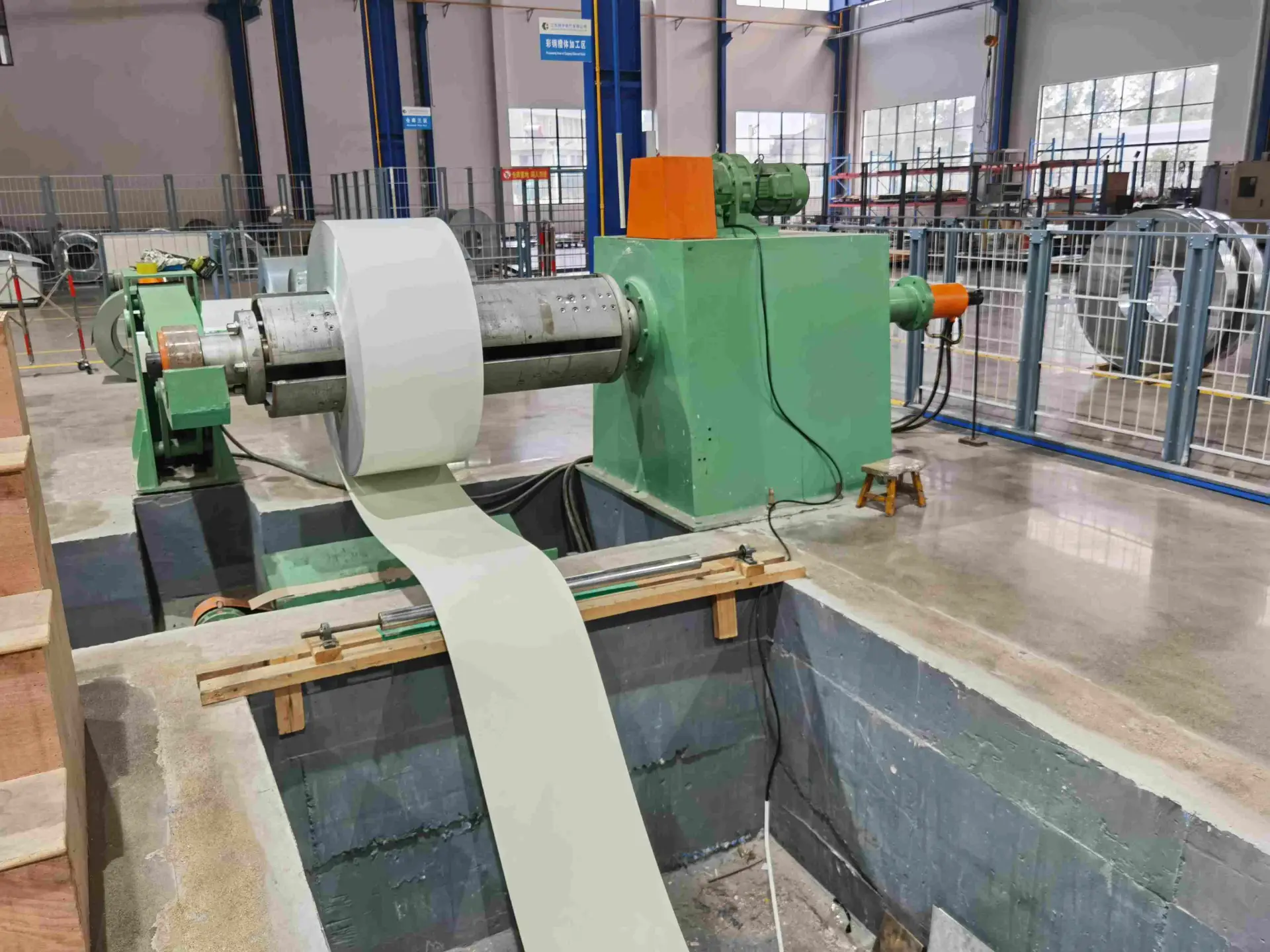
1. Decoiler — 3T to 20T hydraulic mandrel uncoiler. Feeds strip at constant tension regardless of coil diameter changes. For questions on coil feed systems, our roll forming machine auxiliary equipment guide covers the full range of decoiler types.
2. Leveling Unit — 7- or 9-roller straightener. Removes coil set before punching. This is the step most buyers underestimate: skipping it causes hole-position drift. Our roll forming machine leveler page explains why integrated leveling matters for cable tray tolerances.
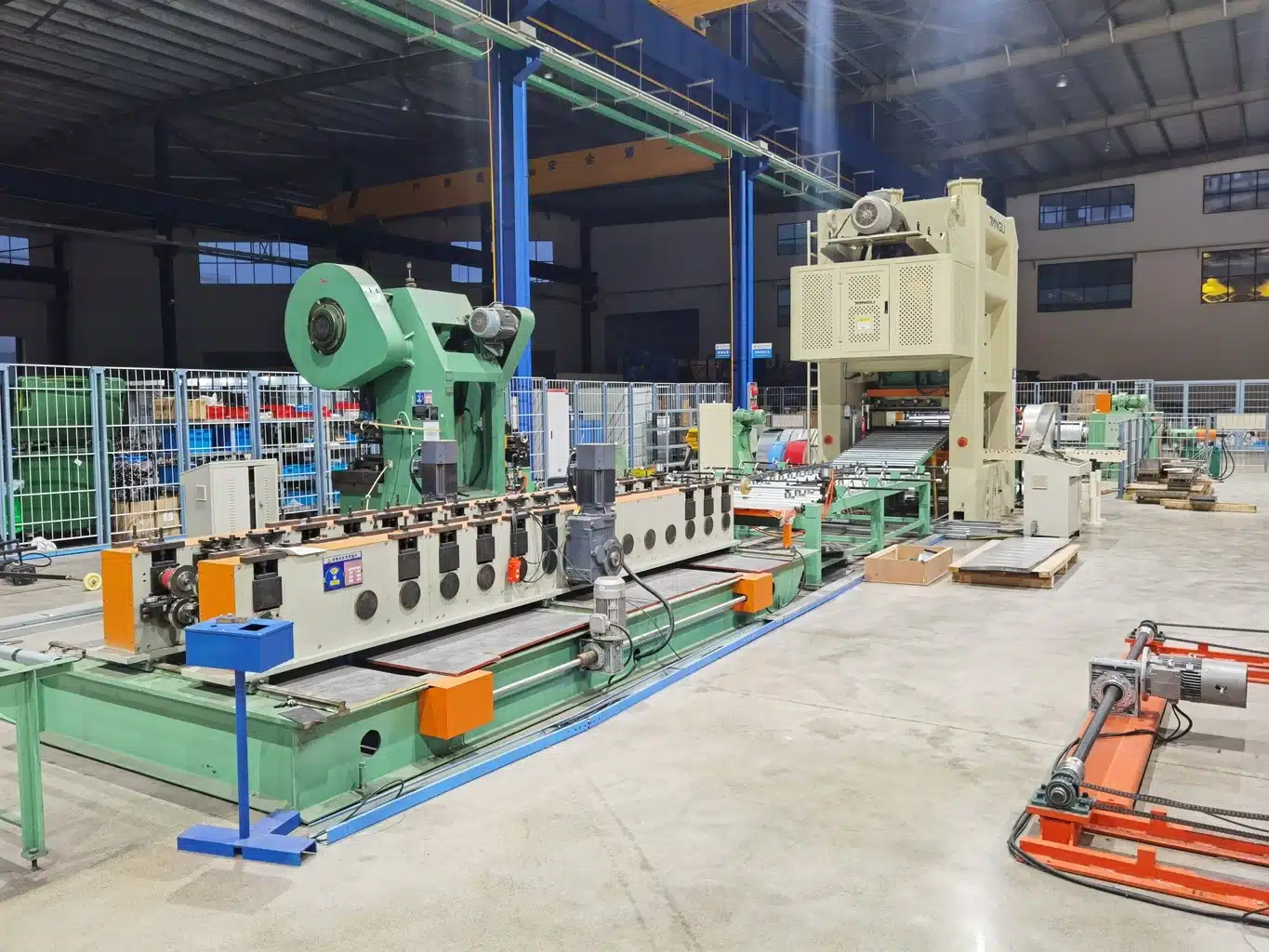
3. Punching Press — Hydraulic or servo-driven. Slots, round holes, and custom patterns. Flying die synced to strip speed — no loop required, no stopping. For a detailed breakdown of punching unit types, see Punching Unit: 7 Proven Advantages.
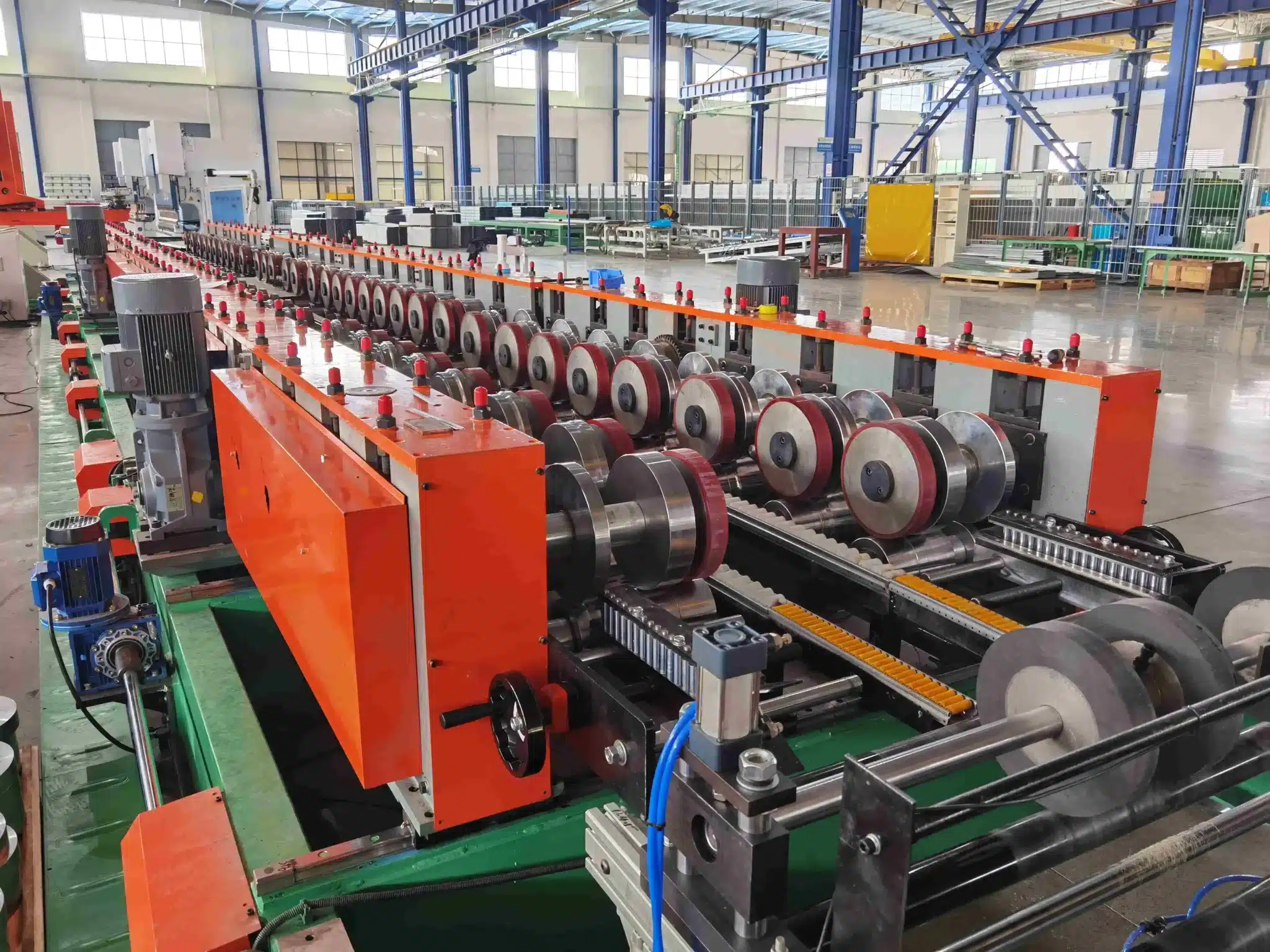
4. Roll Forming Mill — 18–26 stations. 45# steel shafts, GCR15 rollers, vacuum-quenched to HRC 58–62. Station spacing and flower pattern designed for the specific tray profile ordered.
5. Hydraulic Flying Shear — Cuts to programmed length on-the-fly. No stop-start cycle. Length set via HMI; accepts variable length lists for mixed orders.
6. PLC Control System — Siemens, Delta, or Panasonic PLC with 7-inch or 10-inch HMI touchscreen. Production count, length batch control, fault diagnostics. Remote access available for after-sales support.
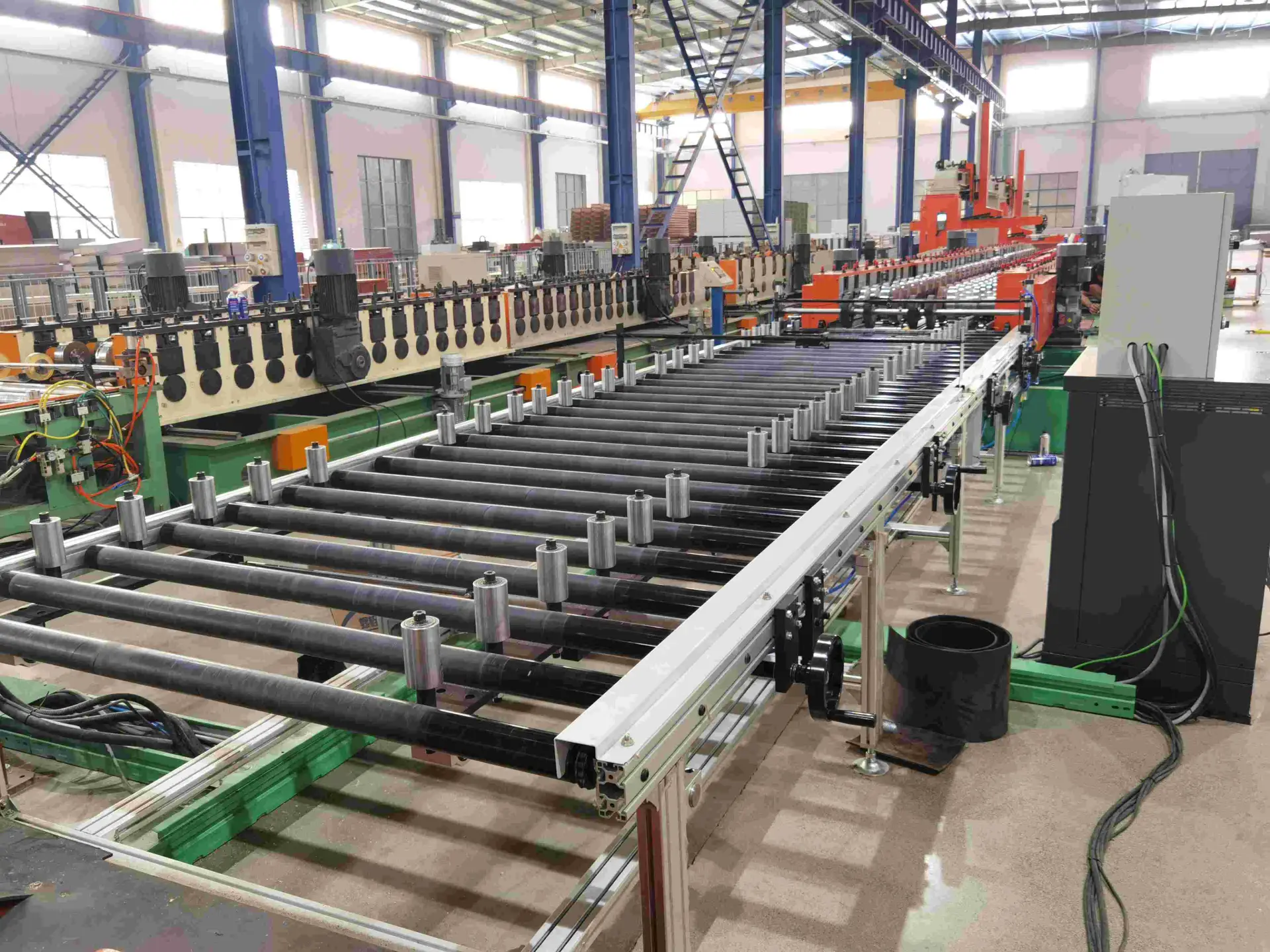
7. Run-Out Table & Stacker — Pneumatic or motorized stacker. Bundles finished trays for easy fork-lift removal. Reduces end-of-line labor by roughly 60%.


⚙️ Cable Tray Roll Forming Machine: Technical Specifications
I. General Machine Performance
| Specification | Typical Range/Value | Options/Remarks |
| Working Speed (Forming) | 8−15 m/min | Up to 25 m/min (higher speed may be possible without punching/cutting actions). |
| Online Punching Speed | 4−8 m/min | Speed is typically slower when punching holes on the fly. |
| Total Installed Power | 15−75 kW | Varies significantly based on material thickness, speed, and punching unit size. |
| Voltage/Frequency | 380 V/50 Hz/3 Phase | Customizable to client country standards (e.g., 480 V/60 Hz). |
| Line Dimension (L x W x H) | 14m×2.2m×1.8m (Min) | Varies greatly depending on the number of stations and accumulator/punching setup. |
| Machine Weight | 10−26 Tons | Depends on material thickness capacity and frame structure (e.g., cast iron vs. welded H-beam). |
II. Material and Product Parameters
| Specification | Typical Range/Value | Options/Remarks |
| Material Thickness | 0.8-2.0 mm | Common range is 0.8-1.5 mm. Thicker capacity requires a heavier-duty machine. |
| Material Width (Input Coil) | 300−1250 mm (Max) | Dependent on the widest cable tray width required. |
| Suitable Material | Galvanized Steel (GI), Stainless Steel, Cold/Hot Rolled Steel, Aluminum | Specified yield strength (e.g., G300 – G550 MPa). |
| Finished Product Width (A) | 50−600 mm | Automatic Width Adjustment is a key feature for multi-size machines. |
| Finished Product Height (B) | 50−150 mm | Also often adjustable, usually requiring changing some forming tools. |
| Product Tolerance (Length) | ≤±2 mm | Typical length tolerance for flying/tracking cutting systems. |
III. Key System Components and Options
| Component | Standard Specification | Options/Customization |
| Decoiler (Uncoiler) | 5T or 10T Hydraulic Uncoiler | 3T/8T/15T/20T capacity, Double-Header Uncoiler (for continuous run). |
| Feeding & Leveling | 7- or 9-Roller Leveler, Servo Feeding System | Allows for high-precision feeding before the punching process. |
| Punching System | Hydraulic Punch Press with multiple die sets | Mechanical Punch Press (higher speed), Flying Punching (non-stop), Adjustable punch patterns. |
| Roll Forming Stands | 18−26 Stations | Number varies based on profile complexity and material thickness. |
| Rollers Material | GCr15 (bearing steel) with Quenching, Hard Chrome Plating | SKD11 (high carbon, high chrome tool steel) for higher durability/thickness. |
| Cutting System | Post-Cutting (Stop-to-Cut), Hydraulic Shear | Tracking/Flying Shear (Non-stop cutting for higher throughput), Pre-cutting. |
| Drive System | Chain Drive or Gear/Sprocket Drive | Gearbox Drive (more robust, higher precision, less maintenance). |
| Sizing Adjustment | Manual adjustment by spacers/screws | PLC Automatic Adjustment (motorized guide rails for width change). |
| Control System (PLC) | DELTA, Panasonic, or Siemens | Siemens (high-end), Allen-Bradley. Includes Touch Screen (HMI) and Encoder (Omron, Kubler). |
| Output System | Simple Un-powered Product Rack (4−8m) | Automatic Stacking System or Palletizer for fully automated collection. |
Pricing & Lead Time
| Standard line (perforated/solid) | 150,000–180,000 | 90–100 days |
| Ladder tray line | 170,000–210,000 | 100–110 days |
| Full turnkey line with auto-stacker | 200,000–250,000 | 110–120 days |
For comparison, equivalent lines from US suppliers typically run 350,000–450,000. The price difference comes from manufacturing cost structure, not component quality — Siemens PLC, SKF bearings, and Rexroth hydraulics are the same regardless of where the line is assembled.
For a complete breakdown of how to evaluate total cost of ownership, see Hidden Costs of Roll Forming Machinery.
Buyers who want a complete production setup from day one — including stacking, conveyor, and packaging — can review the Turnkey Cable Tray Production Line specifications.
Why Choose Believe Industry?
- 30+ cable tray lines installed across 40+ countries since 2005
- ISO 9001 & CE certified — documentation available on request
- ±0.1 mm forming precision — verified by third-party inspection before shipment
- 98.5% uptime guarantee — backed by 24/7 multilingual technical support
- Factory-direct pricing — no distributor margin, no middleman
For buyers researching the broader supplier landscape, Cable Tray Roll Forming Machine Manufacturer: 6 High-Speed Hacks lays out the evaluation criteria used by procurement engineers.
To understand the full manufacturing process your machine will run, Cable Tray Manufacturing Process: 5 Best Secrets explains each stage from coil to finished tray.
Comparison: Believe Industry vs Chinese Competitor vs US Competitor
| Comparison Item | Believe Industry (China) | Chinese Competitor A | US Competitor B |
|---|---|---|---|
| Company Background | 15 years experience, 50+ installations | 10 years experience, 30+ installations | 25 years experience, 100+ installations |
| Technical Source | In-house R&D + German collaboration | Domestic technology | Original US technology |
| Product Range | 8 series, 30+ models | 5 series, 15+ models | 6 series, 20+ models |
| Price Level | Medium (Best value for money) | Lower (Price competition) | Higher (Brand premium) |
| Delivery Time | 90-120 working days (standard) | 120-180 days | 180-240 days |
| Warranty Policy | 12 months complete + 24 months core | 12 months complete | 12 months complete |
| Technical Support | 24/7 English support + remote diagnosis | Weekday 8-hour support | Weekday 8-hour English support |
See Our Equipment in Action: China Customer Success
What Our Customers Are Saying

This cable tray roll forming machine completely transformed our production floor. The automated width and height adjustments via the PLC touch screen mean profile changeovers now take minutes instead of hours. With clean cuts, high punching accuracy, and a 40% boost in daily output, it is highly recommended for scaling up
Omar H.A
ITCC SA
Built with a robust frame and high-quality rollers, this cable tray roll forming machine handles heavy-gauge steel effortlessly without warping. The software is surprisingly user-friendly, allowing our operators to master the line in just two days. A highly reliable, heavy-duty investment that delivers exactly what was promised
Sarah M
Cable Tray Pty Ltd
"Dimensional accuracy is flawless batch after batch, drastically reducing our scrap metal waste and client assembly issues. The servo-feeding system guarantees perfectly aligned punch holes every single time. It’s incredibly fast and has already paid for itself in labor and material savings within the first year
Julia Pinto
CTM Inc
Ready to spec your line?
Send us your tray dimensions, target output, and market (NEMA / IEC / CE), and we’ll return a detailed configuration and price within 24 hours.
Frequently Asked Questions
A cable tray roll forming machine is an automated industrial production line designed to continuously uncoil, flatten, punch, and shape flat metal strips into U-shaped channels. These finished profiles are used in commercial and industrial construction to support, route, and protect electrical wiring and data cables.
These machines are typically designed to produce two main types of trays:
Solid Bottom Trays: Standard U-shaped channels with solid bases for maximum cable protection.
Perforated (Ventilated) Trays: Trays with heavy hole patterns punched into the bottom and sides to allow for airflow and prevent cables from overheating. (Note: Cable “ladder” trays usually require a different type of production line that involves welding individual rungs to side rails.)
Cable trays must support heavy bundles of wire over long spans, so the machines are built to handle structural-grade materials. Common materials include galvanized steel, cold-rolled steel, stainless steel, and aluminum. The typical material thickness ranges from 1.0mm to 2.5mm (or up to 3.0mm for heavy-duty industrial applications).
Because cable trays vary vastly in size (e.g., widths from 50mm up to 1000mm or more), modern cable tray roll forming machines feature an adjustable duplex (double-sided) or cantilever roll forming design. Instead of swapping out heavy roller dies, the operator uses the motorized control panel to mechanically widen or narrow the distance between the left and right roller stands, allowing for rapid size changes within minutes.
Perforated cable trays require a massive amount of punching. The roll forming line is equipped with a heavy-duty inline mechanical or hydraulic punching press, typically located between the leveler and the roll former. A highly accurate CNC servo feeder pushes the flat metal through the press, which stamps out the complex hole patterns before the metal is folded into its final U-shape.
Because of the heavy, continuous punching required for ventilated trays, these lines generally operate a bit slower than standard roll formers. Average production speeds range from 10 to 15 meters per minute (approx. 33 to 50 feet per minute). If running solid bottom trays without punching, the speed can increase.
The cable tray roll forming machine uses a hydraulic post-cutting system equipped with a specialized cutting die. This die is custom-machined to perfectly match the U-shape of the finished cable tray (including the side flanges and return lips). When the shear cycles, it cuts through the profile while fully supporting the walls, ensuring the ends are clean, burr-free, and not crushed.
Yes. The entire line—from the servo feeder and punching press to the roll former and cutting shear—is synchronized by an advanced PLC (Programmable Logic Controller) and a touchscreen HMI. Operators can program the specific batch quantity, the length of each tray, and even the distance between the punched holes. Once set, the machine will run the entire batch completely unattended.
- Daily Maintenance: Clean rollers, check lubrication system, tighten bolts
- Weekly Maintenance: Check hydraulic oil level, clean electrical cabinet, test safety devices
- Monthly Maintenance: Replace filters, check transmission system, calibrate sensors
- Annual Maintenance: Complete overhaul, replace worn parts, system upgrade
Believe Industry provides:
- On-site Installation: Professional engineer team for on-site installation guidance
- Operator Training: 3-5 days comprehensive training ensuring operator proficiency
- Maintenance Training: Equipment maintenance and troubleshooting training
- Remote Support: 24/7 remote technical support service
- Spare Parts Supply: Rapid supply of original spare parts
- Complete Machine Warranty: 12 months (from installation acceptance date)
- Core Components Warranty: 24 months (motors, gear reducers, PLC)
- Lifetime Technical Support: Free technical consultation and software updates
- Quick Response: Technical support solutions within 48 hours
- Optimize Material Selection: Use high-quality coils to reduce breakage risk
- Regular Equipment Maintenance: Preventive maintenance reduces downtime
- Operator Training: Skilled operators increase efficiency by 15-20%
- Process Optimization: Adjust roller parameters, optimize forming speed
- Automation Upgrade: Add automatic feeding and stacking systems
📞 Request Your Quote Today
Ready to optimize your production efficiency and start manufacturing world-class cable trays?
Don’t wait to upgrade your capacity. Contact us now to discuss your specific profile requirements (thickness, width, punching patterns) and request a detailed, customized quote for a Cable Tray Roll Forming Machine built precisely for your business needs.

Believe Industry Company –
Leave your requirements before your leave to get a quick quote now!