










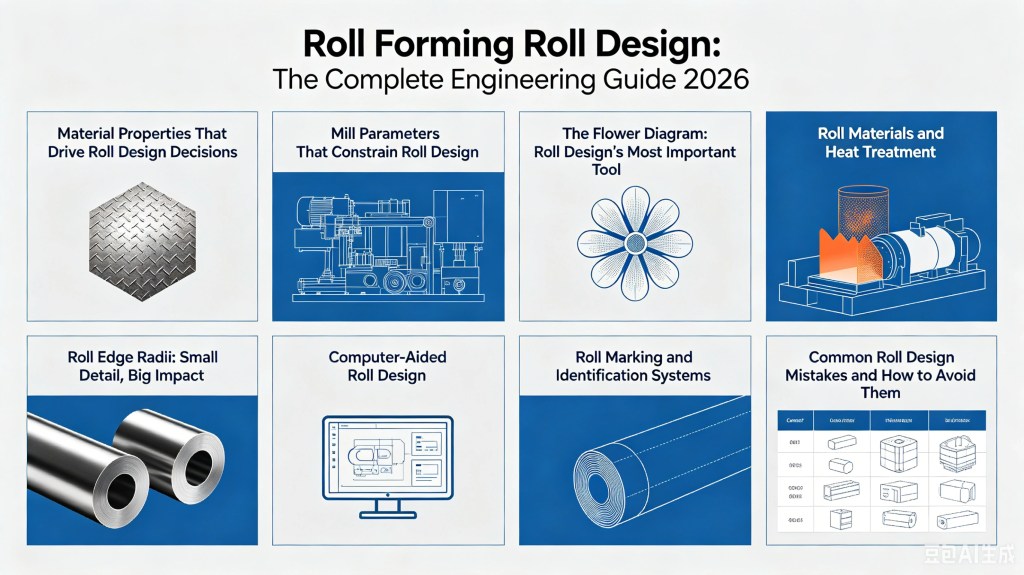
What Is Roll Design in Roll Forming?
Roll Forming Roll design is the engineering backbone of any roll forming machine. It determines how a flat metal strip transforms into a finished profile — how many passes are needed, what angles are formed at each station, how much springback to compensate for, and how the roll tooling fits on the mill shafts.
According to the Roll Forming Handbook (Halmos, 2006), roll design is where “the art and science of roll forming meet.” Experienced designers draw on decades of empirical data to predict material flow, edge strain, and final dimensional accuracy. Newcomers rely on computer-aided design software — such as COPRA® RF (data M Software) or PROFIL — that has dramatically shortened the design cycle. The Fabricators & Manufacturers Association (FMA) publishes technical resources and training programs for roll form designers.
The stakes are high. A poorly designed roll set produces out-of-tolerance profiles, excessive scrap, premature roll wear, and constant setup headaches. A well-designed roll set runs cleanly for years with minimal adjustment.
This guide covers the complete roll design process — from analyzing the finished profile to marking the finished rolls for installation.
How Roll Forming Works: The Forming Sequence
Before designing rolls, you need to understand how material flows through the roll forming process.
A roll forming line typically includes:
- Uncoiler — feeds strip from a coil
- Leveler — removes camber and wavy edges from the incoming strip
- Roll former — the mill with its series of forming stands
- Cutoff — cuts the finished profile to length
At each stand, the strip bends incrementally. The forming sequence — which angles form in which passes — is the core decision in roll design.
The key principle is gradual deformation. Each pass bends the material only a few degrees. Excessive bending per pass causes edge cracking, excessive springback, and surface marking.
Material Properties That Drive Roll Forming Roll Design Decisions
Material characteristics directly influence nearly every aspect of roll forming tooling design.
Mechanical Properties
The roll designer must know the yield strength, tensile strength, and elongation of the material. These properties determine:
- Minimum bend radius (r:t ratio)
- Number of passes required
- Springback magnitude
- Risk of edge cracking
High-strength steels require more passes and wider roll radii. Cold-worked materials — which have been previously bent, tensioned, or compressed below the annealing temperature — develop higher yield and tensile strengths during forming. Some stainless steels and special alloys can exhibit 15 to 25 percent springback at a 90-degree bend instead of the typical 1 to 2 percent.
Springback Compensation
Springback is the elastic recovery of the material after it exits the roll gap. It is influenced by:
- The r:t ratio (inside radius to thickness)
- Material yield strength
- The forming method
- Elastic modulus (E) of the material
For roll design, the designer must specify a bend angle slightly larger than the final required angle. The material springs back to the target angle after leaving the roll.
Several methods compensate for springback:
- Overbending — bend past the target angle so springback returns it to the correct position
- False bends — applying a reverse bend to create opposing stresses that cancel springback
- Variable pass line forming — adjusting the pass line height between stands to apply controlled tension
The springback in roll forming guide covers this topic in greater depth with practical compensation techniques.
Flare: The Width Problem
Flare is a change in the cross-section of a roll formed product at the cut end. Unlike springback, which affects angles, flare changes the width of the finished section.
Internal stresses are balanced in the continuous strip. When the product is cut to length, those stresses become unbalanced, causing the section to flare outward or inward at both ends.
Factors that increase flare:
- Insufficient forming passes, especially for edge forming
- Horizontal centers too close in deep sections
- Excessive inward travel of the edges at the last passes
- Deep notches or cutouts near the edges
Techniques to reduce or eliminate flare:
- Use more passes, particularly for edge formation
- Apply overbending followed by bending back at the last pass
- Use two identical last passes
- Apply edge-only straighteners
- Apply controlled force to squeeze the outside legs
Material Tolerances
Incoming material tolerances affect roll design in several ways.
Thickness: The roll gap is set to the material’s maximum thickness. If the actual thickness varies, the gap changes and dimensional accuracy suffers. For precision products, material thickness variation must be held tight.
Width: For building products like roofing panels, the standard mill tolerance of approximately ±3/16 inch (4.75 mm) is usually acceptable. However, extra “runout” — 0.5 to 1 inch (12 to 25 mm) of additional strip width — is recommended to account for coil-end welding and positioning variation.
Straightness and Flatness: The incoming strip should be flat and straight. If camber (sideways bow) or bow (upward or downward curve) is present, it will compound through the forming passes. A roll forming leveler upstream of the mill can correct these issues before they reach the rolls.
Surface: Hot-rolled, hot-rolled pickled and oiled (HRPO), and cold-rolled steels are forgiving of surface scratches. Pre-painted, galvanized, and aluminum-zinc coated materials require careful handling. Entry guides, side-roll stands, straighteners, and cutoff dies must be designed from appropriate materials to avoid surface marking.
Mill Parameters That Constrain Roll Forming Roll Design
The Roll Forming Roll Designer does not work on a blank canvas. Mill geometry imposes hard constraints.
Shaft Diameter and Deflection
Shaft diameter is established by the mill manufacturer based on maximum material thickness, strength, and width. Excessive shaft deflection changes the roll gap at the center of the shaft, producing an out-of-tolerance cross-section.
For thick materials and high-strength steels, larger diameter shafts with bearing support at both ends are non-negotiable. The shaft for roll former guide covers material grades — typically 40Cr or 45 steel — and heat treatment specifications.
If the roll designer believes the mill shaft diameter is insufficient for the intended product, this must be flagged before roll design begins. Makeshift arrangements — using rolls or yokes to support undersized shafts — are poor substitutes for proper engineering.
Horizontal Centers
The distance between the centerlines of the top and bottom shafts determines the maximum web depth you can form. Wider centers allow deeper sections but increase shaft deflection. Narrower centers provide rigidity but limit section depth.
For duplex and through-shaft duplex mills, the horizontal center distance can often be adjusted to accommodate different profile widths. This flexibility is a key selling point for C and Z purlin roll forming machines.
Pass Line Height
The pass line is the imaginary horizontal plane at which the strip surface speed of the top and bottom rolls is equal. At this height, the strip flows symmetrically without being pushed up or pulled down.
If the pass line height is pre-established by the mill, the roll designer must work backward from that fixed point to determine roll pitch diameters at each stand.
Number of Passes
The number of forming passes is one of the most consequential decisions in Roll Forming Roll Design.
The rule of thumb: each bend requires 3 to 5 passes to form gradually without excessive stress. Complex profiles with many bends can require 20 or more passes.
Factors that increase the required number of passes:
- High yield strength or tensile strength
- Small r:t ratio (sharp inside radius)
- Complex cross-section geometry
- Tight dimensional tolerances
- Sensitive surface requirements
For highway guardrail production in thick, high-strength steel, more passes are essential to avoid edge cracking and excessive springback.
Roll Diameter Increments
The surface speed of the rolls at the pitch (drive) surface determines the speed of the strip. If the top and bottom rolls have different peripheral speeds, the strip will be either pulled or pushed — creating tension or slack between passes.
Typically, roll diameters increase slightly from the first pass to the last. This incremental increase maintains consistent strip tension through the line and prevents looping or buckling between stands.
Key Sizes and Keyways
Key sizes vary from mill to mill and from roll set to roll set due to the lack of industry standardization. Key size is a function of transmitted torque, while shaft diameters are designed for deflection.
The roll designer must verify that the keyway dimensions in the rolls match the mill’s key seats. A mismatch causes slippage, premature wear, or catastrophic failure.
The Flower Diagram: Roll Design's Most Important Tool
The flower diagram is a side-view schematic that shows the anticipated flow of material through each pass. It reveals the sequence of bending, the magnitude of forming angles at each stand, and potential stress concentration points.
How to Draw a Flower Diagram
The process starts with breaking down the finished cross-section into straight and curved elements. Each element is measured from the centerline (vertical guide plane).
For each curved element, calculate the arc length using the inside radius and the bend angle. Add the straight element lengths. This gives the total blank length — the strip width needed to form the profile.
Then work backward from the finished shape, dividing the total bend angles across the available passes. A typical approach distributes the angles incrementally, with a smaller first-pass angle (about 15 degrees, depending on thickness) to ensure smooth strip entry, and a smaller final-pass angle (about 5 to 8 degrees) for gentle closing.
Key Design Principles from the Flower Diagram
Avoid large “jumps” in the forming angle between passes. Large jumps create excessive edge strain and risk cracking.
Smooth entry is critical. The leading edge of the strip must enter the first pass without assistance. A small initial bend angle ensures self-feeding.
Slow start, slow finish. The first and last passes should apply smaller bending increments. Faster forming in the middle passes is acceptable if the edge strain remains below the material’s limit.
Trap the edges when needed. For tight tolerances, the roll designer may specify edge traps — small grooves in the rolls that capture the strip edges and prevent them from spreading.
Consider the top view. A top-view diagram shows lateral material flow. Asymmetrical sections may twist or drift sideways. Side rolls placed between main passes guide the material and prevent flare.
Flower Diagram Examples
Simple C-channel: A basic C-channel can be formed in several ways:
- Lips formed first, web bent last
- Web formed first, lips bent last
- All angles bent incrementally in each pass
- Edge pre-forming followed by web closure
Each approach produces a different stress distribution. Experienced designers select the sequence that minimizes edge strain for the specific material and tolerance requirements.
Asymmetrical sections require more careful guiding. A strut channel roll forming machine producing asymmetrical profiles uses additional side rolls and entry guides to keep the strip centered through the forming sequence.
Ribbed panels with an even number of ribs symmetrical to the centerline maintain the pass line level throughout forming. With an uneven number of ribs, the center rib forms first and the center horizontal flat ascends to full rib height during the process.
Roll Materials and Heat Treatment
Roll material selection affects cost, wear resistance, surface finish, and forming performance.
Common Roll Materials
| Material | Properties | Applications |
|---|---|---|
| AISI 1045 carbon steel | Good machinability, moderate wear resistance | Low-volume, non-critical profiles |
| AISI D2 tool steel | High wear resistance, good hardness retention | High-volume production, abrasive materials |
| AISI O1 tool steel | Good dimensional stability during hardening | Precision tooling |
| Carbide inserts | Extreme hardness and wear resistance | High-speed lines, coated materials |
The Roll Forming Handbook recommends selecting roll material based on production volume, material hardness, surface requirements, and budget. Carbide rolls have a much higher initial cost but last 10 to 20 times longer than steel rolls in high-volume applications.
Surface Hardness
Roll surface hardness is typically specified in Rockwell C (HRC). Common specifications:
- 40–45 HRC — General purpose, easy to machine and repair
- 55–60 HRC — High-wear applications, good balance of hardness and toughness
- 60–65 HRC — Maximum wear resistance, more brittle
For cable tray roll forming machines running galvanized strip at high speed, 55–60 HRC rolls offer the best cost-to-wear ratio.
Heat Treatment
Proper heat treatment develops the desired hardness while minimizing distortion. Quenching and tempering is the standard process for tool steel rolls. The roll designer must specify the heat treatment requirements, and the roll supplier must verify hardness after treatment.
Worn rolls can be re-hardened, but each cycle reduces roll wall thickness. Eventually, the roll must be replaced.
Roll Edge Radii: Small Detail, Big Impact
The radius applied to roll edges — where the roll surface transitions to the bore or side face — affects product quality, marking, and tool life.
Convex vs. Concave Corners
Convex rolls (radius machined on the roll edge) push the material away during forming. If not properly compensated, this movement produces a sharper corner than intended.
Concave rolls (roll edge machined to the tangent point) pull the material inward during forming. They produce a more accurate corner but require more careful alignment along the mill.
Trap Edges
Traps are small grooves or channels cut into the roll face to capture the strip edges and hold them in position. Trap edges can be very sharp and are easily damaged. A small radius (0.020 to 0.060 inches / 0.5 to 1.5 mm) is recommended at trap edges to reduce damage risk.
Scoring (Grooving) Rolls
When the product must be formed with a sharp inside radius, the roll designer may specify scoring rolls — rolls with a groove that pre-creates the bend line. The small radius at the peak of the scoring groove prevents stress concentration and cracking.
Computer-Aided Roll Forming Roll Design
Modern roll design software has transformed the process from an art dependent on individual expertise to a more systematic engineering discipline.
How CAD Roll Design Works
Most software packages follow a similar workflow:
- Input mill parameters — shaft diameters, horizontal centers, maximum pass line adjustment, available pass numbers
- Enter profile geometry — straight element lengths, inside radii, bend angles, bend direction (up or down)
- Specify material properties — thickness range, yield strength, k-factor (neutral axis offset)
- Generate blank size — strip width calculation with tolerances
- Create flower diagram — automatically distributes bend angles across passes
- Generate raw roll profiles — enveloping curves around each pass section
- Add refinements — lead-in flanges, trap edges, radii, side roll locations, cutouts
Leading Software Packages
- CASROL / Delta’s Roll Former’s Guide — Industry standard with extensive library of profile templates
- COPRA® RF (data M Software) — Includes forming stress simulation and optimization
- PROFIL — European standard with strong CAD integration
- SAMCO — Specialized in architectural cladding and roofing profiles
What Software Cannot Replace
No matter how sophisticated the software, the designer’s experience remains essential. Decisions that require human judgment include:
- How the leading edge of the strip will enter the roll gap
- Whether edge trapping is necessary for tolerance control
- How rolls should be split for installation
- Where to add side rolls for asymmetric sections
- How to handle material variation and springback in practice
The Roll Forming Handbook notes that finite element modeling (FEM) can simulate the roll forming process with surprising accuracy under controlled conditions. However, these simulations require large computers and lengthy CPU time not available to most roll designers. The insights from research are gradually being incorporated into commercial software, but the human expert remains irreplaceable.
Roll Marking and Identification Systems
A typical roll forming set contains 40 to 500 rolls and spacers. Without a clear identification system, installation and changeover become chaotic.
Standard Identification Format
The most widely used marking system assigns each roll a code comprising three groups:
Group 1 — Location:
- Pass number (1, 2, 3…)
- Shaft position (T = top, B = bottom)
- Sequence on shaft (1, 2, 3… from the drive side)
Example: 3T4 = 3rd pass, top shaft, 4th roll from the drive side
Group 2 — Job and Supplier:
- Supplier code and job number
- Identical for all rolls in the set
Group 3 — Material:
- Roll material specification (e.g., D2, O1, carbide)
- Identical for all rolls in the set
Side rolls use a different location code: “IN” for the drive side (shaft shoulder) and “OUT” for the operator side.
Setup Charts
A proper setup chart is like a map for roll installation. It specifies the location, marking, length, and contour of every roll and spacer at every pass.
High-quality setup charts also indicate which bend lines are formed at each pass. This information allows the operator to identify and adjust the correct pass when correcting springback — rather than making the common mistake of “squeezing” the last pass to fix every problem.
For quick-change roll forming machines with cassette tooling, setup charts are especially critical. When an entire raft is swapped in minutes, the operator cannot afford to second-guess roll positions.
Common Roll Design Mistakes and How to Avoid Them
Based on field experience and the Roll Forming Handbook, these are the most frequent roll design errors documented in Roll Forming (Wikipedia) and industry publications:
Too Few Passes
Attempting to form complex profiles in fewer passes than the material can tolerate causes edge cracking, excessive springback, and surface marking. Always err on the side of more passes for unknown materials or new profiles.
Ignoring Material Variation
Designing rolls for nominal material properties — without accounting for thickness variation, hardness variation, or surface condition — produces inconsistent results in production. Build appropriate tolerances into the roll design.
Inadequate Guiding for Asymmetrical Sections
Asymmetrical profiles generate lateral forces that push the strip sideways during forming. Side rolls between main passes are essential for these profiles. Skimping on guiding causes flare, camber, and edge misalignment.
Poor Trap Edge Design
Trap edges that are too sharp chip and crack in production. Apply a small radius to all trap edges. Ensure that the trap depth is sufficient to capture the strip without excessive force.
Neglecting Edge Strain Calculations
The outside fiber of the strip stretches during forming. If this strain exceeds the material’s uniform elongation limit, edge cracking occurs. Always calculate edge strain at each pass, especially for high-strength materials.
For solar strut channel machines producing profiles with tight bend radii, edge strain calculations prevent costly field failures.
2026 Roll Design Trends
Simulation-Driven Design
Forming stress simulation is becoming standard in commercial roll design. Software can now predict stress concentration at each pass, flagging potential cracking or buckling before a single roll is machined. The ASTM International standards for metal forming provide reference methods for evaluating forming stress and material behavior.
One example: data M Software’s COPREDIA system calculates and graphically displays forming stresses at each pass. Designers use this output to redistribute bend angles, add passes, or modify radii before finalizing the roll set.
Integrated CAD/CAM Workflows
Direct links between roll design software and CNC machining centers reduce transcription errors and accelerate delivery. The designer outputs a CNC program directly from the CAD system. The machinist loads the program and begins cutting — no intermediate drawings, no manual data entry.
Modular and Parameterized Roll Design
Rather than designing each roll set from scratch, leading manufacturers use parameterized templates. A strut channel template, for example, stores the standard flower diagram, roll materials, and tolerances. The designer adjusts a few key parameters — web height, flange width, lip length — and the software generates a complete roll set.
This approach dramatically reduces design time and standardizes quality across product families.
FAQ: Roll Forming Roll Design
A flower diagram is a side-view schematic showing how the strip bends at each forming pass. It breaks the finished profile into straight and curved elements, calculates the arc lengths and bend angles, and distributes those angles across the available passes. It is the most important planning tool in roll design.
Simple profiles typically need 6 to 10 passes. Complex profiles with multiple bends can require 20 or more. A practical rule: each bend requires 3 to 5 passes. The exact number depends on material properties, r:t ratio, and tolerance requirements.
Edge cracking occurs when the outside fiber strain exceeds the material’s uniform elongation. This happens when too few passes are used, when bend radii are too sharp, or when high-strength materials are formed with insufficient forming angles. Proper roll design — including adequate passes and appropriate radii — prevents edge cracking.
Springback is compensated by overbending — specifying a bend angle slightly larger than the final required angle so that elastic recovery returns the material to the correct position. Methods include direct overbending, false bends (reverse bending to create opposing stresses), and variable pass line height to apply controlled tension during forming.
Choose roll material based on production volume, material hardness, surface requirements, and budget. AISI D2 tool steel (55–60 HRC) is the most common choice for general production. Carbide inserts are preferred for high-speed lines or abrasive coated materials despite the higher initial cost.
Convex rolls have a radius machined on the roll edge, pushing the material away during forming. Concave rolls are machined to the tangent point, pulling material inward. Concave edges produce more accurate corners but require more precise mill alignment.
Roll life depends on material hardness, production volume, forming speed, and the abrasiveness of the strip. Steel rolls in general production typically last 2 to 5 years. Carbide rolls can last 10 to 20 times longer. Worn rolls produce out-of-tolerance profiles and should be inspected regularly and re-hardened or replaced when necessary.
A setup chart is an instruction document that specifies the location, marking, length, and contour of every roll and spacer in the roll set. Good setup charts also indicate which bend lines are formed at each pass, helping operators identify the correct adjustment point when fine-tuning the profile.
Conclusion
Roll design is the engineering discipline that transforms a flat strip into a precision profile. It requires understanding of material behavior, mill geometry, forming mechanics, and practical manufacturing constraints.
The roll designer must analyze the finished cross-section, select the appropriate number of passes, calculate blank sizes and forming angles, specify roll materials and heat treatment, create flower diagrams, and prepare setup charts — all before a single piece of steel is cut.
Getting it right means smooth production, consistent quality, and minimal downtime. Getting it wrong means constant adjustments, excessive scrap, and frustrated operators.
At Believe Industry Company, our engineering team has designed thousands of roll sets since 2005 for applications ranging from cable trays and solar mounting channels to structural purlins and highway guardrails. Whether you need standard tooling or a completely custom roll design for a new profile, our engineers work from your product drawings to delivery of production-ready rolls.
Contact us today for roll design consultation and tooling quotes — our engineers respond within 24 hours.