









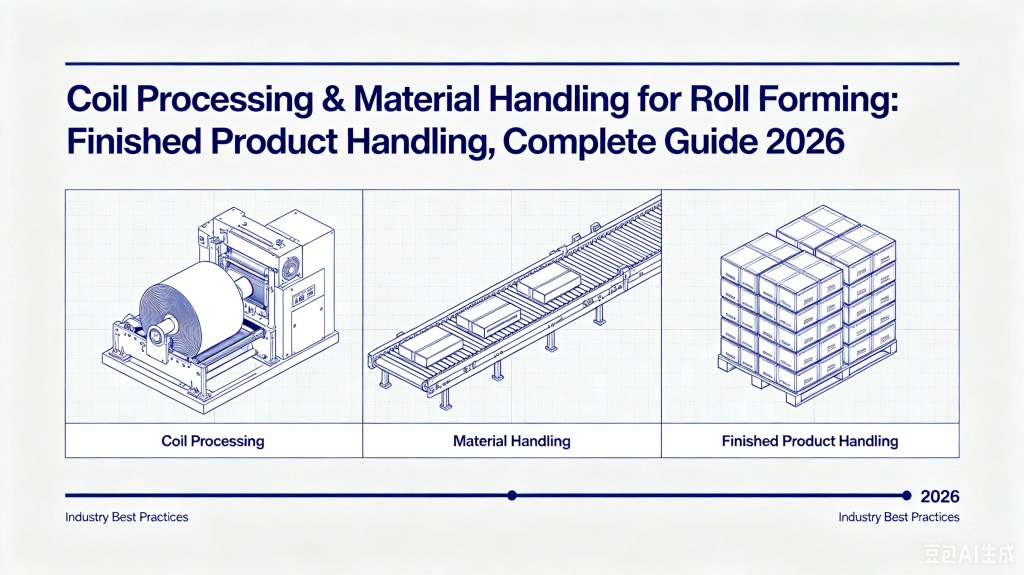
Coil processing and material handling covers every step from receiving raw coil stock to feeding leveled strip into your roll forming machine. Get this wrong, and the rest of the line can’t run at full speed.
A roll forming line burns through material. A single high-speed line can consume 5 to 50 tonnes of coil per shift. Halmos notes that operators and material handlers often spend more time moving material than producing goods. The entry section — coil storage, loading, uncoiling, straightening, and feeding — directly determines uptime, scrap rate, and product quality. These are the core functions of coil processing and material handling in any roll forming plant.
Whether you are setting up a new line or optimizing an existing one, proper coil processing and material handling keeps the strip flowing without interruption.
1. Flow of Material Through the Plant
Material moves through eight stages:
- Receiving and unloading incoming coils
- Coil storage (inventory)
- Moving coils to the processing line
- Feeding strip through the line
- Removing finished product
- Stacking, bundling, marking, and packaging
- Storing finished goods
- Shipping out
Each stage costs labor and time. Halmos points out that the finished product can occupy 2 to 50 times the volume of the starting coil. So exit-end handling often needs more equipment and floor space than the entry side. Smart coil processing and material handling design balances both.
A properly designed material handling industry roll forming machine setup accounts for both ends.
2. Coil Receiving and Storage
Coil processing and material handling starts at the receiving dock. How coils arrive determines what equipment you need downstream.
Receiving Conditions
Coils arrive on open-bed trucks, closed vans, or rail cars. The receiving setup — a critical first step in coil processing and material handling — depends on:
| Factor | Impact |
|---|---|
| Coil orientation | Horizontal eye vs. vertical (“eye to the sky”) |
| Transportation method | Open bed (crane-unloaded) vs. closed van (forklift) |
| Daily volume | Determines storage density and equipment class |
| Material sensitivity | Pre-painted, galvanized, or aluminum may need indoor storage only |
| Weighing needs | In-line scale vs. crane scale vs. floor scale |
Wide hot-rolled, cold-rolled, and galvanized steel coils typically ship with the eye horizontal. Narrow coils, most pre-painted steel, and aluminum usually arrive on pallets with the eye vertical.
Storage Methods
How you store coils directly affects material handling efficiency. The three main approaches:
Floor storage with horizontal axis. Coils rest directly on the floor in rows. Needs 12 to 18 inches (300 to 450 mm) of aisle clearance if using coil grabs. “C” hooks need wider aisles.
Storage racks. These give instant access to any coil. Stacker cranes with specialized attachments handle rack-stored coils. Used mainly by primary steel producers and service centers — typically too expensive for most roll forming plants.
Vertical-axis pallet storage. Narrow coils on pallets stack 2 to 3 high. Handled by forklift. Simple and low-cost.
Coil Upenders
When coils arrive with the vertical axis but the line needs horizontal loading, a coil upender rotates the coil 90 degrees. Below-hook upenders can lift and rotate in one motion — a useful addition to any coil processing and material handling setup that handles mixed-orientation stock.
3. In-Line Coil Handling Equipment
Once coils are in storage, they need to reach the uncoiler. The goal: make the line self-sufficient for hours without tying up the plant crane. This is where coil processing and material handling equipment earns its keep.
Equipment Comparison
| Device | Description | Best For | Limitations |
|---|---|---|---|
| Coil Ramp | Inclined rails; gravity moves coils toward uncoiler | Low-budget setups, narrow coils | Safety hazard; sequence-locked; can’t return partial coils |
| Coil Cradle | Simple support structure; common in stamping | Narrow coils, intermittent feed | Manual loading only |
| Coil Rack | Two parallel bars holding 2–6 coils above a coil car | Culvert lines, medium production | Sequence-locked; needs coil car |
| Coil Conveyor | Live-floor or underfloor conveyor moves coils forward | High-volume primary steel plants | Expensive for smaller operations |
| Turnstile | 2–4 arm rotating holder; any coil accessible in any order | Flexible production, multiple profiles | Needs 200–400 ft² (18–36 m²); higher cost |
| Coil Car | Rail-guided lifting cart; most common in roll forming | Standard roll forming lines | Requires floor rails or pit |
Coil Car Details
The coil car is the workhorse of in-line coil handling. It travels on rails between the storage position and the uncoiler mandrel, then lifts hydraulically to load the coil.
Key design points from Halmos:
- Floor-level cars are preferred over pit-type — pits are safety hazards and expensive to relocate.
- Rails should be sunk into the floor or protected with walkways. Flat bars or inverted angles work for light-to-medium duty.
- Hydraulic lift with built-in power pack gives precise vertical and horizontal control.
- Pendulum controls at the car let the operator walk alongside and position coils accurately.
- A single coil car can serve two opposing roll forming lines to save capital cost.
A 5 ton hydraulic uncoiler paired with a properly specced coil car handles most mid-range roll forming applications.
4. Coil End Welding
Some processes — in-line seam welding, painting, extrusion — demand continuous strip flow. Stopping to thread a new coil creates scrap and downtime. Coil end welding is the solution, and it’s a key capability in automated coil processing and material handling systems.
Recommended Method: GTAW (TIG) Welding
Gas-tungsten-arc welding (GTAW/TIG) is the most practical method for roll forming. A semiautomatic unit shears both coil ends square, clamps them, and welds the seam. Total cycle time: 1 to 3 minutes. No excess material needs grinding.
The strip ends are typically sheared at a 10 to 20 degree angle (skewed) so the weld passes through the rolls at an angle rather than all at once — reducing impact on tooling.
For thick, high-strength material, a 3-, 5-, or 7-roll strip straightener is needed before clamping because inner wraps retain their curvature after uncoiling.
Non-Recommended Methods
- Resistance welding of overlapped ends creates double thickness through the roll gap.
- Stitching and taping don’t hold up under tension.
- Gas/oxyacetylene welding is slow, unreliable, and requires grinding.
Coil end welders are commercially available as self-contained units that can serve multiple lines when mounted on casters.
5. Strip Accumulators
Welding takes 1 to 3 minutes. The line can’t stop during that time. A strip accumulator — one of the most important pieces of coil processing and material handling equipment for continuous lines — stores enough material to feed the mill while the operator welds the next coil.
Accumulator Types
| Type | Storage Capacity | Footprint | Notes |
|---|---|---|---|
| Overhead/Vertical Loop | Moderate | Small floor, tall ceiling | Older technology; used with narrow strip for in-line extrusion |
| Horizontal Spiral | Large | Large floor area | Strip surfaces slide against each other; strip turned 90° for feed |
| Vertical Rotary | 1,000–3,000 ft (300–900 m) | Compact | Surfaces don’t rub; good for narrow strip; highest capital cost |
| Continuous Coil Stack Feed | Multiple coils | Compact | Coil ends pre-welded off-line; limited by speed/thickness/width |
| Pallet Decoiler | Multiple coils | Compact | Coils as-received on pallet; no pre-welding needed |
For most roll forming applications, a vertical rotary accumulator or a pallet decoiler provides the best balance of cost and function in a coil processing and material handling system.
6. Flattening and Leveling
Flattening and leveling are essential coil processing and material handling steps for any line running thick, high-strength, or surface-critical material.
When You Need a Flattener
Not every line needs one. Corrugated roofing and siding panels, for instance — the bend lines are strong enough to mask residual coil curvature.
You need a flattener when:
- Thick or high-strength material won’t feed into the mill without straightening
- Coil ends must be welded and the curvature prevents proper clamping
- Strip passes through a prepunching die that requires flat input
- Wide flat panels with minimal forming (only edge bends) will display center waviness
Flattener Operation
A typical roll forming leveler has 5 to 7 rolls. The strip bends up and down around small-diameter rolls, creating controlled permanent deformation that overrides the residual coil set. Longitudinal bow and coil breaks are eliminated. Crossbow is reduced but may not be fully removed.
Flatteners do not fix edge waviness, center waviness, or camber.
Most flatteners in roll forming are driven with one pair of pinch rolls before and one after the flattening rolls. The pinch rolls can also feed strip into a loop before precutting, prepunching, or roll forming.
Levelers vs. Shape Correctors
Full sheet levelers (17–21 rolls) are used for individual sheets, not in-line with roll forming. Continuous tension leveling at the mill or steel service center usually provides sufficient flatness.
Shape correctors are special flatteners with adjustable roll deflection. They can selectively stretch the edges or center of the strip:
- Deflect roll ends deeper → stretch edges → remove edge waviness
- Deflect roll center deeper → stretch center → remove center waviness
A well-adjusted shape corrector improves finished product quality but can’t guarantee perfect flatness from every coil.
For heavy-gauge work, a dedicated leveling machine with the right roll diameter-to-thickness ratio is essential.
7. Material Handling Equipment
Coil processing and material handling relies on three main equipment types: overhead cranes, forklift trucks, and below-hook attachments. The right combination cuts coil change time and reduces labor.
Overhead Cranes
The most efficient handling equipment in roll forming plants. One well-chosen crane can serve 8 to 12 roll forming lines — handling coil receiving, storage, line loading, and finished product movement. This single piece of material handling equipment is often the backbone of the entire coil processing and material handling system.
Crane selection factors from Halmos:
- Span is determined by the building
- Lifting capacity must cover combined weight of the heaviest coil plus below-hook attachment
- Service classification: Class C (moderate duty) is adequate for most plants; Class D (heavy duty) for high-cycle operations
- Control type: Radio remote is often the most economical for secondary metal manufacturing
Top-running cranes are preferred over underhung — simpler maintenance and rail alignment.
A crane breakdown stops all lines it serves. Redundancy planning matters.
Forklift Trucks
Lowest-cost option. Standard forks move coils on pallets with vertical axes. For horizontal-axis coils, “bull nose” or ram attachments protect the inner core.
Limitations: large aisle space for turning, can’t load directly onto most uncoilers, and not suitable for long finished products.
Crane Attachments
| Attachment | Function | Advantage | Disadvantage |
|---|---|---|---|
| “C” Hook | Lifts coils with horizontal axis | Simple, no moving parts, low cost | Wide aisles needed; can’t load uncoiler directly |
| Coil Grab (Telescopic) | Reaches into coil core | 12–18″ aisle clearance; loads uncoiler | More headroom required; coil width range limited |
| Fork Attachment | Handles palletized coils/sheets | Versatile | Limited to vertical-axis/pallet loads |
| Below-Hook Upender | Lifts and rotates coils 90° | One-handling operation | Narrow coils only |
| Crane Scale | Weighs during lift | Saves floor space and time | Accuracy varies by type |
| Rotating Hook | Changes horizontal axis direction | Avoids manual rotation | Motorized preferred over manual |
8. Finished Product Handling
The exit side of coil processing and material handling needs more equipment and space than the entry side. A finished bundle can take up 50 times the volume of the coil it came from.
Handling Methods
- Drop into containers: Short pieces fall into totes or crates at line end. Simplest method.
- Side removal: Pushers or deflectors move longer pieces sideways off the runout table.
- Belt/Roller conveyors: Move products to bundling, strapping, or the next operation.
- Overhead crane with slings: For long structural sections.
Packaging and Marking
Every bundle needs identification. Methods range from hand-writing (time-consuming, ink can fade) to ink stamping, labels, and bar-coded tags. Bar-coded marking integrates with plant inventory software.
Mismarking is a common and expensive error. Employees need to understand the cost of a mislabeled bundle — it can take 5 to 10 times longer to re-measure and re-bundle.
9. Plant Layout: Coil Flow "IN" and Product Flow "OUT"
Halmos emphasizes that moving material doesn’t add value, only cost. In most roll forming plants, material movement time exceeds actual forming time. Good coil processing and material handling layout shortens every lift and every travel distance.
Layout Checklist — Incoming Material
- Yearly and peak-shift lift quantities
- Coil weight, width, and orientation
- Transportation method (open bed, closed van, rail)
- Storage method (floor pile, rack, pallet)
- Number of lines to serve (current and future)
- Coil upending/rotating requirements
- Weighing and inventory tracking
- Space for rejected or damaged coils
- Auxiliary equipment (turnstile, coil car, upender)
Layout Checklist — Outgoing Product
- Product removal method (conveyor, drop table, drag chain)
- Bundle/package size and weight
- Packaging and strapping requirements
- Indoor vs. outdoor storage
- Loading method (dock-level, crane, forklift)
- Seasonal storage needs
- First-in/first-out vs. first-in/last-out access
Space Reality
The expansion ratio is brutal: finished products occupy 2 to 50 times the volume of the starting coil. A plant producing long building panels needs far more exit-end space than a plant making short brackets.
10. Integration with the Roll Forming Line
All this equipment doesn’t operate in isolation. The entry section feeds the roll forming machine components — and integration quality determines whether the line runs at rated speed or crawls. Proper coil processing and material handling integration is what separates a high-output line from an underperforming one.
A typical entry section for a high-output line:
Coil storage → Coil car → Uncoiler → Flattener/Leveler → Servo feeder → Loop → Prepunch → Roll former
The servo feeder controls strip advance accuracy into the prepunch press. The strip loop between the feeder and the roll former decouples the intermittent prepunch cycle from the continuous forming process. Poor loop control leads to strip buckling or tension spikes.
For lines with flying cutoff, the servo flying shear synchronizes with line speed to cut on the fly — no deceleration needed.
11. Cost and ROI Considerations
Entry section equipment represents 15 to 30% of total line cost, depending on automation level. The payoff from coil processing and material handling investment comes from uptime:
| Configuration | Typical Coil Change Time | Lines/Hour at 15 m/min |
|---|---|---|
| Manual loading, no in-line storage | 8–15 minutes | 0.4–0.6 |
| Coil car + turnstile (3–4 coils ready) | 2–3 minutes | 0.8–1.0 |
| Coil car + end welder + accumulator | 0 minutes (continuous) | 1.0 |
A continuous line that never stops for coil changes can produce 60 to 100% more per shift than a manual-load line. This is why coil processing and material handling automation, including roll forming automation, pays back in months, not years.
For a full breakdown of line pricing, see the roll forming machine price guide and the custom roll forming machine guide.
Use the coil calculator to estimate strip length, weight, and run time for your specific coil dimensions before sizing your entry section equipment.
12. Global Considerations
When sourcing coil processing and material handling equipment for international operations, global roll forming standards apply. Different regions have different crane classifications, safety codes, and electrical requirements.
Roll forming machine installation for the entry section involves foundation work for pit-mounted coil cars, crane rail alignment, and hydraulic system commissioning. Proper installation prevents alignment drift that causes strip tracking issues downstream.
Frequently Asked Questions
Coil processing is the set of operations that prepare raw steel or aluminum coil for roll forming. It covers receiving, storage, uncoiling, straightening, end welding, strip accumulation, and feeding. Material handling includes all the lifting, moving, and positioning equipment that supports these operations. Together, coil processing and material handling determine how fast and reliably the line runs.
A basic hydraulic coil car with 5 to 30 ton capacity costs 3,000 to 25,000 depending on lift capacity, travel length, and control features. Floor-level cars cost less than pit-type installations due to simpler civil work. A coil car with built-in hydraulic power pack and pendulum controls typically falls in the middle of this range.
A flattener has 5 to 7 rolls and removes longitudinal bow and coil breaks. It uses small-diameter rolls to create permanent deformation that overrides the coil’s residual curvature. A sheet leveler has 17 to 21 rolls and achieves flatter results, but is used offline for individual sheets. For in-line roll forming, a flattener or shape corrector is the standard choice.
You need a strip accumulator when your process can’t tolerate stopping — for example, in-line painting, tube welding, or extrusion. The accumulator stores enough strip (300 to 900 meters for a vertical rotary unit) to feed the line while the operator welds the next coil. The welding cycle takes 1 to 3 minutes.
GTAW (TIG) welding is the recommended method. A semiautomatic unit shears, clamps, and welds in 1 to 3 minutes. The skew-cut ends pass through the rolls at an angle, reducing impact. No grinding is needed. This method works for almost all roll formed materials.
One well-selected overhead crane can serve 8 to 12 roll forming lines, assuming reasonable coil sizes, storage layout, and line speeds. The actual number depends on coil weight, lifting distance, frequency of partial coil returns, and crane operator efficiency. A crane breakdown stops all lines — redundancy should be considered.
Pit-type coil cars are a fall hazard — floor-level cars are preferred. Coil ramps with gravity-fed coils are difficult to stop and can be dangerous. Protruding crane rails and coil car rails create tripping hazards unless sunk or protected with walkways. Overhead crane operations require clear walkways and trained operators. The turnstile should lock in position before loading or unloading. All coil processing and material handling areas should have clearly marked walkways and documented safety procedures.
Entry section automation directly determines uptime percentage. Every minute spent on coil changes is a minute the line isn’t producing. A line that spends 30% of its shift waiting for coil loading produces 30% less output. The cost of a coil car, turnstile, and end welder with accumulator is typically recovered within 6 to 12 months through increased production. Effective coil processing and material handling is not overhead — it’s production capacity you either capture or lose. Finished product handling efficiency matters even more, given the 2–50× volume expansion after forming.
References
- Halmos, G.T., Roll Forming Handbook, Chapter 8: Coil Processing, Material Handling, and Plant Layout. CRC Press.
- Theis, H.E., “Corrective Sheet Metal Leveling — Science, Art or Black Magic?” FABTECH Conference, 1985.
- Theis, E., “Strip Shape Control for Roll Formers (Levelers Are Not for Leveling).” SME Roll Forming Conference, 1995.
- Halmos, G.T., “Efficient Material Handling for Roll Forming Mills.” Material Management & Distribution, December 1978.
- Halmos, G.T., “Designing a Plant Layout for Efficient Roll Forming Operations.” The Fabricator, November/December 1981.
- Crane Manufacturers Association of America (CMAA) — Crane service classifications and specifications.
- Material Handling Industry (MHI) — Industry standards and best practices for material handling equipment.
- OSHA Materials Handling and Storage — Safety standards for crane, forklift, and material storage operations.
- World Steel Association — Steel coil production and handling standards.
Last updated: May 2026. Believe Industry Company — For roll forming line specifications including entry section equipment, visit belirollforming.com.