Stay Updated with Believe Industry News


Stay in the loop with Believe Industry’s expert insights!


When it comes to scaling your metal fabrication business, roll forming machine components are the backbone of success. Every part—from the uncoiler that starts the process to the auto stacker that finishes it—works in harmony to reduce scrap, minimize downtime, and deliver parts that meet tight tolerances. Whether you’re making roofing sheets, automotive trim, or HVAC ducts, understanding these 10 critical components is key to unlocking peak performance. Learn More about roll forming machine
Think of your roll forming machine like a chain: its strength depends on its weakest link. Faulty components lead to:
Wasted material: Misaligned uncoilers or worn levelers create warped coil.
Costly downtime: Leaky hydraulics or jammed feeders halt production.
Inconsistent quality: Dull rollers or imprecise cutters ruin part dimensions.
A 2024 Fabricators & Manufacturers Association (FMA)report found that upgrading to precision roll forming machine components cuts scrap by 12% and downtime by 18% annually—saving tens of thousands in operational costs (source: FMA Manufacturing Efficiency Guide).
The uncoiler feeds raw metal coil into your line—and it must do so with consistent tension to avoid wrinkling or loose edges. Opt for:
Motorized uncoilers: Reduce labor and ensure even feeding for high-volume runs.
Coil car systems: Automate loading to slash setup time by 50%
Raw coil often has camber (side-to-side curvature) or waves. A leveler uses adjustable rollers to straighten material, ensuring uniform thickness. Look for digital controls to repeat results and avoid inconsistent part shapes.
Servo Feeders: Computer-controlled motors deliver material at exact speeds, eliminating slippage or jams. Save feed rates for different parts to speed up changeovers.
Punch Devices: CNC-controlled tools add holes, slots, or logos duringforming—no secondary operations needed. Perfect for electronics enclosures or brackets.
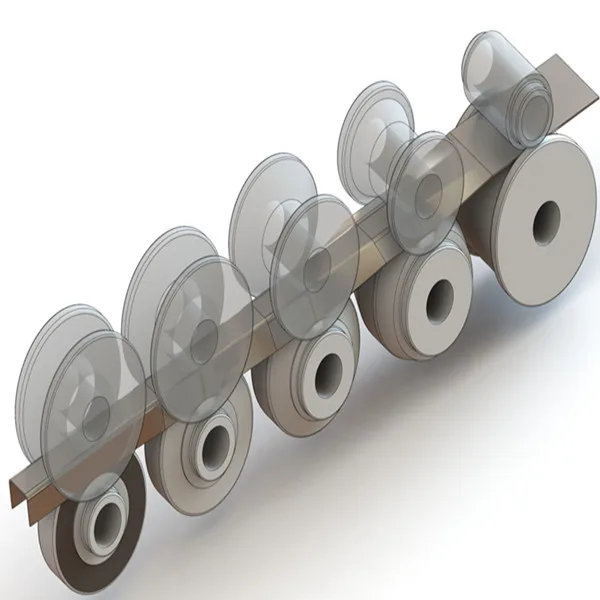
These parts do the heavy lifting of bending metal into your desired profile:
In manufacturing and material processing, a feeder and a guider are two components that work together to handle and position material (like sheet metal, fabric, wire, or film) through a machine.
Feeder: Its job is to move the material forward into the machine at a controlled and precise rate. It provides the “push” or “pull.”
Guider: Its job is to align the material, ensuring it travels in a straight path and doesn’t drift sideways. It provides the correction to keep everything straight.
Stands hold rolls in place; bearings reduce friction between moving parts; shafts connect rolls to stands. Invest in hardened steel bearings to extend shaft life by 30-50%
Rolls (made from D2 tool steel or chrome-plated steel) define your part’s shape. A straightener corrects any remaining curvature for perfect finishes.
Hydraulic or mechanical cutters trim parts to exact lengths. Choose carbide-tipped blades to avoid burrs and extend blade life.
Controllers: CNC or PLC systems let you program profiles, monitor speed, and adjust settings in real time. Touchscreen interfaces simplify recipe management.
Hydraulic Systems: Power cutters, uncoilers, and stand adjustments. Change oil every 500 hours and replace seals to prevent leaks and maintain pressure.
The final piece of the puzzle—auto stackers collect finished parts, stack them neatly, and track output with counters. Eliminates manual labor, reduces damage, and ensures consistent packaging.
Upgrading roll forming machine components isn’t an expense—it’s an investment. Let’s say you:
Cut scrap by 12% ($15,000/year saved).
Reduce downtime by 18% ($20,000/year saved).
That’s a $35,000 return in Year 1—plus happier customers from consistent, high-quality parts.
Roll forming machine components aren’t just “parts”—they’re the foundation of a efficient, profitable fabrication line. By choosing quality uncoilers, servo feeders, and smart controllers, you’ll:
liminate waste and rework.
Reduce downtime and labor costs.
Deliver parts that exceed customer expectations.
Ready to optimize your line? Check out our guide to how to buy a roll forming machine, contact our team for a free component audit. Let’s elevate your fabrication with roll forming machine components that work as hard as you do.

What Is a Punch Press for Roll Forming Industry? A...
Read MoreA servo feeder for the roll forming industry is a...
Read MoreWhen optimizing your roll forming line, the roll forming machine...
Read MoreWhen it comes to scaling your metal fabrication business, roll...
Read MoreWhat is Roll Forming Capacity? Roll forming capacity refers to...Read More
Discover how a composite deck roll former maximizes load-bearing capacity...Read More
In the high-stakes world of industrial manufacturing, global roll forming...Read More
A solar mounting bracket roll forming machine is a high-precision...Read More
Subscribe now to keep reading and get access to the full archive.