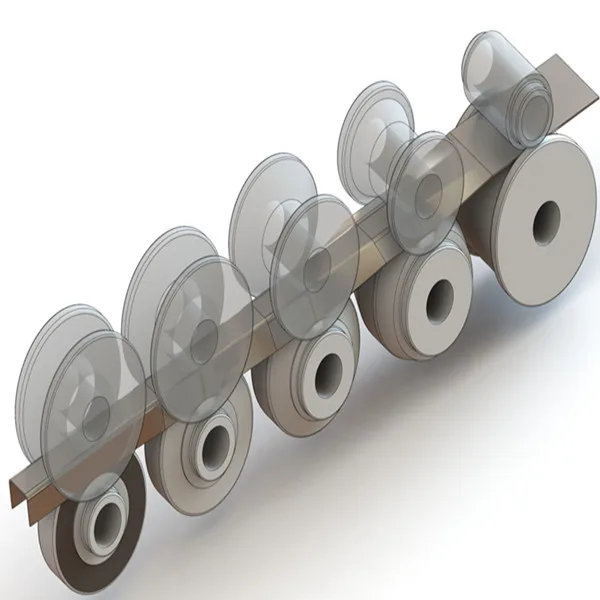
Saudi Arabia’s construction sector is accelerating. Vision 2030 megaprojects — from NEOM to the Red Sea Project — demand thousands of kilometers of structural framing. At the center of this supply chain sits one critical piece of equipment: the strut channel roll forming machine.
A strut channel roll forming machine saudi arabia buyers invest in today must deliver more than just U-shaped profiles. It must handle multiple P-series models, support high-precision punching, and comply with regional standards. This guide compares six P-series strut channel profiles, five punching technologies, and four global suppliers — giving you the data to choose the right line for the Saudi market.
Before diving deep, if you’re new to this equipment category, read our definitive guide to uni strut channel roll forming machines.
Why Saudi Arabia Needs High-Capacity Strut Channel Production
The numbers tell the story. Saudi Arabia’s construction pipeline exceeds USD 1.5 trillion. Every solar farm, every cable management system, every HVAC support framework relies on strut channels as the structural backbone.
The Saudi Standards, Metrology and Quality Organization (SASO) now enforces strict material and dimensional requirements on imported steel framing products. A low-end strut channel roll forming machine saudi arabia importers sometimes settle for will fail compliance checks — and lose the contract.
Manufacturers who invest in a properly specified strut channel roll forming machine from a direct manufacturer gain a measurable competitive edge: faster delivery, lower per-meter cost, and SASO-ready output documentation.
Saudi Arabia’s economic transformation under Vision 2030 is not just a policy document — it’s a concrete procurement pipeline. NEOM alone will require an estimated 200,000+ tons of strut channel profiles over the next decade. The question is not whether demand exists. The question is whether your production line can meet it.
P-Series Strut Channel Models: Complete Comparison
The P-series naming convention comes from the Unistrut system, the global standard for metal framing channels. Each model differs in cross-section, hole pattern, material gauge, and load capacity. Here is the full comparison based on the P-series strut channel buyer’s guide:
Model Overview Table
| Modèle | Cross-Section (mm) | Material Gauge | Typical Hole Pattern | Best Application |
|---|
| P1000 | 41 x 41 | 12 ga / 2.7 mm | Slotted or solid | General framing, solar mounting |
| P1100 | 41 x 41 | 14 ga / 1.9 mm | Solid only | Light-duty support, cable trays |
| P3000 | 41 x 21 | 12 ga / 2.7 mm | Slotted | Wall-mounted cable runs |
| P3300 | 41 x 41 | 12 ga / 2.7 mm | Round holes only | Bolt-through connections |
| P4100 | 64 x 41 | 14 ga / 1.9 mm | Slotted | Long-span support, heavy vertical loads |
| P5000 | 41 x 41 | 12 ga / 2.7 mm | Slotted + round combo | Mixed accessory mounting |
Key Takeaways from the Model Lineup
The P1000 is the benchmark — 41 x 41 mm, 2.7 mm, available in eight hole-pattern variants (T-slotted, WT, SL, DS, H3, HS, KO, and solid). For Saudi solar and infrastructure, the P1000T slotted variant dominates because it lets installers slide and lock fittings anywhere along the channel without field drilling.
The P1100 shares the same cross-section but uses thinner 1.9 mm material — suitable only for non-structural interiors. The P3000 has half the depth (21 mm) and roughly half the bending stiffness, used mainly for shallow wall-mounted cable runs. The P3300 uses round holes instead of slots, limiting adjustability but simplifying tooling. The P4100 offers a wider 64 mm flange for heavy vertical loads but demands wider strip stock and a larger decoiler. The P5000 combines slotted and round holes in one profile — the most complex punch setup.
Most Saudi manufacturers run one multi-profile line covering P1000 + P3300 + P4100, which covers the vast majority of construction and solar specifications.
For a deeper dive into model selection, see our guide de machine de profilage à rouleaux pour profilés de support.
Punching Method Comparison: 5 Technologies Head-to-Head
The punching system defines your line’s speed, accuracy, and flexibility. For any strut channel roll forming machine saudi arabia factories deploy, the right punch technology directly determines output capacity and SASO inspection pass rates. Based on the solar strut channel punch solutions guide, here is a full comparison of five punching technologies:
Comparison Table
| Fonctionnalité | Fixed Punch | Flying Punch | Servo + Hydraulic Press | Servo + Mechanical Press | Poinçon rotatif |
|---|
| Comment ça marche | Punch inline; line stops per stroke | Punch head tracks moving strip; no stop | Servo feeder to standalone hydraulic press | Servo feeder to standalone mechanical press | Rotating die wheel punches while strip moves |
| Line Stops? | Oui | Non | Non | Non | Non |
| Vitesse typique | 4–8 m/min | 10–20 m/min | 10–15 m/min | 20–40 m/min | 40+ m/min |
| Hole Accuracy | ±1.0–1.5 mm | ±0,5–1,0 mm | ±0,3–0,5 mm | ±0,3–0,5 mm | ±0.3–0.8 mm |
| Die Cost | Faible | Moyen | Moyen | Faible à moyen | Haut |
| Die Change Time | 1–2 hours | 2–3 hours | 30–60 minutes | 30–60 minutes | 3–5 hours |
| Profile Flexibility | Haut | Moyen | Haut | Haut | Faible |
| Noise Level | Haut | Moyen | Moyen à élevé | Haut | Faible |
| Equipment Cost | Lowest | Moyen | Moyen | Haut | Le plus haut |
| Idéal pour | Small batches, simple slots | Medium batches, speed focus | High precision, complex patterns | High speed, cost-sensitive | Ultra-high volume, single profile |
Which Punching Method for Saudi Projects?
For most Saudi manufacturers, the servo + hydraulic or servo + mechanical press configuration delivers the best balance. Here’s why:
Saudi projects demand both precision (SASO compliance) and volume (megaproject timelines). A fixed punch system lacks the speed. A rotary punch system locks you into a single profile. The servo-press combination gives you ±0.3–0.5 mm hole accuracy at 15–40 m/min — fast enough for volume, precise enough for compliance.
If your primary market is solar mounting, see our dedicated solar strut channel machine guide for solar-specific punch requirements including anti-scratch guide systems.
Punch Speed vs. Output in an 8-Hour Saudi Shift
| Punch Method | Vitesse de la ligne | Meters per 8-Hour Shift | 3-Meter Pieces per Shift |
|---|
| Fixed Punch | 8 m/min | 3,840 m | 1,280 |
| Flying Punch | 15 m/min | 7,200 m | 2,400 |
| Servo + Hydraulic | 15 m/min | 7,200 m | 2,400 |
| Servo + Mechanical | 30 m/min | 14,400 m | 4,800 |
| Poinçon rotatif | 50 m/min | 24,000 m | 8,000 |
The difference between a fixed punch line and a servo-mechanical line is nearly 4x output per shift. At Saudi labor and overhead rates, that difference recovers the equipment price premium within 12–18 months.
For more on punch press selection, read our essential guide to punch press for roll forming.
Supplier Comparison: Believe Industry vs. US, EU, and Indian Manufacturers
Not all strut channel machine saudi arabia buyers evaluate are equal in capability. Here is a data-driven comparison of four supplier categories based on real market intelligence:
Head-to-Head Supplier Comparison
| Critères | Believe Industry (Chine) | Supplier B (USA) | Supplier C (EU) | Supplier D (India) |
|---|
| Established | 2005 | 2001 | 1978 | 2008 |
| Export Markets | Plus de 40 pays | Primarily North America | Primarily Europe | Limited regional |
| Solar Track Record | GameChange Solar (USA) | Domestic only | European EPCs | Régional |
| Max Forming Speed | 20 m/min | 15 m/min | 12 m/min | 10 m/min |
| Punch Solutions Offered | All 5 types | 2–3 types | 2–3 types | 2 types |
| Profile Customization | Full design service | Limité | Modéré | Limité |
| Système de contrôle | Siemens/Mitsubishi | Allen Bradley | Siemens | Delta/Schneider |
| CE Certification | Facultatif | Standard | Standard | Non-standard |
| Délai de livraison | 45–90 days | 90–120 days | 90 à 150 jours | 30–45 days |
| FOB Price (41×41 line) | USD 95,000–205,000 | USD 120,000–180,000 | USD 150,000–220,000 | USD 30,000–45,000 |
| After-Sales Language | English, 24/7 remote | Anglais | English/German | Limité |
| Garantie | 12 months + remote support | 12 mois | 12 à 24 mois | 6 months |
Why the Strut Channel Machine Itself Matters
A machine à canal de jambe de force is not a commodity purchase. The difference between a well-engineered line and a budget line shows up in:
- Profile consistency — twist and camber within 1 mm per meter vs. 3+ mm
- Hole position repeatability — ±0.3 mm vs. ±1.5 mm
- Die life — 15 million+ meters vs. 3–5 million meters
- Uptime — 92%+ with proper preventative maintenance vs. 70–80%
These differences compound over years of production. A line that runs at 92% uptime produces 20% more output than one at 75% — and that output gap translates directly to revenue.
Technical Specifications for a Saudi-Ready Line
Based on the P-series reference data and Saudi project requirements, here are the recommended specifications for a strut channel roll forming machine saudi arabia projects demand:
Standard Machine Configuration
| Paramètre | Spécification |
|---|
| Profile Capability | P1000, P3300, P4100 (expandable to P3000, P5000) |
| Matériel | GI / GL / PPGI — compliant with ASTM A653, EN 10346 |
| Plage d'épaisseur | 1.5–3.0 mm (4.0 mm optional for heavy-duty) |
| Largeur de la bande | 100–220 mm |
| Coil ID | 508 / 610 mm |
| Poids de la bobine | 3–5 tons standard; 8 tons optional |
| Stations de formation | 18–24 (profile-dependent) |
| Moteur principal | 22–30 kW, gearbox/chain drive |
| Vitesse de formation | 15–20 m/min (servo-press configuration) |
| Cut Length Tolerance | ±1 mm per 6 meters |
| Hole Position Accuracy | ±0,3–0,5 mm |
| Système de contrôle | Siemens S7-1200 or Mitsubishi FX5U + HMI touchscreen |
| Méthode de découpe | Hydraulic flying cut or servo tracking saw |
| Line Dimensions | ~25 m x 1.5 m x 1.5 m |
| Poids de la machine | ~20 tons |
| Alimentation | 380V / 50Hz (customizable) |
| Certification | CE optional; FAT before shipment |
Saudi-Specific Add-Ons
For the Saudi market, consider these upgrades:
- Z350+ coating compatibility for coastal projects (Red Sea, Arabian Gulf)
- Stainless steel roller option for 304/316 stainless strut profiles in chemical/petrochemical environments
- Arabic-language HMI interface for local operator teams
- SASO compliance documentation package with test certificates
- Remote VPN diagnostics for quick troubleshooting without flying in engineers
Standards and Compliance for Saudi Arabia
Relevant International Standards
| Marché | Applicable Standards |
|---|
| Saudi Arabia (SASO) | SASO ISO 9001, SASO 2663, ASTM A653 equivalent |
| International | IEC 61508 for functional safety |
| Amérique du Nord | NEMA VE 1 for metal cable trays; AISC for structural steel |
| Europe | EN 10162, EN 1993 (Eurocode 3) |
Saudi Arabia increasingly aligns with international standards. SASO certification is not optional for government and megaproject procurement. Any strut channel roll forming machine saudi arabia manufacturers import must produce profiles that pass SASO dimensional and material inspections — and you need the documentation to prove it.
Le machine de profilage à rouleaux Unistrut configurations that succeed in Saudi Arabia are those built with this compliance framework in mind from day one, not retrofitted after delivery.
ROI: What a Strut Channel Line Earns in Saudi Arabia
Let’s run the numbers for a typical Saudi manufacturer running a strut channel roll forming machine saudi arabia operations typically deploy at 15 m/min with servo-mechanical punching:
| Métrique | Valeur |
|---|
| Vitesse de la ligne | 15 m/min |
| Effective Uptime | 85% |
| Meters per 8-Hour Shift | 6,120 m |
| Pieces per Shift (3 m each) | 2,040 pieces |
| Weight per Piece (P1000, 2.7 mm) | ~2.9 kg |
| Tons per Shift | ~5.9 tons |
| Tons per Month (26 shifts) | ~154 tons |
| Market Price (Saudi, per ton, fabricated) | ~SAR 3,500–4,500 (USD 930–1,200) |
| Monthly Revenue Potential | ~USD 143,000–185,000 |
At these volumes, a USD 150,000 machine investment pays back in under two months of operation. Even accounting for material costs, labor, facility overhead, and logistics, the breakeven point typically falls within 4–6 months.
For a deeper ROI analysis, see our C strut channel profit guide.
How to Order: 6-Step Process
- Send your requirements — profile drawings, material specs, speed targets, and P-series models needed.
- Receive a proposal within 3 business days — including line layout, component list, and FOB Wuxi pricing.
- Technical review — one round of email or video call to finalize specifications.
- Confirm order with 30% deposit to secure production slot.
- Test d'acceptation en usine (FAT) — on-site at our Wuxi facility or via live video.
- Ship and commission — 20–35 days sea freight to Dammam or Jeddah, plus remote setup support.
Before you commit, read our strut channel machine buyer’s guide for seven strategies to avoid costly specification mistakes.
Conclusion
The strut channel roll forming machine saudi arabia market demands a different caliber of equipment than standard construction markets. Between SASO compliance, Vision 2030 volume expectations, and the multi-profile flexibility that Saudi projects require, the buying decision carries long-term consequences.
Three key takeaways:
- Choose a machine that handles multiple P-series models. A P1000-only line limits your addressable market. The P1000+P3300+P4100 combination covers most Saudi specifications.
- Prioritize servo-driven punch systems. Fixed punch is too slow. Rotary punch is too inflexible. Servo-mechanical punch delivers the accuracy-speed-flexibility balance Saudi projects demand.
- Compare suppliers on total value, not purchase price. A USD 45,000 Indian machine that runs at 70% uptime with 6-month warranty costs far more over five years than a USD 150,000 Chinese machine with 92% uptime and comprehensive support.
Believe Industry has supplied strut channel lines to 40+ countries, including US-tier solar manufacturers. Whether you need a single-profile line or a multi-model strut channel roll forming machine saudi arabia megaprojects require, we build every punch die in-house, run full-speed FAT on every machine before shipment, and provide English-language 24/7 remote support. Contact us at enquiry@believeindustry.com to start your specification.
FAQ