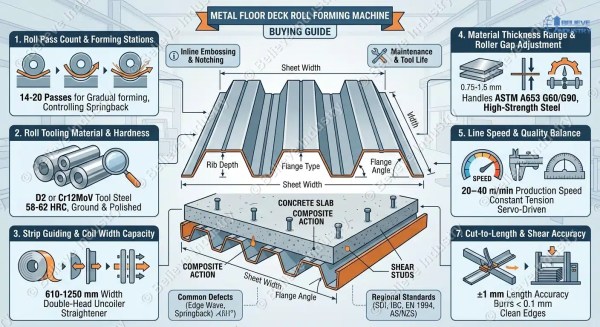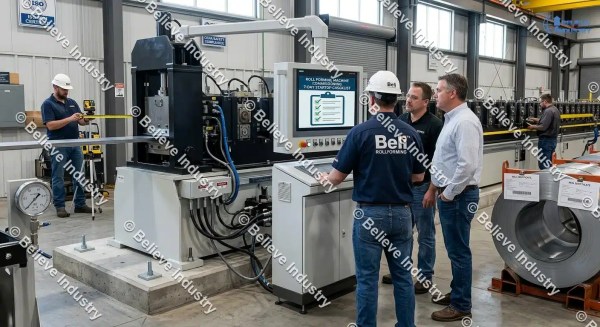











Not every profile fits a standard catalog. When your cross-section is unique — a proprietary roofing rib, a custom solar bracket, or a non-standard logistics beam — you need a custom roll former machine built around your drawing, not the other way around.
This guide covers what goes into a custom roll former build, how to evaluate suppliers, and what a realistic budget looks like in 2026.
What Is a Custom Roll Former Machine?
A custom roll former machine is a production line engineered from scratch — or significantly modified — to produce a specific metal profile.
It differs from a standard catalog machine in one key way: the tooling, station count, and line layout are all driven by your profile geometry rather than a fixed template.
The core components remain consistent: decoiler, leveler, punch press, roll forming stations, flying shear, and runout table. What changes is how each unit is configured. A complex profile might need 22+ stations. A simple one could run in 12.
Learn how each unit contributes to output in our roll forming machine components guide.
What Goes Into a Custom Roll Former Build?
A custom roll former build starts long before the first sheet of steel is cut for tooling.
Step 1: Profile Analysis
The manufacturer reviews your drawing — DXF or PDF — and runs a flower pattern simulation. This maps how the flat coil transitions into your final cross-section across each station.
Proper simulation catches spring-back issues early. Skipping it costs money later. See how springback in roll forming affects profile geometry on high-strength steel.
Step 2: Tooling Design
Rollers are the most critical investment in any custom roll former machine. At Believe Industry, standard tooling uses GCr15 bearing steel, vacuum-quenched to HRC 58–62.
The choice of roll forming tooling material directly impacts dimensional accuracy (typically ±0.3 mm) and long-term wear life.
Step 3: Machine Layout & Station Count
Station count is calculated from:
- Bend angle per station (typically 3–8° for mild steel)
- Material yield strength
- Profile complexity
Step 4: Control System Integration
Most lines today run on Siemens or Mitsubishi PLC. Touchscreen HMI, servo-driven shear, and cut-length encoder come standard on modern builds.
PLC control for roll forming efficiency reduces scrap rate and simplifies operator changeover — particularly important when you run multiple profiles on one line.
Step 5: Factory Acceptance Test (FAT)
Before shipping, the machine runs your profile at rated speed. Dimensional checks are recorded. This is non-negotiable for a quality supplier.
Custom Roll Forming Machine vs Standard Machine
Most buyers start with a shortlist: buy a catalog machine and adapt it, or commission a true custom roll former machine from scratch.
| Factor | Standard Machine | Custom Roll Forming Machine |
|---|---|---|
| Lead time | 15–30 days | 60–120 days |
| Tooling | Fixed | Profile-specific (your DXF) |
| Profile flexibility | Limited to catalog shapes | Any cross-section |
| Price | 15,000–15,000–80,000 | 40,000–40,000–300,000+ |
| Station count | 10–18 (fixed) | 12–28+ (engineered to profile) |
| PLC control | Basic / optional | Standard on most custom builds |
| Quick-change option | Rarely | Available — see cassette type machines |
| Double profile option | No | Available — double layer machine |
| Ideal for | High-volume standard profiles | Proprietary or non-standard shapes |
For buyers comparing machine types before deciding, our roll forming machine VS press brake breakdown covers when each process makes economic sense.
Key Specifications to Define Before You Quote
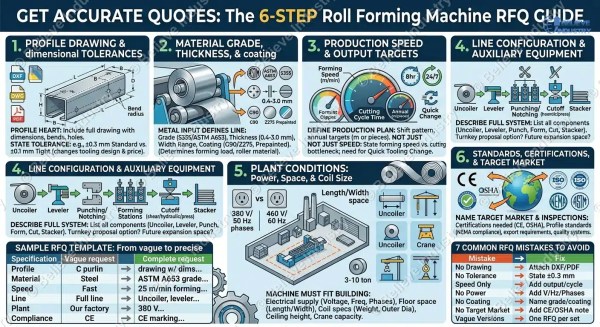
Send these details to any supplier. Incomplete specs produce inaccurate quotes.
| Specification | Typical Range | Notes |
|---|---|---|
| Material | PPGI, GI, mild steel, aluminum | Yield strength affects station count |
| Coil thickness | 0.3–3.0 mm | Thicker = more stations, heavier frame |
| Coil width | 100–1,250 mm | Determines machine width |
| Profile height | Up to 200 mm typical | Deep profiles need more stations |
| Production speed | 10–60 m/min | Faster = servo shear required |
| Punching required? | Yes / No | Inline servo punch or pre-punch |
| Cut-to-length tolerance | ±0.5 mm standard | ±0.2 mm available with encoder |
| Power supply | 380V / 415V / 480V | Confirm local grid voltage |
Getting this right at the front end avoids costly engineering changes mid-build.
Custom Roll Former Machine Suppliers: What to Compare
The roll forming machine manufacturers landscape breaks down into three tiers. Each has trade-offs.
Tier 1 — Chinese Export Manufacturers
Companies like Believe Industry operate at scale. 3,000+ lines delivered to 50+ countries since 2005. The advantage is engineering depth combined with factory-direct pricing.
Key things to verify:
- Do they run a FAT on your actual profile?
- Do they offer on-site installation? (We do — roll forming machine installation)
- What is the spare parts lead time post-delivery?
For Australian buyers specifically, our roll forming machine Australia page covers compliance, installation support, and technician availability with valid Australian visas.
Tier 2 — European & US OEMs
Higher base price. Faster local support. Lead times are often longer for custom builds. Strong on regulatory compliance (CE, UL). Best suited when local certification is a hard requirement.
Tier 3 — Used/Reconditioned Lines
Lower upfront cost, but custom profile fit is hit-or-miss. Read the used roll forming machine risk guide before going this route.
Supplier Comparison: China vs EU vs US for Custom Builds
| Criteria | China (Believe Industry) | European OEM | US OEM |
|---|---|---|---|
| Custom build cost | 40K–180K | 120K–400K | 150K–500K+ |
| Lead time (custom) | 60–100 days | 90–180 days | 90–150 days |
| FAT included | Yes | Yes | Yes |
| On-site commissioning | Yes | Yes (regional) | Yes (domestic) |
| Spare parts availability | Global stock | Regional | Domestic |
| CE certification | Available | Standard | Not applicable |
| Language support | English, multi-language | English, DE, FR | English |
| Australia market experience | Yes — see guide | Limited | Very limited |
Pricing benchmarks vary by specification. Use our roll forming machine price guide for current 2026 ranges.
How to Avoid Hidden Costs on a Custom Order
Custom builds carry more financial exposure than standard machines. The biggest surprises:
- Tooling revisions — If your DXF changes after tooling starts, expect rework charges.
- Freight and import duties — Not always included in the quoted price. Confirm DDP vs FOB terms.
- Electrical adaptation — 380V machines need a transformer for 415V/480V grids. Budget 1,500–1,500–4,000.
- Training and commissioning — Factor in on-site time. Remote commissioning saves cost but adds risk.
- Spare tooling set — Always order a backup set of rollers. Downtime waiting for replacement tooling is expensive.
The hidden costs of roll forming machinery article breaks down the full TCO picture before you sign.
Custom Roll Former Applications by Industry
A custom roll former machine is not limited to one sector. Common application areas:
- Roofing & cladding — Proprietary standing seam, corrugated ribs, IBR, Klip-Lok profiles
- Solar racking — Custom C-channels and Sigma profiles for ground-mount and roof-mount systems
- Warehouse racking — Step beams, uprights, and shelf decking with non-standard perforations
- Construction steel — Z/C purlins, sigma purlins, custom stud profiles
- Cable management — Ladder trays, perforated trays, and bespoke NEMA cable tray profiles
- Automotive & transport — Floor channels, body reinforcements, logistics beams
For a broad overview of where roll forming fits across manufacturing sectors, the roll forming machine pillar page is the best starting point.
5 Questions to Ask Every Supplier Before You Commit
Can you simulate my flower pattern and share it before signing?
Any serious manufacturer can produce this in 48–72 hours.What steel grade are the rollers made from, and what is the surface hardness?
GCr15 at HRC 58–62 is the industry standard. Cheaper rollers wear faster and drift dimensionally.Will you run a full FAT on my profile at rated speed?
Insist on this. Video evidence is acceptable if you cannot attend in person.What is included in the warranty, and how are spare parts handled?
A 12-month mechanical warranty with a defined spare parts program is standard.Do you have experience shipping to my country, and can you handle local compliance?
This matters more than most buyers realize. See the China roll forming compliance checklist for importers.
Maintenance Planning for a Custom Line
A custom roll former machine represents a significant capital investment. Protect it.
The most common failure points on custom lines:
- Roller wear — Caught early by measuring profile dimensions against tolerance weekly
- Shear blade dulling — Burr height on cut ends is the first indicator
- Hydraulic system contamination — Filter changes on schedule prevent 80% of hydraulic faults
- PLC parameter drift — Back up parameters after every successful FAT and after any tuning session
Our roll forming preventative maintenance guide has daily, monthly, and annual checklists formatted for production teams.
Frequently Asked Questions
One unit. Custom builds are single-unit projects by definition. No MOQ applies.
Typically 60–100 days from drawing approval to FAT completion, depending on complexity and supplier workload.
Yes — with quick-change tooling cassettes or a double layer machine configuration. Changeover time drops from 3–4 hours to 15–30 minutes.
DXF is preferred. PDF with dimensioned cross-sections works. CAD files (STEP, IGES) are welcome.
Yes. Believe Industry has technicians with valid visas for Australia, the US, EU, and Southeast Asia. Details at roll forming machine installation.
Entry-level custom lines start around 40,000.Complex high−speed lines with integrated punching and automated stacking reach 200,000–$300,000+. See our roll forming machine price page for a full breakdown by specification.
Ready to Get a Quote?
Send us your profile DXF, coil thickness, material grade, and required production speed. We’ll return a flower pattern simulation and preliminary quotation within 48 hours.
For more detail on the full buying process, read the complete roll forming machine buyer’s guide 2026.
Outbound Reference Links (Editorial Context)
- The Fabricator — Roll Forming Process Overview — Industry publication reference for process fundamentals
- AISI Cold-Formed Steel Design Manual — Referenced for yield strength and material standards
- NEMA VE 1 Cable Tray Standard — For cable tray compliance reference
- ISO 9001 Quality Standard — Quality management reference for supplier evaluation