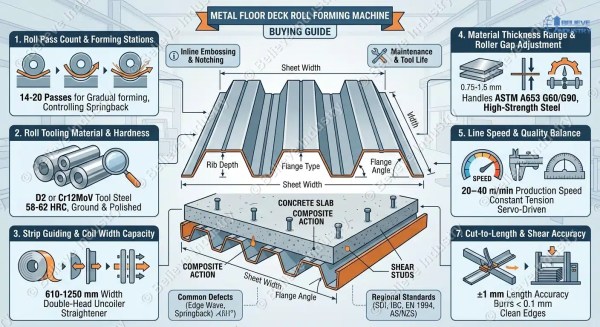











Tous les profils ne correspondent pas à un catalogue standard. Lorsque votre section transversale est unique (une nervure de toiture exclusive, un support solaire sur mesure ou une poutre logistique non standard), vous avez besoin d'un machine de profilage personnalisée construit autour de votre dessin, et non l'inverse.
Ce guide explique en quoi consiste la construction d'une profileuse à rouleaux sur mesure, comment évaluer les fournisseurs et à quoi ressemble un budget réaliste en 2026.
Qu'est-ce qu'une profileuse sur mesure ?
A machine de profilage personnalisée une ligne de production conçue de A à Z — ou considérablement modifiée — pour produire un profilé métallique spécifique.
Elle diffère d'une machine à catalogue standard par un point essentiel : l'outillage, le nombre de stations et la disposition de la ligne sont tous déterminés par la géométrie de votre profil plutôt que par un gabarit fixe.
Les composants principaux restent inchangés : dérouleur, aplanisseur, poinçonneuse, postes de profilage, cisaille volante et table de sortie. Seule la configuration de chaque unité varie. Un profil complexe peut nécessiter plus de 22 postes, tandis qu’un profil simple peut en nécessiter 12.
Découvrez comment chaque unité contribue à la production dans notre Guide des composants des machines de profilage à rouleaux.
Quels sont les éléments nécessaires à la fabrication d'une profileuse sur mesure ?
A construction de profileuse sur mesure Cela commence bien avant la découpe de la première tôle d'acier pour l'outillage.
Étape 1 : Analyse du profil
Le fabricant examine votre dessin (DXF ou PDF) et effectue une simulation de motif floral. Celle-ci permet de visualiser la transition de la bobine plate vers votre section transversale finale à chaque station.
Une simulation adéquate permet de détecter rapidement les problèmes de retour élastique. Négliger cette étape engendre des coûts supplémentaires par la suite. Voyez comment. retour élastique lors du profilage à froid affecte la géométrie du profil sur l'acier à haute résistance.
Étape 2 : Conception de l'outillage
Les rouleaux représentent l'investissement le plus crucial dans n'importe quel projet. machine de profilage personnalisée. Chez Believe Industry, l'outillage standard utilise de l'acier à roulement GCr15, trempé sous vide à HRC 58–62.
Le choix de outillage de profilage à rouleaux Le matériau a un impact direct sur la précision dimensionnelle (généralement ±0,3 mm) et sur la durée de vie à long terme.
Étape 3 : Disposition des machines et nombre de postes
Le nombre de stations est calculé à partir de :
- Angle de pliage par station (généralement 3 à 8° pour l'acier doux)
- limite d'élasticité du matériau
- Complexité du profil
Étape 4 : Intégration du système de contrôle
La plupart des lignes de production actuelles fonctionnent avec des automates programmables Siemens ou Mitsubishi. Les modèles modernes sont équipés de série d'une interface homme-machine tactile, d'une cisaille servo-motorisée et d'un codeur de longueur de coupe.
Contrôle PLC pour une efficacité de profilage à rouleaux optimale réduit le taux de rebut et simplifie le changement d'opérateur, ce qui est particulièrement important lorsque vous exécutez plusieurs profils sur une même ligne.
Étape 5 : Test d'acceptation en usine (FAT)
Avant l'expédition, la machine exécute votre profil à vitesse nominale. Les dimensions sont contrôlées. C'est une condition sine qua non pour un fournisseur de qualité.
Machine de profilage à rouleaux personnalisée vs machine standard
La plupart des acheteurs commencent par une liste restreinte : acheter une machine à catalogue et l’adapter, ou commander une véritable machine à imprimer. machine de profilage personnalisée à partir de zéro.
| Facteur | Machine standard | Machine de profilage à rouleaux personnalisée |
|---|---|---|
| Délai de mise en œuvre | 15 à 30 jours | 60 à 120 jours |
| Outillage | Fixé | Spécifique au profil (votre DXF) |
| Flexibilité du profil | Limité aux formes du catalogue | Toute section transversale |
| Prix | 15,000–15,000–80,000 | 40,000–40,000–300,000+ |
| Nombre de stations | 10–18 (fixe) | 12–28+ (conçu selon le profil) |
| Contrôle PLC | Basique / optionnel | Standard sur la plupart des configurations personnalisées |
| Option de changement rapide | Rarement | Disponible — voir machines à cassettes |
| Option double profil | Non | Disponible - machine à double couche |
| Idéal pour | Profils standard à volume élevé | Formes exclusives ou non standard |
Pour les acheteurs qui comparent les types de machines avant de se décider, notre Profileuse à rouleaux vs presse plieuse Cette analyse détaillée explique quand chaque processus est économiquement viable.
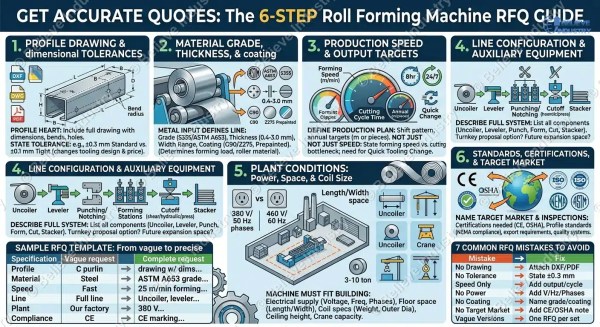
Spécifications clés à définir avant d'établir un devis
Veuillez transmettre ces informations à tout fournisseur. Des spécifications incomplètes entraînent des devis inexacts.
| Spécification | Plage typique | Notes |
|---|---|---|
| Matériel | PPGI, GI, acier doux, aluminium | La force de rendement influe sur le nombre de stations |
| Épaisseur de la bobine | 0,3–3,0 mm | Plus épais = plus de stations, cadre plus lourd |
| Largeur de la bobine | 100–1 250 mm | Détermine la largeur de la machine |
| Hauteur du profil | Jusqu'à 200 mm typique | Les profils profonds nécessitent davantage de stations |
| vitesse de production | 10–60 m/min | Plus rapide = cisaillement servo requis |
| Poinçon requis ? | Oui / Non | poinçonnage servo en ligne ou pré-poinçonnage |
| Tolérance de coupe à longueur | ±0,5 mm standard | Précision de ±0,2 mm disponible avec l'encodeur |
| Alimentation électrique | 380 V / 415 V / 480 V | Vérifier la tension du réseau local |
Bien concevoir cela dès le départ permet d'éviter des modifications techniques coûteuses en cours de construction.
Fournisseurs de profileuses à rouleaux sur mesure : que comparer ?
Le fabricants de machines de profilage à rouleaux Le paysage se divise en trois niveaux. Chacun présente des avantages et des inconvénients.
Niveau 1 — Fabricants chinois exportateurs
Des entreprises comme Believe Industry opèrent à grande échelle. Plus de 3 000 lignes de production ont été livrées dans plus de 50 pays depuis 2005. Leur atout : une expertise technique pointue associée à des prix directs d’usine.
Points clés à vérifier :
- Effectuent-ils une analyse FAT sur votre profil réel ?
- Proposent-ils une installation sur site ? (Nous le faisons.) installation de la machine de profilage à rouleaux)
- Quel est le délai de livraison des pièces détachées après la livraison ?
Pour les acheteurs australiens en particulier, notre machine de profilage à rouleaux Australie Cette page traite de la conformité, de l'assistance à l'installation et de la disponibilité des techniciens possédant des visas australiens valides.
Niveau 2 — Constructeurs européens et américains
Prix de base plus élevé. Assistance locale plus rapide. Délais de livraison souvent plus longs pour les fabrications sur mesure. Excellente conformité réglementaire (CE, UL). Idéal lorsque la certification locale est une exigence absolue.
Niveau 3 — Lignes d'occasion/reconditionnées
Coût initial plus faible, mais l'ajustement sur mesure est aléatoire. Lire la suite machine de profilage à rouleaux d'occasion Guide des risques avant d'opter pour cette solution.
Comparaison des fournisseurs : Chine vs UE vs États-Unis pour les fabrications sur mesure
| Critères | Chine (Believe Industry) | OEM européen | OEM américain |
|---|---|---|---|
| coût de la construction personnalisée | 40K–180K | 120K–400K | 150K–Plus de 500 000 |
| Délai de livraison (personnalisé) | 60 à 100 jours | 90 à 180 jours | 90 à 150 jours |
| Matières grasses incluses | Oui | Oui | Oui |
| Mise en service sur site | Oui | Oui (régional) | Oui (domestique) |
| Disponibilité des pièces détachées | Bourse mondiale | Régional | Domestique |
| Certification CE | Disponible | Standard | Non applicable |
| Soutien linguistique | Anglais, multilingue | Anglais, DE, FR | Anglais |
| expérience du marché australien | Oui - voir le guide | Limité | Très limité |
Les prix de référence varient selon les spécifications. Utilisez notre prix d'une machine de profilage à rouleaux Guide des gammes actuelles pour 2026.
Comment éviter les frais cachés sur une commande personnalisée
Les configurations sur mesure présentent un risque financier plus élevé que les machines standard. Les plus grandes surprises :
- Révisions d'outillage — Si votre fichier DXF change après le début de la fabrication des outils, attendez-vous à des frais de reprise.
- Frais de transport et droits d'importation — Non systématiquement inclus dans le prix indiqué. Veuillez confirmer les conditions DDP et FOB.
- Adaptation électrique — Les machines 380 V nécessitent un transformateur pour les réseaux 415 V/480 V. Budget 1,500–1,500–4,000.
- Formation et mise en service — Tenez compte du temps passé sur site. La mise en service à distance permet de réduire les coûts, mais augmente les risques.
- Ensemble d'outillage de rechange — Commandez toujours un jeu de rouleaux de rechange. Les temps d'arrêt liés à l'attente de pièces de rechange sont coûteux.
Le coûts cachés des machines de profilage à rouleaux Cet article détaille l'ensemble du coût total de possession (TCO) avant votre signature.
Applications de profilage sur mesure par secteur d'activité
A machine de profilage personnalisée ne se limite pas à un seul secteur. Domaines d'application courants :
- Toiture et bardage — Profils de couture debout exclusifs, nervures ondulées, IBR et Klip-Lok
- Système de montage solaire — Profilés en C et profilés Sigma sur mesure pour systèmes de montage au sol et sur toiture
- rayonnages d'entrepôt — Poutres à gradins, montants et platelages avec perforations non standard
- Acier de construction — Pannes en Z/C, pannes en S, profils de montants sur mesure
- Gestion des câbles — Chemins de câbles à échelles, chemins de câbles perforés et profils de chemins de câbles NEMA sur mesure
- Automobile et transport — Profilés de plancher, renforts de caisse, poutres logistiques
Pour un aperçu général de la place du profilage à rouleaux dans les différents secteurs manufacturiers, le machine de profilage à rouleaux La page pilier est le meilleur point de départ.
5 questions à poser à chaque fournisseur avant de s'engager
Pouvez-vous reproduire mon motif floral et me le montrer avant de signer ?
N'importe quel fabricant sérieux peut produire cela en 48 à 72 heures.De quelle nuance d'acier sont faits les rouleaux, et quelle est leur dureté superficielle ?
Le GCr15 à une dureté Rockwell C de 58 à 62 est la norme industrielle. Les rouleaux moins chers s'usent plus vite et subissent des variations dimensionnelles.Allez-vous effectuer une analyse FAT complète de mon profil à vitesse nominale ?
Insistez sur ce point. Une preuve vidéo est acceptable si vous ne pouvez pas être présent en personne.Que comprend la garantie et comment sont gérées les pièces détachées ?
Une garantie mécanique de 12 mois avec un programme de pièces détachées défini est incluse de série.Avez-vous déjà effectué des livraisons vers mon pays et pouvez-vous gérer la conformité aux réglementations locales ?
Cela compte plus que la plupart des acheteurs ne le pensent. Voir le Profilage à rouleaux en Chine Liste de contrôle de conformité pour les importateurs.
Planification de la maintenance pour une ligne personnalisée
A machine de profilage personnalisée représente un investissement important. Protégez-le.
Les points de défaillance les plus courants sur les lignes personnalisées :
- Usure des rouleaux — Détecté précocement en mesurant les dimensions du profil par rapport à la tolérance chaque semaine
- émoussement des lames de cisaille — La hauteur des bavures sur les extrémités coupées est le premier indicateur
- contamination du système hydraulique — Le remplacement régulier des filtres permet d'éviter les pannes hydrauliques du 80%.
- Dérive des paramètres de l'automate programmable — Sauvegardez les paramètres après chaque FAT réussi et après chaque session de réglage
Notre maintenance préventive du profilage à rouleaux Ce guide contient des listes de contrôle quotidiennes, mensuelles et annuelles formatées pour les équipes de production.
Foire aux questions
Une seule unité. Les constructions sur mesure sont par définition des projets à unité unique. Aucune quantité minimale de commande n'est requise.
En général, il faut compter entre 60 et 100 jours entre l'approbation des plans et la réalisation des tests d'acceptation en usine (FAT), en fonction de la complexité et de la charge de travail du fournisseur.
Oui — avec des cassettes d'outillage à changement rapide ou un machine à double couche configuration. Le temps de basculement passe de 3 à 4 heures à 15 à 30 minutes.
Le format DXF est préférable. Un fichier PDF avec des coupes dimensionnées convient également. Les fichiers CAO (STEP, IGES) sont acceptés.
Oui. Believe Industry dispose de techniciens possédant des visas valides pour l'Australie, les États-Unis, l'Union européenne et l'Asie du Sud-Est. Plus d'informations sur [lien manquant]. installation de la machine de profilage à rouleaux.
Les gammes personnalisées d'entrée de gamme commencent aux alentours de 40,000.Complex Salutgh−speed ldanses with danstegrated punching und automated stacprocheg concernantach 200 000 à $300 000+. Consultez notre prix d'une machine de profilage à rouleaux page pour une ventilation complète par spécification.
Prêt à obtenir un devis ?
Envoyez-nous votre fichier DXF de profil, l'épaisseur de la bobine, la nuance de matériau et la cadence de production souhaitée. Nous vous ferons parvenir une simulation de motif floral et un devis préliminaire sous 48 heures.
Pour plus de détails sur le processus d'achat complet, consultez le Guide complet d'achat de machines de profilage à rouleaux 2026.
Liens de référence sortants (Contexte éditorial)
- Le fabricant — Aperçu du processus de profilage à froid — Publication de référence du secteur sur les principes fondamentaux des procédés
- Manuel de conception de l'acier formé à froid AISI — Référence pour la limite d'élasticité et les normes de matériaux
- Norme NEMA VE 1 pour chemins de câbles — Référence pour la conformité des chemins de câbles
- Norme de qualité ISO 9001 — Référence de gestion de la qualité pour l'évaluation des fournisseurs