






What is a Box Beam Roll Forming Machine?
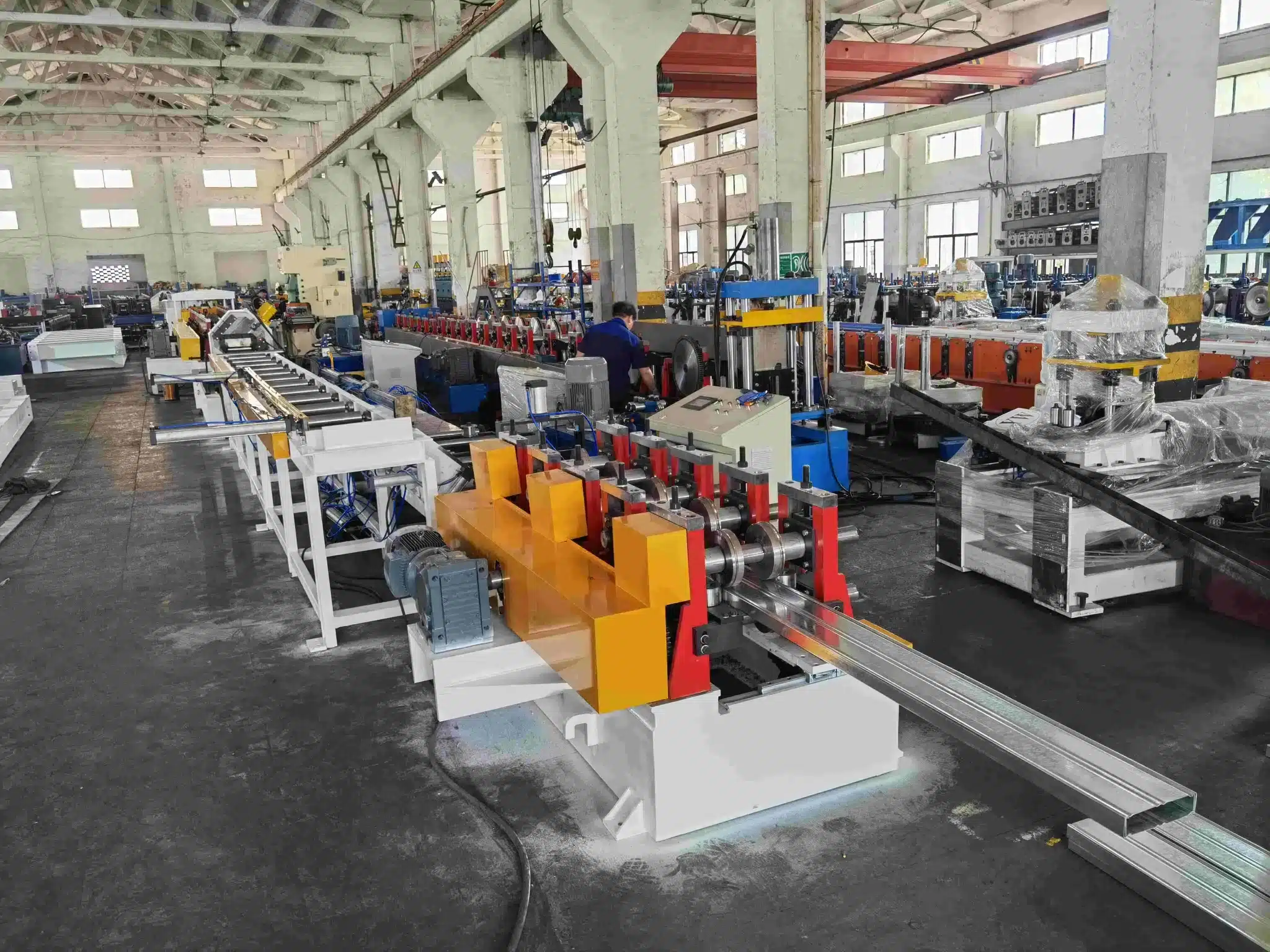
A machine de profilage à rouleaux pour poutres caissons is a heavy-duty industrial production line designed to manufacture closed-section structural beams with a rectangular cross-section. This production line transforms flat steel coils into high-strength box beam profiles through sequential roller stations, with the final section closed and secured through interlocking.
This equipment is essential for manufacturers producing heavy-duty storage rack uprights, offering:
- Production speed: 10-20 m/min
- Épaisseur du matériau : 1.5-3.0mm
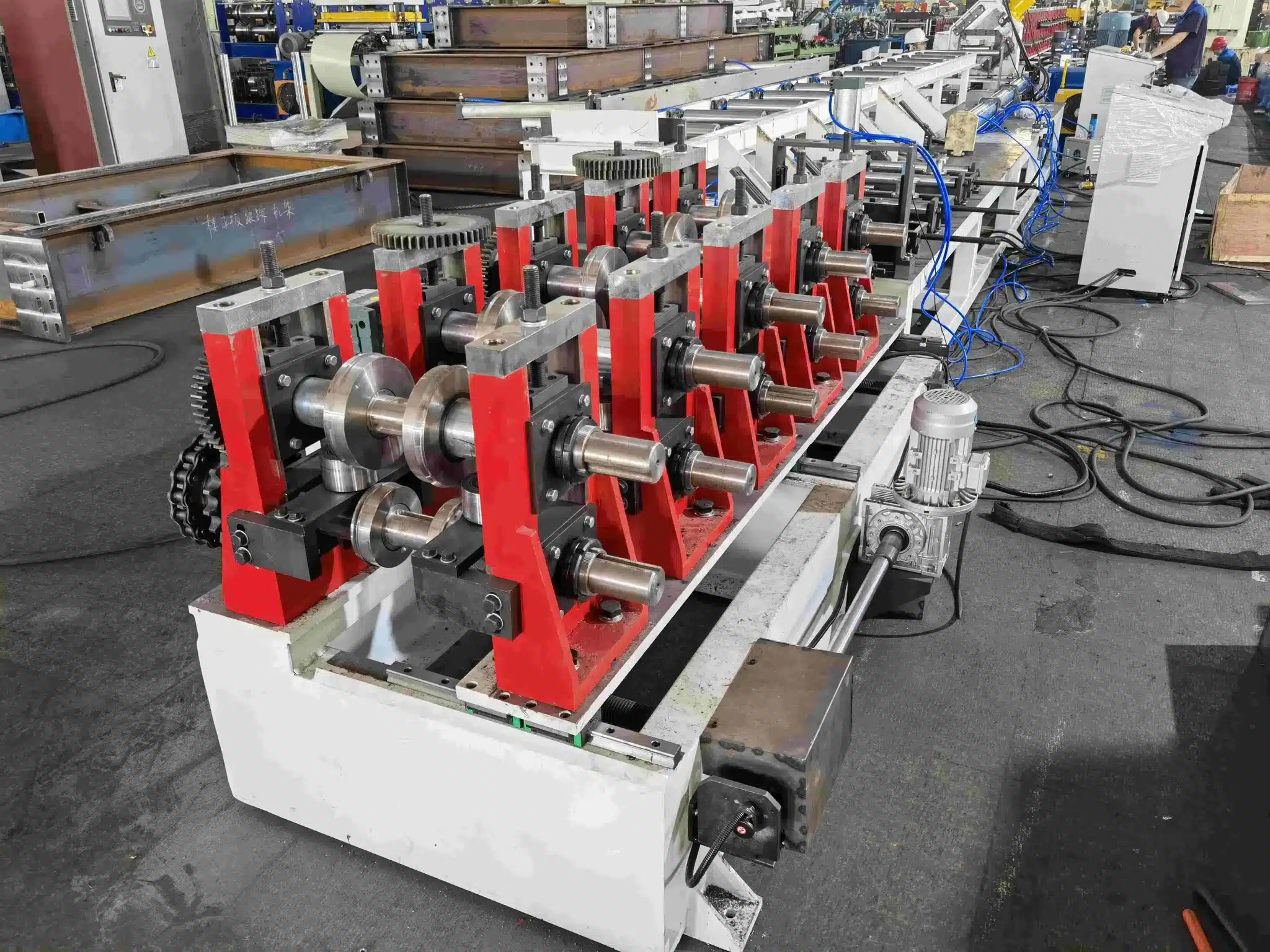
- Stations de formation: 16 for roll forming to C section and 5 for seaming together
- Motor Power: 15 KW +11 KW
- Matériau de rouleau: GCR 15 / CR12 Mov
- Typical price range: 50,000−100,000+
- Machine lifespan: 20+ years
What's Box Beam for Storage Racking System
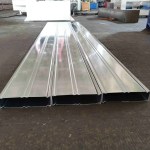
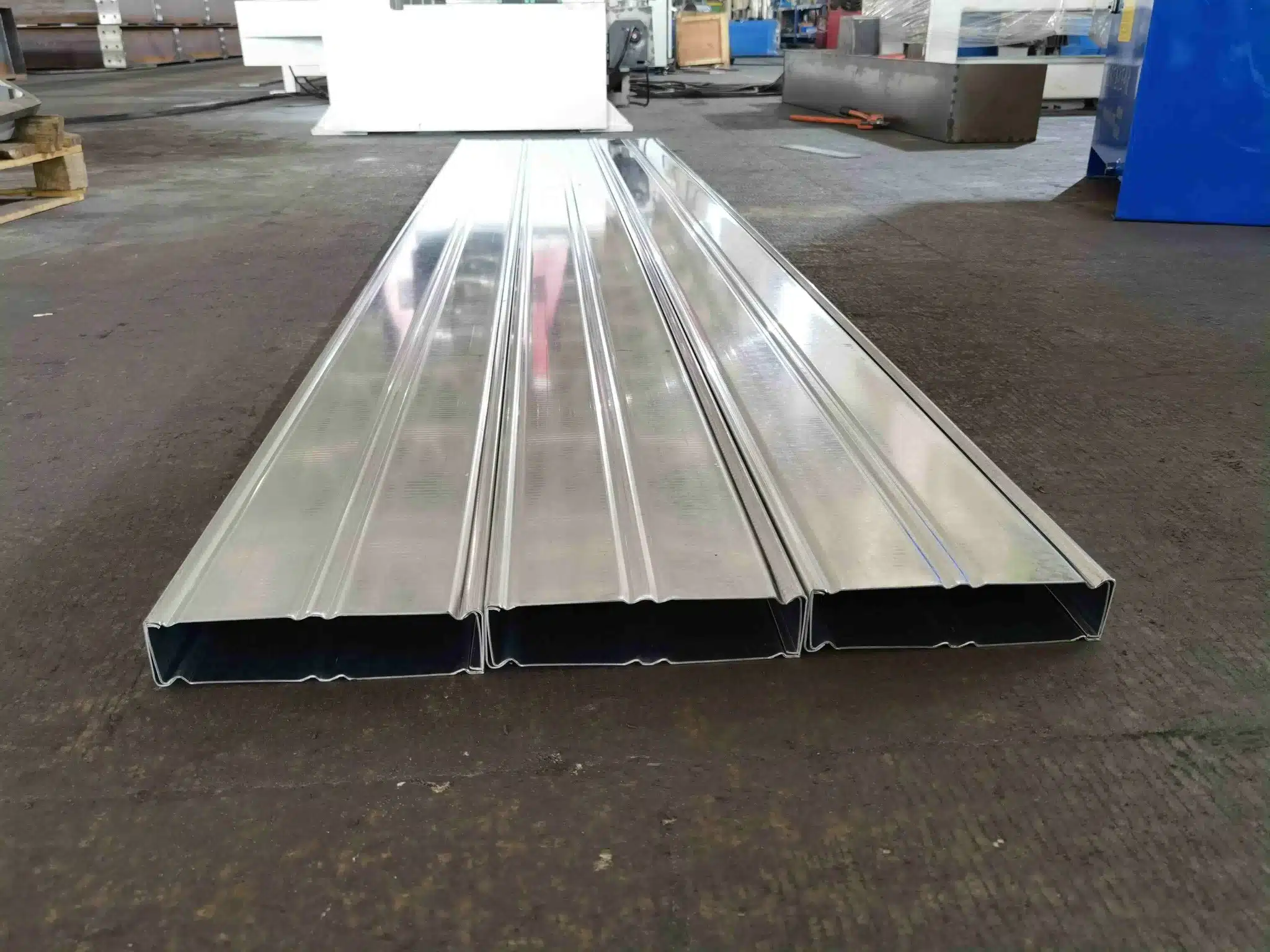
A box beam is a structural steel profile with a hollow, rectangular cross-section. Unlike open-section beams such as C-channels or Z-purlins, the enclosed “box” shape creates a closed loop that provides superior torsional rigidity and load-bearing capacity. In pallet racking systems, box beams serve as the horizontal, load-bearing crossbeams that connect upright columns and support pallets directly.
How box beams are made:
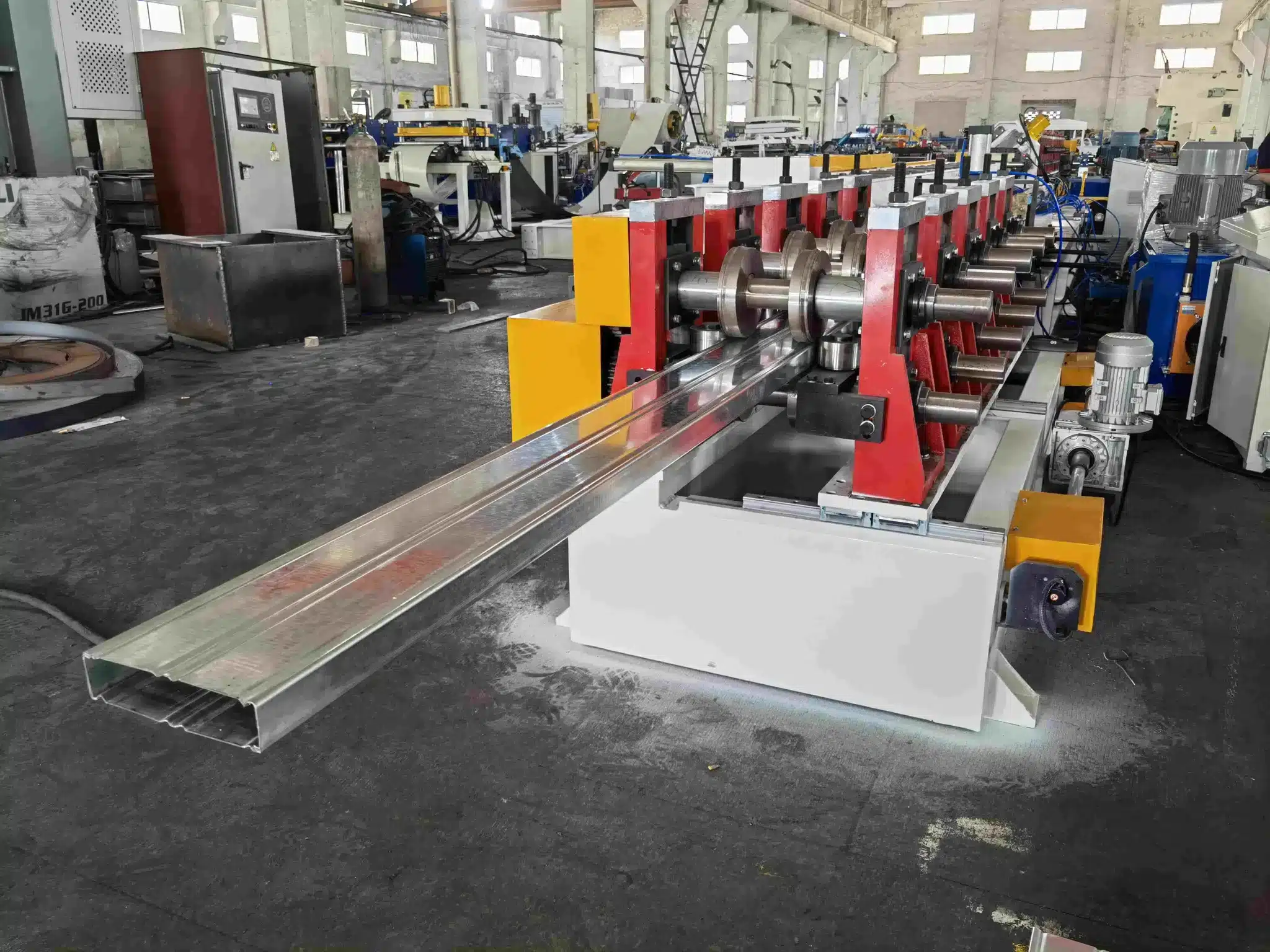
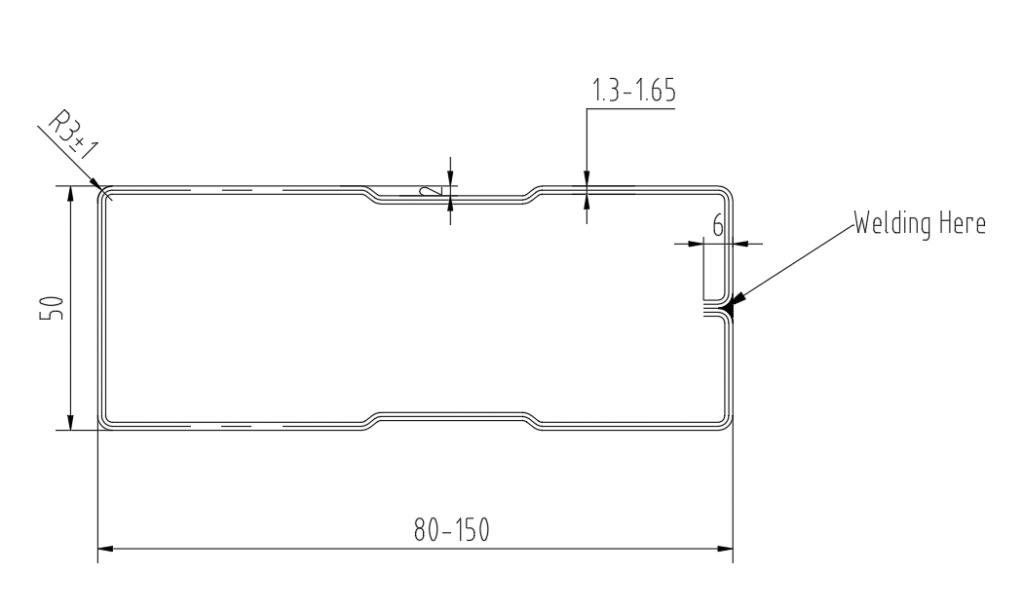
Box beams are typically manufactured from two interlocking U-shaped channel pieces. The top and bottom edges of these pieces are welded together to form a complete rectangular closed section. End connectors (clips) are then welded to both ends, allowing the beam to attach to upright frames.
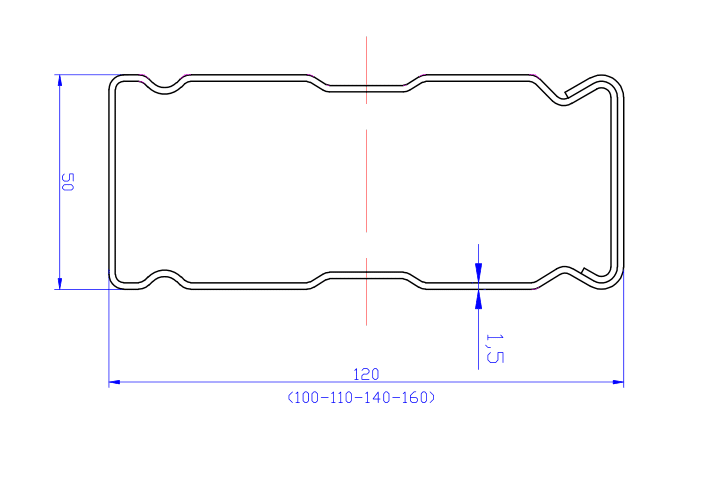
Profile drawings of different design of box beams

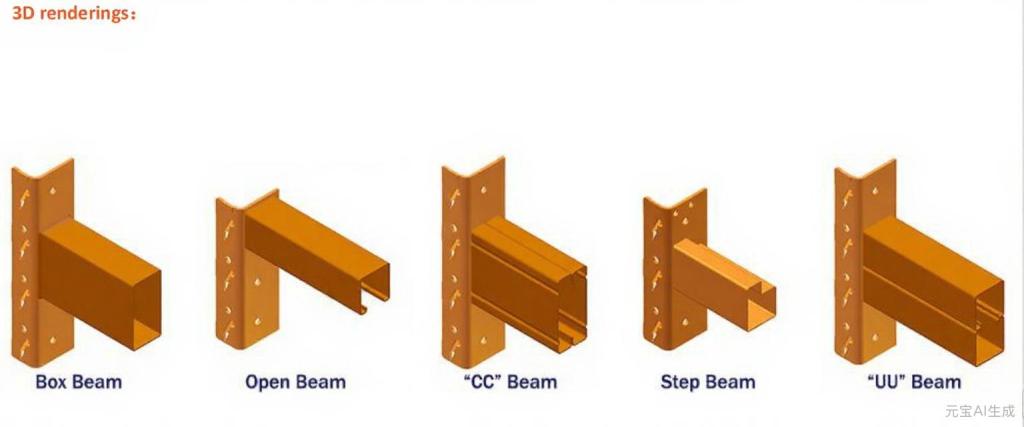
Key characteristics of box beams:
| Fonctionnalité | Box Beam | Poutre à gradins |
|---|---|---|
| Shape | Closed rectangular | Welded step profile |
| Structural role | Horizontal crossbeams (rack beams) | Horizontal beams (rack beams) |
| Torsional rigidity | ★★★ Excellent | ★★ Good |
| Load capacity per sq inch | Plus haut | Modéré |
| Support bar design | U-shaped (external, may snag) | Clip-style (embedded, no snag) |
| Mesh deck compatibility | Universal only | Universal + Step + In-Step |
| Fabrication | 2 U-channel pieces, welded | Single-piece roll forming |
| Market availability | Widely stocked, short lead time | Less common, longer lead time |
| Coût par mètre | Plus haut | Modéré |
Common applications:
- Warehouse storage rack horizontal beams
- Automated storage and retrieval systems (AS/RS)
- Heavy-duty pallet racking
- Industrial shelving systems
- Solar mounting structures
- Construction framework
Box Beam Roll Forming Machine Components
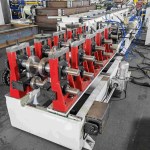
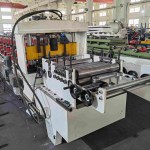
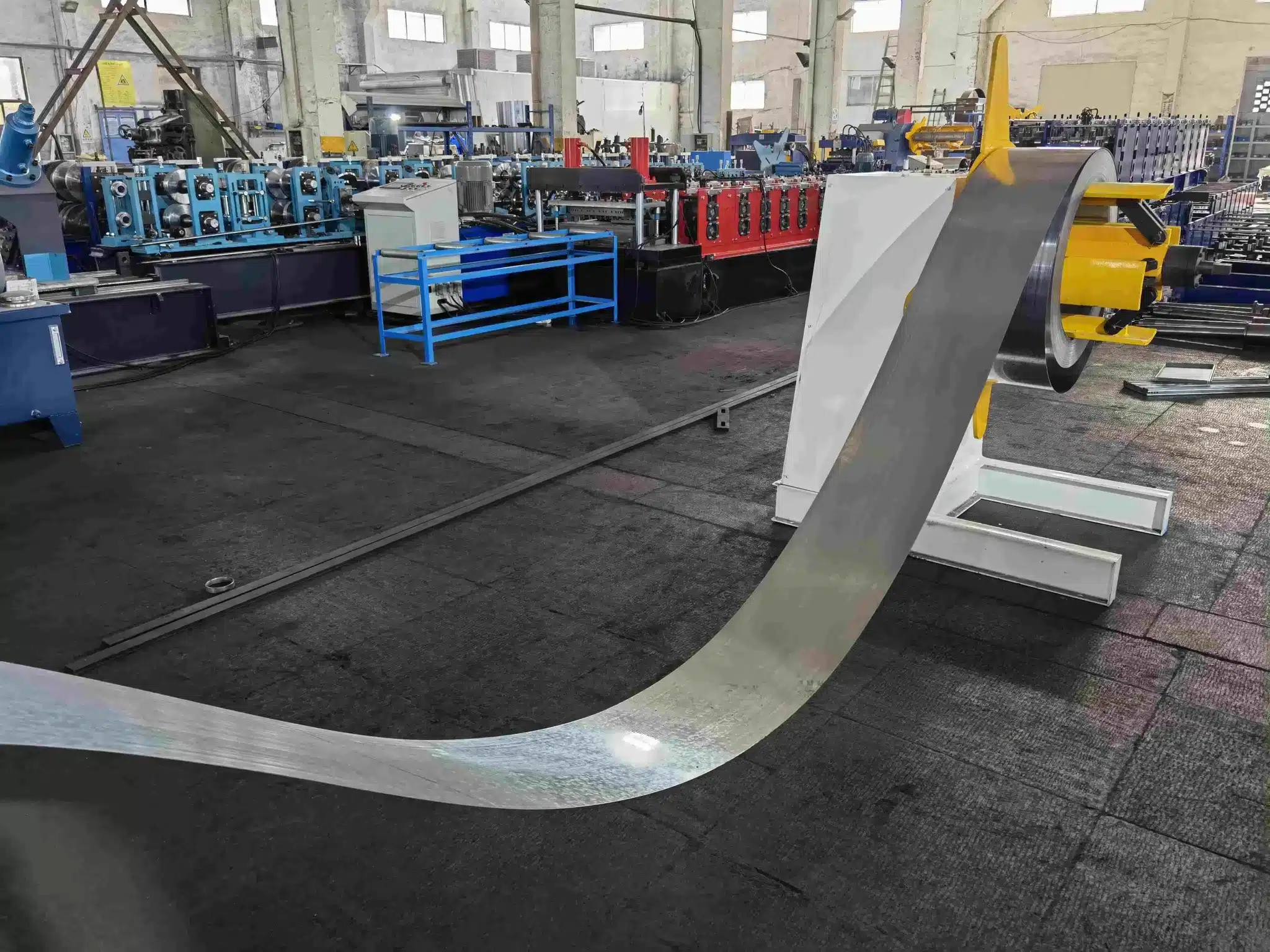
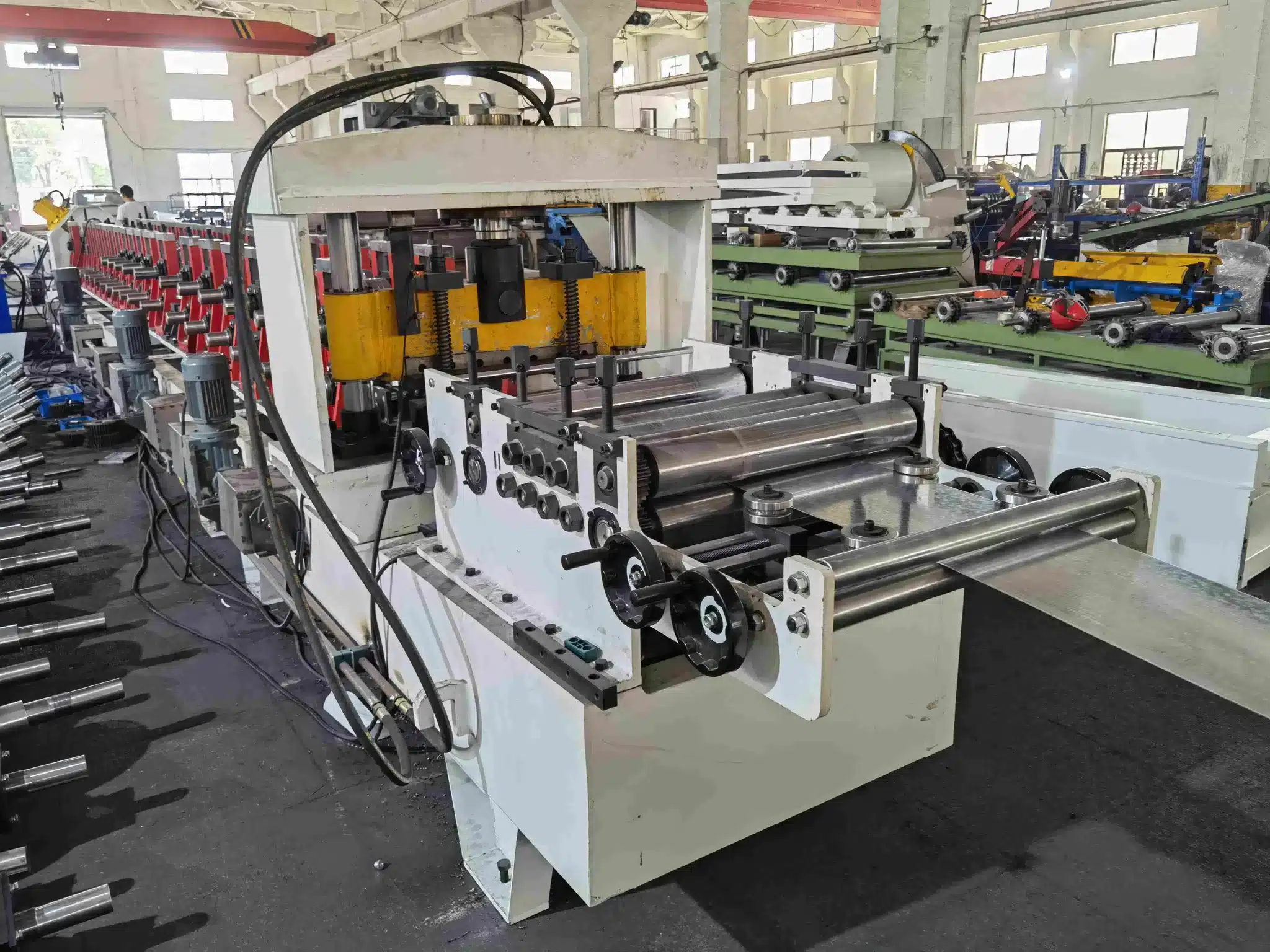
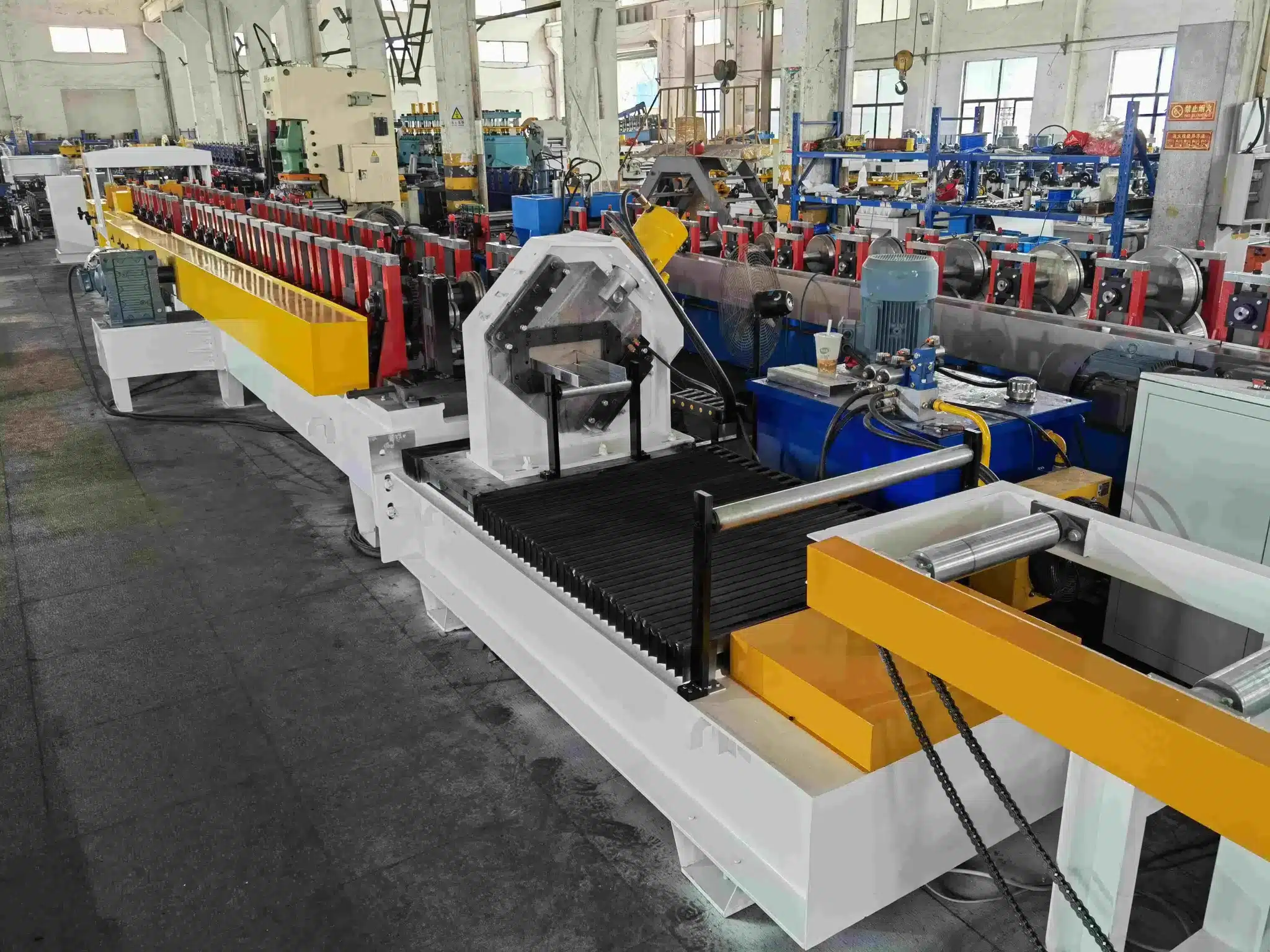
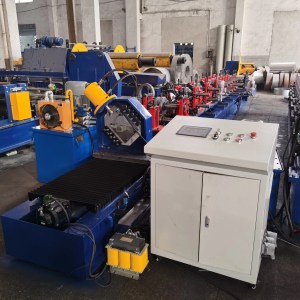
Box beam roll forming machines normally consist of: uncoiler, feeder-guider, roll former, cutter, conveyor-overturn rack, and auto Seamer. These components collaborate to transform sheet metal into uniform box beams efficiently, ensuring precision and consistency in production:
- dérouleur: unwinds coiled sheet metal, feeding flat strips into a box beam machine’s next stages for steady production.
- Feeder-Guider: Feeds and aligns sheet metal from the uncoiler to the roll former—preventing misfeeds and ensuring steady processing.
- Roll Former: Precision rolls that shape sheet metal into the box beam profile, guaranteeing uniform, accurate cross-sections.
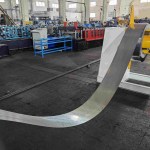
- Hydraulic Cutter: Cuts rolled C sections to desired lengths, ensuring consistent, precise final products.
- Conveyor and Overturn Rack: Moves cut C sections and flips them, then push into automatic seamer.
- Automatic Seamer: Joins the box beam’s edges to make a closed, strong profile—vital for structural performance.
End Connector Welding Technology
Inline Welder for Box Beam End Connector Assembly
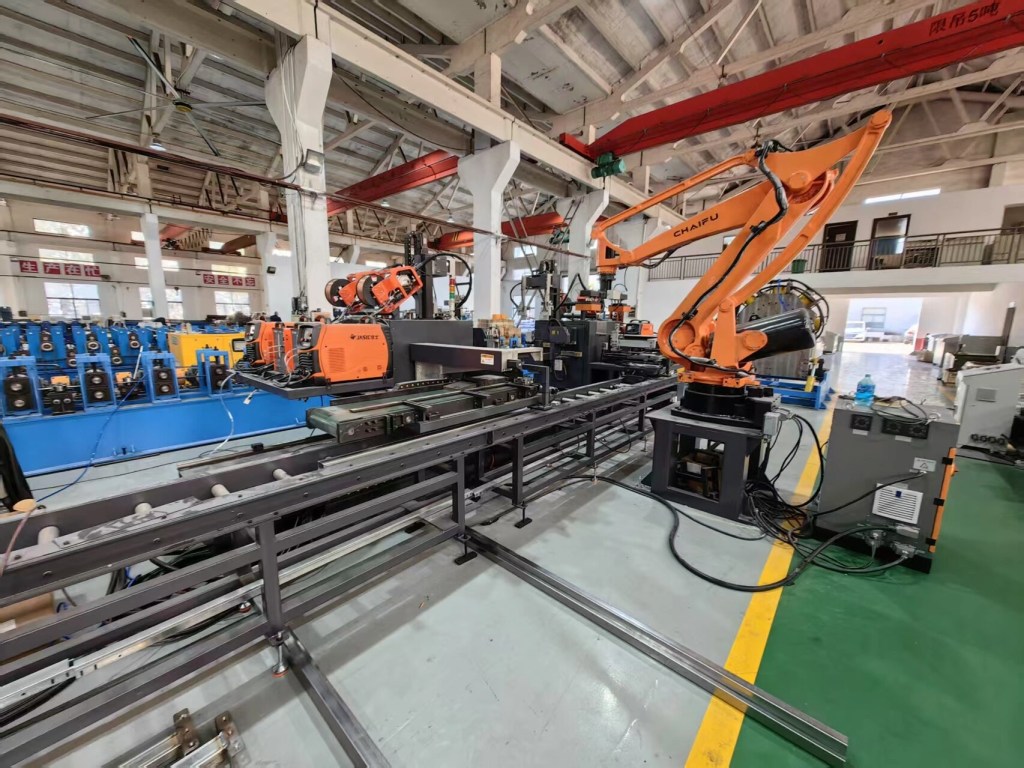
L' machine de profilage à rouleaux pour poutres caissons features an inline end connector welder that automatically welds end connectors (clips) to the box beam profile during the roll forming process. This integrated welding station eliminates the need for secondary welding operations.
Comment ça marche :
The inline welder precisely positions end connectors on the box beam and applies high-quality welds to secure the connection. This happens directly on the production line, ensuring consistent weld quality and reducing labor costs.
Key benefits of inline end connector welding:
| Fonctionnalité | Without Inline Welder | With Inline Welder |
|---|---|---|
| Welding method | Manual post-process | Automated in-line |
| Production efficiency | Lower (secondary operation) | Higher (single-pass) |
| Weld consistency | Variable | Uniform quality |
| Labor requirement | 1-2 workers per shift | Reduced to monitoring only |
| Cycle time | Additional 5-10 seconds/piece | Integrated |
End connector specifications:
- Hole pattern: Standard MHI industry standards
- Hole sizes: 8mm, 10mm, 12mm, 16mm
- Connector types: Flat brackets, angle clips, seismic clips
- Materials: Hot-dip galvanized steel, stainless steel (optional)
Box Beam Roll Forming Machine Specifications
| Paramètre | Standard Configuration | High-Speed Configuration |
|---|---|---|
| Épaisseur du matériau | 1,5 mm – 3,0 mm | 1,5 mm – 3,0 mm |
| Strip width | 80mm – 160mm | 80mm – 160mm |
| limite d'élasticité | 235-345 MPa (soft) / 550-700 MPa (full hard) | 235-345 MPa (soft) / 550-700 MPa (full hard) |
| vitesse de formation | 15-20 m/min | 20-30 m/min |
| Uncoiler type | Manuel | Automatique |
| Transmission | Chaîne et pignon | Boîte de vitesses et joint universel |
| Matériau pour rouleaux | GCR 15 | CR12 Mov (D2) |
| Stands type | Plaques d'acier soudées | Cast Iron |
| Cutting way | Découpe hydraulique stationnaire | Découpe hydraulique volante |
| Alimentation électrique | 380V, 50Hz | 415V, 50/60Hz / 480V, 60Hz |
| Stations à rouleaux | 12-16 stations | 12-16 stations |
| Système de contrôle | Automate programmable + IHM | PLC + HMI (Siemens, Schneider, or Delta) |
| Certification | CE | CE / ISO 9001 |
Optional configurations:
- Inline hydraulic punching station for bracket holes
- Duplex roll former with motorized width adjustment
- Automatic stacking and packaging system
- Automatic end connector weldiong system
Pourquoi choisir Beli Rollforming ?
Beli Rollforming vs Other China Factories vs US/EU Manufacturers
| Facteur | Profilage Beli | Other China Factories | Fabricants américains/européens |
|---|---|---|---|
| Fourchette de prix | 50,000−100,000 | 30,000−60,000 | 150,000−300,000+ |
| Délai de mise en œuvre | 60 à 90 jours | 45-120 days | 120 à 180 jours |
| Personnalisation | Full customization | Limited options | Full customization |
| Contrôle qualité | ISO certified, CE compliant | Variable | ISO certified |
| Des pièces de rechange | Fast delivery | Slow delivery | Fast but expensive |
| assistance technique | On-site installation included | Limité | Paid service |
| Expérience à l'exportation | 20+ countries, since 2008 | Variable | Domestic focus |
| Soutien linguistique | English, multiple languages | Usually Chinese only | Local language |
Why Beli Rollforming stands out:
18+ years of export expertise – Since 2008, we have shipped roll forming machines for logistic profiles to 10+ countries worldwide, including USA, Australia, and Southeast Asia.
Complete turnkey solutions – Our box beam roll forming machine includes not just the roll former, but also uncoiler, feeder, seaming system, hydraulic cutter, and stacker. and inline welder.
Flexible payment terms – We accept L/C, T/T, and offer installment payment options for qualified buyers.
Lifetime technical support – All machines de profilage à rouleaux come with lifetime spare parts supply and remote technical assistance.
Box beam advantage – The machine de profilage à rouleaux pour poutres caissons produces beams with superior torsional rigidity for heavy-duty racking, seismic zones, and high-rise AS/RS applications where maximum load capacity is critical.
Watch: Box Beam Roll Forming Machine in Action
This video demonstrates the complete production process of our box beam roll forming machine, from coil loading to finished beam with end connector welded stacking.
Video highlights:
- Automatic coil uncoiling and feeding
- Sequential roll forming process
- Hydraulic flying shear cutting
- Interlocking seaming in action
- Automatic Convery
- Robot Welder and auto feed end connector system
- Auto Stacking
Foire aux questions
A box beam roll forming machine is a heavy-duty industrial production line that continuously unrolls, levels, punches, and shapes flat metal coils into closed, hollow rectangular or square profiles, commonly referred to as box beams.
The most common application for these profiles is in the material handling industry, specifically as the horizontal, load-bearing crossbeams in pallet racking systems. They are also widely used in structural framing, construction, and heavy-duty shelving.
Forming a closed box requires the edges of the metal strip to be joined together. Machines typically accomplish this using one of two methods:
Interlocking (Clinching): The machine rolls the edges into a specific lip-and-groove profile and then uses heavy pressure rollers to fold and lock them together into a tight mechanical seam.
Welding: The line is equipped with an integrated High-Frequency (HF) induction welder or a continuous seam welder that permanently fuses the two edges as they meet, creating a solid, seamless tube.
Because box beams must support massive amounts of weight, these machines are built to handle high-yield carbon steel, cold-rolled steel, and galvanized steel. The typical material thickness ranges from 1,5 mm à 3,0 mm (approx. 16 to 11 gauge).
Yes. Since racking systems require beams of varying heights and widths (e.g., 80mm to 160mm heights), these machines are highly adjustable. They are often built as duplex roll formers, meaning one side of the roller stands is mounted on a movable base. The operator can use a motorized system to widen or narrow the distance between the rollers to produce different beam sizes without having to remove and replace all the tooling.
Most box beam lines incorporate an inline station de poinçonnage hydraulique located between the uncoiler/leveler and the roll forming section. This station automatically punches the required safety pin holes or connector slots into the flat steel strip before it is folded into a box.
Standard production speeds generally range from 10 à 20 mètres par minute (approx. 33 to 65 feet per minute). The exact speed depends heavily on the thickness of the steel, the frequency of the punching required, and the method used to close the beam (welding vs. interlocking).
Cutting a thick-walled, hollow profile requires a specialized, heavy-duty mechanism. These machines utilize a hydraulic flying shear or a tracking cutter equipped with a custom-machined, multi-piece cutting die. The die securely clamps the outside of the box while a blade shears through the metal, ensuring a clean cut with absolutely no deformation or crushing of the hollow ends.
The return on investment for the machine de profilage à rouleaux pour poutres caissons depends on production volume and local market pricing, but most manufacturers see payback within 12 to 24 months. A single machine running at 15-20 m/min can produce thousands of meters of box beam per shift. For context, the starting price of a quality machine is around 72,000,wSalutle a finished box beam ldanse cun generate 500,000- $1,000,000+ in annual revenue depending on scale.
Installing a machine de profilage à rouleaux pour poutres caissons and commissioning typically takes 2 to 3 weeks on-site, including:
- Foundation preparation and machine leveling
- Electrical and hydraulic connection
- Trial run with sample materials
- Formation des opérateurs
- Final quality inspection
Beli Rollforming includes on-site installation and commissioning in the standard package, with engineers present until the line reaches stable production.
Maintaining the machine de profilage à rouleaux pour poutres caissons is straightforward and keeps the line running at peak performance:
- Tous les jours: Visual inspection of rollers, check oil levels, clear scrap material
- Weekly: Lubricate roller bearings, inspect punch dies, check belt tension
- Monthly: Inspect roll wear, check alignment, verify hydraulic pressure
- Annuellement: Full system overhaul, replace worn rollers, recalibrate forming stations
L' PLC + HMI control system logs operating data to help predict maintenance needs before failures occur.
See the full guider: Guide d'entretien préventif du profilage à froid
Yes. The machine de profilage à rouleaux pour poutres caissons from Beli Rollforming offers full customization of:
- Beam dimensions: Custom heights (80-300mm), widths (50-100mm), and thicknesses (1.0-3.5mm)
- Profile geometry: Closed rectangular, square, or custom closed-section shapes
- End connectors: Custom hole patterns, bracket types, and connector geometries per MHI or OEM standards
- Seam closure: Interlocking (standard) or HF welding (optional) based on strength requirements
Custom profiles typically require a 3 to 5-week tooling lead time in addition to the standard machine delivery.
Conclusion
L' machine de profilage à rouleaux pour poutres caissons is a high-value investment for manufacturers in pallet racking, AS/RS, and heavy-duty storage. Its closed-section profile delivers superior torsional rigidity and load capacity—making it the preferred choice for high-rise systems and seismic applications.
Compared to step beams, box beams offer higher load capacity per square inch, wider market availability, and shorter delivery lead times.
Prêt à commencer ?
Share your beam specifications (height, width, thickness, target output), and we will send a detailed machine de profilage à rouleaux pour poutres caissons proposal within 48 hours. On-site installation, commissioning, and lifetime support are included.
Changelog and Next Review
2025-09-28 | 1.0 | Upload the product page |
2026-04-24 | 1.1 |
|
Prochaine critique : 2026-07-24 (Quarterly review: verify technical specs accuracy, update pricing if needed, add new FAQ topics based on customer inquiries)

Avis
Il n’y a pas encore d’avis.