






A C to Z purlin changeover is only as fast as the adjustments the machine can make without new tooling. Buyers ask for one line that runs both sections. Fewer ask which axes actually move. That omission costs hours on every switch.
On a well specified line, the operator selects a recipe. The machine moves the stands, sets the roll gap, shifts the punch frame and resets the straightener. A C to Z purlin changeover takes 15 to 30 minutes on 1.5 to 3.0 mm stock. With fixed stands and hand shims, it can take half a shift.
This guide lists seven features to specify, the FAT numbers to record, and the standards behind profile tolerances. See our roll forming machine overview.
What a C to Z Purlin Changeover Actually Changes
A C to Z purlin changeover resets one roll forming line from a symmetric C section to a point symmetric Z section without replacing the forming rolls. It moves at least four axes: web width, flange orientation, roll gap and hole pattern.
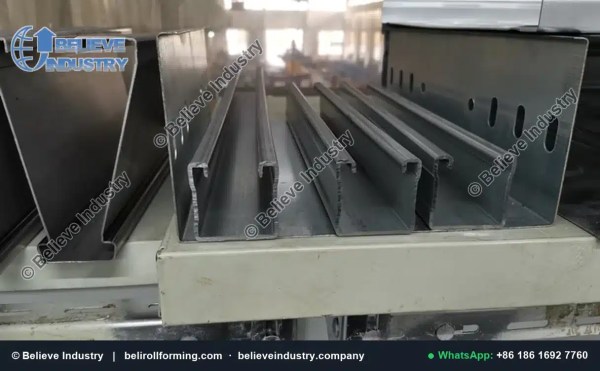
A C section has both flanges pointing the same way. A Z section has one flange up and the other down. The strip bends on a different path, springs back differently and needs its lap holes elsewhere. The geometry is compared in C purlin vs Z purlin.
| Variable | C section | Z section | Axis that must move |
|---|---|---|---|
| Flange direction | Both to one side | Opposite sides | Reversible or swivel stands |
| Web width | 100 to 300 mm | 100 to 300 mm | Lateral stand position |
| Lip return | Same on both flanges | Mirrored | Roll profile or second stand |
| Lap hole pattern | Centred on the web | Offset for overlap | Punch frame lateral position |
| Springback | Low and symmetric | Higher, with twist | Straightener head |
Each row is a physical adjustment.
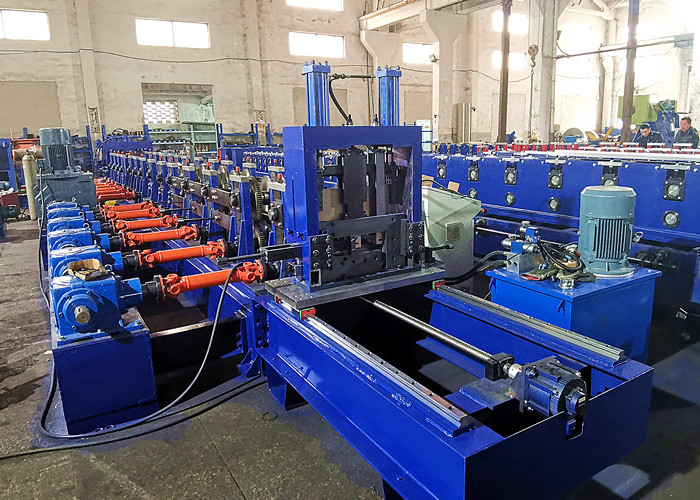
7 Adjustable Machine Features to Specify
1. Lateral Stand Adjustment With a Digital Readout
Web width is the first variable in a C to Z purlin changeover. Structural purlins fall between 100 and 300 mm, so the stands need to slide and lock anywhere in that band.
Ask for servo driven screws with an encoder or digital readout at each stand. Repeatability of ±0.1 mm lets the line return to a width without a trial piece. Check the lock too. A stand that creeps under load widens the web over 6 m. Width ranges are covered in the Z purlin buying guide.
2. Reversible or Swivel Forming Stands
Flange direction separates the two sections. A C to Z purlin changeover must turn one side of the pass line over, either by swivelling a stand 180 degrees or indexing a second cassette into place.
A swivel stand costs less. A cassette keeps the C tooling set up while the Z tooling runs, as our cassette type roll forming machine notes explain. Check that the punch frame and straightener follow the same change.
3. Servo Controlled Roll Gap by Strip Thickness
Strip thickness runs from 1.5 to 3.0 mm on structural purlins. Every stand needs its gap set for that thickness, and again when yield strength changes.
A servo gap with a stored value per stand holds about ±0.05 mm. Shim packs turn a C to Z purlin changeover into a mechanical task. Ask to see the gap screen, not just the motor. The Fabricator’s review of roll forming tooling describes how gap error shows up as marking and shape drift.
4. Programmable Punch Unit With Lateral Hole Shift
Purlins are bolted through the web. C sections use a centred hole pattern. Z sections need the holes offset so two lengths can lap. That is a lateral shift of the punch frame, not a new die.
Specify a servo shifted frame with position feedback and hole pitch driven from the line encoder. Typical bolt holes are 12, 14 or 16 mm on a 50 mm pitch grid. Ask for hole position within ±0.5 mm on a 6 m part. The recipe must hold the first hole distance from the cut, or lap holes will not line up on site.
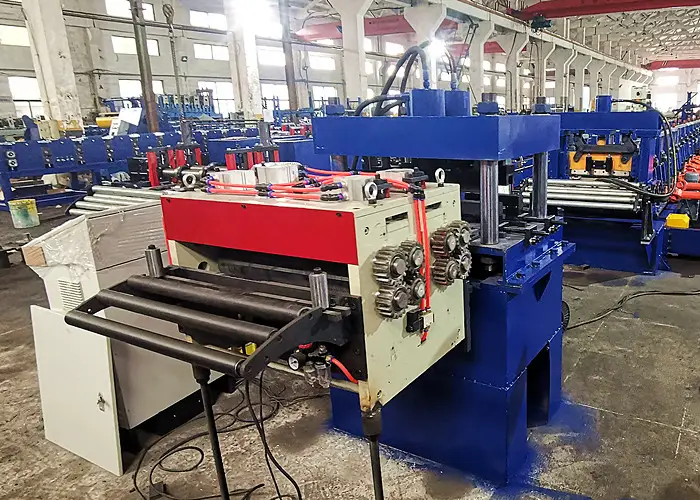
5. Independent Straightening Head for Twist and Bow
Z sections twist more than C sections. The bend path is asymmetric, so residual stress leaves the last stand unevenly. One vertical straightening roll cannot correct that.
Look for independent top, bottom and side roll adjustment with a readable scale on each. Measure bow and twist on a 6 m part after every C to Z purlin changeover. EN 10162 sets delivery tolerances for cold rolled sections in Europe, so put that clause in the acceptance sheet.
6. Quick Swap or Combination Flying Shear Tooling
The cut die has to match the section. A C profile and a Z profile need different blade shapes, and a blunt universal blade crushes one of the lips.
A combination blade handles both with no swap but wears faster. A quick change blade cassette takes about 10 minutes and cuts cleaner. Either way, a C to Z purlin changeover should not end with a grinder at the shear. Ask for cut length within ±1 mm on a 6 m part, with shear and punch reading one encoder.
7. Recipe Driven PLC With Automatic Axis Positioning
The first six features only save time if one command moves them together. A recipe driven PLC stores width, gap, punch offset, straightener setting and shear data for each section.
Ask how many recipes ship with the machine. Fifty or more is normal for several web widths. The screen should show target and actual position per axis and log settings per batch. That log makes a C to Z purlin changeover repeatable. OSHA machine guarding guidance covers reachable powered axes.
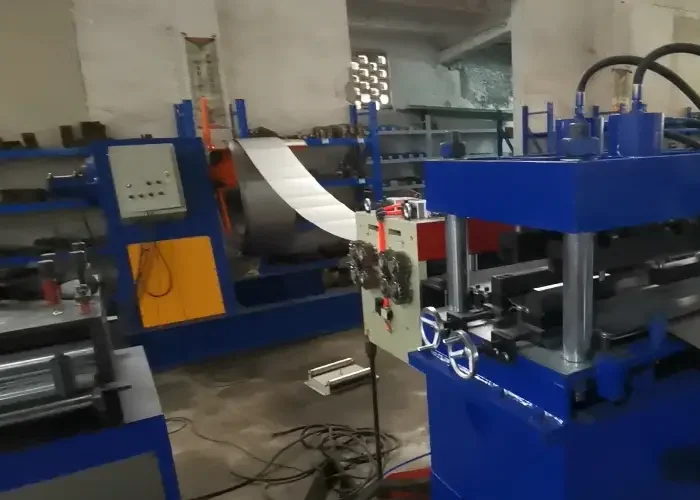
Changeover Time: What to Measure at FAT
Fast changeover in a brochure tells you nothing. Ask the supplier to run a full C to Z purlin changeover and back to C, using your coil, and record each step.
| Feature | Record at FAT | Typical target |
|---|---|---|
| Lateral stands | Width setpoint vs measured web | 100 to 300 mm, repeat ±0.1 mm |
| Reversible stands | Time to swivel or index all stands | 10 to 20 minutes |
| Roll gap | Gap at each stand vs strip thickness | 1.5 to 3.0 mm, ±0.05 mm |
| Punch unit | Hole position on a 6 m part | ±0.5 mm from drawing |
| Straightener | Bow and twist on a 6 m part | Within EN 10162 limits |
| Shear tooling | Blade swap time and cut length | 10 minutes, ±1 mm at 6 m |
| PLC recipe | Full C to Z to C cycle | 15 to 30 minutes total |
Run three cycles and keep the slowest result. Record scrap length in metres. Our quick swap procedure gives the operator sequence.
Tolerances and Standards That Govern the Profile
A C to Z purlin changeover is accepted against dimensional standards, not against a sample the supplier likes. Put the standard number in the acceptance sheet before the machine is built.
| Standard | Scope | What it controls for purlins |
|---|---|---|
| EN 10162 | Cold rolled steel sections, delivery conditions | Section dimensions, straightness, twist |
| EN 1993-1-3 | Eurocode 3, cold formed members | Effective widths, thin gauge design |
| AISI S100 | North American cold formed steel specification | Section properties, design checks |
| ASTM A653 / A653M | Zinc coated steel sheet | Coating class, base steel for galvanized coil |
| EN 10346 | Continuously hot dip coated steel | European coil specification |
| AS/NZS 4600 | Australia and New Zealand cold formed steel | Design rules for purlin projects |
| EN 1090-2 | Execution of steel structures | Tolerance class for CE marked packages |
Check the current edition in the AISI standards catalogue and on the European Commission Eurocodes pages. ASTM publishes the A653 coating specification for galvanized stock, and the Precision Metalforming Association publishes forming and safety material for operators. A quotation that says to standard without a number and edition is not an acceptance criterion.

Buying Checklist: 6 Questions Before You Sign
- Which axes move automatically during a C to Z purlin changeover, and which need a spanner?
- What are the widest web and thickest strip for both C and Z sections on this line?
- How many recipes ship with the machine, and who may edit them?
- Will the supplier run a full C to Z to C cycle at FAT using your coil?
- Which standard and edition sets the dimensional acceptance criteria?
- What does the warranty on the complete machine cover, and for how long?
For the commercial side, see nine comparisons before you buy a C purlin roll former and how to buy a sigma purlin machine.
Frequently Asked Questions
1. How long should a C to Z purlin changeover take? Allow 15 to 30 minutes with servo positioning and stored recipes. Manual stands and shim packs can take half a shift. Measure a full C to Z to C cycle at FAT.
2. Can one roll forming line make both C and Z purlins? Yes, if the stands can swivel and the punch frame can shift sideways. Web widths from 100 to 300 mm are common. Ask the supplier to prove it with your coil.
3. Do I need two sets of forming rolls? Usually not within one web width family. A swivel stand or second cassette handles flange direction. Separate rolls are needed when the lip profile or web depth falls outside the adjustment range.
4. What web width range should I specify? Most structural purlins fall between 100 and 300 mm. Specify the widths you run, then add the largest coil width you plan to buy. A wider range costs more in stand travel.
5. Why do Z purlins twist more than C purlins? The Z bend path is asymmetric, so residual stress leaving the last stand is uneven. An independent straightening head with side roll adjustment corrects it. Vertical pressure alone does not.
6. How tight should the cut length tolerance be? Ask for ±1 mm on a 6 m part. That keeps lap holes aligned at erection. The flying shear and the punch should read the same line encoder.
7. Which standard covers purlin dimensional tolerances in Europe? EN 10162 covers delivery conditions and dimensional tolerances for cold rolled steel sections. EN 1993-1-3 covers design, and EN 1090-2 sets the execution tolerance class.
8. Can the punching unit stay in place during changeover? The frame can stay on the line, but its lateral position and hole pattern must change. A servo shifted frame with encoder driven pitch holds hole position within about ±0.5 mm on a 6 m part.
9. What should a factory acceptance test include? A full C to Z to C cycle using your coil, three repeats, and measured web width, roll gap, hole position, bow, twist and cut length. Record scrap metres and keep the slowest cycle time.
10. Does a recipe driven PLC reduce scrap after changeover? It does when the recipe stores every axis and the log is kept. Measure the first part after a changeover. Compare settings with the last good batch if a dimension drifts.
Conclusion
A C to Z purlin changeover is a positioning problem. Seven axes have to move, hold and repeat. Put all seven in the specification.
Beli Rollforming has built roll forming machines since 2005. We have delivered 500+ machines to 50+ countries from a 15,000 m² plant, with 80+ engineers and technicians. Every machine carries a 24-month warranty on the complete machine. Ask two suppliers to run the same C to Z to C cycle at FAT and hand you the measurement sheet.
Last updated: 2026-11-11
Article Changelog
- 2026-11-11: First publication. Seven adjustable machine features, an FAT measurement table, a standards table, a six point buying checklist and ten FAQ entries.
Next Review Triggers
- A revision to EN 10162, EN 1993-1-3 or AISI S100 that changes dimensional or design criteria
- New in house FAT data on C to Z to C cycle time or scrap length
- A customer project outside the 100 to 300 mm web width or 1.5 to 3.0 mm thickness bands



 English