






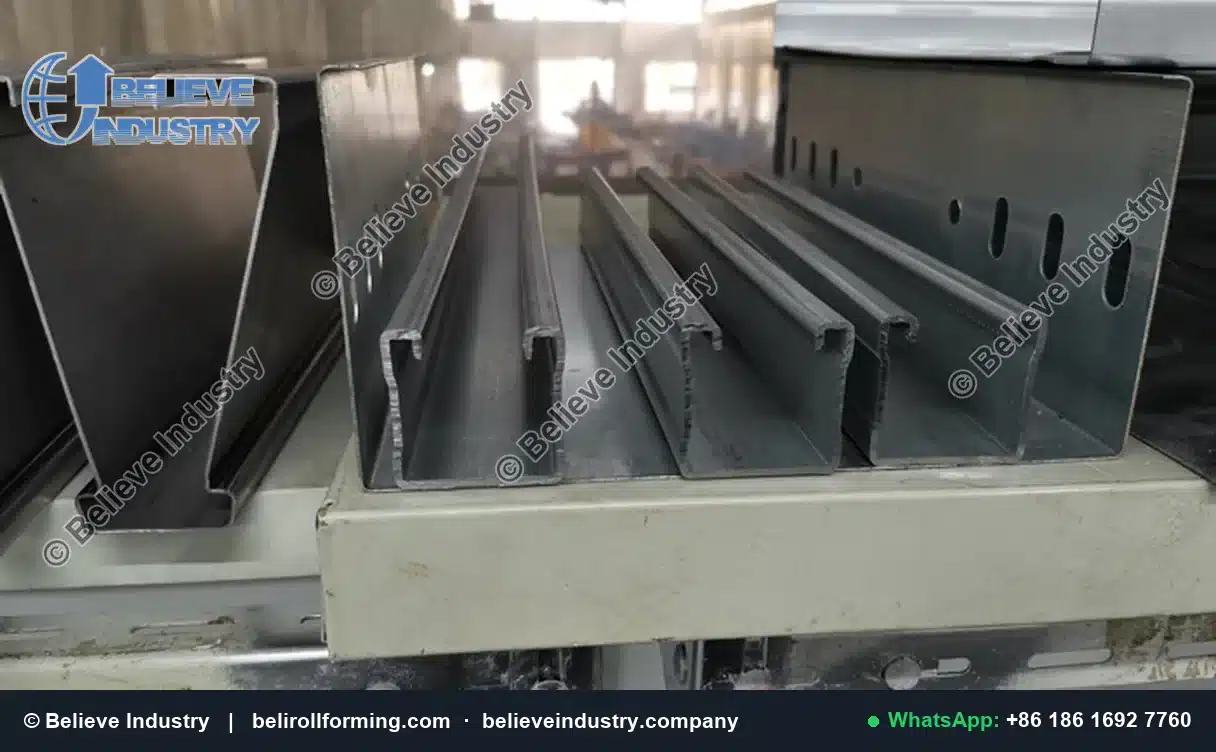
If you are evaluating strut channel manufacturers in the USA, the label alone tells you very little. Some names on a supplier list run their own roll forming lines. Others buy finished channel and resell it from a US address. Both groups can call themselves a manufacturer. Only one controls the coil, the passes, the slots and the finish.
This guide gives buyers a short verification routine. Seven checks separate a real producer from a trading company. Each check comes with a question to ask and an answer to expect. The point is not to favor one supplier. The point is to know what you are actually buying before the purchase order goes out.
The product itself is well defined. A 41 mm base, often called 1-5/8 inch, with depths from 21 to 82 mm. Twelve gauge is about 2.7 mm and 14 gauge about 1.9 mm. Those numbers are the start of the check, never the end.
What “manufacturer” means on a US supplier list
Ask any of the strut channel manufacturers in the USA to describe the site where the channel is made. A real producer can name the town, the number of forming stands and the make of the uncoiler. A broker will talk about warehouses, lead times and shipping terms. Both answers sound confident, but only one describes a forming line.
The difference matters on a spec job. When an engineer sizes a hanger from a published load table, the assumption is that the channel matches a tested section. A reseller may source from a different mill each month. The profile looks the same, the gauge call is the same, and the section modulus is not.
| Signal | In-house producer | Broker or reseller |
|---|---|---|
| Can name the forming line and pass count | Yes | No |
| Provides mill certificates per heat | Yes | Rarely |
| Controls slot and cut length on site | Yes | No |
| Quotes a load table for its own section | Often | Copies a generic table |
| Visiting the plant is possible | Yes | Not applicable |
A buyer does not need to reject a reseller outright. Many resellers add value in stocking and delivery. The mistake is paying producer prices for brokered channel, or assuming a load table applies to steel the seller never formed. When shortlisting strut channel manufacturers in the USA, write the answers to this table into your notes.
Check the standard and the published load table
The second of the seven checks is documentary. Ask which standard the section is made to and where the load figures come from. In North America the reference is MFMA-4, published by the Metal Framing Manufacturers Association. It fixes profile dimensions, tolerances and the test basis behind published capacity tables.
A credible answer names the standard and prints the table on the company site or in the catalog. A weak answer points to a single number with no span, no safety factor and no section. Watch for these three details:
- The span used in the test, commonly 24 in and 48 in.
- The safety factor, often near 1.67 for a simple span.
- Whether the figure is a uniform load or a mid span point load.
A mid span point load is usually taken at about half the uniform rating. A cantilever carries roughly a quarter of a simple span of the same length. If a supplier quotes one load number for every case, the table is marketing, not engineering. Several of the larger strut channel manufacturers in the USA publish fenced tables by depth and gauge. Use them rather than a sales sheet.
Depth drives bending more than thickness. Common depths on the 41 mm base are 21, 41, 52, 62 and 82 mm. A 62 mm channel in 14 ga can outbend a 41 mm channel in 12 ga on a long span. Comparing two offers only by gauge misses this. The Metal Construction Association publishes envelope guidance that helps when strut sits on a roof or an exposed wall.
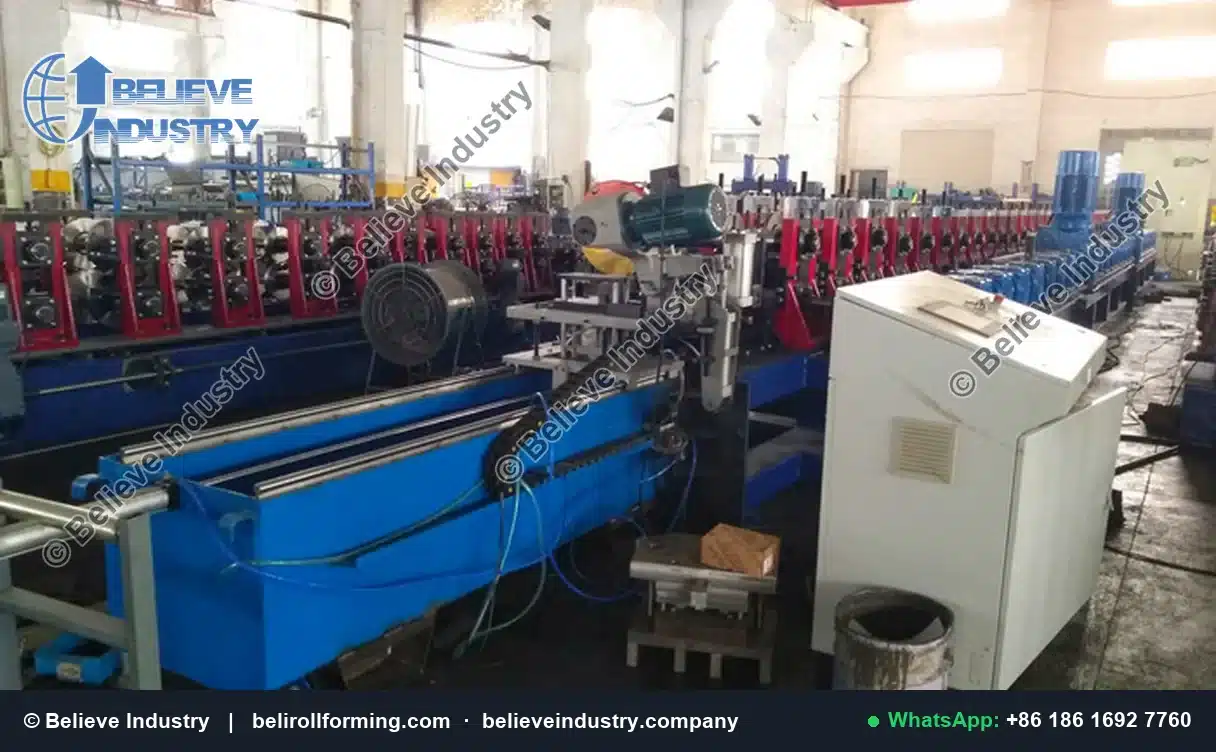
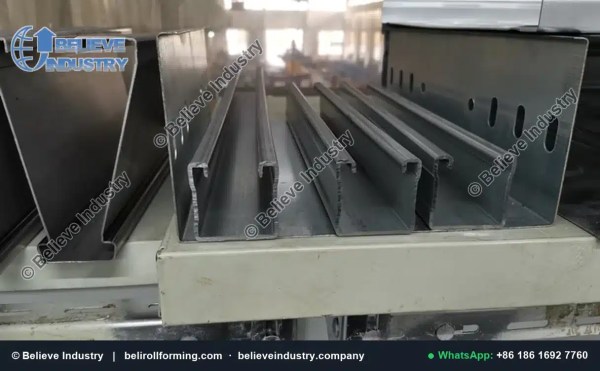
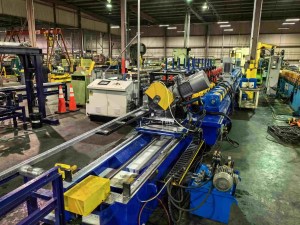
A forming line you can name and visit is the first proof a supplier actually manufactures the channel.
Check the coil and the mill certificate
The third check follows the steel back to the mill. Ask for a certificate with the heat number, yield strength and coating weight. A 350 MPa yield coil and a 550 MPa high strength coil behave very differently at the same 1.9 mm or 2.7 mm thickness. The gauge call alone hides that gap.
Traceability is the practical test. A producer that formed the channel in house can tie a bundle to a coil and a heat. A broker often cannot, because the steel came from several mills. This is why buyers who care about seismic work narrow their list of strut channel manufacturers in the USA to suppliers with their own lines. The World Steel Association explains how flat products are specified and traded, which helps when reading a certificate.
Ask two more questions at this stage. Does the supplier offer a high strength grade, and will it state the yield on the quote? If the answer is yes, request the value in writing. A supplier that will not put yield on paper is telling you something.
Check the coating and the slot pattern
The fourth check is about what happens after forming. Outdoor channel in the USA is normally hot dip galvanized to ASTM A123. Pre galvanized G90 to ASTM A653 suits dry indoor service. The difference shows up at the slots and the cut ends, where bare steel is exposed. The American Galvanizers Association documents how coating thickness is specified and measured.
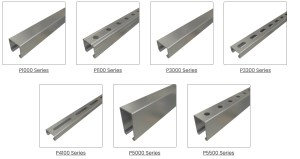
A 9/16 inch slot takes 1/2 inch spring nuts and threaded rod, and is the default for most mechanical and electrical work. A wider 13/16 inch slot fits 3/4 inch hardware on heavier jobs. Slots remove steel from the back face, so a slotted section keeps about 85 percent of the capacity of the same solid profile. Published slotted tables already include that loss. Do not derate a second time.
Ask the supplier to show a sample with the cut end and the slot edge. Coating buildup inside a slot, a burr at the cut, or a bent lip tells you how the line is set up. Among the strut channel manufacturers in the USA that pass this check, the sample usually arrives within a day. Our slotted vs solid strut channel guide covers the punch bypass question in more detail, and the strut channel vs Unistrut guide explains how to answer an or equal call on a drawing.
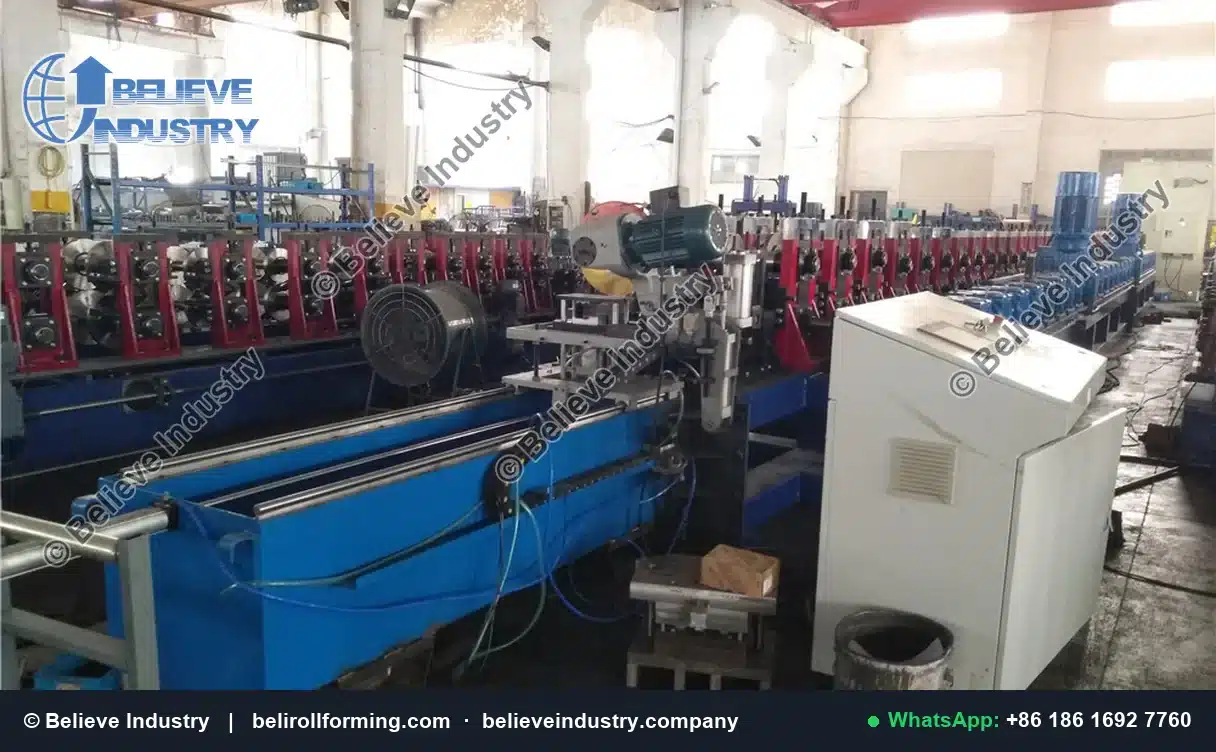
Pass count and roll gaps tell you whether the line can hold an MFMA-4 section tolerance.
Check the line, the QA and the warranty
The fifth check is the visit, or a live video walkthrough when travel is not practical. Watch the uncoiler, the leveler, the pass sequence, the punch unit and the cut off. A line built for both 12 ga and 14 ga needs adjustable roll gaps and a written setup sheet. Without that, the first meters of a heavier gauge come out oversize.
Quality control should be visible on the floor. Look for a gauge or caliper at the pass stands, a slot gauging routine and a record of the last inspection. Ask how often the die is dressed and how straightness is checked on a 6 m length. These habits separate the serious strut channel manufacturers in the USA from the ones that inspect only at dispatch.
The warranty closes the check. Ask what it covers, for how long and who honors it. A 24-month warranty on the complete machine is a useful benchmark when the question turns to equipment. On the channel itself, ask for a written dimensional tolerance rather than a verbal promise. Our strut channel roll forming machine guide walks through the uncoiler to cut off workflow, and the strut channel machine selection guide compares pre punch, flying punch and post punch setups. Both sit inside the wider roll forming machine category.
Beli Rollforming has built roll forming equipment since 2005 and delivered 500+ machines to 50+ countries. Our team includes 80+ engineers and technicians working from a 15,000 m² facility, and every complete machine carries a 24-month warranty on the complete machine.
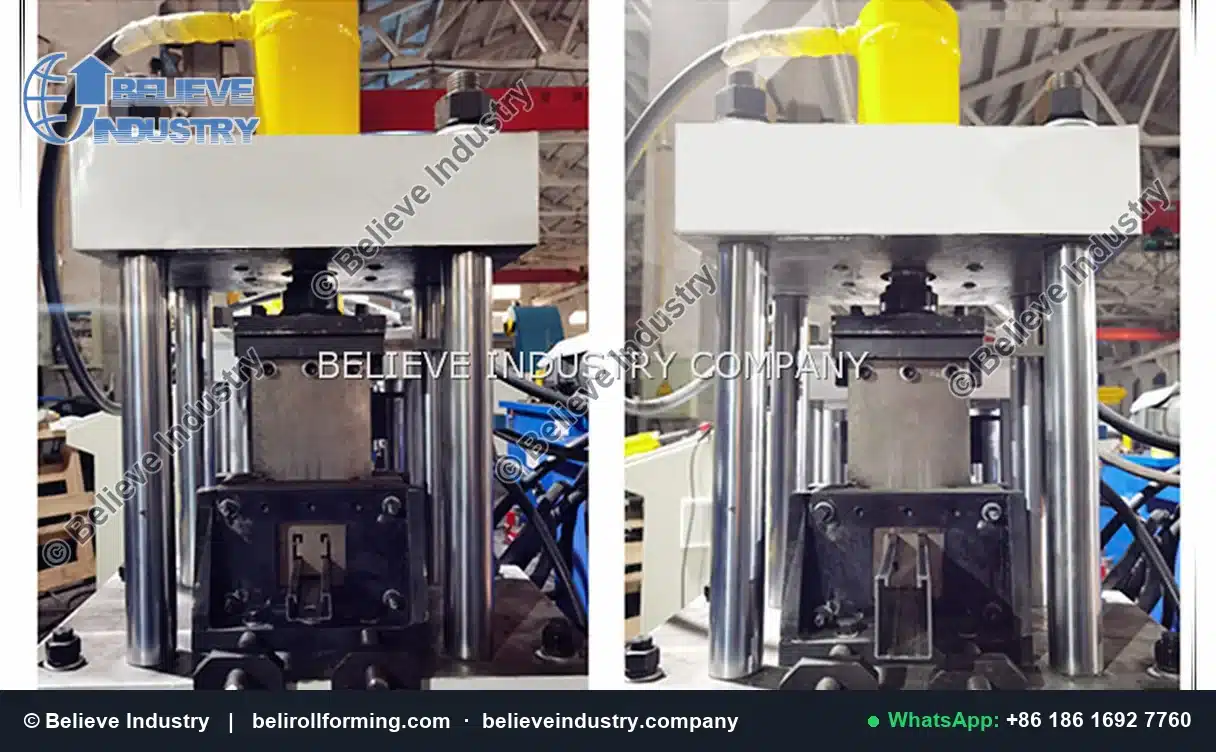
Flying cut off and slot control are checked on site, not inferred from a catalog page.
A 7-point verification sheet you can send today
Turn the five checks above into a short form and send it to every supplier on your list. The comparison is often decided by what is missing. Use this table as the body of the email.
| # | Check | Question to ask | Answer you want |
|---|---|---|---|
| 1 | Facility | Where is the channel formed, and how many passes? | A named site and a pass count |
| 2 | Standard | Is the section made to MFMA-4? | Yes, with the tolerance sheet |
| 3 | Load data | Which table, span and safety factor? | A published table by depth and gauge |
| 4 | Steel | Heat number and yield on the certificate? | Yes, traceable to the bundle |
| 5 | Coating | ASTM A123 or A653, and what weight? | A named spec with thickness |
| 6 | Slots and cut | Slot width, cut length tolerance and sample? | A sample with a clean cut end |
| 7 | QA and warranty | Inspection record and warranty terms? | A routine and written terms |
Two more references help once the sheet comes back. The metal framing channel guide defines the profile terms used in most US specifications, and the 12 ga vs 14 ga strut channel guide sets out the thickness and load differences behind the gauge call. Shortlisting strut channel manufacturers in the USA is simpler when every supplier answers the same seven lines.
Frequently Asked Questions
1. How do I know if a US strut channel supplier really manufactures the product?
Ask for the forming site, the number of passes and a mill certificate tied to your bundle. A producer can answer all three. A broker usually cannot provide the pass count or heat traceability.
2. What standard should strut channel manufacturers in the USA meet?
MFMA-4 is the main North American reference. It sets profile dimensions, tolerances and the basis for published load tables. Ask for the tolerance sheet, not just a claim of compliance.
3. What load figure should I expect from a 12 ga, 1-5/8 in channel?
A standard 1-5/8 by 1-5/8 in, 12 ga section carries roughly 850 to 870 lb uniform load on a 4 ft simple span, using a safety factor near 1.67. Confirm against the supplier’s own table.
4. Does slotting reduce the load rating?
Yes, by about 15 percent, because slots remove steel from the back face. Published slotted tables already include this reduction, so do not apply a second derating factor.
5. Which coating should I specify for outdoor use?
Hot dip galvanized to ASTM A123. Pre galvanized G90 to ASTM A653 suits dry indoor service but protects slots and cut ends less well outdoors.
6. Why ask for yield strength and not just the gauge?
Gauge is thickness, not strength. A 350 MPa coil and a 550 MPa coil at the same 1.9 mm behave differently. The mill certificate gives you the real value.
7. Can one line make both 12 ga and 14 ga strut channel?
Yes, with adjustable roll gaps, a documented setup sheet and the right press tonnage. Pass schedules differ by gauge, so changeover is a setup procedure, not a button press.
8. How deep should the channel be for a long span?
Depth drives bending more than thickness. On the 41 mm base, options run from 21 to 82 mm. Compare section moduli in the load tables at your exact span.
9. Is a 24-month warranty normal for strut channel equipment?
A 24-month warranty on the complete machine is a useful benchmark for the forming line. For the channel itself, ask for written dimensional tolerances and coating specs instead.
10. What belongs in an RFQ to strut channel manufacturers in the USA?
Seven lines: forming site, MFMA-4 compliance, load table with span and safety factor, mill certificate, coating spec, slot width and cut tolerance, and QA plus warranty terms.
Last updated: 2026-11-23
Article Changelog
| Date | Change |
|---|---|
| 2026-11-23 | First published. Seven verification checks for US strut channel suppliers: facility, MFMA-4, load data, mill certificate, coating, slots and QA, with a sendable RFQ sheet. |
Next Review Triggers
- MFMA revises MFMA-4 dimensions or load table methods.
- ASTM updates A123 or A653 coating requirements.
- A supplier on the shortlist changes mill or forming location.
- New strut channel equipment or buyer guides go live on this site.


 English