






If you are comparing strut channel vs unistrut, the short answer is that they are the same thing. One is a product category. The other is a brand name that became the category name in everyday speech.
A buyer who asks for Unistrut usually gets a strut channel. A buyer who asks for a strut channel may be shown a Unistrut box. In practice, the two phrases point to the same cold formed steel profile with inward lips and a row of slots.
This guide clears up the naming. It also gives you the sizes, gauges and standards that matter when you write a specification. If you are buying equipment rather than profiles, the naming question changes which machine you order.
The short answer: strut channel vs unistrut
Strut channel is the generic name for a lipped metal framing channel. Unistrut is a brand owned by Atkore that makes this product. The brand is so well known that many people use “unistrut” as a common noun.
So when you see strut channel vs unistrut in a search or a drawing, read it as brand versus category. There is no technical difference in the profile itself. A 41 mm channel made by Atkore and a 41 mm channel made by another mill can meet the same MFMA-4 standard.
The useful distinction is about documentation and supply. Branded product comes with a published load table and a known finish warranty. Generic product can be equally good, but you need to ask for the mill certificate and the load data.

A slotted strut channel is the product most buyers mean when they say Unistrut.
What “strut channel” means
The industry term is metal framing channel. The profile starts as flat steel coil and passes through a series of roll forming stations. Each station bends the strip a little more. The finished section has a flat back, two side walls and lips that curl inward at the opening.
Those lips are the whole point. A spring nut slides into the channel, turns a quarter turn and locks behind the lips. Brackets, clamps and threaded rod then bolt on anywhere along the length. No drilling, no welding on site.
The Metal Framing Manufacturers Association publishes MFMA-4, the North American standard for metal framing channel and fittings. It covers dimensions, tolerances and testing. When you specify a strut channel vs unistrut product by size and standard instead of by brand, you keep more suppliers in the bid.
Common sizes follow a 41 mm, or 1-5/8 inch, base width. Depth options include 21, 41, 52, 62 and 82 mm. Standard lengths are 10 ft and 20 ft in North America, and 3 m and 6 mm metric stock elsewhere.
Where “Unistrut” came from
Unistrut began as a trademark in the United States and grew into a shorthand for the entire product family. The brand is now part of Atkore, which still publishes one of the most cited load tables in the trade. You can see the original product family on the Unistrut site and the corporate history on Atkore.
This is why the phrase strut channel vs unistrut confuses new buyers. A specification that says “Unistrut or equal” is really asking for a channel in the 41 mm family with comparable load performance. The words do not lock you to one manufacturer unless the project engineer says so.
There are other brands in the same space. Superstrut, PowerStrut and Kindorf all make lipped channels that fit the same accessories. In most cases a fitting from one brand will slide into a channel from another, provided the lip geometry follows the common 41 mm pattern.

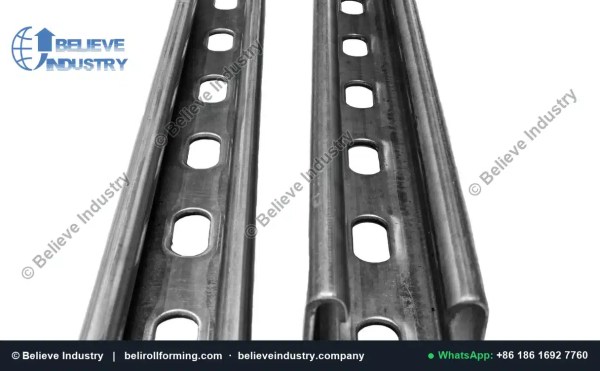
Solid and slotted profiles from the same 41 mm strut channel family.
Strut channel vs unistrut, side by side
| Term | What it refers to | How it is used |
|---|---|---|
| Strut channel | Generic product category | Drawings, specs, procurement |
| Unistrut | A specific brand, now a common noun | Speech, catalogues, brand-led specs |
| Metal framing channel | Formal industry term | MFMA-4, engineering documents |
| Slotted channel | Channel with elongated slots in the back | Adjustable fixing |
| Solid channel | Channel with no slots | Higher load, cleaner face |
| Support channel | Functional description | Install guides, MEP drawings |
The table shows why strut channel vs unistrut is not really a product comparison. It is a vocabulary question. Once you translate the brand name into a size, gauge and standard, the two sides of the comparison become identical.
One practical tip for anyone writing an RFQ. Name the profile size, the gauge, the slot pattern and the standard. Then list acceptable brands if the project requires them. That removes the ambiguity from strut channel vs unistrut before a quote is issued.
Sizes, gauges and MFMA-4
Gauge is the next thing to pin down. The two common North American gauges are 12 ga at about 2.7 mm and 14 ga at about 1.9 mm. A slotted channel carries roughly 85 percent of the capacity of the same solid section, because the slots remove material from the back.
| Property | Common value | Why it matters |
|---|---|---|
| Base width | 41 mm / 1-5/8 in | Sets fitting compatibility |
| Depth options | 21, 41, 52, 62, 82 mm | Controls bending strength |
| Material thickness | 12 ga 2.7 mm, 14 ga 1.9 mm | Sets load capacity |
| Slot size | Sized for 1/2 in threaded rod | Fixes accessory choice |
| Standard | MFMA-4 | Dimensions and test method |
| Common finishes | Pre-galv, hot dip, stainless, aluminium | Corrosion environment |
Galvanizing choice drives service life outdoors. The American Galvanizers Association explains the difference between pre-galvanized and hot dipped coatings. For coastal or chemical exposure, ask for hot dip or stainless rather than relying on a brand name to imply corrosion resistance.
The Metal Construction Association publishes guidance on how coated steel performs in building envelopes. That is useful background when a strut channel vs unistrut decision turns on finish rather than shape.
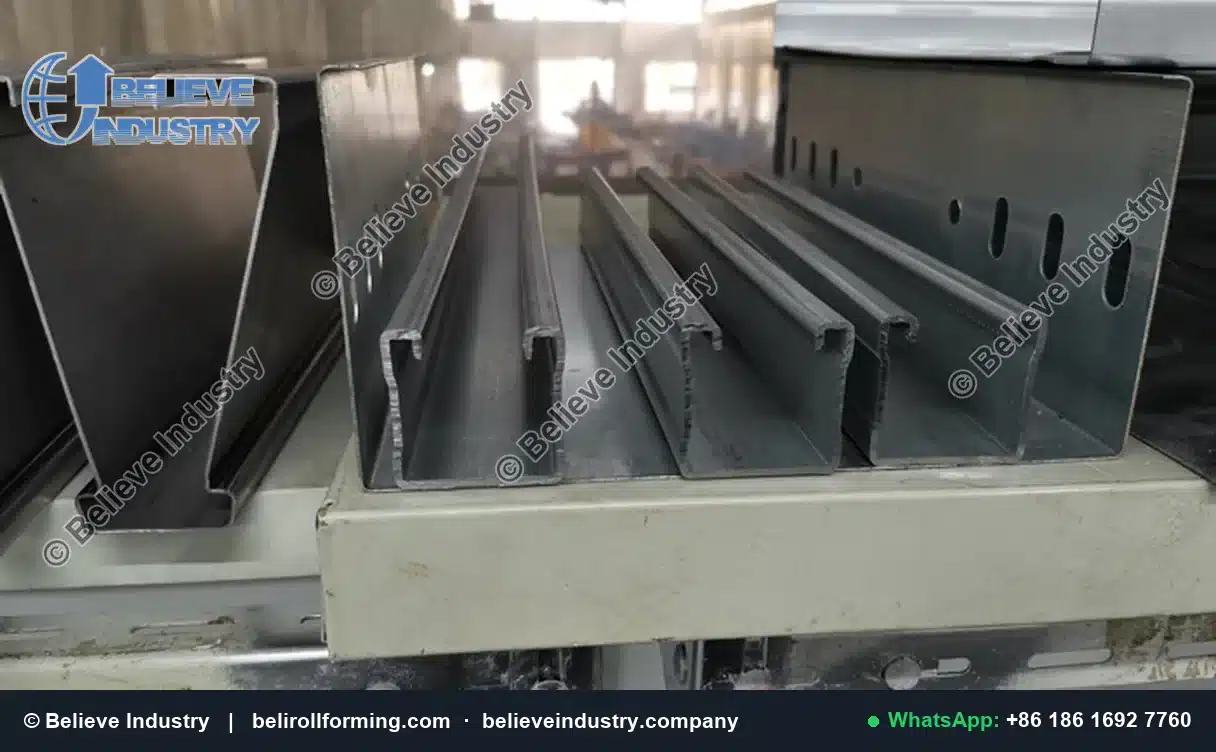
Depth and gauge are the two dimensions that decide how much load a channel carries.
What the naming means for machine buyers
Here is where the distinction earns real money. If you make profiles, “Unistrut machine” and “strut channel machine” are both used as search terms. Suppliers list both because buyers type both. A line sold under either name should do the same job.
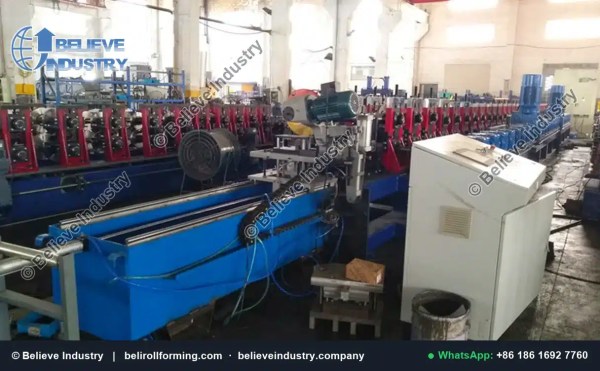
A proper production line takes coil through an uncoiler, a leveler, a servo feeder, a punching press, the roll former, a cut off unit and a run out table. The punching station makes the slots before or after forming. That choice affects accuracy and changeover time more than the name on the machine does.
Our strut channel roll forming machine guide breaks down that workflow. For the brand term specifically, see the unistrut roll forming machine page. Both describe equipment that produces the same 41 mm family.
If you are still choosing a configuration, the strut channel machine selection guide covers punch methods and tooling. Every roll forming line sits inside the wider roll forming machine category, which is the best place to start if you are new to the process.
Believe Industry has built machines since 2005 and delivered 500+ machines to 50+ countries. Our team includes 80+ engineers and technicians working from a 15,000 m² facility. Every complete machine carries a 24-month warranty. That experience applies whether a customer calls the profile strut channel or Unistrut.
Frequently Asked Questions
1. Are strut channel and Unistrut the same product?
Yes. Unistrut is a brand of strut channel, and the brand name is widely used as a generic term. The profile, sizes and fittings are the same category of product.
2. Why do people call all strut channel “Unistrut”?
The brand was an early market leader in North America and its name entered everyday speech. Using the brand as a noun is common even when the channel comes from another manufacturer.
3. What does MFMA-4 cover?
MFMA-4 is the North American standard for metal framing channel and fittings. It sets dimensions, tolerances and test methods, so channels from different makers can be compared on equal terms.
4. What is the standard strut channel size in the US?
The base width is 1-5/8 inch, or 41 mm. Common depths are 1-5/8 and 2-1/2 inch, with deeper 82 mm sections for heavier loads.
5. Is 12 gauge or 14 gauge strut stronger?
12 gauge is stronger. It is about 2.7 mm thick versus 1.9 mm for 14 gauge. Use 12 gauge for structural and seismic work and 14 gauge for lighter cable and conduit support.
6. How much strength do slots remove?
A slotted channel carries about 85 percent of the load of the same solid profile. The slots also let you move fittings along the channel, which is why most MEP installations use slotted stock.
7. Will fittings from one brand fit another brand’s channel?
Usually yes, if both follow the standard 41 mm lip geometry. Always confirm the lip profile when mixing brands on a seismic or load critical job.
8. What machine makes strut channel?
A strut channel roll forming machine, also called an unistrut machine or slotted channel production line. It forms coil into the lipped profile, punches the slots and cuts to length in one pass.
9. Can one machine make both solid and slotted channel?
Yes. The punching station can be bypassed for solid sections, or fitted with different dies for slot and round hole patterns. Tooling changeover is the main cost.
10. Which finish should I specify for outdoor use?
Hot dip galvanized for general outdoor exposure. Stainless steel for coastal or chemical environments. Pre-galvanized is fine for dry indoor framing.
Last updated: 2026-11-17
Article Changelog
| Date | Change |
|---|---|
| 2026-11-17 | First published. Brand versus category naming, MFMA-4, gauges and machine terminology. |
Next Review Triggers
- MFMA revises MFMA-4 or publishes a new metal framing standard.
- Atkore changes the Unistrut product range or load tables.
- Common gauge or depth preferences shift in the US market.
- New internal links on strut channel equipment go live.

 English