Upright Rack Machine Buy Guide_ 7 Proven Steps to the Best Deal in 2026

Upright Rack Machine Buy Guide: 7 Proven Steps to the Best Deal in 2026

Buying an upright rack roll forming machine is a significant capital decision. The wrong machine locks you into the wrong profile, the wrong punch system, and the wrong supplier relationship for years.

This upright rack machine buy guide cuts through the noise. You will learn the key specifications, compare bolted vs welded rack production, evaluate three punch technologies, and see how global suppliers stack up side by side.

Use it as your definitive checklist before you sign any purchase order. Whether you are searching for an upright rack roll forming machine buy guide for a new factory or comparing suppliers for a second line, the sections below answer the questions that matter most.

1. What Is an Upright Rack Roll Forming Machine?

An upright rack roll forming machine continuously forms steel coil into structural uprights (columns) for pallet racking and industrial shelving systems. These uprights carry the entire load of a storage system, so dimensional accuracy and material consistency are non-negotiable. For a technical primer on the cold forming process itself, the Metal Forming Handbook (Schuler) remains the industry reference.

A full production line typically includes:

  • Uncoiler — feeds the steel coil
  • Straightener / leveling unit — removes coil set
  • Pre-punch press — creates teardrop or round holes before forming
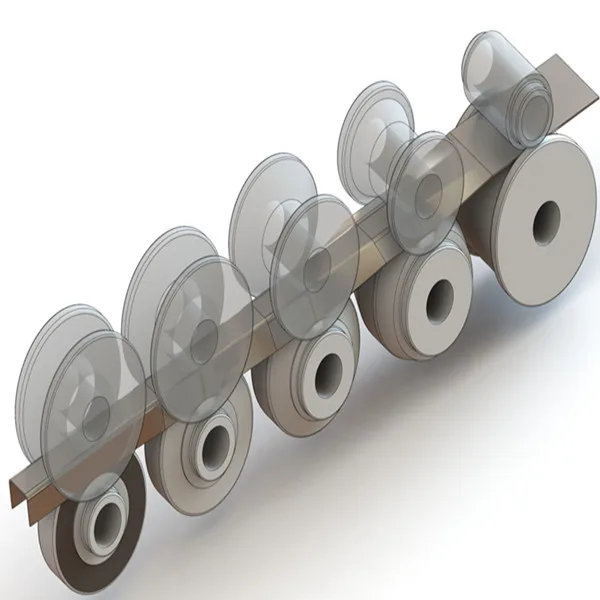
  • Roll forming mill — shapes the C, Z, or box profile
  • Post-punch press (optional) — adds secondary holes after forming
  • Flying cut-off / shear — cuts to exact length
  • Stacker / conveyor — collects finished uprights

The upright rack roll forming machine from Believe Industry integrates all seven modules into a single automated line, running at up to 20 m/min with a flying cutter that eliminates stop-start cutting losses.

Bolted Upright Rack Machine Welded Upright Rack Machine

2. Know Your Upright Profile Before You Buy

Every upright rack machine buy guide starts here. The profile cross-section you choose defines every major machine parameter — roller stand count, punch die geometry, mill width, and whether or not you need a welding module. There are three primary profile types used in pallet rack upright production worldwide.

Profile Type 1 — C-Section (Welded Upright Rack)

The C-section is the building block of welded upright rack systems. Two C-channels are roll-formed separately, then welded back-to-back (open side to open side) to create a closed box column. Diagonal braces are then welded across the box to complete the frame.

  ┌─────┐    ┌─────┐         ┌───────────┐
  │     │    │     │         │  ████     │
  │  C  │ +  │  Ↄ  │  =      │  ████     │  ← welded box column
  │     │    │     │         │  ████     │
  └─────┘    └─────┘         └───────────┘
ParameterTypical Value
Common cross-sections3×3 in (76×76 mm), 3×4 in (76×101 mm), 3×1-5/8 in
Steel thickness1.8 – 3.0 mm per C panel
Steel gradeASTM A1011 SS Grade 33-50, S235JR, Q235B
MarketDominant in North America (USA, Canada), some Latin America
Machine neededWelded upright frame roll forming machine — 2 C-sections formed + inline welding + brace welding

Profile Type 2 — Omega Section (Bolted Upright Rack)

The omega (Ω) section — sometimes called a sigma or hat channel — is an open-section profile shaped like the Greek letter omega. It has a wide flat face with two return flanges. Diagonal and horizontal braces are bolted to the flanges at the factory. No welding is involved anywhere in the frame.

  ┌─────────────────────┐
  │                     │
  │   Omega (Ω)         │  ← single open-section profile
  │   ┌───────┐         │     braces bolt to flange holes
  │   │       │         │
  └───┘       └─────────┘
ParameterTypical Value
Common cross-sections80×45 mm, 90×50 mm, 100×70 mm, 110×70 mm
Steel thickness1.5 – 2.5 mm
Steel gradeS235JR, S355JR, Q235B, Q355B
MarketEurope, Asia, Middle East, Australia, Africa — the global standard
Machine neededUpright rack roll forming machine — single profile, roll-punched, no welding

Profile Type 3 — Slotted Angle Upright

Slotted angle is the simplest and lightest upright profile — an L-shaped or simple open-channel angle with pre-punched slots along the entire length. Used for light-duty shelving and small-parts storage, not for pallet racking.

ParameterTypical Value
Common cross-sections45×45 mm, 50×50 mm L-angle
Steel thickness1.2 – 2.0 mm
Steel gradeQ235B, DC01
MarketUniversal — light-duty shelving worldwide
Machine neededShelf post roll forming machine — compact, high-speed, simple tooling

Why this matters for your machine specification:

A C-section welded line and an omega-section bolted line share almost no tooling in common. The roller sets, punch die geometry, and downstream modules (welding vs bolting fixture) are fundamentally different. A machine tooled for omega-section bolted uprights cannot produce C-section welded columns without a complete retooling — and it cannot weld at all unless a welding module was spec’d at purchase.

Confirm your target profile — and your target market — before contacting any supplier. If you plan to serve multiple markets, consider a cassette type roll forming machine that allows rapid changeovers between omega profiles in under 15 minutes.

3. Bolted vs Welded Upright Rack: Which Machine Do You Need?

This is the first and most consequential decision in your upright rack machine buy guide. Bolted and welded uprights look similar on a warehouse floor but require fundamentally different production lines — and deliver very different economics for the end user.

Why does this decision matter so much? Because the construction method determines everything downstream — how easy it is to repair a forklift-hit upright, how the rack behaves in an earthquake, how much it costs to ship, and even how visible damage is to a warehouse safety inspector per OSHA 1910.176.

Two independent industry sources make this case with hard data:

Rack Systems Inc.’s Paul Haggett notes that “European material handling professionals have been constructing upright frames using a bolted construction for years” — and that bolted racking outperforms welded on manufacturing cost, repairability, seismic performance, customization, and shipping.

American Material Handling adds the structural analogy: roughly 90% of large warehouse buildings, retail structures, and skyscrapers use bolted connections per AISC 360 — not welded. If bolted connections are strong enough for a 50-story building, they are strong enough for a pallet rack frame.

What Is a Bolted Upright? (Omega-Section)

A bolted upright is built from an omega (Ω) section profile — a single open-section channel with a wide face and return flanges. The profile emerges from the roll forming mill with pre-punched teardrop or oval slots. Diagonal braces are bolted to the flange holes at the factory. No welding is required anywhere in the frame. This is the dominant design in Europe, Asia, the Middle East, and Australia.

What Is a Welded Upright? (C-Section Box Column)

A welded upright is built from two C-section profiles that are roll-formed, then welded back-to-back (open side to open side) to create a closed box column. Diagonal braces are then welded across the box to complete the frame. This adds a welding station to the line and a secondary brace-welding fixture. There is a hidden cost here too: if the finished rack requires hot-dip galvanizing (common in food, pharma, and cold storage applications), welded frames must be galvanized after assembly — a far costlier process than galvanizing individual bolted components before assembly. Poor welds can also create structural defects invisible from the outside, creating latent safety risks that routine visual inspections will not catch. Welded uprights are still the default in North America (common cross-sections: 3×3 in and 3×4 in).

Comparison Table: Bolted Upright Rack vs Welded Upright Rack

FactorOmega Section (Bolted Upright Rack)C-Section (Welded Upright Rack)
Profile typeOmega (Ω) — single open-section profile with return flangesC-Section — two C-channels welded back-to-back into a closed box column
Production methodPure cold roll forming; braces bolted to flange holesRoll forming + inline column welding + brace welding
Equipment capital costLower — no welding module, no brace welding fixtureHigher — requires welding head, seam prep, brace welding jig
Floor spaceCompact line footprintRequires extra 3–6 m for welding station + brace station
Typical marketsEurope, Asia, Middle East, Australia, Africa — global standardNorth America (USA, Canada), some Latin America
Common cross-sections80×45 mm, 90×50 mm, 100×70 mm, 110×70 mm omega3×3 in (76×76 mm), 3×4 in (76×101 mm) closed box
Load capacityMedium to high (~200 kN/upright)Very high (~350 kN/upright)
Steel thickness1.5 – 2.5 mm1.8 – 3.0 mm (per C panel)
Seismic performance✅ Superior — bolted frames flex and deform without fracturing; absorb energy like building structural frames⚠️ Poorer — rigid welded joints are brittle, cannot absorb ground motion, prone to shear fracture during earthquakes
Damage behavior after impact✅ Safe — a damaged bolted frame continues to provide structural support until the problem is repaired; will not suddenly collapse❌ Dangerous — a damaged welded upright can fail catastrophically and cause a rack collapse with no warning
Defect visibility✅ Visible — loose bolts, bent braces, or cracked members are obvious to the naked eye during routine inspections❌ Hidden — faulty welds can look normal on the outside while concealing cracks or incomplete fusion inside the joint
Repairability after damage✅ Excellent — unbolt the damaged member, bolt in a replacement. Done with a wrench and a band saw. No hot work permit needed❌ Poor — cut out the damaged section with a torch, grind the weld area, fabricate a custom replacement, re-weld, repaint. Hard to get engineering sign-off
Customization / height modification✅ Easy — adjustable diagonal braces slide along the upright column; cut to length and re-bolt. Quick, low-cost❌ Difficult — must cut braces off, remove them, cut the column, re-weld braces. Sometimes physically impossible to achieve required dimensions
Installation labor✅ Lower-cost — installers do not need certified welder qualifications; lower hourly rates, faster assembly❌ Higher-cost — pre-assembled frames are heavier to handle; reconfiguration requires skilled labor
Shipping efficiency✅ 2× capacity — a 40-ft truck carries up to 48,000 lbs in knocked-down (KD) bundles; roughly half the per-unit freight cost of welded❌ 1× capacity — same truck carries only 20,000–25,000 lbs of pre-assembled welded frames due to wasted air space
Bolt loosening riskNone — serrated lock nuts with limited thread depth prevent over-tightening; once torqued at the factory, the nut is permanently locked. Bolted frames ship fully assembled without looseningN/A
Corrosion protectionGalvanized coil input standard; zinc layer uniform across all surfacesWeld seams destroy zinc coating; requires additional zinc-rich primer at every weld point
Line speedUp to 20–25 m/minUp to 15–18 m/min (limited by welding cycle time)
End-user assembly experienceBeam connectors bolt in — same as weldedBeam connectors bolt in — identical experience

Key takeaway from this upright rack machine buy guide: Bolted upright racking wins on manufacturing cost, repairability, seismic safety, damage behavior (won’t collapse), defect visibility, customization flexibility, installation labor, and shipping efficiency — eight of the nine total-cost-of-ownership dimensions. The shipping advantage alone is dramatic: a 40-ft truck carries 48,000 lbs of bolted KD components vs just 20,000–25,000 lbs of welded assemblies — roughly half the freight cost per upright. Welded racking wins on one dimension only: ultimate static load capacity. And it still dominates North America by convention, not by engineering merit — much like the 90% of large steel buildings worldwide that prove bolted connections work at scale.

If you are targeting USA or Canadian warehouse markets and your customers still demand welded uprights, you need the welded upright frame roll forming machine configuration, which Believe Industry specifically engineers for 480V/60Hz North American grid standards. But if you are producing for Europe, Asia, the Middle East, or emerging markets — or if you plan to educate North American customers on the bolted advantage — a pure roll forming line for bolted uprights is almost certainly the better investment.

Bolted Upright Frame vs Welded Upright Frame Construction Comparison

4. Choosing Your Punch System: The Decision That Drives Your Throughput

No upright rack roll forming machine buy guide is complete without a deep dive on punching. The punch press is the most performance-critical component on an upright line. Uprights require precise hole patterns (teardrop slots, round holes, rectangular ports) that must be perfectly repeatable at production speeds.

There are three main technologies. Each has a different speed, cost, and maintenance profile.

Comparison Table: Hydraulic Punch vs Mechanical Punch Press vs Rotary Punch

FactorServo Hydraulic PunchServo Mechanical Punch PressRotary Punch
Operating principleHydraulic cylinder drives punch die; servo valve controls strokeEccentric crankshaft driven by servo motorRotating die drum with fixed punch tools
Punching speed2–6 m/min (line speed with punch active)12–15 m/minUp to 30–40 m/min
Punch force (tonnage)20–200 tons, easily adjustable30–150 tons, fixed by flywheelLow-medium (≤30 tons, suits thin gauge)
Material thickness1.2 – 3.5 mm (ideal for heavy upright stock)1.5 – 3.0 mm0.5 – 3.0 mm 
Hole pattern flexibilityVery high — programmable stroke depth and positionHigh — servo-controlled feed pitchLow — die drum is fixed per pattern
Cost (press only)Medium (60,000)High (120,000)Low–medium (100,000)
Energy consumptionMedium — pump runs only when punchingHigh — flywheel spins continuouslyLow
Noise levelLow–mediumHigh (mechanical impact)Low
Maintenance complexityMedium (hydraulic seals, filters)Medium–High (crankshaft, clutch, brake)Low (few moving parts)
Tooling costMediumMedium–HighHigher
Best for upright rack?✅ Yes — heavy gauge, flexible patterns✅ Yes — high-volume, single patternDifferent to change hole patten
Downtime riskLowMedium (clutch/brake wear)Very low
Typical applicationStandard upright lines, heavy-duty profilesHigh-volume dedicated upright factoriesLight-gauge shelving, solar bracket

Believe Industry recommendation for upright rack lines:

For most buyers, the servo hydraulic punch is the optimal balance of cost, flexibility, and reliability. It handles 1.5–3.0 mm steel without flinching, allows pattern changes via PLC touchscreen, and runs smoothly at the 4–8 m/min range most upright factories operate.

For customers targeting very high volume with a single dominant hole pattern (e.g., a dedicated teardrop slot for one specific racking standard), the servo high-speed mechanical punch press at 12–15 m/min delivers the lowest cost-per-piece at scale.

Learn more about punch technologies in our dedicated guide: Punch Press for Roll Forming Industry.

5. Key Machine Specifications to Demand From Any Supplier

This is the technical core of the upright frame machine buy guide. Before requesting a quotation, finalize these parameters:

5.1 Material Spec

ParameterTypical RangeNotes
Coil width100 – 450 mmMatch to your profile blank width
Coil thickness1.5 – 3.0 mmVerify punch press tonnage covers max thickness
Steel gradeQ235B, S235JR, SS400, ASTM A1011Confirm yield strength ≤ 350 MPa for standard tooling
Coil inner diameter508 mm or 610 mmMatch to your uncoiler mandrel
Max coil weight3–8 tonnesDefines uncoiler capacity

5.2 Production Output

ParameterTarget
Line speed15–20 m/min minimum
Cut length tolerance±1.0 mm
Straightness tolerance≤1.5 mm per 3 m
Hole position tolerance±0.5 mm
Uptime (annual)>95%

5.3 Control System

  • Siemens or Mitsubishi PLC (avoid no-name PLCs on export machines)
  • Touchscreen HMI with recipe memory (at least 50 product programs)
  • Automatic length counter and batch counter
  • Remote diagnostics capability (Ethernet / VPN)

5.4 Electrical Standards

If you are importing into a specific market, confirm the machine voltage/frequency matches your national grid. Believe Industry builds to:

  • 220V/380V 50Hz — Standard for Asia, Europe, Middle East, Africa, Australia
  • 480V 60Hz — North America (USA, Canada, Mexico)
  • 220V 60Hz — Some Latin American markets

Mismatched electrical specs require costly transformers and void most warranties. Confirm this before you accept any quotation.

For a broader specification checklist, see our guide on how to buy a roll forming machine.

6. Supplier Comparison: Believe Industry vs China vs EU/US

Choosing the right supplier is just as important as choosing the right machine. Here is an honest comparison of the three supplier tiers.

Comparison Table: Believe Industry vs China Suppliers vs EU/US Suppliers

FactorBelieve Industry (Beli Rollforming)Other China SuppliersEU / US Suppliers
HeadquartersWuxi, Jiangsu, China (est. 2005)Various — Jiangsu, Guangdong, ShandongGermany, Italy, USA, UK
Upright rack machine price (FOB)250,000 (7-module full line)80,000400,000+
Production speed (upright line)Up to 20 m/min10–18 m/min (varies widely)Up to 25–35 m/min
Roller materialD 2 steel, HRC 58–62Varies — some use 45# steel (lower hardness)D2 / HSS tool steel, HRC 60–64
PLC brandSiemens, Mitsubishi, Omron (buyer’s choice)Mixed — some use no-name PLCSiemens, B&R, Allen-Bradley
CE / ISO certificationISO 9001 + CE standardCE available on request (quality varies)CE / UL standard
Factory inspectionYes — in-person FAT at Wuxi plantVariesYes (usually remote or third-party)
Language supportEnglish, Chinese, Arabic, SpanishMainly Chinese; English variesEnglish, German, Italian
Lead time45–75 days (standard line)30–60 days90–180 days
Shipping termsFOB Shanghai / CIF any portFOB or EXWFOB, CIF, DAP
Payment terms30% deposit, 70% before shipment30–50% deposit typical30–40% deposit, milestone-based
Warranty24 months12 months typical24–36 months
After-sales supportOnline 24/7 + spare parts + on-site optionOnline only (quality inconsistent)Full on-site service (included in price)
Spare parts availabilityStock in Wuxi; DHL express worldwideVariableStocked regionally; expensive
Total cost of ownership (5-yr)Low–MediumLow (if quality holds) — Medium–High if reliability issues ariseHigh (equipment + service costs)
Best forExport-focused buyers, mid-to-large volume, buyers who need flexibilityVery price-sensitive buyers, simple profiles, domestic China marketBuyers in regulated EU/US markets who require local service contracts

Plain-language verdict: For global buyers outside the EU and North America, Believe Industry delivers the best balance of engineering quality, price, speed, and support. For buyers inside the EU who require full CE documentation and on-site European service, a European machine may be warranted despite the higher price. For buyers prioritizing absolute lowest initial cost on simple profiles, other China suppliers exist — but conduct rigorous due diligence on roller hardness, PLC brand, and test run protocol before committing.

See how we compare globally: Top Roll Forming Machine Manufacturers in China and Roll Forming Machine Manufacturers.

7. The 7-Step Upright Rack Machine Buy Guide Checklist

This upright rack machine buy guide distills the entire sourcing process into seven sequential steps. Follow them in sequence. Skipping any step is how buyers end up with the wrong machine.

Step 1 — Define your product specification

Lock down your upright profile dimensions, hole pattern, steel grade, and coil thickness range. Do this before contacting any supplier. Do not let suppliers define your spec for you.

Step 2 — Decide bolted or welded

Use the comparison table in Section 3. Bolted open-section for most markets; welded box section for North America. This decision determines whether you need a welding module.

Step 3 — Choose your punch system

Match punch technology to your volume and flexibility needs (see Section 4). For most upright factories: servo hydraulic for flexibility, servo mechanical for high volume.

Step 4 — Set your electrical and voltage standard

Confirm local grid voltage and frequency. Specify this to all suppliers from the start.

Step 5 — Request formal quotations from at least three suppliers

Include your profile drawing, hole layout, coil spec, and required line speed. Compare like-for-like, not just headline price.

Step 6 — Verify with a Factory Acceptance Test (FAT)

Do not pay the final balance without a witnessed FAT. If you cannot travel, appoint a local third-party inspection agent (SGS, BV, TÜV). The high-speed upright roll former from Believe Industry runs full production tests at our Wuxi factory before crating.

Step 7 — Clarify spare parts, training, and after-sales

Ask for: a standard spare parts list (dies, belts, filters), commissioning included in the price, operator training (on-site or video), and the warranty claim process. Understand the hidden costs of roll forming machinery before finalizing your budget.

8. Understanding Total Cost of Ownership

he machine sticker price is not your real cost. Factor these items into your ROI calculation:

Cost ItemTypical RangeNotes
Machine purchase price400,000Varies by supplier tier
Freight & insurance8,000FOB to CIF conversion
Import duties & taxes0–15% of CIF valueVaries by country
Foundation & installation12,000Concrete pad, electrical hookup
Commissioning & training015,000Some suppliers include; EU suppliers typically charge
Initial tooling setIncluded or 25,000Always confirm what’s included
Annual maintenance (parts + labor)10,000Hydraulic filters, punch dies, roller inspection
Downtime cost (if reliability poor)Can exceed machine purchase price over 5 yearsInvest in quality upfront

Buying a 20,000machinethatloses15productiondaysperyeartobreakdownscostsmorethana55,000 machine that runs 98% uptime. Use our roll forming preventative maintenance guide to calculate realistic maintenance costs before you buy.

9. Why Believe Industry for Your Upright Rack Line?

Believe Industry has manufactured roll forming machines since 2005. We have installed lines in over 50 countries across all major racking markets.

Our upright rack roll forming machine includes:

  • 7-module integrated line — uncoiler to stacker in one line
  • Flying cut-off shear — cuts at full speed, no production stops
  • Servo hydraulic punch or mechanical punch — buyer’s choice
  • GCr15 hardened steel rollers — vacuum-quenched to HRC 58–62
  • Siemens or Mitsubishi PLC — standard on all export machines
  • 24-month warranty — the longest in the China supplier segment
  • CE + ISO 9001 certification
  • 480V/60Hz or 380V/50Hz — built to your market’s standard

We offer on-site commissioning, video training, and a dedicated after-sales engineer for every machine.

Contact us now explore the full spec page: Upright Rack Roll Forming Machine.

Machine in action

10. Frequently Asked Questions (FAQ)

What is the difference between an upright rack machine and a step beam machine?

An upright rack machine produces the vertical columns (uprights) of a racking system. A step beam roll forming machine produces the horizontal load beams. Both are needed for a complete pallet racking production line.

How long does it take to receive an upright rack roll forming machine from China?

After order confirmation and deposit, production takes 45–60 days. Sea freight adds 15–35 days depending on destination port. Total lead time is typically 60–90 days from deposit to delivery.

Can one machine produce multiple upright sizes?

Yes, if the machine is equipped with adjustable-width components or cassette tooling. Standard tooling is fixed to one profile. Specify all target profiles before ordering. See the cantilever rack roll forming equipment page for multi-profile options.

What steel grade should I use for pallet rack uprights?

Most international standards specify structural steel with a minimum yield strength of 235 MPa (S235JR, Q235B, A36). High-density or seismic applications may require 355 MPa steel (S355, Q355). Confirm with your structural engineer and local racking standard (e.g., EN 15512, RMI MH16.1, AS 4084).

What hole pattern do pallet rack uprights use?

 The most common patterns are teardrop slots and round holes on a 50 mm or 2-inch pitch. The exact slot size and pitch depend on the racking manufacturer’s beam connector standard. Always provide a profile drawing with your hole layout to your machine supplier before tooling is cut.

Is a hydraulic punch press or a mechanical punch press better for upright rack production?

For most buyers: hydraulic is better for flexibility (multiple patterns, heavy gauge). Mechanical is better for dedicated high-volume production of one hole pattern at maximum speed (12–15 m/min). See the punch press for roll forming industry guide for a full breakdown.

What is a Factory Acceptance Test (FAT) and do I need one?

A FAT is a witnessed production run at the manufacturer’s factory before the machine ships. It proves the machine meets your spec before you pay the final balance. Always require a FAT. Believe Industry conducts full FATs at our Wuxi plant and welcomes client inspectors. We also partner with SGS, BV, and TÜV for remote inspection.

Can I start with a manual line and upgrade later?

You can, but it rarely saves money. A semi-automatic line that you retrofit later almost always costs more than buying the full automated line upfront. Calculate your 3-year volume before deciding. Our buy a roll forming machine guide covers this trade-off in detail.

Tab Title
Lorem ipsum dolor sit amet, consectetur adipisicing elit. Optio, neque qui velit. Magni dolorum quidem ipsam eligendi, totam, facilis laudantium cum accusamus ullam voluptatibus commodi numquam, error, est. Ea, consequatur.
What is the minimum order quantity for an upright rack machine?

There is no minimum order quantity. We supply single machines to startup racking manufacturers and multi-line orders to large-scale producers. Each machine is custom-built to your profile and market spec.

How do I calculate whether the machine ROI makes sense?

Estimate your annual upright volume in linear meters. Divide by your machine’s output rate (m/min × operating hours). Compare the landed cost of buying finished uprights vs producing them. Most buyers reach payback in 18–36 months at medium production volumes. Use our roll forming machine manufacturers comparison to benchmark pricing.

Conclusion

This upright rack machine buy guide has covered the full decision chain: from profile selection and punch technology to supplier comparison and total cost of ownership. Bookmark this upright rack roll forming machine buy guide and return to it at each stage of your sourcing process.

The three critical decisions are:

  1. Bolted or welded — determines your machine configuration
  2. Punch system — determines your throughput ceiling
  3. Supplier tier — determines your long-term cost and reliability

Believe Industry’s upright rack roll forming machines are engineered to deliver on all three. Explore the high-speed upright roll former and storage shelf roll former pages for full technical specifications, or contact our team for a free consultation and quotation.

Changelog

DateChangeAuthor
2026-06-24Initial publicationBelieve Industry Content Team

Next Review Triggers

  • Any update to EN 15512, RMI MH16.1, or AS 4084 racking standards
  • New punch technology options added to the product line
  • Significant price movement in China steel coil (>15% change)
  • New competitor supplier tiers entering the market
  • Article word count falls below 2,500 words after edits

Table of Contents

Discover more from Believe Industry Company | Roll Forming Machine Manufacturer & Exporter

Subscribe now to keep reading and get access to the full archive.

Continue reading