


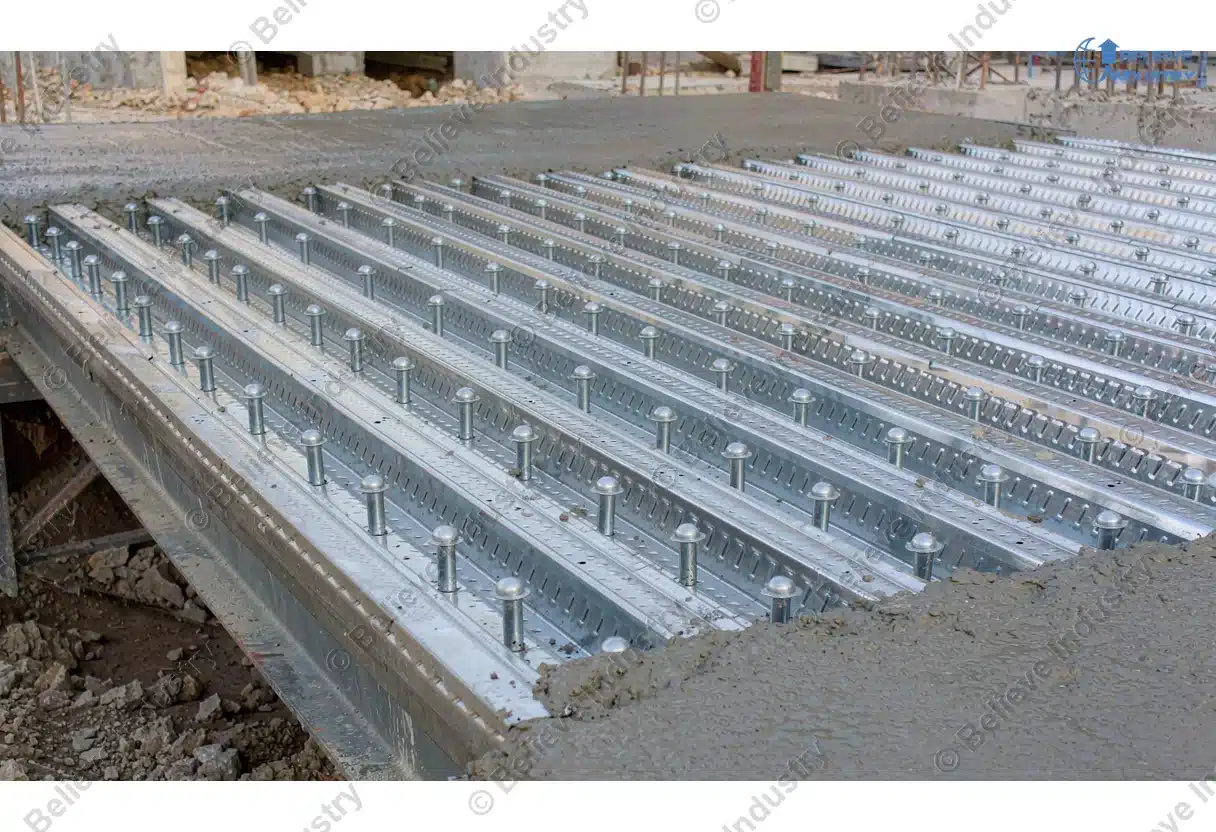
Floor deck embossment design sets the horizontal shear bond between steel and concrete. A profile with the right embossment depth, spacing, and shape raises the m-k bond coefficients that SDI and EN 1994 use to size composite slabs. Beli Rollforming builds the เครื่องขึ้นรูปม้วน that cut these embossments to repeatable tolerances, so the bond numbers on paper match the bond in the field.
Composite floor deck bond strength is not automatic. The steel sheet must grip the concrete well enough to act as one member. Embossment is the primary grip mechanism when no shear studs are present, and it still influences the kt factor when studs are used. The seven rules below cover the geometry, the material limits, and the tests that prove the bond works.
1. Embossment Depth: 0.3 mm to 0.6 mm Is the Working Range
The embossment depth is the vertical height from the sheet surface to the peak of the formed dimple. SDI practice and Eurocode slab tests both show that useful bond starts near 0.3 mm and tops out around 0.6 mm for most profiled sheets. Below 0.3 mm the concrete cannot develop full mechanical keying. Above 0.6 mm the sheet thins too much and the coating cracks at the embossment root.
| ความลึกของลายนูน | ระดับการยึดติดทั่วไป | ความเสี่ยงของชั้นเคลือบ |
|---|---|---|
| 0.2 to 0.3 mm | Marginal | Low |
| 0.3 to 0.5 mm | Standard composite | Low |
| 0.5 to 0.6 mm | High bond | Moderate |
| Above 0.6 mm | Possible cracking | High |
For galvanized sheets, the extra coating thickness reduces the raw steel depth slightly. Measure depth on the base metal, not through zinc. Our floor deck roll forming machine buying guide explains how roller wear changes depth batch to batch.
2. Embossment Spacing Must Match Rib Pitch
The distance between embossments along the rib should stay uniform. Spacing that is too wide leaves long concrete tongues that can crack under shrinkage. Spacing that is too dense weakens the web between embossments and invites pitting corrosion.
A common rule is to place one embossment per rib or one per flute, aligned with the shear span. For trapezoidal decks with 200 mm rib spacing, a 50 to 100 mm embossment pitch keeps the concrete keys short enough to prevent diagonal cracks. For deeper ribs, reduce pitch toward the lower end.
| Rib spacing | ระยะห่างลายนูนที่แนะนำ |
|---|---|
| 150 to 180 mm | 50 to 75 mm |
| 200 to 250 mm | 75 to 100 mm |
| 300 mm and above | 100 to 125 mm |
Our long span floor deck rib depth rules show how span length and rib geometry interact with these pitches.
3. Chevron and Rectangular Patterns Produce Different m-k Values
Pattern shape changes the mechanical interlock direction. Chevron embossments point load toward the rib web and usually give higher m values. Rectangular embossments are easier to form and give consistent results across speed ranges, but they sit lower on the m-k table.
| ประเภทของรูปแบบ | Typical m (N/mm²) | Typical k (N/mm²) | ความยากในการขึ้นรูป |
|---|---|---|---|
| Chevron / herringbone | 90 to 110 | 0.02 to 0.04 | Medium |
| Rectangular | 70 to 95 | 0.02 to 0.05 | Low |
| No embossment | 50 to 70 | 0.01 to 0.03 | None |
These are research ranges, not guaranteed numbers. Every deck profile needs its own m-k test because rib height, sheet thickness, and concrete mix all shift the result. The SDI standard roll forming tolerances page notes why rib height control protects that bond.
4. Pre-Painted and Galvanized Sheets Need Different Roller Clearances
Coated sheets behave differently in the embossing station. Pre-painted steel has a softer surface layer that can orange-peel if the embossing roller is too sharp or the gap is too tight. Galvanized sheet work-hardens at the embossment root and can micro-crack if the depth target is aggressive.
A safer approach is to verify embossment depth on a test coil before running production, then lock the roller gap. Keep the embossing rollers polished to Ra 0.8 µm or better. The floor deck fire compliance guide shows how coating thickness interacts with fire-rated assemblies.
5. Stud kt Factor and Embossment Depth Are Linked
When headed shear studs are welded through the deck, the profiled sheeting reduces stud capacity through the kt factor. EN 1994-1-1 caps kt by the number of studs per rib and the sheet thickness. AISC 360 covers the same concept for North American composite decks. Deeper embossments inside the rib can help local concrete confinement, but they do not remove the kt reduction.
| สตัดต่อซี่ | Sheet ≤ 1 mm | Sheet ≥ 1 mm |
|---|---|---|
| 1 | 0.85 | 1.00 |
| 2 | 0.70 | 0.80 |
One stud per rib keeps kt near 1.0 for thicker sheets. Two studs per rib in a thin sheet drops kt to 0.70. Embossment design does not fix a bad stud layout.
6. Bond Strength Must Be Verified by Slab Tests, Not Just Depth Gauges
Depth gauges and profilometers confirm geometry. They do not prove the concrete bites. The only accepted proof is a full-scale composite slab test that produces an m-k pair for the exact profile. SDI C-2017 and EN 1994-1-1 both require this validation. SDI publishes deck-specific m and k values, and Eurocode research reports them in N/mm². If the supplier only offers a depth certificate, ask for an m-k test report before signing the submittal.
The table below gives research ranges for common embossments. Treat them as benchmarks, not design values.
| แหล่งที่มา / โปรไฟล์ | m | k |
|---|---|---|
| Wright, Evans and Harding (1987, chevron emboss | 107.5 | 0.040 |
| Marimuthu et al. (2007), rectangular emboss | 88.0 | 0.032 |
| Corrugated sheet, no emboss | 65.0 | 0.094 |
7. Over-Embossing Causes Web Cracking and Coating Delamination
Every sheet has a forming-limit curve. ความลึกของลายนูน that is too high for the material thickness pushes the web into local necking. In galvanized sheets, the zinc layer splits at the embossment root and corrosion starts there within months. In pre-painted sheet, the paint cracks in a starburst pattern around the dimple.
A practical limit is to keep the embossment depth below twenty percent of the sheet thickness for most applications. For a 1.2 mm sheet, that is 0.24 mm maximum depth unless the material is tested and approved for deeper forming. Our roll forming roller materials guide explains why roller polish and material grade affect how deep you can safely go.
บทสรุป
Floor deck embossment design is a geometry problem with structural consequences. Depth between 0.3 mm and 0.6 mm, spacing matched to rib pitch, and a pattern chosen for the target m-k value keep the steel and concrete bonded. Coated sheets need gentler rollers and tighter inspection. Stud layout and kt reduction are separate from embossment, so design both. Beli Rollforming builds roll forming machines with inline embossing stations that hold these dimensions repeatably, so your slab tests pass the first time.
คำถามที่พบบ่อย
1. What is the ideal embossment depth for composite floor deck? The ideal embossment depth is 0.3 mm to 0.6 mm measured on the base metal. Below 0.3 mm the concrete keying is weak. Above 0.6 mm the sheet web risks cracking and coating delamination.
2. Does embossment spacing affect composite bond strength? Yes. Embossment spacing that matches rib pitch keeps concrete keys short and reduces shrinkage cracking. A 50 to 100 mm pitch works for most 200 mm rib decks. Wider spacing leaves long tongues that crack. Denser spacing weakens the web.
3. Which embossment pattern gives higher m-k values? Chevron embossments typically give higher m values, from 90 to 110 N/mm². Rectangular embossments are easier to form and still reach 70 to 95 N/mm². The exact value depends on rib geometry, sheet thickness, and concrete mix.
4. Does embossment replace shear studs in composite slabs? No. Embossment provides mechanical keying for composite action without studs, but most designs use both. Embossment does not remove the stud kt reduction in EN 1994-1-1. One stud per rib keeps kt near 1.0 for thicker sheets.
5. How do I verify embossment bond strength? Verify bond strength with a full-scale composite slab test that produces m and k values for the exact profile. Depth gauges confirm geometry. They do not prove concrete bite. Ask your supplier for an m-k test report, not just a depth certificate.
6. Can pre-painted floor deck be embossed without damaging the coating? Yes, if the embossing roller is sharp, polished to Ra 0.8 µm or better, and the depth stays within the paint elongation limit. Test a coil first. Over-embossing causes orange peel or starburst cracking around the dimple.
7. What is the kt factor for studs in embossed deck? The kt factor reduces headed stud capacity in profiled decking. EN 1994-1-1 caps kt by studs per rib and sheet thickness. One stud per rib in sheet 1.0 mm or thicker keeps kt near 1.0. Two studs per rib in thin sheet drops kt to 0.70.
8. Why does embossment depth matter for galvanized floor deck? Galvanized sheet work-hardens at the embossment root. Depth above 0.6 mm or sharp die radii split the zinc layer and start corrosion at the crack. Measure depth on base metal and keep forming angles gentle.
9. How does floor deck embossment design relate to deflection limits? Bond strength affects composite action, which raises slab stiffness and reduces deflection. Poor embossment lets the deck slip under load, increasing span deflection. SDI practice caps wet-concrete deflection at span over 180 or 20 mm absolute.
10. Where can I find standard floor deck embossment specifications? Standard embossment specifications appear in SDI C-2017 and EN 1994-1-1 through the m-k method. Beli Rollforming supplies tolerance reviews and inline embossing stations engineered to hold depth and pitch within these standards.
อัปเดตล่าสุด: 2026-10-28
บันทึกการแก้ไขบทความ
- 2026-10-28: Initial version for the 2026-10-28 calendar slot. 7 embossment design rules for composite bond strength, 3 tables, 10 คำถามที่พบบ่อยs, SDI and EN 1994 references.
เงื่อนไขการทบทวนครั้งถัดไป
- SDI or EN 1994 revises embossment depth or m-k guidance
- A new coating system changes allowable embossment depth limits
- A project type drives demand for higher bond classes or special patterns
- A buyer asks about embossment specifications for a deck profile not yet covered




 ไทย