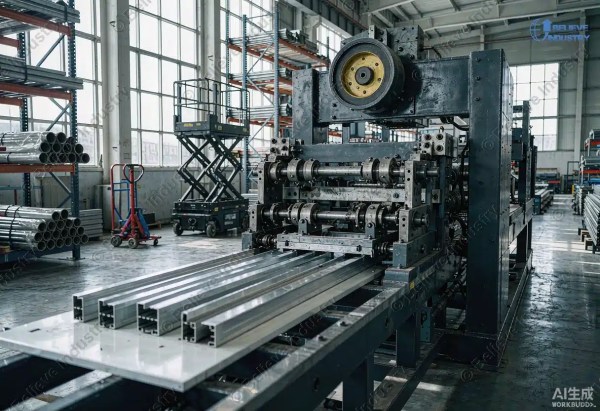









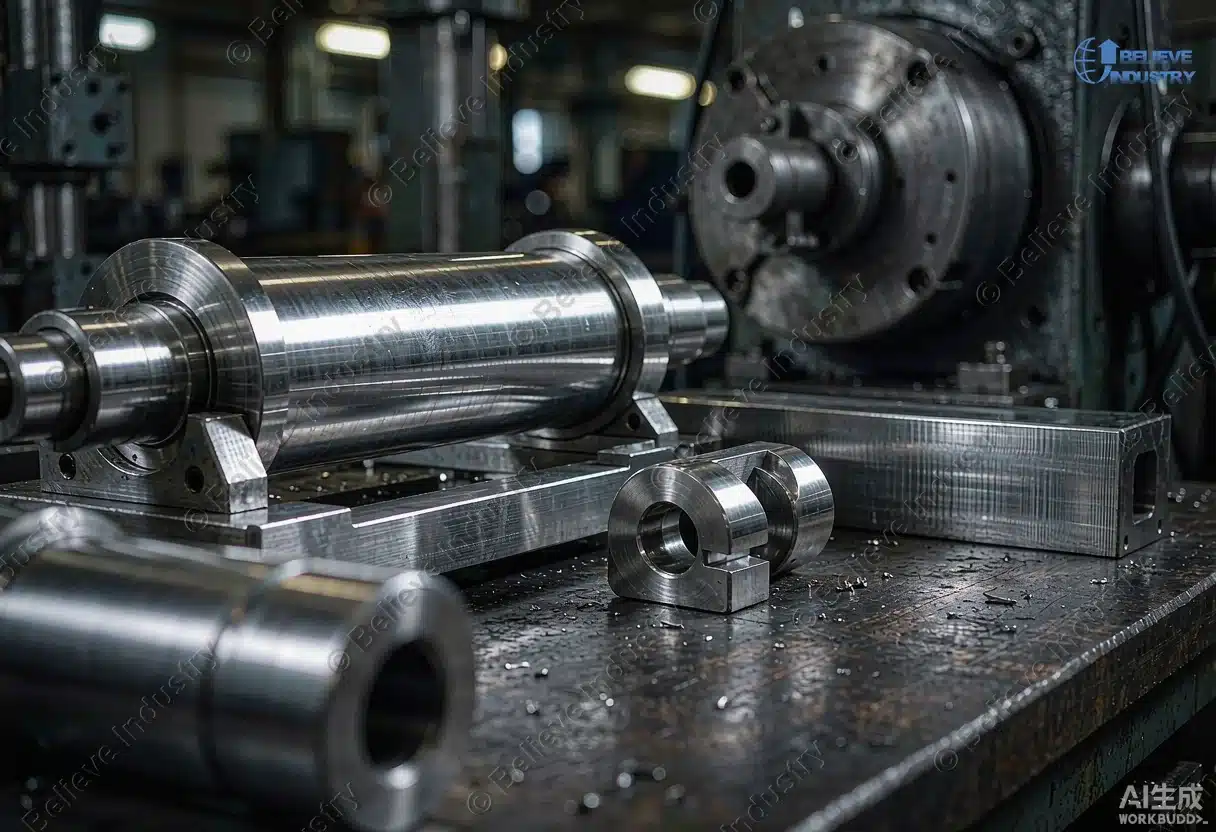
Rollers shape every profile that comes off a roll forming line. They control accuracy. They determine surface finish. They are the single most important wear component in the machine.
การเลือกสิ่งที่ถูกต้อง roll forming roller materials separates lines that run 24/7 from lines that stop every shift for tooling changes.
This guide compares seven steel grades for roll forming rollers: D2, DC53, Cr12MoV, GCr15, A2, M2, and H13. You will get hardness data, toughness ratings, cost comparisons, and an application matching table.
Whether you are buying a new machine or replacing worn tooling, understanding roll forming roller materials is step one. เครื่องมือขึ้นรูปม้วน selection starts with the right steel grade. When sourcing a complete machine, the complete buyer’s guide explains how roller material specs fit into the bigger purchasing decision.
Why Roll Forming Roller Materials Matter
Roll forming rollers operate under constant friction, cyclic loading, and heat buildup from deformation.
A good roller material does three things well. It resists abrasive wear from coil stock. It absorbs impact without chipping. It holds dimensional stability over millions of cycles.
Get the material wrong and you see immediate problems. Scratched panels. Profile drift. Cracked rollers. Unplanned downtime.
The most expensive roll forming roller materials per kilogram are often the cheapest per meter of profile produced. Tooling is not where you cut cost. It is where you invest for margin. Industry sources like Roll-Kraft emphasize that proper heat treatment matters as much as steel grade selection.
The 7 Steel Grades at a Glance
Here are all seven roll forming roller materials compared side by side.
| เกรดเหล็ก | พิมพ์ | Typical HRC | เหมาะสำหรับ |
|---|---|---|---|
| D2 | Cold Work Tool Steel | 58-62 | General roofing, PBR, standard profiles |
| DC53 | Cold Work Tool Steel | 60-63 | High-speed lines, chipping-prone uses |
| Cr12MoV | Cold Work Tool Steel | 54-60 | Budget production, entry-level machines |
| จีซีอาร์15 | Bearing Steel | 60-66 | High-speed continuous lines, precision |
| A2 | Cold Work Tool Steel | 58-62 | Backup rolls, unstable load conditions |
| M2 | High Speed Steel | 62-65+ | Abrasive materials, high-temperature |
| H13 | Hot Work Tool Steel | 42-52 | Heavy gauge, structural, high impact |
These roll forming roller materials range from budget Cr12MoV at under $10/kg to premium M2 at $25+/kg. The right pick depends on your coil material, line speed, and production volume.
D2: The Industry Standard Roll Forming Roller Material
D2 is the most widely used of all roll forming roller materials. High carbon (1.40-1.60%) and high chromium (11.0-13.0%) give it outstanding wear resistance.
After proper heat treatment, D2 reaches HRC 58-62. It handles galvanized steel and mild steel up to 1.0 mm gauge. Roofing panels, PBR profiles, AG panels — D2 is the default.
The weakness is toughness. D2 contains large chromium carbides. Under impact or misalignment, these become crack initiation points. D2 rollers chip more than they wear out.
D2 also softens above 250°C. In high-speed lines where friction heat builds, this becomes a problem. For standard roofing production at 15-35 m/min, D2 is the right balance of cost and performance. According to Aobo Steel’s tool steel selection guide, D2 is suited for cold rolling where abrasive wear is the primary concern.
ของเรา การออกแบบลูกกลิ้งขึ้นรูป uses D2 as the baseline. Most Beli Rollforming standard roofing machines ship with D2 rollers plus chrome plating.
D2 Quick Specs: Carbon 1.40-1.60% | Chromium 11.0-13.0% | HRC 58-62 | Toughness: Moderate | Cost: $$
DC53: Premium Roll Forming Roller Materials for Tough Jobs
DC53 is a modified cold work steel engineered to fix D2’s toughness problem. Lower carbon (~1.0%) and chromium (~8.0%), but higher molybdenum (2.0%).
The result: roughly twice the impact toughness of D2 at equivalent hardness. Finer carbide distribution means DC53 resists chipping far better. When D2 rollers crack, DC53 is the upgrade.
DC53 reaches HRC 60-63. It machines 30-40% faster than D2, which partly offsets its higher material cost.
This is the go-to choice among roll forming roller materials for high-speed lines above 25 m/min. Lines forming high-tensile steel. Lines forming stainless. Any application where the dominant failure mode is chipping, not gradual wear.
Beli Rollforming uses DC53 rollers on เครื่องรางสายเคเบิล punching and sizing stations where impact loads peak.
DC53 Quick Specs: Carbon ~1.0% | Chromium ~8.0% | HRC 60-63 | Toughness: High (2x D2) | Cost: $$$
Cr12MoV: Budget Roll Forming Roller Materials
Cr12MoV is widely used as a lower-cost alternative to D2. It contains similar chromium (11.0-12.5%) with added molybdenum and vanadium.
Hardness lands at HRC 54-60 — slightly below D2 but adequate for standard profiles and moderate production volumes.
Most China-made entry-level roll forming machines ship with Cr12MoV rollers. The trade-off is quality consistency. Carbide distribution varies between steel mills. Heat treatment response depends heavily on the source.
For low-to-medium production, Cr12MoV works. For export-quality machines or heavy production, D2 or DC53 are better roll forming roller materials — they pay back through longer tooling life.
Cr12MoV Quick Specs: Carbon 1.45-1.70% | Chromium 11.0-12.5% | HRC 54-60 | Toughness: Moderate | Cost: $
GCr15: The Bearing Steel for Roll Forming Rollers
GCr15 is bearing steel — Chinese equivalent of AISI 52100. It is engineered for rolling contact fatigue, which is exactly what roll forming rollers experience.
GCr15 hits HRC 60-66 with exceptionally uniform microstructure. This gives it superior contact fatigue resistance. For precision profiles where dimensional tolerance is tight, GCr15 holds shape longer than D2.
This grade excels in high-speed continuous lines. It handles repetitive contact stress better than most cold work tool steels. For roofing lines at 30+ m/min, GCr15 often delivers the lowest cost per meter of output.
The catch: only 1.40-1.65% chromium means lower corrosion resistance. Chrome plating is mandatory for GCr15 rollers used with galvanized coil.
Among roll forming roller materials, GCr15 sits between D2 and DC53 in cost but often outperforms both in high-speed wear scenarios.
GCr15 Quick Specs: Carbon 0.95-1.05% | Chromium 1.40-1.65% | HRC 60-66 | Toughness: Good | Cost: $$
A2: Balanced Roll Forming Roller Materials
A2 is an air-hardening steel with 5% chromium. It occupies the middle ground — better toughness than D2, better wear resistance than H13.
At HRC 58-62, A2 works well for backup rolls and side rolls. Positions where alignment is imperfect. Where loads fluctuate. A2 forgives setup errors that crack D2.
A2 also shows less dimensional change during heat treatment than D2. This matters for complex roller profiles where post-grinding must be minimal.
The trade-off: lower wear resistance than D2 in abrasive conditions. For main forming passes with continuous contact, D2 or DC53 usually outperform A2. But for forgiving positions, these roll forming roller materials make sense.
A2 Quick Specs: Carbon 0.95-1.05% | Chromium 4.75-5.50% | HRC 58-62 | Toughness: Good | Cost: $$
M2: High-Speed Roll Forming Roller Materials
M2 is high-speed steel. Tungsten (6.0%), molybdenum (5.0%), vanadium (2.0%). This formula gives M2 red hardness — it stays hard at elevated temperatures.
M2 reaches HRC 62-65+. It retains hardness up to 540°C. D2 starts softening at 250°C. That gap drives the choice for high-temperature zones.
For lines running abrasive materials at high speed, M2 delivers 30-50% longer life than D2. The fine carbide structure resists micro-chipping better than D2 too.
The downsides are price and machinability. M2 costs 15-25% more per set. It grinds slower. Lead times run longer.
M2 is the right call when temperature or abrasion limits your current roll forming roller materials. Welding stations. Fin passes on high-speed tube mills. Coated material lines where roller surface temperature spikes.
M2 Quick Specs: Carbon 0.78-0.88% | Tungsten 5.50-6.75% | HRC 62-65+ | Toughness: Moderate | Cost: $$$$
H13: Heavy-Duty Roll Forming Roller Materials
H13 is hot work tool steel — 5% chromium with molybdenum and vanadium. It is built for thermal fatigue resistance.
H13 runs at HRC 42-52, intentionally softer than cold work grades. At higher hardness, H13 gets brittle. At its design range, it is exceptionally tough.
For roll forming, H13 shines in heavy-gauge structural applications. Profiles above 2.0 mm. High-strength steels. Guardrail beams. Structural purlins. Anywhere forming forces run high.
H13 resists heat checking — surface cracks from repeated heating-cooling cycles. Cold work steel grades for roll forming rollers suffer badly from this. H13 handles it.
The trade-off: lower surface hardness means faster wear in abrasive conditions. H13 is wrong for light-gauge roofing. It is right for heavy structural work where impact toughness matters more than wear.
สำหรับ shaft material selection and heavy forming, H13 offers toughness that cold work roll forming roller materials cannot match.
H13 Quick Specs: Carbon 0.32-0.45% | Chromium 4.75-5.50% | HRC 42-52 | Toughness: Excellent | Cost: $$$
Head-to-Head Comparison
| เกรดเหล็ก | Wear Resistance | Toughness | Hot Hardness | Relative Cost |
|---|---|---|---|---|
| D2 | ★★★★☆ | ★★☆☆☆ | ★★☆☆☆ | $$ |
| DC53 | ★★★★☆ | ★★★★☆ | ★★★☆☆ | $$$ |
| Cr12MoV | ★★★☆☆ | ★★★☆☆ | ★★☆☆☆ | $ |
| จีซีอาร์15 | ★★★★☆ | ★★★☆☆ | ★★☆☆☆ | $$ |
| A2 | ★★★☆☆ | ★★★★☆ | ★★☆☆☆ | $$ |
| M2 | ★★★★★ | ★★★☆☆ | ★★★★★ | $$$$ |
| H13 | ★★☆☆☆ | ★★★★★ | ★★★★☆ | $$$ |
ที่สุด roll forming roller materials match your dominant failure mode. Rollers wearing out? Prioritize wear resistance (D2, M2, GCr15). Rollers chipping? Prioritize toughness (DC53, A2, H13).
Application Matching: Which Roller Material for Your Profile?
| Profile Type | Gauge | ความเร็ว (เมตร/นาที) | Recommended Roll Forming Roller Materials |
|---|---|---|---|
| Roofing (PBR, AG, corrugated) | 0.3-0.7 mm | 15-35 | D2 + chrome plating |
| Roofing (high-speed) | 0.3-0.7 mm | 35-60 | DC53 or GCr15 + chrome |
| Light structural (C/Z purlin) | 1.0-2.5 mm | 10-25 | DC53 or H13 |
| Heavy structural (guardrail) | 2.0-4.0 mm | 5-15 | H13 |
| Cable tray / strut channel | 1.0-2.5 mm | 10-20 | D2; DC53 for punching |
| Steel deck / floor deck | 0.8-1.5 mm | 10-25 | D2 or DC53 |
| Stainless steel profiles | 0.3-1.5 mm | 5-15 | DC53 or M2 |
| Precision (DIN rail) | 0.8-1.5 mm | 15-30 | GCr15 or DC53 |
Matching steel grades for roll forming rollers to your specific profile, gauge, and speed avoids both under-spending and over-spending.
Surface Treatments
The base steel grade is half the equation. Surface treatment multiplies roller life.
Hard chrome plating (10-20 µm, HV 900-1100) is standard for all roofing and PPGI lines. It prevents zinc pickup from galvanized coil and protects rollers in storage.
Polishing to Ra 0.4-0.8 µm is critical for coated materials. Rough rollers mark the surface. Over-polished rollers lose lubrication retention.
PVD coatings (TiN, TiCN, DLC) add extreme surface hardness for high-end applications. Worth it for lines running abrasive materials at 40+ m/min.
Chrome and polish are not optional for quality production. They are standard on every Beli Rollforming roofing and PPGI line. Machinematcher’s tooling guide notes that chrome plating plus D2 is the industry-proven combination for roofing panel production.
Cost vs. Life: The Numbers
Cheaper roll forming roller materials often cost more per meter produced.
| วัสดุ | Set Cost vs Baseline | Expected Life (million m) | Cost per Million Meters |
|---|---|---|---|
| Cr12MoV | 100% | 2-3 | สูง |
| D2 | 115-130% | 4-6 | ปานกลาง |
| DC53 | 130-150% | 6-10 | ต่ำ |
| จีซีอาร์15 | 120-140% | 5-8 | Medium-Low |
| M2 | 140-165% | 6-12 | Low-Medium |
| H13 | 130-150% | 3-5* | ปานกลาง-สูง |
*H13 life varies with application. In heavy structural forming, it outlasts D2 2-3x. In light-gauge roofing, D2 wears better.
The lowest cost-per-meter roll forming roller materials in most cases are DC53 and GCr15. Not Cr12MoV.
3 Rules for Choosing Roll Forming Roller Materials
Rule 1: Match toughness to failure mode. Chipping or cracking? Buy tougher, not harder. DC53 or A2 over D2. Going to M2 makes chipping worse.
Rule 2: Chrome plate every roofing roller. The cost is marginal. The marking resistance improvement is drastic. Galvanized zinc embeds into bare steel and ruins profiles.
Rule 3: Demand heat treatment certification. A badly tempered D2 roller underperforms a correctly treated Cr12MoV roller. The grade matters less than the heat treat cycle. Good suppliers provide hardness test reports per roller.
These rules apply whether you buy a new เครื่องขึ้นรูปโลหะแบบม้วน or replace tooling on an existing line. The ASTM A681 standard specifies tool steel compositions — verify your supplier references it. Regular การบำรุงรักษาเชิงป้องกัน extends roller life regardless of the material grade you choose.
คำถามที่พบบ่อย
What is the most common roll forming roller material?
D2 tool steel. It balances wear resistance, hardness (HRC 58-62), and cost. Roughly 70% of roll forming machines worldwide use D2 rollers for standard roofing and light structural profiles.
Which steel grade offers the longest roller life?
DC53 for cold forming. M2 for high-temperature zones. DC53 gives roughly 2x the impact toughness of D2 with equal or better wear resistance. This translates to 50-100% longer service life in most applications.
Can I use H13 rollers for roofing panels?
No. H13 runs at HRC 42-52 — too soft for light-gauge roofing wear. H13 is designed for heavy-gauge structural forming where impact toughness dominates.
What hardness should roll forming rollers be?
HRC 58-62 for most cold forming work. Below 55 HRC accelerates wear. Above 63 HRC risks brittleness. Exact target depends on the specific steel grade.
Is chrome plating worth it?
Always for roofing and PPGI lines. Chrome reduces friction, blocks zinc pickup, and protects during storage. Cost is negligible relative to the roller set.
D2 vs DC53 — which is better?
Depends on failure mode. DC53 has 2x the toughness, resists chipping, and handles high speed better. D2 costs less and has excellent wear resistance. If your D2 rollers crack, switch to DC53. If they wear out gradually, D2 is fine.
Which material for stainless steel roll forming?
DC53 or M2. Stainless work-hardens and generates high forming forces. DC53 handles the impact. M2 handles the heat. Pick based on line speed.
How long do roll forming rollers last?
With correct material and maintenance: D2 roofing rollers produce 4-8 million meters. DC53 and GCr15 reach 8-12 million. Heavy structural rollers produce fewer meters but run for years.
Does roller material affect profile accuracy?
Directly. Softer grades wear unevenly, shifting the flower pattern. Harder, wear-resistant roll forming roller materials like GCr15 and DC53 hold dimensional accuracy longer.
Can I mix steel grades in one machine?
Yes, and you should. Tougher grades (DC53, A2) in breakdown and fin-pass stations where impact is highest. Harder grades (D2, GCr15) in sizing stations where wear matters most.