




End flare shows up at the worst moment. The profile runs true for metres, then the first 100 mm at the cut end opens like a trumpet. The part fails a gauge check, and the line stops while someone adjusts the shear.
End flare is the opening of a flange at the cut end of a roll formed profile. It happens when bending stress stored in the strip is released by the cut. A sharp blade with the right clearance cuts cleanly and limits that release. A dull blade or a wide gap pushes the flange instead of shearing it, and the flare gets worse.
The fix is not one knob. Six adjustments, from the last forming pass to the blade gap, bring end flare under control. This guide covers each one with the measurement method behind it.
If you are new to the line itself, start with our ภาพรวมเครื่องขึ้นรูปม้วน. It explains the sections this adjustment routine touches.
What end flare is and where it comes from
A roll formed profile leaves the last pass with stress locked into the bend. The steel wants to spring back, but the strip is still continuous, so it stays in shape. Cut that strip and the constraint disappears at the cut end. The flange opens there first. That opening is end flare.
Three things decide how much flare you see:
| ปัจจัย | หน้าที่ | Direction of the effect |
|---|---|---|
| Overbend at the last pass | Sets the stored bending stress | More overbend, more flare |
| Strip tension through the line | Holds or releases that stress | Uneven tension, uneven flare |
| Shear condition and clearance | Releases stress cleanly or pushes the flange | Dull blade or wide gap, more flare |
End flare is a release problem, not a bending problem in most cases. The geometry through the line is already correct. The trouble starts in the last two passes and the cutoff. That distinction matters because it tells you where to look first.
Springback and flare are related but not the same. Springback in roll forming is the angle change over the whole part after it leaves the rolls. End flare is local to the cut end. A profile can have acceptable springback and still flare at the shear.
For the steel side, the สมาคมเหล็กโลก publishes background on how formed strip behaves after rolling, and AHSS Insights covers forming behavior in higher strength grades. The machine side is what this guide handles.
The 6 end flare corrections
Work through these in order. Each one removes a cause, and the first four usually solve the problem before you reach the blade.
- Reduce overbend at the last forming pass. The finishing pass often carries 1 to 2 degrees of extra bend to hold the final angle. If flare exceeds your limit, take a little of that overbend out. Change one stand at a time and measure again. Removing too much leaves the profile short on angle, so keep the change small.
- Balance strip tension across the width. A strip that tracks to one side pulls harder on that edge. The flange on the tight side then flares more at the cut. Check the entry guide and the first pass for sideways bias. Our frame alignment guide gives the measurement sequence for the stands.
- Add a straightening pass before the shear. A short set of straightener rolls between the last pass and the cutoff lets the stored stress settle before the cut. Three to five light passes are usually enough. Keep them light. Heavy straightening work changes the angle you just finished forming.
- Check the flange for edge wave near the cut. A flange with a wavy edge carries uneven length across its width. That extra length shows up as flare once the strip is cut. The คู่มือการป้องกันขอบเป็นคลื่น covers the strip tension fixes that remove it.
- Set the shear clearance to the strip thickness. Blade clearance is commonly 5 to 10 percent of material thickness for mild steel. Too wide and the blade pushes the flange open before it cuts. Too tight and the blades wear fast. Check the setting with a feeler gauge on both ends of the blade, not just the centre.
- Keep the blade sharp and the cut square. A dull blade stretches the strip at the cut line instead of shearing it. That stretch opens the flange. Grind or replace the blade when the cut edge starts to show a rollover or burr. Confirm the shear is square to the strip before you blame the blade.
Steps 1 and 5 account for most end flare complaints we see. Start there if you only have time for two checks.
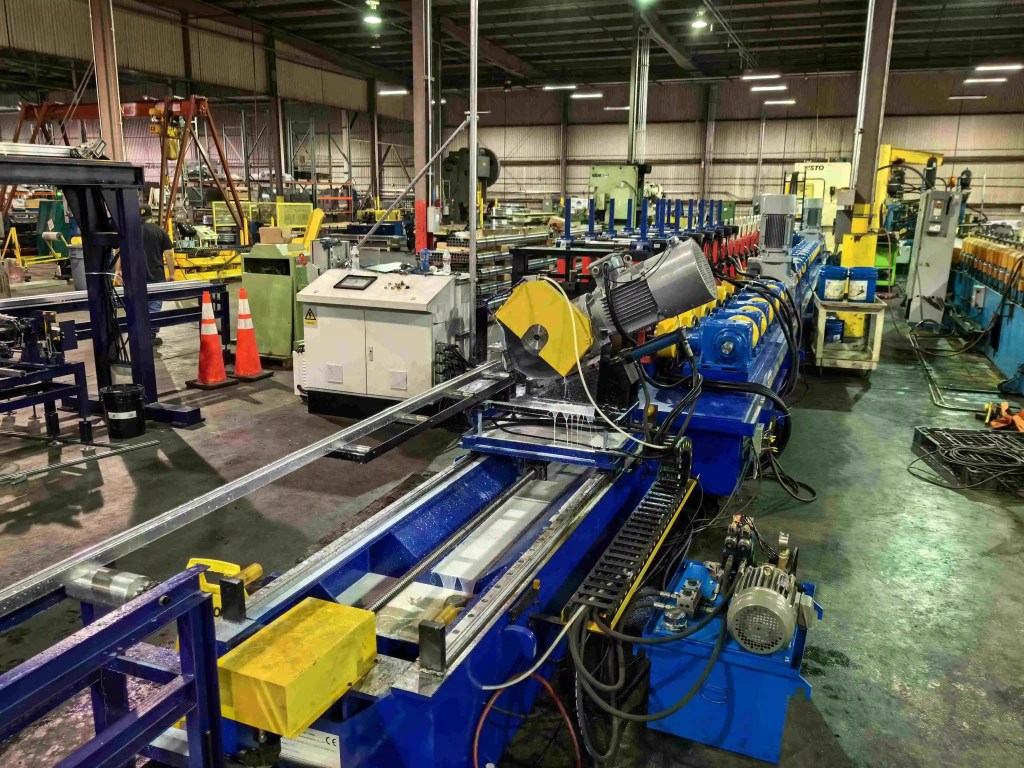
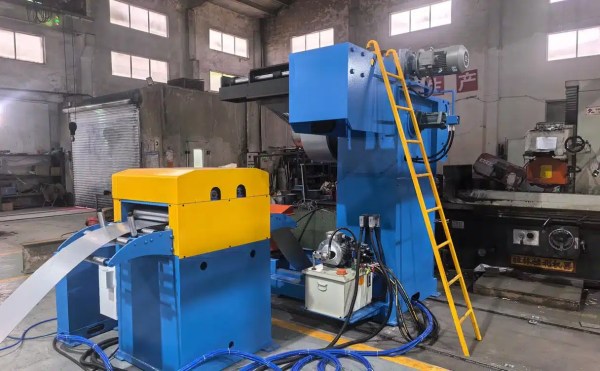
A sharp, square shear releases cut-end stress without opening the flange.
Measuring flare and setting a limit
You cannot correct what you do not measure. End flare is measured as the gap between the flange edge and a straight edge placed along the profile, taken 100 mm back from the cut end. A common acceptance limit is under 3 mm at that point, though your drawing or standard takes priority.
| Measurement point | What it tells you | Typical limit |
|---|---|---|
| At the cut end | Immediate stress release | Largest gap, tracked for trend only |
| 100 mm from the cut | Whether flare is under control | Under 3 mm for many profiles |
| 300 mm from the cut | Whether the problem is in the forming passes | Should match the running profile |
If the 300 mm reading is already open, the problem is upstream in the rolls. If only the cut end is open, the shear and the last pass are the cause. This one table saves a lot of guesswork on the shop floor.
Use the same gauge and the same operator method on every shift. A reading taken at 80 mm and one taken at 120 mm are not comparable, and the difference looks like a machine change when it is not.
Cold formed steel dimensional tolerances are covered by EN 10162, while AISI S100 sets the design rules for cold formed steel members. The สมาคมการก่อสร้างโลหะ publishes guidance on formed panel and profile tolerances. Neither document gives a single universal flare number. Your product drawing and customer specification are the authority for the limit you hold.

Measure flare at 100 mm from the cut end and hold a consistent method each shift.
When flare is a setup problem, not a cutoff problem
Some flare will not respond to blade changes. If the profile is also twisting, or the hole positions drift near the cut end, the line is out of alignment upstream. A sharp blade cannot fix a strip that arrives at the shear already loaded unevenly.
Run this check before changing the blade again. Cut a length, then measure the flare. Move the cut position 500 mm along the same strip and cut again. If the flare follows the blade, the shear is the cause. If it stays with the same piece of steel, a roll or guide upstream is the cause.
For profiles that switch between shapes, flare often appears only on one profile. The C-to-Z purlin changeover guide explains how pass settings shift between sections and where to recheck the finishing angle after a change.
If the bend radius is tight, look at the minimum bend radius values for the grade and thickness you run. A radius below the practical limit stores more stress and makes flare harder to remove at the shear.
Beli Rollforming has built roll forming lines since 2005 and delivered more than 500 machines to customers in over 50 countries. Every line is backed by a 24-month warranty on the complete machine. Our engineers set the finishing passes and shear clearance against your drawing before the line ships.

Stand alignment and even strip tension keep stress balanced before the cut.
คำถามที่พบบ่อย
1. What is end flare in roll forming? End flare is the opening of a flange at the cut end of a roll formed profile. Stored bending stress is released when the shear cuts the strip, and the flange springs open in the first 100 mm.
2. What causes end flare on a purlin line? Too much overbend at the last pass, uneven strip tension, a dull blade, or excessive shear clearance. Overbend and blade condition cause most cases.
3. How much end flare is acceptable? Many profiles hold flare under 3 mm measured 100 mm back from the cut. Your drawing or the customer specification is the final authority, and standards such as EN 10162 cover wider dimensional tolerances.
4. How do I measure end flare? Place a straight edge along the flange and measure the gap at the cut end, at 100 mm, and at 300 mm. Use the same tool and method on every shift so readings stay comparable.
5. Can shear clearance alone fix end flare? It can when the blade is dull or the gap is too wide. Set clearance to about 5 to 10 percent of strip thickness for mild steel. If flare remains, reduce overbend at the finishing pass.
6. Does a straightener before the shear help? Yes. Three to five light straightening passes let stored stress settle before the cut. Keep the passes light so the finished angle does not change.
7. Is end flare the same as springback? No. Springback is the angle change across the whole part after forming. End flare is local to the cut end and appears when the shear releases the strip.
8. Why does only one of my profiles flare? Profile-specific flare usually comes from finishing pass settings for that section. Recheck overbend and strip width after a changeover, and confirm the shear is square.
9. Can edge wave cause end flare? Yes. A wavy flange edge carries uneven length, which opens at the cut. Fix strip tension and the edge condition first, then reset the shear.
10. When should I call the machine supplier about flare? Call when flare persists after you have corrected overbend, tension, blade condition, and clearance. A persistent one-sided flare often points to a stand or guide that needs realignment.
อัปเดตล่าสุด: 2026-11-27
บันทึกการเปลี่ยนแปลงบทความ
- 2026-11-27: Initial publication with 6 end flare corrections, measurement limits, and 10 FAQ entries.
ตัวกระตุ้นการทบทวนครั้งต่อไป
- Revise when a customer specification sets a flare limit other than 3 mm at 100 mm.
- Update blade clearance guidance if the line runs predominantly stainless or high-strength steel.
- Revisit alignment checks after a shear or finishing stand replacement.


 ไทย