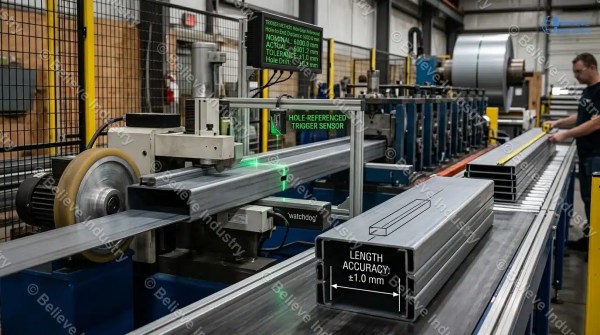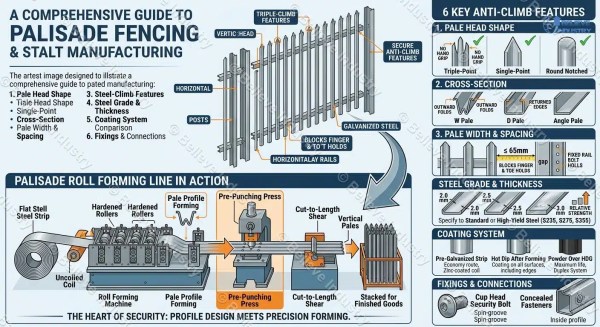










For manufacturers using high-strength steel (HSS) or specialized alloys, managing การคืนตัวของสปริงในการขึ้นรูปด้วยการรีด is not just an optimization goal—it is a mandatory step toward achieving dimensional accuracy. Springback is the elastic recovery of the material after the forming pressure is released, causing the final profile angle to open up slightly from the intended design.
Uncontrolled การคืนตัวของสปริงในการขึ้นรูปด้วยการรีด leads to profiles that are out of tolerance, resulting in fit-up issues, material scrap, and potential structural failure in the end application. This challenge is magnified in modern production environments, where lighter gauges and higher material strengths are increasingly common.
At Beli RollForming, our philosophy integrates sophisticated springback mitigation directly into the machine and tooling design. This guide outlines 4 key technical techniques that can be implemented on your production line to master the การคืนตัวของสปริงในการขึ้นรูปด้วยการรีด challenge.
Why Springback is a Core Problem in the Roll Forming Industry
The severity of การคืนตัวของสปริงในการขึ้นรูปด้วยการรีด is directly proportional to the material’s yield strength and the desired bend radius. The higher the yield strength, the greater the internal elastic stress that seeks to recover.
To truly understand this challenge, it is critical to first analyze your material properties. As detailed in our article, วัสดุขึ้นรูปด้วยการรีด: 8 ข้อแตกต่างที่สำคัญระหว่างเหล็กและอลูมิเนียม, steel presents a significantly higher springback challenge than aluminum. Successfully mitigating this issue is a defining characteristic of advanced เทคโนโลยีการขึ้นรูปม้วน. This ability to precisely control material behavior is what separates a world-class machine builder from the competition.
4 Key Techniques to Master Springback in Roll Forming
Technique 1: Tooling Compensation via Over-Bending
The most common and effective technique to control การคืนตัวของสปริงในการขึ้นรูปด้วยการรีด is tooling compensation, also known as over-bending.
This method involves designing the forming rolls (or “flower pattern”) to intentionally bend the material beyond the required final angle. When the material exits the final stand and the forming pressure is released, the springback effect snaps the material back to the precise desired angle.
Implementation Tip: Accurate over-bending requires meticulous testing and adjustment of the final forming stands. The geometry of the ชิ้นส่วนเครื่องรีดขึ้นรูป must be perfectly aligned to execute this subtle, progressive over-bending without inducing new defects like wave or camber.
Technique 2: Stress Equalization Through Material Preparation
Springback is fundamentally a stress-relief phenomenon. If the input material already carries uneven residual stresses (known as “coil memory”), the final profile will twist or warp in addition to suffering angular springback.
The solution is proactive stress equalization using a precision leveler before the strip enters the mill. By subjecting the strip to bending and reverse bending, the leveler neutralizes these stresses, ensuring the only stress introduced during the forming process is predictable and manageable. This critical pre-processing step must be the starting point for any high-precision operation.
Technique 3: Leveraging Finite Element Analysis (FEA) Modeling
Modern complex profiles and high-strength materials make traditional trial-and-error compensation too costly and time-consuming. This is where advanced simulation comes in.
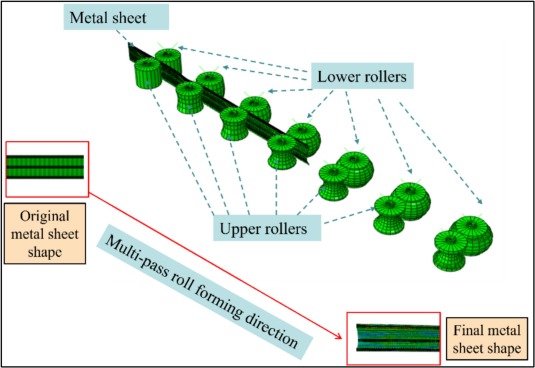
FEA modeling is a powerful application of เทคโนโลยีการขึ้นรูปม้วน that digitally simulates the entire forming process. By inputting the material properties (yield strength, modulus of elasticity), the roll design, and the forming speeds, the software predicts the exact degree of การคืนตัวของสปริงในการขึ้นรูปด้วยการรีด for every bend. This allows engineers to determine the perfect tooling compensation angle ก่อน cutting any steel, significantly reducing development time and material waste.
For more technical background on the machine structure required for these high-stress operations, consult our การวิเคราะห์เครื่องขึ้นรูปม้วนอย่างครอบคลุม ผลงาน.
Technique 4: Dedicated Post-Forming Correction
For extreme cases, particularly with high-tensile materials, compensation through over-bending alone may be insufficient or inconsistent. A final correction unit is necessary.
This technique uses dedicated straightening equipment immediately after the final forming stand and before the cut-off saw. Examples include:
Turk’s Heads: Specialized roll clusters that apply corrective twisting or angular pressure.
Powered Straighteners: Units that use friction and counter-bending force to lock the material into the straight condition.
This equipment acts as the last guard against การคืนตัวของสปริงในการขึ้นรูปด้วยการรีด. The precise control and positioning of these ชิ้นส่วนเครื่องรีดขึ้นรูป are key to neutralizing the final residual elastic energy in the profile. For any company in the competitive อุตสาหกรรมการขึ้นรูปม้วน, minimizing defects through such advanced techniques is a mandate.
The Beli RollForming Advantage in Springback Control
At Beli RollForming, our success in the อุตสาหกรรมการขึ้นรูปม้วน stems from integrating these four techniques into our machine builds. We design machines with advanced leveling systems (Technique 2), use FEA for tooling development (Technique 3), and ensure all critical ชิ้นส่วนเครื่องรีดขึ้นรูป are engineered for the required over-bending and final correction (Techniques 1 & 4).
For further technical insights into the mechanical forces at play during forming, the วารสารเทคโนโลยีการแปรรูปวัสดุ provides valuable academic research on predicting material deformation.
By prioritizing precision engineering, we ensure that every profile produced on a Beli machine meets the tightest dimensional specifications, tackling the serious challenge of การคืนตัวของสปริงในการขึ้นรูปด้วยการรีด head-on.