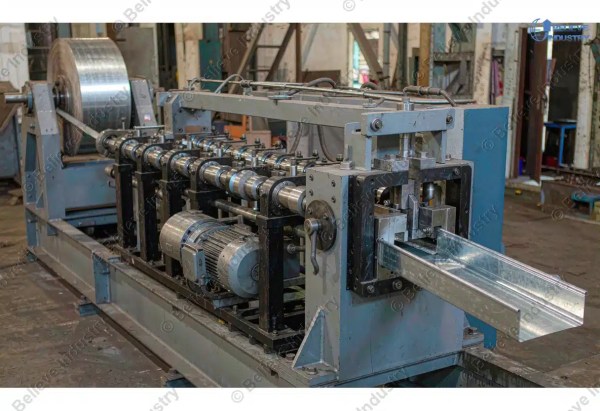




The global elevator and escalator market sits at $130 billion in 2025 and climbs toward $185 billion by 2030. Urbanization in Asia, the Middle East, and Africa drives relentless demand for vertical transport. Every new high-rise needs guide rails and car frames. Every transit hub needs escalators and moving walkways. Behind every installation sits an elevator roll forming machine turning steel coil into the precision profiles that keep people moving safely.
Believe Industry Company has manufactured roll forming equipment for over 15 years, shipping to 20+ countries. This guide covers four critical roll-formed profiles that define elevator and escalator production. Each demands tighter tolerances, harder steels, and stricter quality control than standard building profiles.
Why Elevator Roll Forming Is Different
Elevator profiles carry human lives. A guide rail that deflects 2mm causes a bumpy ride. A car frame channel with inconsistent dimensions can vibrate loose over 100,000 cycles. Escalator step profiles that wear unevenly create trip hazards in high-traffic transit stations. The stakes are higher than roofing or cladding, and the manufacturing standards reflect that.
Guide rail straightness must hold 0.5mm per meter. Twist on car frame channels cannot exceed 1 degree per meter. Surface hardness on T guide rail running faces targets 180 to 220 HB. These numbers push roll forming equipment to its limits. The International Organization for Standardization publishes ISO 7465 for guide rail tolerances. European EN 81-20 governs elevator safety. In the US, ASME A17.1 covers safety code for elevators and escalators. Every elevator roll forming machine must produce profiles that satisfy these standards.
Profile 1: T Guide Rail Roll Forming Machine
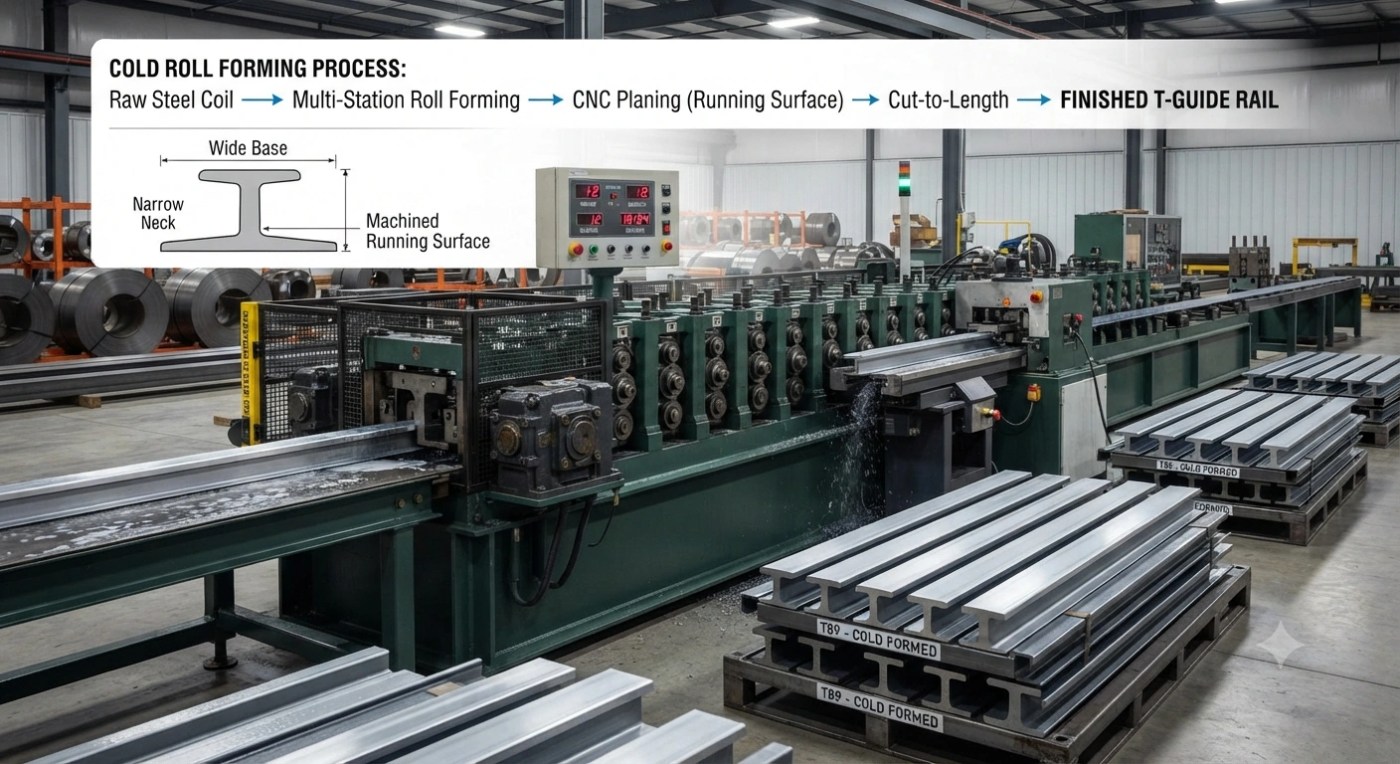
The T guide rail is the backbone of every elevator system. It is the precision track that guides the car and counterweight up and down the shaft. The profile consists of a wide base, a narrow neck, and a machined running surface at the top, resembling the letter T.
Standard sizes range from T45 to T140, where the number represents the base width in millimeters. T45 and T50 serve light-duty passenger lifts. T78 and T82 handle mid-rise applications up to 15 floors. T89 and T90 cover standard commercial buildings. T114, T127, and T140 support high-speed elevators and heavy freight lifts.
Traditional T guide rails are hot-rolled sections, but cold roll forming has entered this market for lighter grades. A guide rail roll former for T45 through T82 produces these sections from high-carbon steel strip. The running surface gets machined after roll forming to achieve 180 to 220 HB hardness and Ra 1.6 surface roughness. Cold-formed T guide rails offer cost savings of 15 to 20% over hot-rolled equivalents for lighter-duty applications.
Key machine specifications:
| Параметр | Спецификация |
|---|---|
| Материал | C45 to C55 high-carbon steel strip, 3.0 to 6.0mm |
| Скорость линии | 8 to 15 m/min |
| Валовые станции | 18 to 26 |
| Straightness tolerance | 0.5mm per meter |
| Post-forming | CNC planing of running surface |
| Cut-to-length | Flying saw, ±1mm |
Fish plates and connecting brackets are also roll-formed. A slotted strut channel roll forming machine produces compatible bracket profiles that mount guide rails to shaft walls.
Profile 2: Hollow Guide Rail Roll Forming Machine
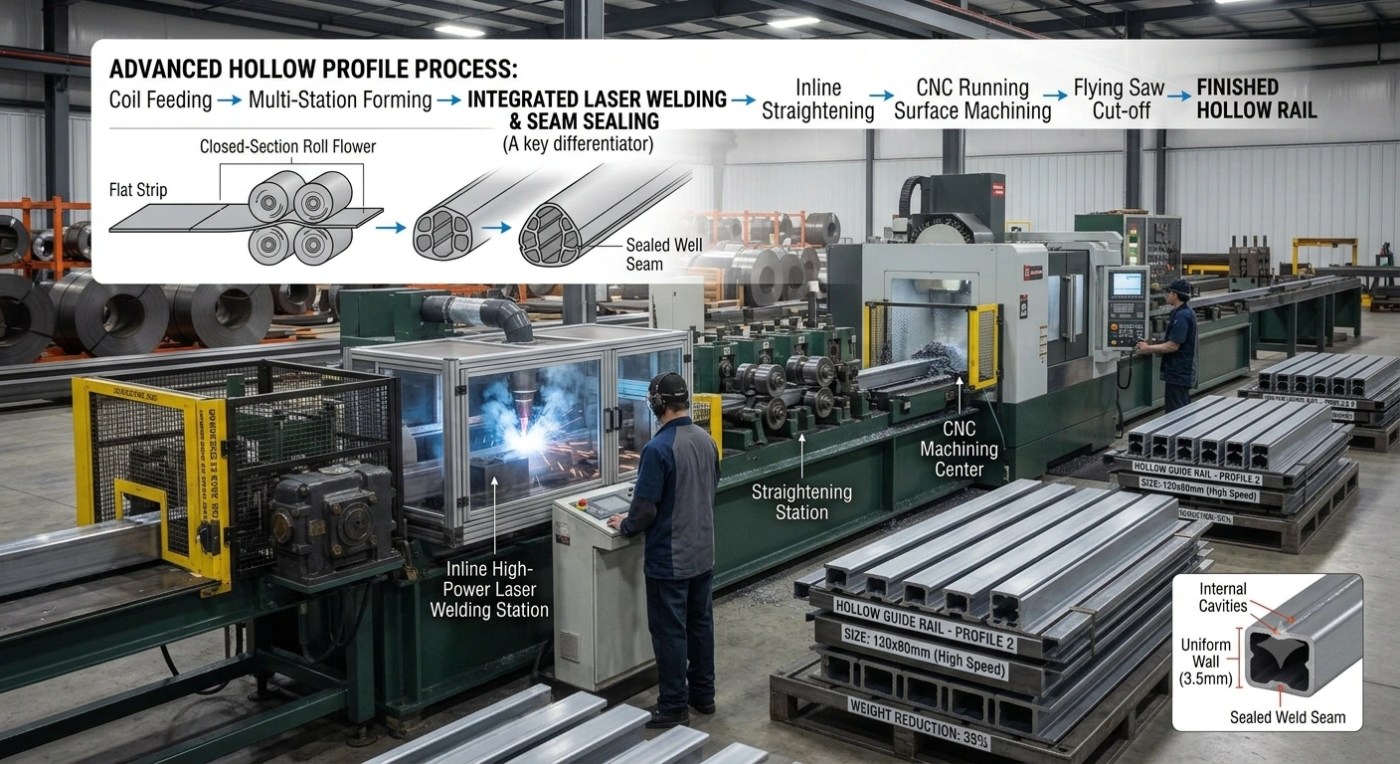
Hollow guide rails are the modern answer to high-speed elevator demands. Unlike solid T rails, hollow guide rails feature a closed cross-section with internal cavities. This design reduces weight by 30 to 40% while maintaining comparable stiffness. High-speed elevators running at 5 to 10 meters per second rely on hollow guide rails for smoother rides and reduced shaft loads.
A hollow guide rail roll forming machine starts with flat steel strip and progressively forms it into a closed section. The profile features a rectangular or teardrop-shaped cross-section with a machined running surface. Roll forming closes the section, and laser welding or ERW seals the seam. This is what makes a hollow guide rail roll former fundamentally different from open-profile machines. The closed section requires precise roll flower design to control springback and maintain wall uniformity.
Институт c-strut roll forming machine platform provides the structural foundation, but hollow guide rail lines add welding stations, online straightening, and CNC machining. Wall thickness runs 2.5 to 4.0mm. Cross-section dimensions range from 60x40mm for mid-speed to 120x80mm for high-speed and freight configurations.
Production specs:
| Параметр | Спецификация |
|---|---|
| Материал | C45 or S355MC steel strip, 2.5 to 4.0mm |
| Скорость линии | 6 to 12 m/min (welding limits speed) |
| Валовые станции | 22 to 30 |
| Welding | Laser or ERW seam station |
| Straightness tolerance | 0.3mm per meter |
Институт профилегибочная машина для кабельных лотков shares similar closed-section techniques. Both require precise material flow control to prevent distortion.
Profile 3: Elevator Car Frame Channel Roll Forming Machine
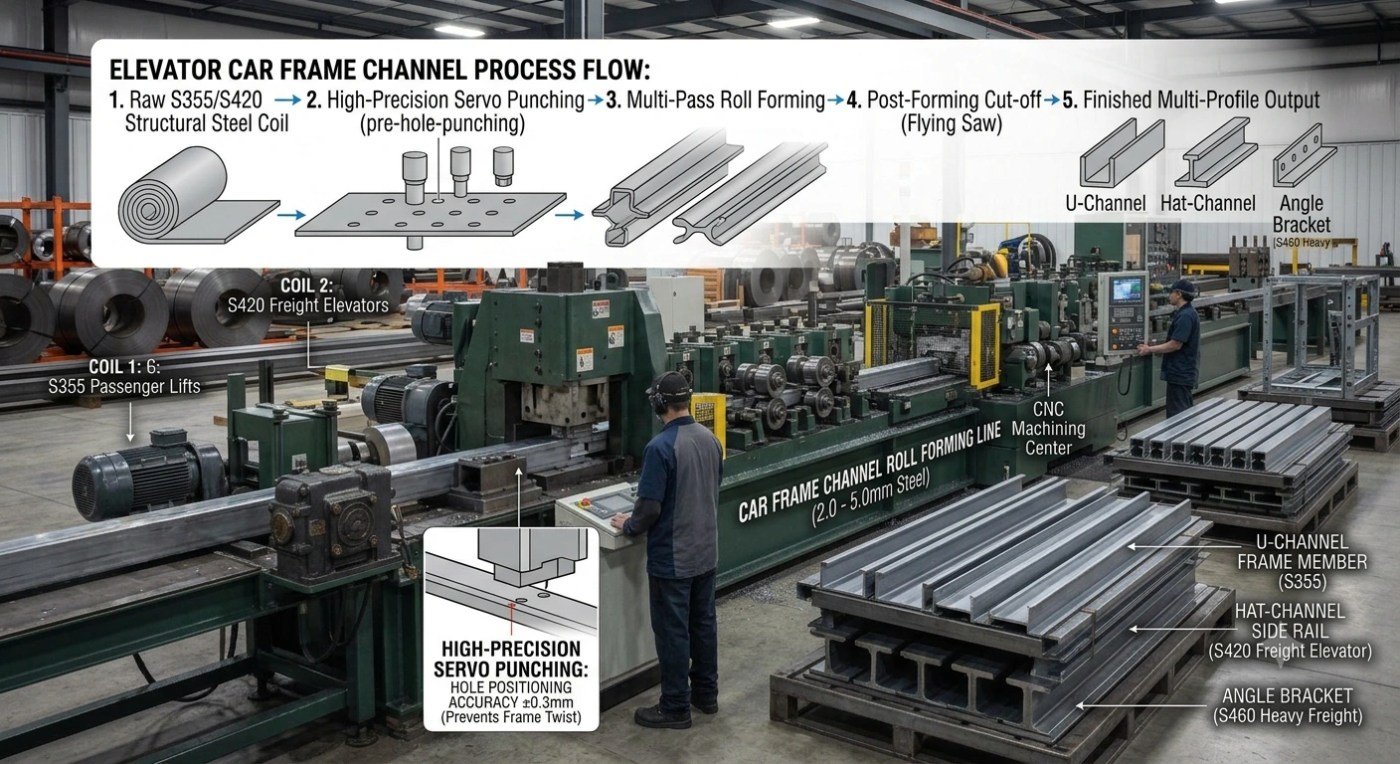
Every elevator car sits in a steel frame. That frame consists of structural channels, angles, and beams that carry the car weight, passenger load, and safety braking forces. An elevator car frame channel roll forming machine produces these sections from 2.0 to 5.0mm steel.
Car frame channels are typically U-shaped or hat-shaped profiles. The U-channel forms the top and bottom frame members. Hat channels create the side rails. Angles connect the frame to the guide shoes that ride the T guide rails. Every profile must maintain dimensional consistency because frame assembly relies on bolted connections with pre-punched holes.
The line integrates servo-driven punching and cutting. Hole positioning accuracy must hold 0.3mm because misaligned holes mean frame twist. The Станок для профилирования листового металла для стеллажей поддонов shares this pre-punching approach, but elevator channels demand tighter positioning and heavier material. Passenger lifts use S355 structural steel. Freight elevators require S420 or S460. The профилегибочная машина для вертикальных стоек handles similar high-strength grades with 20 to 24 forming stations.
Key specs:
| Параметр | Спецификация |
|---|---|
| Материал | 2.0 to 5.0mm S355 to S460 structural steel |
| Скорость линии | 10 to 20 m/min |
| Валовые станции | 16 to 22 |
| Штамповка | Servo-driven, 0.3mm positioning accuracy |
| Straightness tolerance | 1mm per meter |
Counterweight frames use similar channels in lighter gauges. The racking system box beam line produces compatible box sections for counterweight enclosures.
Profile 4: Escalator Step Profile Roll Forming Machine
Escalators and moving walkways run in transit stations, airports, shopping malls, and convention centers. Each step is an assembly of die-cast aluminum treads, steel chain links, and roll-formed structural profiles. An escalator step profile roll forming machine produces the steel support sections that give each step its structural rigidity.
The primary profile is the step track rail, the channel that guides step rollers along the incline. Step track rails must maintain consistent curvature over escalator lengths reaching 30 meters. Roll forming produces these in straight sections, and installers bend them to the required radius on site.
Escalator truss angles and channels are also roll-formed. The truss is the structural framework supporting the entire assembly. Truss members use heavier angles from 3.0 to 6.0mm steel. The standing seam roll forming machine shares similar heavy-gauge capabilities, but escalator profiles require stricter flatness tolerances on flange faces. Moving walkway profiles are simpler, using flat or slightly corrugated sections. A corrugated sheet roll forming machine produces similar walkway decking.
Escalator step profile specs:
| Параметр | Спецификация |
|---|---|
| Материал | 2.0 to 4.0mm galvanized or stainless steel |
| Скорость линии | 12 to 25 m/min |
| Валовые станции | 14 to 20 |
| Flatness tolerance | 0.3mm on flange faces |
| Качество поверхности | Zinc coating or 304/316 stainless for transit |

Comparison Table: 4 Elevator and Escalator Roll Forming Profiles
| Параметр | T Guide Rail | Hollow Guide Rail | Car Frame Channel | Escalator Step Profile |
|---|---|---|---|---|
| Толщина материала | 3.0-6.0mm | 2.5-4.0mm | 2.0-5.0mm | 2.0-4.0mm |
| Скорость линии | 8-15 m/min | 6-12 m/min | 10-20 м/мин | 12-25 m/min |
| Roll Stations | 18-26 | 22-30 | 16-22 | 14-20 |
| Steel Grade | C45-C55 high-carbon | C45 or S355MC | S355-S460 | S275 or 304/316 SS |
| Post-Processing | CNC planing of rail face | CNC milling + welding | Pre-punched holes | Field bending to radius |
| Straightness Tol. | 0.5mm/m | 0.3mm/m | 1.0mm/m | 0.5mm/m |
| Основное приложение | Car and counterweight | High-speed elevators | Car structural frame | Escalator track and truss |
| Machine Cost Range | $90K-$180K | $160K-$280K | $60K-$140K | $55K-$120K |
Comparison Table: Elevator Profiles vs Standard Structural Profiles
| Параметр | Elevator Guide Rail | Standard Strut Channel |
|---|---|---|
| Tolerance Level | 0.3-0.5mm per meter | 1.0-2.0mm per meter |
| Steel Hardness | 180-220 HB (guide surface) | 120-150 HB (standard) |
| Post-Processing | CNC machining mandatory | Никто |
| Контроль качества | 100% inspection on critical dims | Batch sampling |
| Отделка поверхности | Ra 1.6 or better on running face | Ra 6.3 acceptable |
| Сертификация | EN 81, ASME A17.1, ISO 7465 | ASTM A653 or EN 10346 |
| Safety Critical | Yes, life safety component | No, structural support only |
| Machine Investment | 2-3x standard line cost | Исходный уровень |
Standards and Compliance
Elevator and escalator manufacturing is one of the most regulated industries in the world. In Europe, EN 81-20 defines design and construction rules for passenger and freight elevators, specifying guide rail stiffness, car frame loads, and dimensional tolerances. Guide rails must carry CE marking and full material traceability.
In the United States, ASME A17.1 is the safety code for elevators and escalators. It covers guide rail design loads, car frame factor of safety, and escalator step chain requirements. ISO 7465 defines guide rail dimensions and tolerances internationally. China follows GB/T 22588 for guide rail specifications, with GB 7588 aligning to EN 81 for safety.
Believe Industry configures every elevator roll forming machine for the target market regulatory framework. Full material test reports, hardness certificates, dimensional inspection records, and CE documentation ship with every line.
Production Economics
T guide rail lines run $90,000 to $180,000. Hollow guide rail lines are the most expensive at $160,000 to $280,000 due to welding and straightening systems. Car frame channel machines cost $60,000 to $140,000. Escalator step profile lines start at $55,000 and reach $120,000 for stainless configurations.
The margins justify the investment. A T89 guide rail at 4.5mm high-carbon steel costs $8 to $12 in material per 3-meter length. Finished guide rails sell at $22 to $38. Margin per piece: $14 to $26. At 12 m/min producing 3-meter sections, that is 4 pieces per minute, $56 to $104 per minute. An 8-hour shift generates $26,880 to $49,920 in gross margin.
Hollow guide rails for high-speed elevators command higher premiums. A 90x60mm hollow rail costs $15 to $20 in material per 3-meter piece. Finished rails sell at $45 to $70. At 8 m/min, that is $80 to $133 per minute. Car frame channels at 3.0mm S355 cost $4 to $6 per meter, sell at $12 to $18. At 15 m/min, that is $120 to $180 per minute.
Институт roofing sheet roll forming machine market is more crowded with thinner margins. Elevator profiles carry higher barriers to entry and less competition. Payback on a T guide rail line: 6 to 10 months. Hollow guide rail line: 10 to 16 months. Car frame channel machine: 4 to 7 months. The double-layer roll forming machine concept applies here. Some manufacturers combine car frame and escalator step profiles on one line with quick-change tooling.
Frequently Asked Questions of Elevator Roll Forming Machine
No. T45 through T82 share one tooling set. T89 through T127 require a second, heavier line with larger roll stands and more forming stations. Attempting to span the full range on one line compromises quality at both ends. Most manufacturers run two dedicated lines.
Hot-rolled T rails dominate heavy-duty applications (T89 and above) because hot rolling produces the dense grain structure needed for high surface hardness. Cold-formed T rails serve lighter applications (T45 to T82) and cost 15 to 20% less. Both require CNC machining of the running surface after forming.
Welding is the bottleneck. Laser welding runs at 3 to 6 m/min. ERW reaches 8 to 12 m/min but requires post-weld heat treatment. The welding station, cooling zone, and straightener add 8 to 15 meters to the line length. This is why hollow guide rail lines cost 60 to 70% more than open-profile lines.
S355 is the baseline for passenger elevators. Freight elevators require S420 or S460 for higher load ratings. Counterweight frames can use S275 because they carry fixed loads. Always verify yield strength and impact toughness on mill certificates before production.f
No, but transit and airport installations usually specify 304 or 316 stainless for corrosion resistance in high-traffic environments. Indoor shopping mall escalators often use galvanized steel. Stainless lines require polished chrome rolls to prevent surface marking during forming.
We integrate CNC planing and milling stations directly into the roll forming line. The running surface gets machined to Ra 1.6 roughness and measured with online laser profilometry. This inline approach eliminates secondary machining and reduces material handling by 40%.
45 to 90 days from deposit to shipment. T guide rail lines with integrated machining take the longest. Hollow guide rail lines with welding stations run 60 to 90 days. Car frame and escalator step profile lines ship in 45 to 60 days. Believe Industry sends an engineer for installation.
Not efficiently. The profile geometries, material grades, and tolerance requirements are too different. Quick-change tooling handles similar profiles within one category, like different T rail sizes. But switching from T guide rails to escalator step tracks requires a full tooling change and recalibration.
Getting Started with Elevator Roll Forming
Институт vertical transport market is not slowing. Asia accounts for 60% of new elevator installations worldwide. The Middle East builds supertall towers demanding high-speed elevator systems. Transit infrastructure projects in Africa and Southeast Asia drive escalator demand. Every project needs guide rails, car frames, and step profiles produced on precision roll forming equipment.
Three decisions determine success. First, pick your primary profile. T guide rails offer the highest volume but require machining capability. Hollow guide rails target the premium high-speed segment. Car frame channels are the fastest payback. Escalator step profiles serve transit contracts. Second, secure your steel supply. High-carbon C45 to C55 strip and S355 to S460 plate cost 20 to 30% more than standard grades. Third, choose the right manufacturing partner.
Believe Industry Company has built roll forming machines for over 15 years. We ship to 20+ countries. From solar strut channel roll forming machines to elevator guide rail production lines, we cover the complete vertical transport manufacturing ecosystem.
The elevator industry rewards precision. Every ride starts with a steel profile formed to tolerance.
Last updated: July 30, 2026
Article Changelog:
- July 30, 2026: Initial publication. Covers T guide rail roll forming, hollow guide rail production, elevator car frame channels, and escalator step profiles for vertical transport manufacturing.
Триггеры для следующего обзора:
- EN 81-20 significant amendment affecting guide rail tolerances or car frame requirements
- ASME A17.1 code update changing escalator step chain or guide rail specifications
- ISO 7465 revision to dimensional standards for T and hollow guide rails
- New laser welding technology reducing hollow guide rail production costs by 20% or more
- Believe Industry launches new integrated guide rail machining line