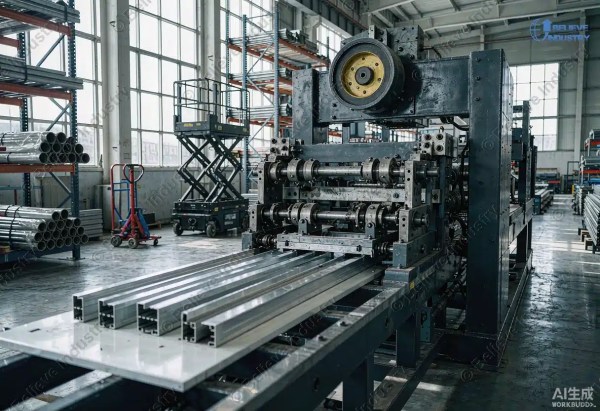










Roll forming roller wear is the gradual loss of surface finish and dimensional accuracy on the forming rolls that shape your profile. Left alone, it turns a precise line into a scrap generator.
Every roller loses material with use. The difference between a smooth shift and a shutdown is catching that loss early. Roll forming roller wear is a maintenance problem you can predict, not a surprise you react to.
This guide covers six diagnostic signs of roller wear, the numbers that tell you when to act, and the maintenance habits that extend roller life. It pairs with our инструмент для профилирования overview for a full picture of the tooling stack.
What Causes Roll Forming Roller Wear?
Four mechanisms remove metal from a roller surface during production.
Abrasive wear is the most common. Hard particles in the strip, scale, or trapped debris grind the roll face. It grows with coil cleanliness and line speed.
Adhesive wear happens when strip and roller surfaces momentarily bond, then tear. Stainless steel and aluminium are the worst offenders because they gall easily.
Corrosive wear attacks rollers between shifts. Humid air, acidic residues, and galvanized zinc fumes pit the surface when rollers sit idle.
Fatigue wear shows as micro cracks and spalling after millions of load cycles. It accelerates once the hardened case below the surface starts to fail.
Material choice sets the baseline. GCr15 bearing steel and D2 tool steel resist all four mechanisms far better than mild tool steel. GCr15 conforms to ASTM A295 for high-carbon bearing steel, and the full tolerance tables sit on the ASTM International site.
6 Diagnostic Signs of Roller Wear
Each sign maps to a cause and a fix. Catch it in the early column and you repolish. Wait for the late column and you regrind or scrap the roller.
| # | What you see | Early sign | Late sign | Likely cause |
|---|---|---|---|---|
| 1 | Surface finish | Strip Ra climbs past 0.4 µm | Visible roller scoring lines | Abrasive or adhesive wear |
| 2 | Strip marks | Faint intermittent lines | Continuous scratch track | Roller Ra above 0.8 µm |
| 3 | Profile size | Drift within ±0.3 mm | Out of tolerance, rejects | Worn forming diameter |
| 4 | Shape defects | Slight edge wave | Permanent camber, twist | Uneven stand wear |
| 5 | Coating pickup | Light zinc dust on roll | Hard zinc nodul on roll face | Galvanized strip adhesion |
| 6 | Machine feel | Higher stand noise | Vibration, bearing load | Spalling, out of round |
Sign 3 is the one that costs money fastest. A profile that drifts beyond ±0.3 mm fails inspection and the whole coil is at risk. Our surface scratch fix guide covers the repolish sequence when sign 2 appears.
A roller that shows sign 5 needs immediate attention. Zinc pickup hardens on the roll face and acts like sandpaper on the next coil.
How to Measure Roll Forming Roller Wear
Measurement turns guesswork into a schedule. Use three checks on every planned maintenance window.
- Measure roller surface finish with a portable Ra probe. New rolls sit at Ra 0.2 to 0.4 µm. Plan a repolish at 0.8 µm.
- Check the roll diameter with a micrometer at three points across the face. Diameter loss of 0.2 to 0.5 mm is the regrind trigger.
- Run a profile gauge on the first strip after a stand change. Compare the reading to the approved sample. Drift beyond ±0.3 mm means the stand is worn.
Log every reading. A simple spreadsheet shows wear rate per 100,000 linear meters and predicts the next service date.
The same discipline applies to roller gap clearance. Gap and wear move together, so measure them on the same window.
Roller Replacement Timing: Regrind vs Replace
Know the line between a cheap fix and a false economy.
Regrind when diameter loss is 0.2 to 0.5 mm and the hardened case is intact. A reground GCr15 roller returns to Ra 0.2 to 0.4 µm and runs for another 1,000 to 3,000 hours.
Replace when any of these appear:
- Hardened case is breached and the core shows lower hardness.
- Chrome plating is worn below 10 µm and the base metal is exposed.
- Spalling or cracks cover more than one pass section.
- Diameter loss exceeds the regrind reserve built into the original drawing.
Well maintained rollers last 1,000 to 3,000 production hours before the first regrind. After three regrinds the reserve is usually gone and replacement is the only option.
A профилегибочная машина с быстрой сменой профилей shortens the swap, so timing decisions stop blocking the line.
Maintenance Practices That Extend Roller Life
Good habits delay roll forming roller wear and push every number above. Four of them matter most.
Set and verify the roller gap on a schedule. A gap that squeezes the strip past nominal doubles abrasive wear.
Commission the line correctly. Our 7-day startup checklist sets bearing preload and alignment before the first coil, which prevents early fatigue.
Store rollers dry. The coil storage rack systems guide applies to tooling too: racks, V-blocks, and silica packs stop corrosive wear during idle weeks.
Lubricate the strip, not just the machine. A thin, clean lube film between strip and roller cuts adhesive wear on stainless and aluminium.
Choosing Wear-Resistant Rollers
Specify the roller material against the strip, not the catalogue.
| Материал ролика | Hardness (HRC) | Лучше всего подходит для | Coating |
|---|---|---|---|
| Подшипниковая сталь GCr15 | 58 to 62 | Carbon and galvanized steel | Chrome 20 to 50 µm |
| Инструментальная сталь D2 | 60 to 64 | Abrasive profiles, speeds above 30 m/min | Chrome 20 to 50 µm |
| Chrome plating (skin) | Surface only | Low Ra finish, corrosion resistance | 20 to 50 µm, renew below 10 µm |
GCr15 bearing steel, vacuum quenched to HRC 58 to 62, is the default for carbon and galvanized steel. It balances cost and wear life for most lines.
D2 tool steel, at HRC 60 to 64, wins on abrasive profiles and high speed runs above 30 m/min where heat builds fast.
Chrome plating adds a 0.02 to 0.05 mm (20 to 50 µm) skin that protects the base and gives a low Ra finish. Renew it when it wears below 10 µm.
For stainless and aluminium, pick the harder base plus chrome, then watch lubrication closely to avoid galling. The Fabricator и Ассоциация точной металлообработки publish field guides on roller metallurgy and lubrication that match these specs.
Frequently Asked Questions of Roll Forming Roller Wear
1. What are the first signs of roll forming roller wear?
The first signs are a climbing strip surface finish past Ra 0.4 µm, faint intermittent scratch lines, and a profile drifting within ±0.3 mm of tolerance. Catch these during routine measurement and you only need a repolish.
2. How do you measure roller wear on a roll forming machine?
Measure roller wear with a portable Ra probe for surface finish, a micrometer for diameter loss at three points, and a profile gauge on the first strip after a stand change. Log readings per 100,000 linear meters to predict service dates.
3. When should you regrind instead of replace a roller?
Regrind when diameter loss is 0.2 to 0.5 mm and the hardened case is intact. Replace when the case is breached, chrome is below 10 µm, spalling covers a pass section, or diameter loss exceeds the regrind reserve.
4. What roller hardness is best for wear resistance?
GCr15 bearing steel at HRC 58 to 62 suits carbon and galvanized steel, while D2 tool steel at HRC 60 to 64 suits abrasive profiles and speeds above 30 m/min. Harder base metal delays fatigue and abrasive wear.
5. How long do roll forming rollers last before regrinding?
Well maintained GCr15 rollers run 1,000 to 3,000 production hours before the first regrind, then another similar span after each regrind until the reserve is consumed, usually after three regrinds.
6. Does production speed increase roller wear?
Yes. Wear roughly doubles when line speed moves from 15 to 30 m/min because contact pressure cycles and heat both rise, so high speed lines need harder rollers and tighter lubrication control.
7. How does chrome plating protect rollers from wear?
Chrome plating adds a 0.02 to 0.05 mm skin that resists abrasion and gives a low Ra finish, and you renew it when worn below 10 µm to keep the base metal sealed.
8. How should you store rollers to prevent corrosion wear?
Store rollers in a dry rack on V-blocks with silica packs and a light oil film, because humid air and galvanized zinc fumes pit the surface during idle weeks and start corrosive wear.
9. Can roller wear cause profile dimensional drift?
Yes. As the forming diameter shrinks, the profile drifts, and once it passes ±0.3 mm the part fails inspection, so wear is the first thing to check on out of tolerance rejects.
Заключение
Roll forming roller wear is predictable. Six signs tell you the story, and the numbers tell you when to act: Ra 0.8 µm to repolish, 0.2 to 0.5 mm to regrind, 10 µm chrome to renew.
Pick the right base material, keep the gap and lubrication disciplined, and store rollers dry. Those habits push the first regrind past 3,000 hours.
Beli Rollforming has built custom roll forming machines for customers in 20+ countries over the past 15+ years. Every line ships with tooling documentation and setup support. Contact us about your next профилегибочная машина.