


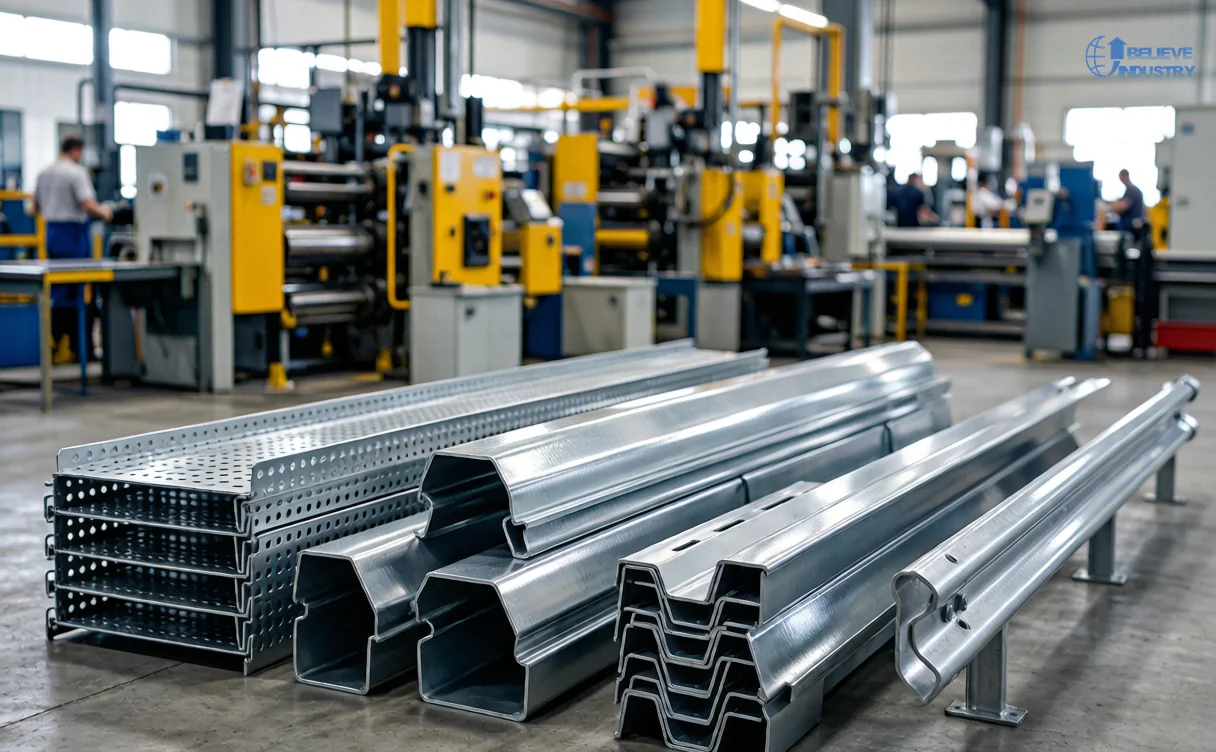
Every production manager faces the same question at some point. The old line still runs, but it runs slower, stops more often, and eats repair hours. Do you fund a roll forming machine upgrade vs replacement, or do you commit to full replacement?
Guesswork is expensive on both sides. An upgrade on the wrong machine burns capital with nothing to show for it. An early replacement scraps a machine with 10 good years left in its frame. The decision gets simple when you run the right numbers.
For the roll forming machine upgrade vs replacement decision, this guide gives you six trigger point calculations. Each one produces a number you can put in front of your finance team. Beli Rollforming has built custom lines for buyers in 20+ countries for over 15 years, and this exact question comes up in almost every serious inquiry. One note before we start: any decision you make should sit inside a wider equipment plan built around your roll forming machine.

Trigger 1: The 50% Repair Cost Rule
The most widely used benchmark in capital planning is the 50% rule. If annual repair spend on a machine passes 50% of the price of a comparable new machine, replacement usually wins. The logic is simple. A rebuilt machine still carries old shafts, old hydraulics, and old electrics, so the repair curve keeps climbing.
The calculation:
“` Repair Cost Ratio = Annual repair spend ÷ Price of a comparable new line × 100 “`
Worked example. Your line needs USD 18,000 per year in repairs and a similar new line costs USD 60,000. The ratio is 30%, so the machine sits in the repair zone. Next year the bill climbs to USD 32,000. The ratio hits 53% and the trigger fires. Replacement wins.
Be honest with the input numbers. Include emergency call-out labor, expedited spare freight, and the maintenance hours your own team logs. A solid preventative maintenance program keeps this ratio low for years, but no program reverses an aging machine’s curve. Track the ratio every year so you see the trend, not just the snapshot.
Trigger 2: Annual Downtime Cost
Unplanned stops are the hidden engine behind most replacement decisions. The repair invoice shows one number. The stopped line shows a much bigger one.
The calculation:
“` Downtime Cost = Unplanned downtime hours × Contribution margin per hour “`
Worked example. Your line stops 120 hours per year outside planned maintenance. Your contribution margin is USD 450 per production hour. That is USD 54,000 per year evaporating. If a control and drive upgrade removes 80% of those stops, the upgrade pays USD 43,200 per year before touching any other benefit.
Here is the replacement trigger on top of the math. If downtime stays above 5% of scheduled production hours even after a mid-life upgrade, the base machine is the problem. Aging frames, worn shafts, and misaligned bases cause chronic stops that no control panel can fix. That is the moment to stop funding upgrades and start pricing new lines. It is the clearest roll forming machine upgrade vs replacement signal the downtime data can give you.
Trigger 3: The Capability Gap
This trigger compares what your market demands with what your machine can produce. It is the most strategic of the six, because it can force replacement even on a machine that runs reliably.
The calculation:
“` Capability Gap = Annual revenue from orders you decline or outsource “`
List every quote you turned down or subcontracted in the last 12 months. Common gaps: gauge range too narrow, speed too slow for contract volumes, no high-strength steel capability, profile width beyond the forming stations.
Worked example. Your line forms 0.8 to 1.5 mm at 15 m/min. Tenders now ask for 2.0 mm sections in 550 MPa steel at 20 m/min. No control retrofit closes that gap. If the frame, shaft diameter, and station count cannot support the new spec, the machine replacement decision is made for you.
The practical test: a gap in tooling alone is an upgrade case, and new roll sets are a fraction of a line price. See our roll forming tooling guide for what new tooling can and cannot change. A gap in the frame itself is a replacement case. As we note in our stainless steel forming guide, a line with fewer than 18 forming stations cannot gain enough passes through a rebuild.
Trigger 4: Operating Cost Drift
Old machines leak money quietly through scrap, rework, and energy. This trigger converts that leak into an annual figure.
The calculation:
“` Annual Drift Cost = (Old scrap rate − Benchmark scrap rate) × Annual material spend + Excess energy cost per ton × Annual tonnage “`
Worked example. Your scrap rate is 3% on USD 1,500,000 of annual coil spend. A modern line with servo feeding and a cutoff die in good condition runs below 0.5%. The difference is USD 37,500 per year. Add drives that draw 15 to 25% more power per ton than modern units, and the drift easily passes USD 50,000.
When the three-year total of operating drift exceeds the price gap between a full upgrade and a new machine, replacement wins. The drift also compounds: worn guides create off-tolerance parts, off-tolerance parts create rework, and rework consumes the same machine hours you were short on in Trigger 2.
Trigger 5: Obsolescence and Spare Part Risk
Controls and drives have a service life independent of the mechanics. PLC platforms typically reach end of support 10 to 15 years after launch. After that, one failed module can idle your line for weeks while you hunt a used part.
The calculation:
“` Obsolescence Risk = P(failure this year) × Expected downtime (hours) × Margin per hour + Expedited parts premium “`
Worked example. A discontinued servo drive has a 30% chance of failure this year. Sourcing one used costs USD 6,000 and still means an expected 4-week wait. At USD 450 per hour, the expected annual loss is roughly USD 22,000 before the freight premium.
If your line depends on any single obsolete component, fund a control retrofit now. If three or more critical components are obsolete, the electronics case alone can justify line replacement, especially when you combine it with Triggers 2 and 4. Our roll forming automation guide covers what a modern control platform adds beyond risk removal.
Trigger 6: The Payback Comparison
The final trigger puts upgrade and replacement on the same scoreboard.
The calculation:
“` Upgrade payback (months) = Upgrade cost ÷ Monthly cash gain from upgrading Replacement payback (months) = (New machine cost − Trade-in or resale value) ÷ Monthly cash gain from replacing “`
Worked example. An upgrade costs USD 35,000 and adds USD 6,000 per month in recovered margin. Payback is 5.8 months. A new line costs USD 120,000, the old machine trades in at USD 15,000, and the new line adds USD 11,000 per month. Payback is 9.5 months. On pure payback, the upgrade wins.
Now add two reality checks. First, if the upgrade payback extends beyond 24 months, or if you expect a second upgrade within 3 years, replace instead. Second, remember delivery time: export lead times for a new line typically run 90 to 120 days, while an upgrade fits into 4 to 8 weeks. If contracts are already slipping, the fastest acceptable option matters as much as the cheapest.
The Decision Table
| Trigger | Metric | Replace when | Upgrade when |
|---|---|---|---|
| 1. Repair cost | Annual repair ÷ new machine price | Above 50% | Below 30% |
| 2. Downtime | Unplanned stops as % of scheduled hours | Above 5% after an upgrade | Upgrade cuts stops by 50%+ |
| 3. Capability gap | Revenue from declined orders | Gap is in frame, shafts, or station count | Gap is tooling only |
| 4. Operating drift | Scrap + energy + rework per year | 3-year drift exceeds price gap | Drift falls with new controls and dies |
| 5. Obsolescence | Obsolete critical components | 3 or more, no support path | 1, with a retrofit path |
| 6. Payback | Months to recover capital | New payback under 24 months and no repeat upgrade | Upgrade payback under 24 months |
Roll Forming Machine Upgrade vs Replacement at a Glance
| Factor | Upgrade | Full replacement |
|---|---|---|
| Capital outlay | USD 20,000 to 60,000 typical | USD 80,000 to 250,000+ |
| Lead time | 4 to 8 weeks | 90 to 120 days export |
| Capability gain | Controls, speed, feeding, tooling | Full gauge range, materials, automation |
| Life added | 5 to 8 years | 20+ years on the frame |
| Production gap during change | Days | Requires line handover planning |
| Residual risk | Old base mechanics remain | New machine warranty and support |
A third path sits between the two. A used roll forming machine can close a capability gap at a lower capital cost, but it carries its own inspection burden. Our guide on the hidden costs of roll forming machinery lists the line items buyers forget in both directions.
FAQs
1. When should I replace instead of upgrade a roll forming machine? Every roll forming machine upgrade vs replacement review starts with the same test. Replace when annual repair spend exceeds 50% of a comparable new machine price, when the capability gap sits in the frame rather than the tooling, or when three or more critical components are obsolete. Also replace when upgrade payback extends beyond 24 months. All three conditions point the same way.
2. What is the 50% rule for industrial machinery? The 50% rule says replacement beats repair once annual repair costs pass half the price of a new machine. It is a screening benchmark, not a law. A machine under the threshold can still fail Trigger 3 or 5.
3. How do I calculate the cost of unplanned downtime? Multiply unplanned downtime hours per year by your contribution margin per production hour. A line losing 120 hours per year at USD 450 per hour loses USD 54,000 annually. Use your own margin, not a generic industry figure.
4. How much does a typical roll forming machine upgrade cost? Most upgrades fall between USD 20,000 and USD 60,000, covering new PLC controls, servo feeding, drive replacement, or new tooling. A full control and drive package on a mid-size line sits near the middle of that range. Quotes vary with the age of the base machine.
5. Can an old roll forming machine be retrofitted with modern PLC controls? Yes, most mechanically sound machines accept a modern PLC, HMI, and servo drive retrofit in 4 to 8 weeks. The retrofit fails only when the base mechanics, shafts, or frame cannot support the new performance targets. Run Trigger 3 before committing.
6. How long does a roll forming machine last? A quality roll forming line runs 20 to 30 years on its frame, with tooling regrinds and drive refurbishments along the way. Controls and hydraulics need renewal every 10 to 15 years. Documented maintenance extends every one of those intervals.
7. Is buying a used machine a good middle option for replacement? A used line can cut capital cost by 40 to 60% and shorten delivery, but it transfers the same aging risks you are trying to escape. Inspect shaft condition, control generation, and tooling wear before buying. Our used machine guide lists the five biggest risks.
8. Does a major rebuild or retrofit require new safety certification? A rebuilt machine exported to Europe needs renewed CE marking under the Machinery Directive 2006/42/EC, and in the US, servicing must follow Occupational Safety and Health Administration (OSHA) lockout procedures under 29 CFR 1910.147 during the work. Factor certification cost into the upgrade budget. A new machine ships with certification already in place.
Conclusion: Roll Forming Machine Upgrade vs Replacement
A roll forming machine upgrade vs replacement is not a gut call. Six calculations turn it into a finance-ready case: repair cost ratio, downtime cost, capability gap, operating drift, obsolescence risk, and payback. Run all six, compare the numbers, and the stronger option usually shows itself within an hour.
If two triggers point to replacement, talk to a builder who can also tell you when an upgrade is honest engineering rather than a sales pitch. Beli Rollforming advises buyers across the US, Europe, and Australia on both paths. When the math says buy, our team can quote a line matched to your profiles and budget. When the math says rebuild, we will tell you that too. Start the conversation through our buy a roll forming machine guide or request a tailored quotation.
Last updated: 2026-10-05
Article Changelog
- 2026-10-05: Initial publication of the upgrade vs replacement decision guide with 6 trigger point calculations, 2 comparison tables, and 8 FAQs.
Next Review Triggers
- New benchmark data on downtime costs or scrap rates becomes available
- Beli releases a retrofit package price list or upgrade program
- Changes to Machinery Directive or OSHA servicing requirements
- Customer case study data from a completed upgrade vs replacement decision



 English