







Job site floor deck production looks like an obvious saving. Roll the deck where it is installed, skip the trucking, and cut the schedule by a week.
That logic holds inside a certain radius and fails outside it. The break-even point is measurable, and it depends on five cost lines that most comparisons leave out.
The five below are the ones that move the answer. Each has a number attached, and the numbers are what a project decision should rest on. Deck installation practice from the Steel Deck Institute assumes panels arrive cut to length, which is the assumption job site floor deck production removes.
Comparison 1: Equipment Investment
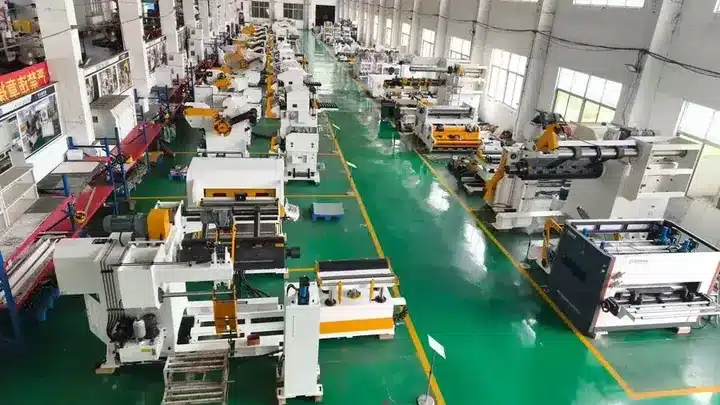
A fixed floor deck line and a mobile unit are not priced the same, and they do not do the same job.
| Item | In-plant fixed line | Job site unit |
|---|---|---|
| Typical line speed | 25 to 40 m/min | 15 to 25 m/min |
| Decoil and shear | Integrated, automatic | Integrated, manual or semi |
| Changeover time | 1 to 2 hours | 2 to 4 hours |
| Foundation | Poured and levelled | Prepared pad or ballast |
| Power requirement | 200 to 400 kW | 150 to 300 kW, generator capable |
| Enclosure | Building | Container or canopy |
The fixed line costs more and produces faster. The mobile unit costs less per tonne of capacity and produces slower, which matters when the project schedule is tight.
For a single 8,000 m² project, the mobile unit wins on capital. For a plant supplying several projects a year, the fixed line wins because the capital is spread across projects.
Equipment price ranges are covered in this guide to floor deck machine price tiers, and the tier you need depends on which model above you are buying.
Comparison 2: Labour
Labour is where the job site model usually loses, and the loss is rarely counted properly.
A fixed line runs with three operators per shift, plus a material handler. A job site unit needs four to six people because everything is done in the same place: decoiling, forming, cutting, stacking, and moving the finished bundle to the install point.
The job site crew also carries travel and subsistence costs, and productivity drops in bad weather. A line that runs 22 hours a day in a plant may run 14 hours on a site with wind and rain. Site safety rules add another layer, and OSHA requirements for steel erection change how the machine area is guarded and accessed.
| Item | In-plant | Job site |
|---|---|---|
| Operators per shift | 3 | 4 to 6 |
| Supervision | Shared across lines | Dedicated |
| Weather losses | None | 5 to 15 percent of available hours |
| Overtime exposure | Moderate | High, schedule driven |
A useful comparison is cost per square metre of finished deck, not cost per hour. The operating cost calculation gives the plant number, and the site number usually lands 20 to 35 percent above it on labour alone. The same logic applied to material and waste gives the true cost per metre, which is the number a tender should carry.
Comparison 3: Freight and Radius
This is the line that decides most projects, and it is the easiest to model.
Finished deck is bulky. A truck that carries 25 tonnes of coil carries a much smaller weight of formed deck because the profile traps air and the bundles stack poorly. In practice, deck freight per tonne runs three to five times the coil freight per tonne over the same distance.
Coil can also be shipped to any site on a standard flatbed, while long deck panels need longer trailers, escorts in some jurisdictions, and crane time on arrival.
The model looks like this. Forming on site avoids deck freight entirely and replaces it with coil freight plus the cost of moving the machine. Below roughly 300 km between plant and site, the two models land close. Above 300 km, job site production wins on freight, and the advantage grows with distance.
Panel length matters as much as distance. A 12 m panel is hard to truck and easy to roll on site. A 3 m panel is easy to truck, which weakens the case for a mobile unit. Handling advice from The Fabricator covers the bundle and crane practice that keeps long panels flat in transit.
Comparison 4: Scrap and Yield
A fixed line produces less scrap, for a structural reason: the operator can stop, adjust and restart without delaying an installation crew.
| Source | In-plant | Job site |
|---|---|---|
| Setup and trial scrap | 1 to 2 percent | 2 to 4 percent |
| Cut-off waste | 1 to 2 percent | 2 to 3 percent |
| Damage in handling | Low | Higher, multiple moves |
| Rejected panels on site | Replaced from stock | Reworked or scrapped |
The job site figure is not a criticism of the crew. It is the cost of producing next to an installation sequence, where a bundle that is 200 mm short becomes a scrap panel instead of a queue item.
On high value coated steel, a 2 percent scrap difference is enough to change the decision. On commodity galvanized deck it rarely is.
Comparison 5: Schedule and Cash Flow
Schedule is the reason job site production exists, and it deserves a number rather than an opinion.
In-plant production adds a transport step between forming and installation. That step costs 3 to 7 days for a regional delivery, and it locks the panel length before the site is measured. If the steel frame moves during erection, the panels arrive wrong.
Job site production removes that step and lets the panel be cut to the measured length on the day. On a project with a moving frame, that can recover a week of schedule and remove a category of rework.
The trade is risk. A machine on site depends on site power, site access, site security and a crew that may be shared with other trades. A breakdown on site is harder to fix than a breakdown in a plant with a spare parts room, and this spare parts list becomes critical rather than prudent.
The Break-Even Rule
| Condition | Better model |
|---|---|
| Project under 5,000 m² | Job site, if panels are long |
| Project 5,000 to 20,000 m² | Depends on radius and panel length |
| Project over 20,000 m² | In-plant, unless radius exceeds 300 km |
| Panel over 9 m | Job site, transport becomes the constraint |
| Panel under 4 m | In-plant, freight is manageable |
| Multiple projects per year | In-plant line, mobile unit as backup |
| Single remote project | Job site unit, rented or contracted |
Read the table as a first filter, then run the five costs on the actual numbers. Two projects with the same area can land on different answers because one has a 200 km radius and the other has 900 km.
What Changes on the Machine
A mobile unit is not a fixed line on a trailer. Four features matter.
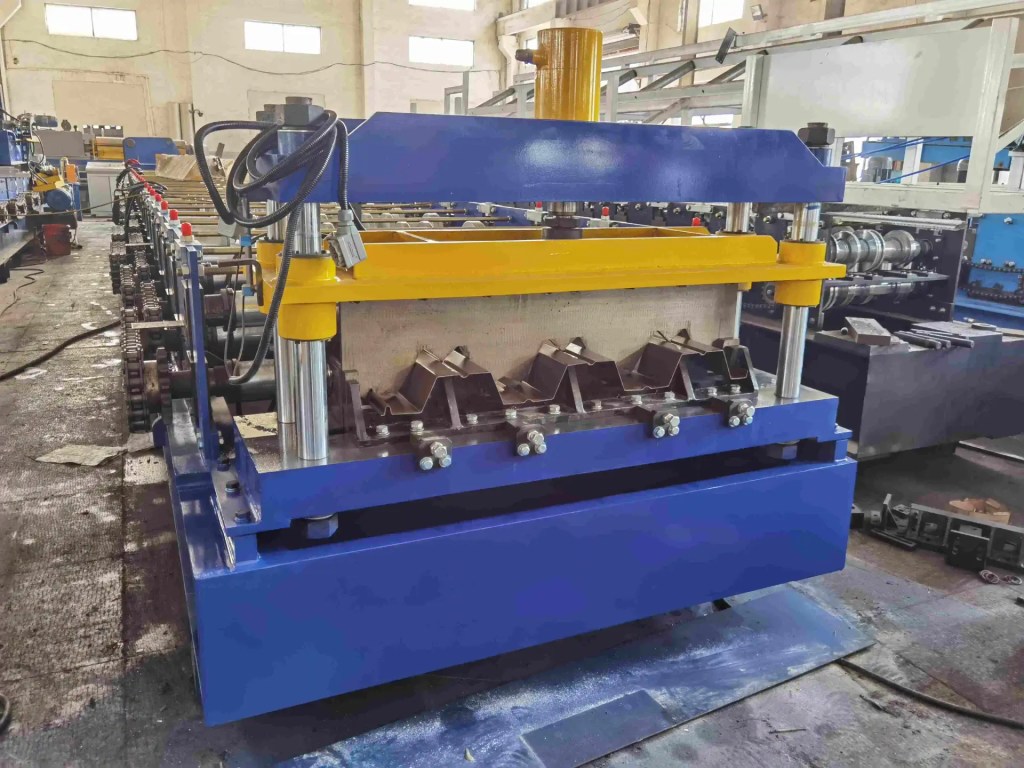
Frame stiffness. A line that levels on a concrete floor can rely on the floor. A site unit has to hold alignment on a prepared pad, so the frame is heavier and the levelling points are more numerous.
Power flexibility. Site power is often a generator, and a generator responds differently to a drive starting under load. Specify the drive and the soft start for generator supply, not for grid supply.
Dust and weather protection. Electrical panels need IP rated enclosures and heating, because a site panel sees condensation that a plant panel never does.
Lifting and transport. The line has to break down into transportable modules, and the joints have to be repeatable. A joint that needs re-alignment after every move adds a day to each mobilisation.
These features cost money, and they are why a mobile unit is not simply a cheaper fixed line. Commissioning a site unit is also a different job, and this commissioning checklist covers the alignment and trial run steps that have to be repeated after every move.
FAQ
1. Is job site floor deck production cheaper than a factory? Inside roughly 300 km of the plant, usually not once labour and scrap are counted. Beyond that radius, the freight saving usually wins, and job site floor deck production becomes the lower cost model.
2. What project size justifies a mobile deck line? Below about 5,000 m² with long panels, a mobile unit is often the only practical option. Above 20,000 m², a fixed line wins unless the site is remote.
3. How much does deck freight cost compared with coil freight? Three to five times per tonne over the same distance, because formed deck is bulky and stacks poorly.
4. What panel length makes site production attractive? Above 9 m, transport becomes the constraint and rolling on site is usually cheaper. Below 4 m, freight is manageable and the plant keeps the advantage.
5. How many people run a mobile deck line? Four to six per shift, against three on a fixed line, because the same crew handles decoiling, forming, cutting and moving bundles.
6. Does weather really affect site production? Yes. Expect 5 to 15 percent of available hours lost to wind, rain and heat, and plan the schedule with that allowance.
7. What is the biggest risk of site production? A breakdown far from the spare parts room. Carry the critical spares, especially sensors, blades and a drive module.
8. Can a mobile line run on a generator? Yes, if the drive and soft start are specified for generator supply. A line specified for grid power can trip repeatedly on a generator.
9. Does site production change the profile quality? Not if the line is aligned and the coil is stored properly. Quality problems on site usually trace to foundation, power or coil handling, not to the rolls.
10. How is the decision documented for a tender? With the five costs on one page: equipment, labour, freight, scrap and schedule days. A comparison that lists only freight is not a comparison.
Conclusion
Job site floor deck production is a radius and panel length decision, priced through five cost lines. Get the freight, labour and scrap numbers on one page and the answer usually becomes obvious.
The machine choice follows the decision, not the other way round. A mobile unit specified for grid power and a concrete floor will disappoint on a site.
Beli Rollforming builds roll forming machines for both fixed plant and site deployment, with frame stiffness, drive specification and panel protection matched to the installation model. Since 2005 and across 50+ countries, the projects that stay on schedule are the ones where the production model was chosen before the machine was ordered, and the buying guide for deck lines was applied to that choice.
Last updated: 2026-11-04
Article Changelog
- 2026-11-04: First publication. Five cost comparisons for job site and in-plant deck production, the 300 km radius rule, project size break-even table and four machine features that change on a mobile unit.
Next Review Triggers
- Freight rate changes above 15 percent on regional lanes
- A project data set that shifts the break-even radius
- New mobile line designs that change the labour requirement



 English