









Floor deck profiles fail on long spans for one main reason. The rib depth does not match the span the sheet must carry before the concrete cures. A long-span floor deck is any steel deck profile designed to carry wet concrete across 4.5 m or more without temporary shoring.
This article gives you 6 rib depth engineering rules for 4.5 m unshored spans. You will see which rib depths work, how gauge pairs with depth, and what the deflection limits allow. We also cover what a deep deck profile demands from a floor deck roll forming machine.
Every rule here reflects how Beli Rollforming engineers deep deck tooling for fabricators across more than 20 countries.
Why Rib Depth Governs the Unshored Span
An unshored span is the distance a steel deck sheet must bridge between beams with no temporary props underneath. The deck carries itself, the wet concrete, and construction loads during this stage. This is the most stressed condition in the life of a floor deck profile.
Structural capacity in this stage comes almost entirely from section modulus. Deeper ribs place more steel away from the neutral axis, which raises stiffness faster than any other geometry change. A 76 mm rib is roughly 4 times stiffer than a 38 mm rib of the same gauge.
Le Institut des pontons en acier (SDI) publishes the span tables most North American engineers use. The pattern in those tables is consistent. Deeper profile, longer unshored span. The table below shows the typical working ranges.
| Rib Depth | Type de profil | Typical Unshored Span | Common Application |
|---|---|---|---|
| 38 mm (1.5 in) | Shallow deck | Up to 2.4 m | Tight joist spacing, short bays |
| 51 mm (2 in) | Standard deck | 2.4 to 3.0 m | Office floors, mixed bays |
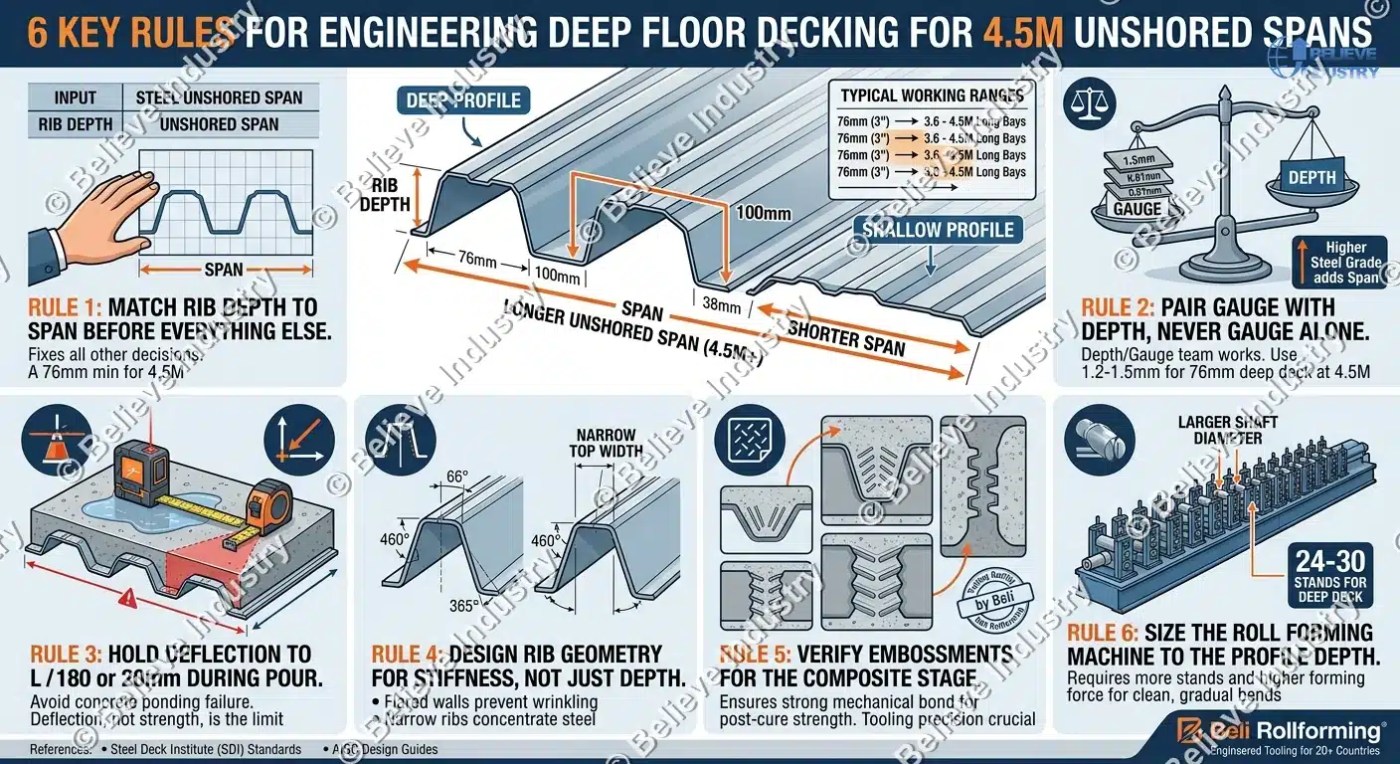
| 76 mm (3 in) | Deep deck | 3.6 to 4.5 m | Parking structures, long bays |
| 100 to 125 mm (4 to 5 in) | Long-span deep deck | 4.5 to 6.0 m | Column-free floors, transfer levels |
For a 4.5 m unshored span, the 76 mm class is the practical starting point. A façonneuse à rouleaux pour pont composite built for this depth class must form the deep ribs without springback distortion at the rib root.

6 Rib Depth Engineering Rules for 4.5 m Spans
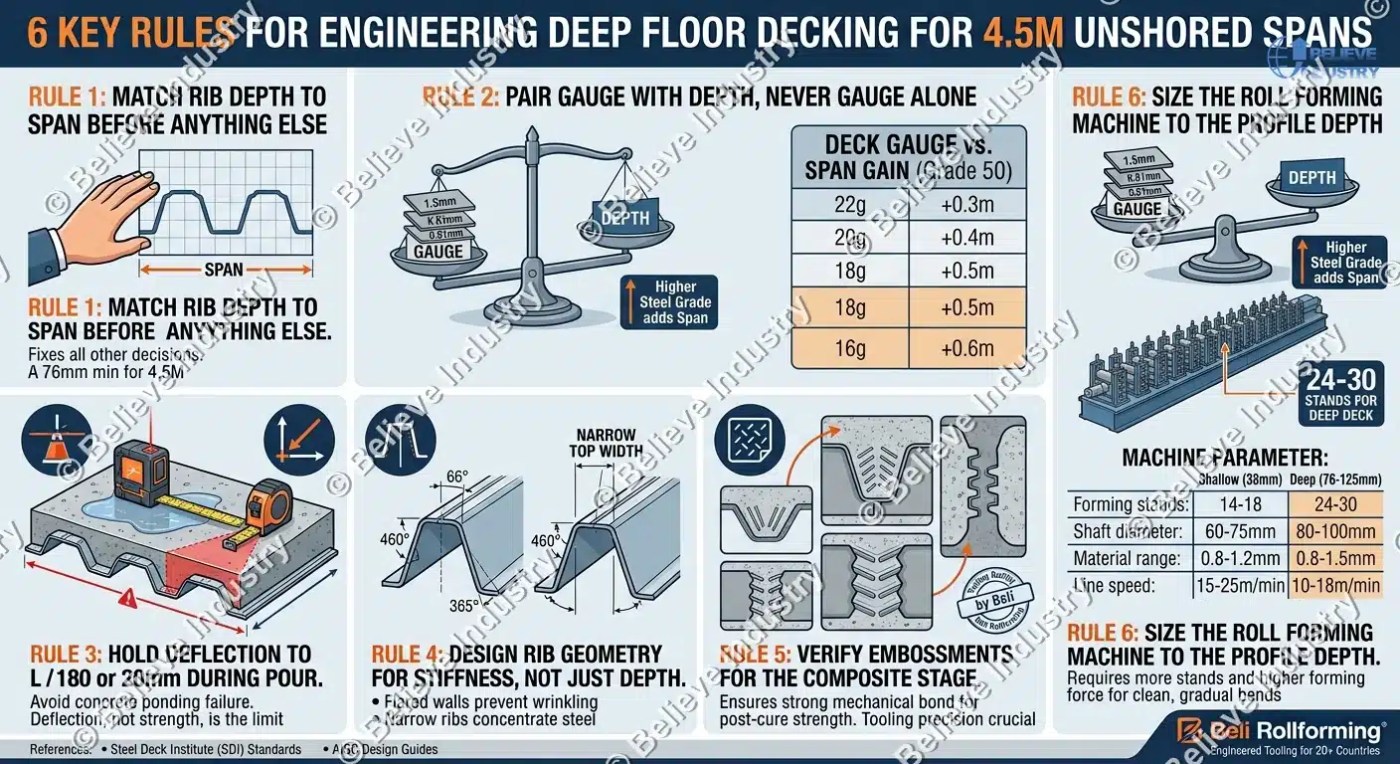
Rule 1: Match Rib Depth to Span Before Anything Else
Rib depth selection comes first because it fixes every other decision. A 4.5 m unshored span needs a 76 mm deep deck profile at minimum. Shallower profiles cannot reach that span at any practical gauge.
Pushing a 51 mm profile to 4.5 m fails on deflection, not strength. The sheet may hold the concrete weight, but it sags past allowable limits. The ponding effect then adds even more concrete in the low spot, which adds more load. This feedback loop is the classic long-span floor deck failure mode.
Deep profiles from 100 to 125 mm reach 4.5 m with margin and stretch to 6.0 m at heavier gauges. Verify against SDI load tables for your exact slab depth before committing tooling money.
Rule 2: Pair Gauge With Depth, Never Gauge Alone
Thickness and depth work as a team. A 76 mm profile spanning 4.5 m needs 1.2 to 1.5 mm (16 to 18 gauge) steel. The same profile at 0.8 mm drops to roughly 3.0 m of unshored capability.
Steel grade matters as much as thickness. Most deck sheet is ASTM A653 Structural Steel Grade 33, 40, or 50. Moving from Grade 33 to Grade 50 can add 10 to 15 percent span at the same gauge because higher yield steel resists the bending stress better.
| Deck Gauge | Steel Thickness | 76 mm Profile Span | Grade 50 Span Gain |
|---|---|---|---|
| 22 gauge | 0.76 mm | 3.0 to 3.6 m | +0.3 m |
| 20 gauge | 0.91 mm | 3.6 to 4.2 m | +0.4 m |
| 18 gauge | 1,2 mm | 4.2 to 4.5 m | +0.5 m |
| 16 gauge | 1,5 mm | 4.5 to 5.0 m | +0.6 m |
Design the profile for the thinnest gauge you will sell, then confirm the heavy gauge still forms cleanly in the same tooling.
Rule 3: Hold Deflection to L/180 or 20 mm During the Pour
Deflection, not strength, sets the real span limit. The common SDI-based limit for deck under wet concrete is the span divided by 180, or an absolute cap of 20 mm (3/4 inch), whichever is smaller. At 4.5 m, the L/180 value is 25 mm, so the 20 mm absolute cap governs.
Excess deflection creates concrete ponding. Concrete flows to the low point, the slab thickens there, and the load grows beyond the design value. Field fixes are expensive. Pouring a leveling topping over a sagged deck can add 15 to 20 mm of extra concrete across the bay.
Check the deflection case with the full slab depth plus a construction live load of 1.0 to 1.5 kPa. The Institut américain de la construction en acier (AISC) publishes design guides that walk through this load combination for composite floors.
Rule 4: Design Rib Geometry for Stiffness, Not Just Depth
Depth alone is not enough. Rib width controls how efficiently that depth works. Narrow ribs at 40 to 50 mm top width concentrate the steel webs and raise the moment of inertia per meter of cover width. Wide ribs at 150 mm or more dilute stiffness even at 76 mm depth.
Keep the rib walls flared between 10 and 20 degrees from vertical. This flare lets the profile roll form without web wrinkling and keeps the concrete keys locked into the rib valleys. Vertical rib walls roll harder and risk oil canning on the bottom flange.
Bottom flange width also matters for bearing. SDI detail practice calls for at least 50 mm of end bearing on supports. Thin metal bearing on a narrow flange at 4.5 m span invites local web crippling, which is a sudden failure mode.
Rule 5: Verify Embossments for the Composite Stage
The unshored span is a construction stage problem. After the concrete cures, the floor deck profiles act compositely with the slab. The embossments rolled into the rib webs create that bond. Embossment pattern, pitch, and depth are specified in the deck manufacturer’s evaluation report.
A typical composite embossment is 2 to 3 mm deep, pitched at 50 to 80 mm along the rib web. That pattern delivers the horizontal shear transfer most published composite deck tables assume. Weak or inconsistent embossments drop the composite section modulus, sometimes by 20 percent or more.
For machine buyers, this is a tooling precision question. Embossment rolls wear. Ask for hardened D2 or DC53 steel embossment rollers with a documented 200,000 linear meter service interval. Our floor deck profile quality guide covers the full tooling checklist.
Rule 6: Size the Roll Forming Machine to the Profile Depth
Deep deck profiles need more forming stands than shallow ones. A 38 mm profile forms cleanly in 14 to 18 stands. A 76 mm deep deck profile needs 24 to 30 stands so each pass bends the ribs gradually. Forcing deep ribs through few stands produces twist, edge wave, and springback at the rib root.
Shaft diameter and roller blank size scale up too. Long-span deep deck tooling runs on 80 to 100 mm shafts, versus 60 to 75 mm for shallow profiles. Under-sized shafts deflect under the higher forming force of deep ribs, and the profile tolerances drift.
| Machine Parameter | Shallow Deck Line (38 mm) | Deep Deck Line (76 to 125 mm) |
|---|---|---|
| Forming stands | 14 to 18 | 24 to 30 |
| diamètre de l'arbre | 60 to 75 mm | 80 to 100 mm |
| Plage d'épaisseur du matériau | 0.8 to 1.2 mm | 0.8 to 1.5 mm |
| Forming force per stand | Lower | 30 to 50 percent higher |
| Typical line speed | 15 to 25 m/min | 10 to 18 m/min |
These machine requirements are why a purpose-built machine à platelage en acier for deep profiles costs more than a shallow deck line, and why the investment pays back on long-span projects. Tooling resources from Le fabricant describe the same stand count logic for any deep section.