









Rollforming-Software is the backbone of modern engineering in the metal construction industry. For a manufacturer like Beli RollForming, moving from a manual design process to a digital simulation environment is not just an upgrade—it is a competitive necessity. Profile simulation allows engineers to predict how metal will react during the bending process before a single roller is machined.
By utilizing high-end Rollforming-Software, we can eliminate the “trial and error” phase that plagues traditional manufacturing. This guide explores the clever 7 programs currently leading the industry in profile simulation and flower pattern design.
Why Profile Simulation is Essential for Success
Before we list the programs, it is vital to understand why Rollforming-Software is a game-changer. When designing complex shapes, such as those found in a Downpipe Roll Former: Incredible 2 Ways to Prevent Seam Opening, the risk of material stretching or thinning is high. Simulation software predicts these “hot spots,” allowing for adjustments in the roller geometry early on.
The Clever 7 Programs for Roll Forming Simulation
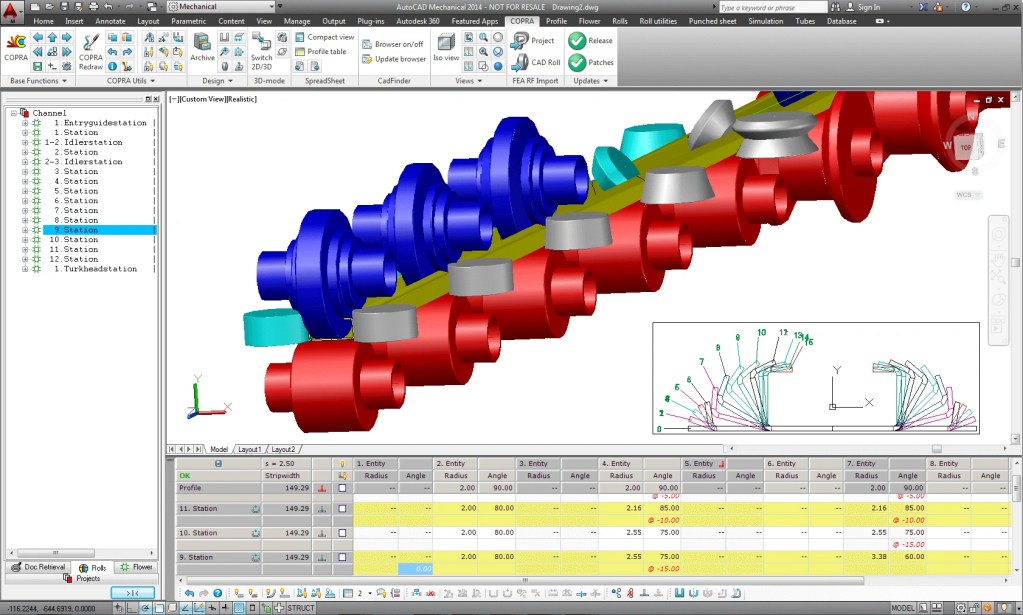
1. COPRA RF (data M Sheet Metal Solutions)
COPRA is arguably the most recognized Rollforming-Software globally. It provides a complete workflow from the initial “flower” design to the management of rolls in the warehouse. Its FEA (Finite Element Analysis) module is world-class for predicting material spring-back.
2. PROFIL (Ubeco)
PROFIL is a highly efficient Rollforming-Software designed for quick iterations. It is favored for its user-friendly interface and extensive library of standard profiles. For custom projects, it allows for rapid calculations of developed lengths.
3. Roll-2-Roll
This software focuses on the synergy between the machine and the material. It is a clever choice for manufacturers who need to simulate the interaction between the strip tension and the drive speed of the rollers.
4. B&R Industrial Automation Suites
While not exclusively for design, this Rollforming-Software integrates with the PLC to simulate the machine’s movement. This is critical for high-speed lines, such as the technology we discuss in Fliegende Schere: 4 überzeugende Gründe, warum Beli RollForming auf Servotechnologie setzt..
5. AutoCAD with Roll-Forming Plugins
Many engineers prefer the familiarity of AutoCAD. Specialized plugins transform standard CAD into a dedicated Rollforming-Software, allowing for 2D flower patterns to be generated with automated bend allowance calculations.
6. SolidWorks Simulation
By using the sheet metal module within SolidWorks, engineers can perform basic linear and non-linear simulations. While not a “pure” Rollforming-Software, its ability to integrate with the overall machine assembly design is unparalleled.
7. Virtual Roll Former (VRF)
VRF is a niche but clever program used for training and process optimization. It allows operators to “run” the machine in a virtual environment to see how different material thicknesses affect the final output.
Reducing Waste and Improving Precision
The primary goal of implementing Rollforming-Software is the reduction of scrap material. In the past, “tuning” a machine could take days and waste hundreds of meters of steel. With digital simulation, the first piece off the line is often a perfect match to the design specifications.
This level of precision is exactly what is required for infrastructure projects. You can see how we apply these standards in our analysis of the Leitplankenmaschine: 6 wichtige Spezifikationen für die Einhaltung der Straßenverkehrssicherheitsstandards.
Compliance and Global Standards
When exporting machinery from China, ensuring that the design software used complies with international engineering standards is a key part of the quality control process. For a deeper look at what to check before importing, see our guide on Rollformen aus China: 10 kritische Konformitätsprüfungen für den Import.
For engineers looking to study the underlying physics of metal deformation, we recommend consulting the resources provided by the International Journal of Mechanical Sciences for peer-reviewed studies on roll forming mechanics.
Abschluss
Investing in the right Rollforming-Software is the difference between a machine that “works” and a machine that “excels.” At Beli RollForming, these clever simulation programs ensure that every profile, from simple C-channels zu komplex aufrechte Regale, is manufactured with surgical precision.
Ready to see digital simulation in action? Kontaktieren Sie Beli RollForming noch heute. to learn how our software-driven design process can optimize your next production line.