







Coil feeding problems are easy to misread. The strip arrives at the first stand crooked, the operator blames the guides, and the line is stopped for an adjustment that does not hold. The real cause is often several metres upstream, at the decoiler or in the coil itself. Most coil feeding problems trace back to the material or the first few metres of the line.
This guide walks back through the feed section and names 6 causes of tracking failure and telescoping. For each one you get the symptom, the mechanism and the correction, so you can fix the source instead of chasing the result.
If you are still choosing the feed equipment, read our açıcı tipleri kılavuzu first. This article assumes a machine is already installed and running. All of these components sit inside the larger rulo şekillendirme makinesi astar.
Why feeding decides profile quality
A roll former makes a profile by bending strip a little at each stand. That only works if the strip enters on centre and under steady tension. When the feed wanders, every downstream stand sees a different entry position, and the error is stamped into the finished part.
Feed problems also waste material. A coil that binds or slips forces an operator to stop and rethread, and each restart produces off-spec length near the head. Stable feeding is the cheapest quality control you can buy, and it removes most coil feeding problems before they start.
The two complaints that start most investigations are strip walking sideways and a coil that will not uncoil cleanly. They have different causes and need different fixes. Our overview of coil processing and material handling gives the wider context.
The 6 coil feeding problems and their fixes
Work from the coil outward. Check the material first, then the decoiler, then the guides. Changing three things at once hides which one helped.
- Telescoping coil. The inner wraps have shifted sideways, leaving a stepped or cone-shaped coil face. It comes from loose winding, poor lifting or transport vibration. A badly telescoped coil cannot be mounted safely and is often a write-off. Reject it at receiving, and specify tight winding plus blocking and lashing in the purchase order.
- Camber in the strip. The strip bows to one side along its length. Camber makes the coil walk toward one guide no matter how the guides are set. It is a rolling defect from uneven reduction across the width. Guides can steer a straight strip; they cannot correct a bowed one. Track the coil supplier with the coil ID. The World Steel Association publishes background on flatness and dimensional tolerances in flat rolled products.
- Coil set. The strip keeps the curvature of the coil after it is unwound. Left uncorrected, it produces camber in the profile and inconsistent leg height. Pass the strip through a leveler with enough work rolls and the right intermesh for the gauge and yield strength. Our machine leveler guide covers roll count and depth settings.
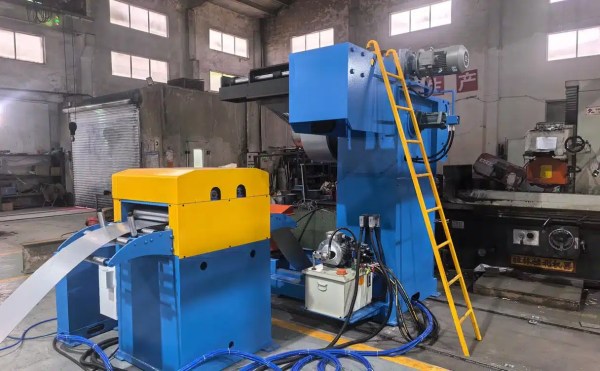
- Wrong decoiler brake tension. Too tight and the strip stretches or snaps forward on release. Too loose and the coil overruns, forming slack loops and jerky feeding. Set the brake for smooth, steady payout. Watch the loop during startup, not only at full speed.
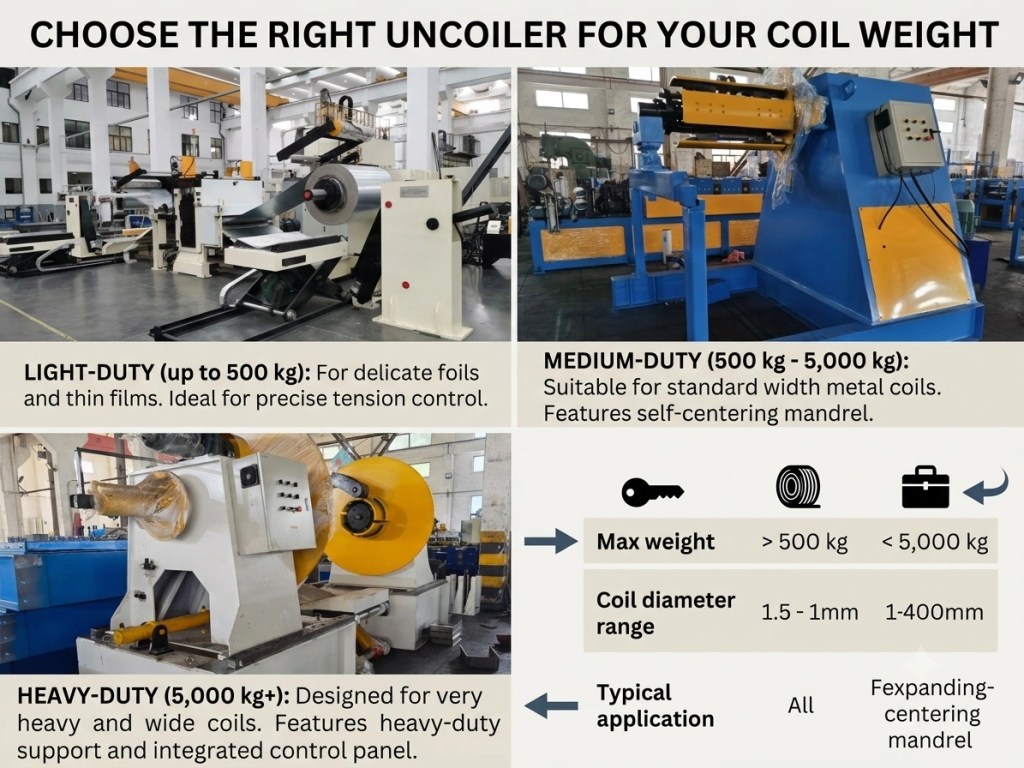
- Mandrel grip and coil ID mismatch. If the mandrel does not expand fully, the coil slips on the core and tension goes unstable. Confirm full expansion pressure and match the coil ID sleeve, commonly 508 mm or 610 mm. Inspect the mandrel shoes for wear so contact is even around the bore.
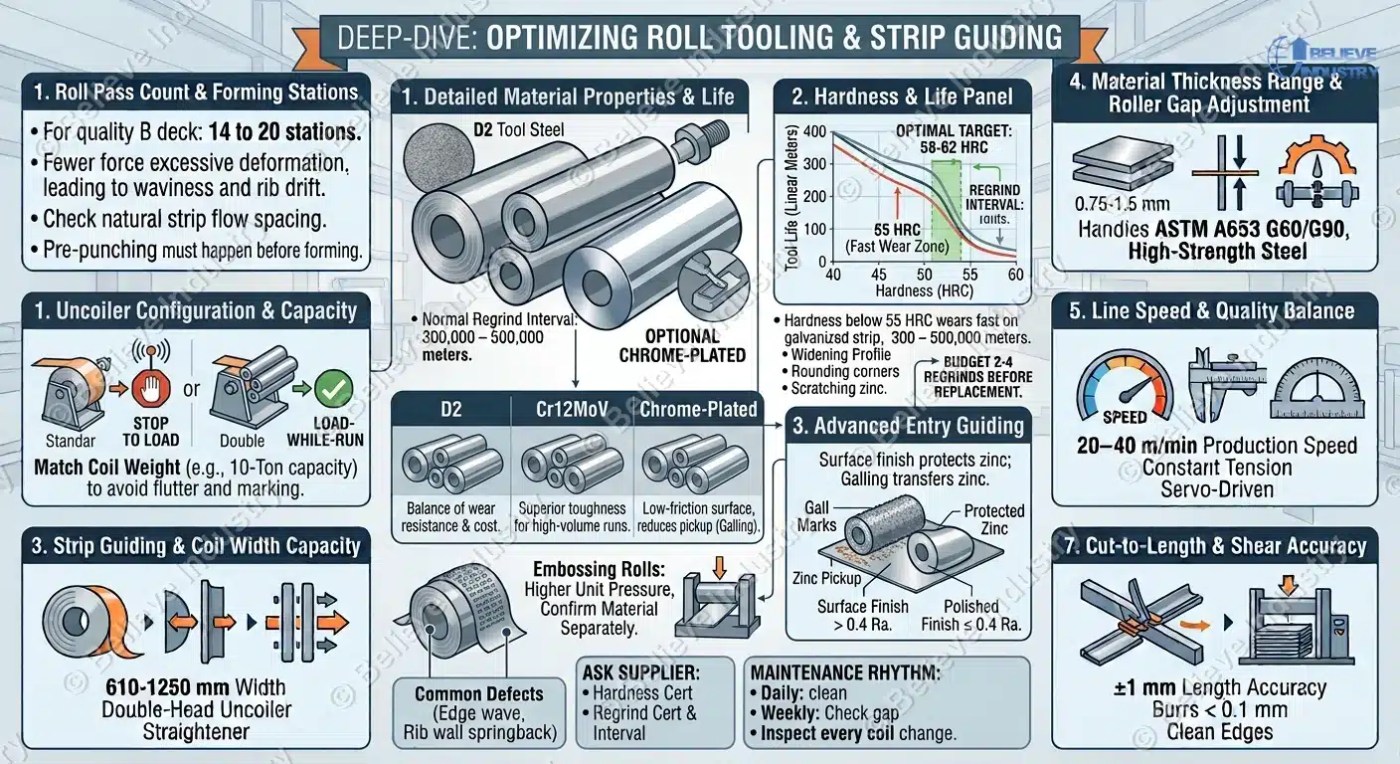
- Entry guide and pinch roller setup. Guides set too tight clamp the strip instead of steering it, causing edge damage and drift. Set them parallel with slight clearance. If the pinch rollers slip, the encoder counts roller rotation that the strip does not follow, and length drifts. Keep the rollers clean and replace worn covers. The Metal Construction Association publishes guidance on handling and installing coated sheet, which helps when feed damage shows up on the strip surface.
Steps 2 and 3 are material conditions. You manage them by inspection and supplier control. Steps 4 to 6 are machine setup, and they are the ones an operator can correct on the floor.
Entry guides set with light clearance steer the strip without damaging the edge.
Read the symptom before you touch a screw
A symptom pattern narrows the cause faster than trial and error. Use this table as a first pass.
| Symptom | Likely cause | First check |
|---|---|---|
| Strip walks to one side continuously | Camber or a shifted coil | Lay a straightedge on a loose length of strip |
| Feeding jerks only during acceleration | Brake tension or ramp setting | Watch the loop as speed ramps up |
| Length drifts, holes move | Pinch roller slip or encoder fault | Mark the strip and compare roller turns to travel |
| Coil wobbles or rotates off centre | Loose mandrel or damaged core | Check expansion pressure and coil ID |
| Stepped coil face before mounting | Telescoping from handling | Reject or rewind the coil at receiving |
| Rippled edge entering the mill | Edge wave from prior rolling | Measure wave height over a fixed pitch |
Not every feed defect can be fixed on the line. Some are material conditions you manage by inspection and supplier control. Knowing which is which saves hours of adjustment.
| Kusur | Where it starts | Can the line correct it? |
|---|---|---|
| Telescoping | Winding, handling or transport | No, reject or rewind the coil |
| Enine eğim | Uneven rolling reduction at the mill | No, steer around it or reject |
| Coil set | Winding tension | Yes, with a leveler |
| Kenar dalgalanması | Uneven elongation across strip width | Partly, with careful leveling |
| Brake and mandrel faults | Machine setup | Yes, adjust on the floor |
| Guide and pinch faults | Machine setup | Yes, adjust on the floor |
Flatness defects are measured, not guessed. Flatness is stated in I-units or as wave height over a defined pitch. Under-leveled strip entering the mill can produce profile camber that exceeds the limits in EN 10162, a common cold-formed steel tolerance standard. For how measurement fits into acceptance, see our first article inspection guide.
How the leveler removes coil set
The leveler bends the strip back and forth through a series of offset work rolls. Each bend pushes the outer fibres past their yield point, so the strip comes out flatter instead of springing back into a coil.
The number of rolls and the intermesh depth depend on the material. Standard building-product lines often use 7 to 9 rolls. Precision work on thin or high-strength strip can use 11 to 21 smaller rolls with tighter pitch. Higher yield strength and thicker gauge need deeper intermesh and more bending cycles.
Coated strip needs a lighter touch. The roll diameter and surface condition must flatten the steel without cracking the zinc or pre-paint layer. The American Galvanizers Association documents how galvanized coatings behave under forming, which is useful when a coating problem appears at the same time as a flatness problem.
Set the leveler from the middle of the gauge range, then adjust in small steps. Over-leveling is real: too much intermesh can stretch the strip and introduce its own wave. Change one setting at a time and run a short length before committing to a coil.
The first threaded length is checked before a full coil is accepted.
A repeatable feeding setup routine
A short routine at the start of each coil prevents most coil feeding problems. Train operators to follow the same order every time.
- Confirm the coil ID, width, gauge and weight against the job before lifting.
- Inspect the coil face for telescoping, ovality and edge damage, and photograph any defect.
- Center the coil on the mandrel, then expand it fully and verify even contact.
- Adjust brake tension for a smooth loop at low speed, then recheck as the line ramps.
- Set entry guides parallel with light clearance, never clamped onto the strip edge.
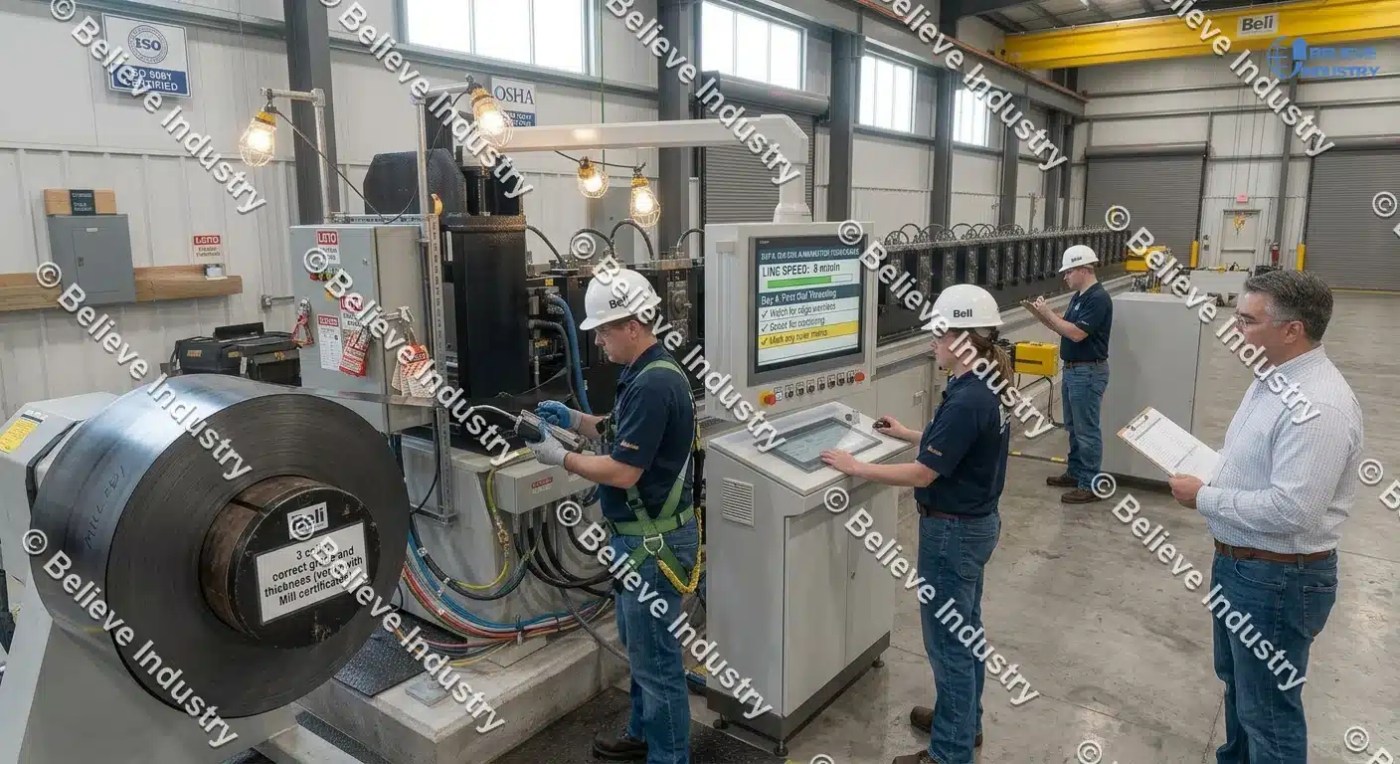
- Verify pinch roller pressure and encoder feedback with a short marked length.
- Run the first profiles through the inspection checklist before accepting the coil.
If the line only feeds well at low speed, the cause is usually tension instability or a ramp setting rather than a mechanical jam. Slow, steady changes beat aggressive acceleration on a heavy coil. The same logic applies to drive and control faults described in our electrical troubleshooting guide.
Beli Rollforming has built roll forming equipment since 2005 and delivered 500+ machines to 50+ countries. Our team includes 80+ engineers and technicians working from a 15,000 m² facility. Every complete machine ships with a 24-month warranty on the complete machine, covering mechanical, hydraulic and electrical systems, with wear parts excluded.
Sıkça Sorulan Sorular
1. What are the most common coil feeding problems?
The most common coil feeding problems are telescoping, camber, coil set, incorrect brake tension, poor mandrel grip and misaligned entry guides. Material defects and machine setup each account for roughly half of the cases.
2. Why does the strip walk to one side?
Strip walking usually comes from camber in the coil or from a strip that was not centered on the mandrel. Guides can steer a straight strip, but they cannot correct a bowed one. Check the material before adjusting the machine.
3. What is a telescoping coil?
A telescoping coil has inner wraps that slid sideways, leaving a stepped or cone-shaped face. It is caused by loose winding, rough handling or transport vibration. A badly telescoped coil often cannot be uncoiled safely.
4. How do I set decoiler brake tension?
Set the brake so the coil pays out smoothly without over-running or stretching the strip. Watch the loop during startup and during acceleration. Too tight causes snapping; too loose causes slack loops and jerky feeding.
5. What coil inner diameters are common?
Common coil IDs are 508 mm (20 in) and 610 mm (24 in). Use the correct sleeve and confirm the mandrel expands fully so the coil grips evenly without crushing the core.
6. How many rolls does a leveler need?
Standard lines often use 7 to 9 work rolls. Thin, high-strength or precision strip may need 11 to 21 smaller rolls with tighter pitch. Thicker and higher-yield material needs deeper intermesh and more bending cycles.
7. Can a leveler fix camber?
A leveler removes coil set, the curvature from winding. It cannot remove camber, which is a side bow from uneven rolling reduction. Camber has to be caught at the coil supplier.
8. What causes strip length to drift?
Length drift is usually pinch roller slip or an encoder fault. The encoder counts roller rotation, so if the roller slips on the strip, the measured length no longer matches travel. Clean the rollers and check the covers.
9. What is coil set?
Coil set is the curvature the strip keeps after unwinding, caused by the winding tension. If it is not removed by a leveler, it shows up as camber and uneven leg height in the profile.
10. When should I reject an incoming coil?
Reject a coil with a telescoped face, oval core, crushed bore, edge wave or visible camber beyond your tolerance. Photograph the defect and record the coil ID so the claim can be traced to the supplier.
Son güncelleme: 2026-11-26
Match the uncoiler capacity and coil ID to the job before loading.
Makale Değişiklik Günlüğü
- 2026-11-26: Published. 6 coil feeding problems with symptom table, leveler setup guidance and a repeatable startup routine, 10 FAQs.
Sonraki İnceleme Tetikleyicileri
- A change in coil supplier or winding specification that alters defect rates.
- New EN 10162 or I-unit flatness tolerance applied to incoming material.
- Repeat feeding faults traced to a specific mandrel, brake or leveler setting.



 Türkçe