






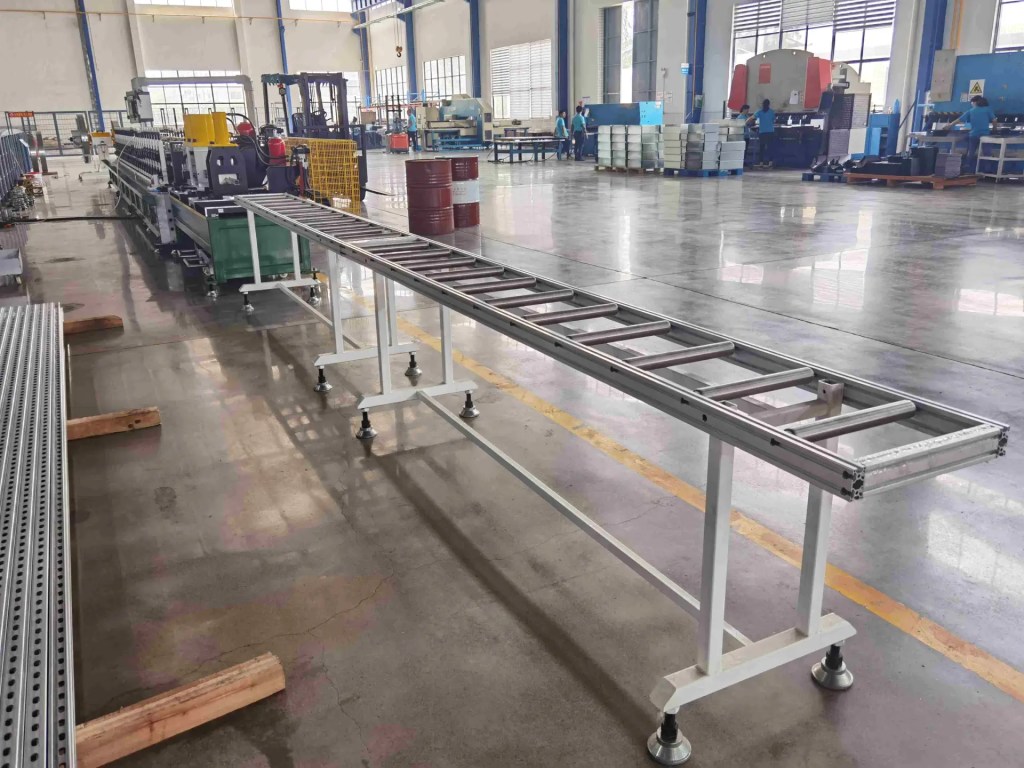
A strut channel production line turns one coil of steel into straight, slotted, cut-to-length channel in a single pass. The section looks simple. A 41 mm base, two inturned lips, maybe a row of slots. The line behind it is not simple. Nine stages sit between the coil car and the stacked bundle, and each one owns a number that ends up on your inspection report.
This guide walks those nine stages in order. For each stage you get the job it does, the spec it controls and the choices that change price and lead time. If you are comparing quotes from different builders, the stage map below tells you where the money actually goes. If you want the machine-level view first, our strut kanalı rulo şekillendirme makinesi kılavuzumuz covers the line types before you come back to the process detail here.
Stage map: what a strut channel production line includes
Every strut channel production line shares the same backbone. The table lists all 9 stages and the spec each one controls. Later sections explain the stages where buyers most often lose money.
| Sahne | Unit | What it controls |
|---|---|---|
| 1 | Coil car and decoiler | Coil change time, strip tension |
| 2 | Strip guide and leveler | Flatness, edge alignment |
| 3 | Pre punch press | Hole and slot pattern |
| 4 | Şekillendirme passesi | Profile, rib angle, lip inturn |
| 5 | Flying punch | Slot pattern on the run |
| 6 | Doğrultma ünitesi | Bow, camber, twist |
| 7 | Fly die cut off | Cut length tolerance, burr |
| 8 | Runout and conveyor | Piece handling, scratch control |
| 9 | Stacker and bundler | Bundle size, count accuracy |
A medium speed strut channel production line runs 15 to 30 m/min. High speed lines reach 40 to 60 m/min on solid profiles. Speed is never the first spec to negotiate. Cut length tolerance and straightness sell channel, and both are decided downstream of the fastest stand.
Coil entry: decoiler, guide and leveler (stages 1 to 2)
Stage 1 is the coil car and double-head decoiler. A double-head setup lets an operator strap, shear and thread one coil while the other feeds. Changeover drops from about 20 minutes on a single head to under 8. Over an 8 hour shift, that difference is worth 2 to 3 extra coils of output without touching line speed.
Strip tension is set here. Too little tension and the strip wanders in the passes. Too much and the lip inturn springs back oversize. Most builders set tension by coil weight class, not by trial. Ask a supplier which coil weight range the decoiler mandrel is rated for, 1.5 t, 3 t or 5 t, and match it to the coil you actually buy.
Stage 2 is the guide and leveler. Five-roll levelers are standard on strut lines. The leveler takes out coil set so the strip enters the first pass flat. Flat strip is what keeps the 41 mm base dimension stable across the bundle. On a strut channel production line without a leveler, base width drifts and the punch stage amplifies the error into misaligned slots.
Coil spec matters as much as the machine. Most strut channel is formed from structural grade steel to ASTM A653, with G90 or Z275 galvanized coating. Hot dip galvanized channel after forming follows ASTM A123, which the American Galvanizers Association documents in detail. Forming before galvanizing and galvanizing before forming are different products with different tolerance behavior, so state which one your project calls for.
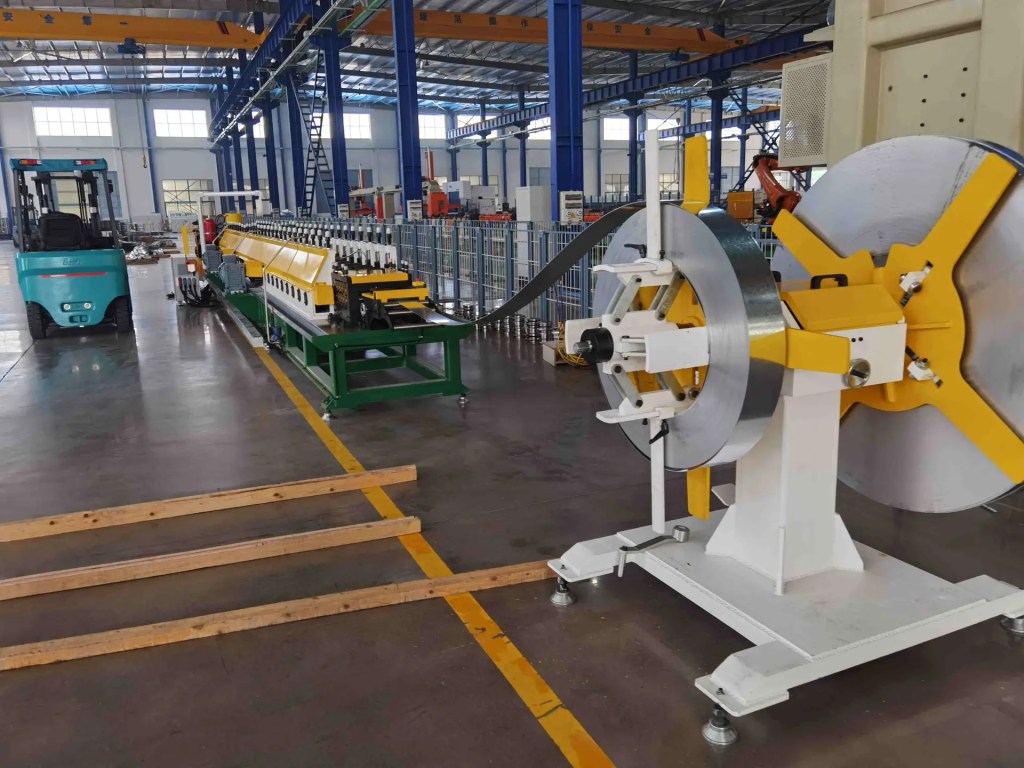
Double-head decoiler feeding a strut channel production line
Punching: pre punch, flying punch or post punch (stages 3 and 5)
The slot question decides more cost than any other option on a strut channel production line. Three setups exist, and each trades changeover time against output.
| Setup | Where it sits | En iyisi | Trade off |
|---|---|---|---|
| Pre punch | Before forming, on flat strip | Long runs, one or two patterns | Fast, but every pattern needs strip stop |
| Flying punch | After forming, on the run | Mixed orders, many patterns | Tooling cost up, no line stop |
| Post punch | Off line, on finished channel | Very short runs, samples | Lowest output, highest labor |
A 9/16 in slot is the default for 1/2 in spring nuts and threaded rod. A 13/16 in slot takes 3/4 in hardware on heavier jobs. Slots remove steel from the back face, so a slotted section keeps about 85 percent of the capacity of the same solid profile. Our yuvalı ve yuvasız strut kanalı kılavuzumuz covers how that reduction is calculated and why published slotted tables already include it.
Flying punch presses rate by strokes per minute. At 30 m/min and a 100 mm slot pitch, the press needs about 300 strokes per minute with acceleration headroom. If a quote quotes punch speed without the pitch you order, the number is decoration. Give suppliers your slot pitch and ask for the rated output at that pitch.
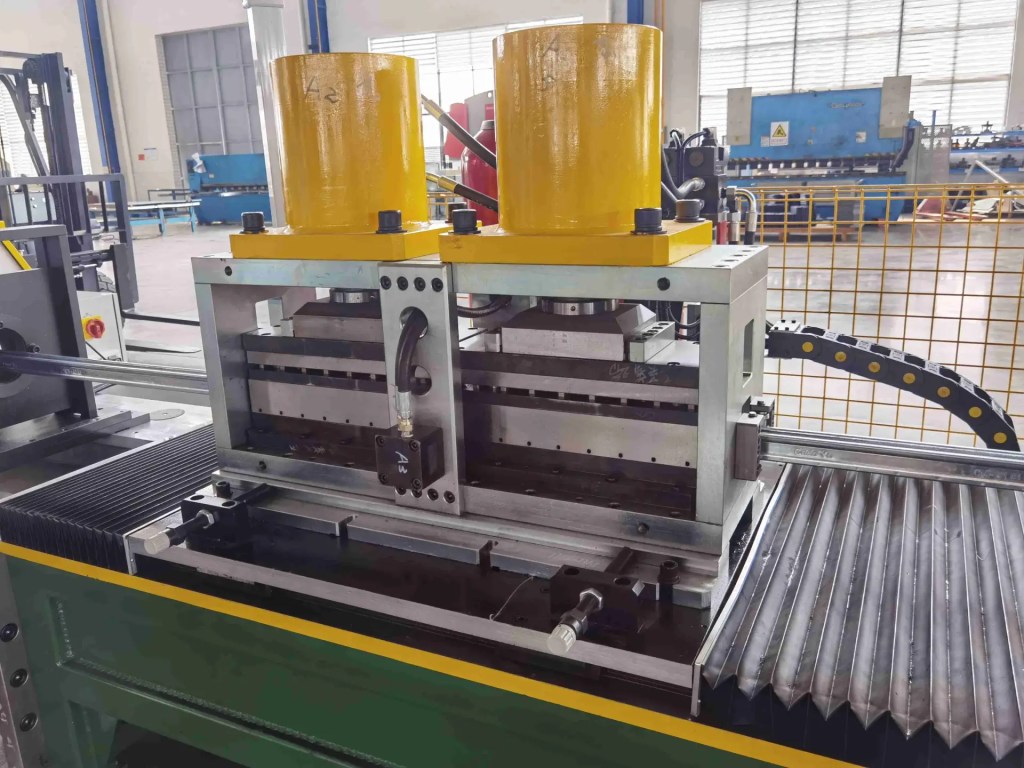
Flying punch press slotting formed strut channel on the run
Forming passes and gauge changeover (stage 4)
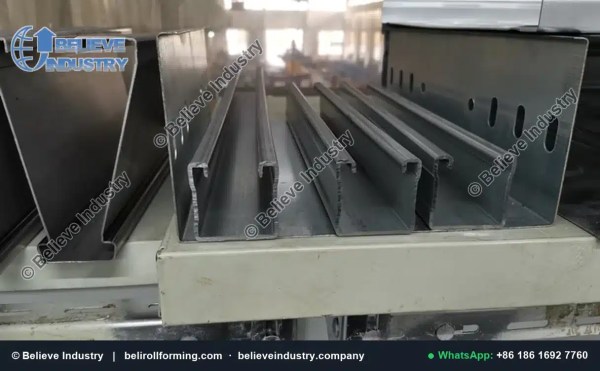
Stage 4 is where the profile forms. Typical strut lines run 12 to 18 passes. Pass count is not a bragging number. More passes spread the deformation, which lowers edge wave and keeps the lip inturn repeatable. Fewer passes on a heavy gauge shorten tool life.
Twelve gauge is about 2.7 mm and 14 gauge about 1.9 mm. A line built for both needs adjustable roll gaps and a written setup sheet. Without them, the first meters of a heavier gauge come out oversize while the crew chases the setting. Our 12 ga ve 14 ga strut kanalı kılavuzu sets out the load and tooling differences behind the gauge call.
Forming tolerance is judged against MFMA-4, the standard published by the Metal Framing Manufacturers Association. It fixes profile dimensions and the test basis behind load tables. A channel that meets MFMA-4 dimensional rules fits standard fittings from any compliant supplier. That interchangeability is the real reason to hold tolerance, not just the inspection report.
Depth drives bending more than gauge. Common depths on the 41 mm base are 21, 41, 52, 62 and 82 mm. A 62 mm channel in 14 ga outbends a 41 mm channel in 12 ga on long spans. When you size a strut channel production line, confirm the roll tooling covers the depths you sell most.
Cut off and exit: fly die, conveyor, stacker (stages 6 to 9)
Stage 6 straightens the formed channel. A second straightening stage after forming removes bow and twist that forming itself introduced. Good lines check straightness on a 6 m length against a straight edge, not by eye.
Stage 7 is the fly die cut off. The die travels with the channel, cuts, and returns. Cut length tolerance on a well set line is plus or minus 0.5 mm on lengths up to 6 m. Burr height should sit under 0.3 mm without a second deburring pass. Ask how the builder verifies both, and how often the die is dressed. A die that wears past its dress interval starts leaving a flare at the cut end, and every bundle after that fails the fit up with fittings.
Stage 8 runs the pieces out on a conveyor sized to the longest cut length you order. Stage 9 stacks and bundles. Automatic stackers bundle by count and square the pack, which matters when a container holds 20 bundles per bundle size. Manual stacking works at low speed, but above about 20 m/min it becomes the bottleneck and the scratch source.
The exit end is also where the money quote hides. Auto stackers, magnetic conveyors and saw blade options can be 20 to 30 percent of the line price. Buy them against your order mix. A shop cutting one length all day does not need the stacker a mixed length shop needs.
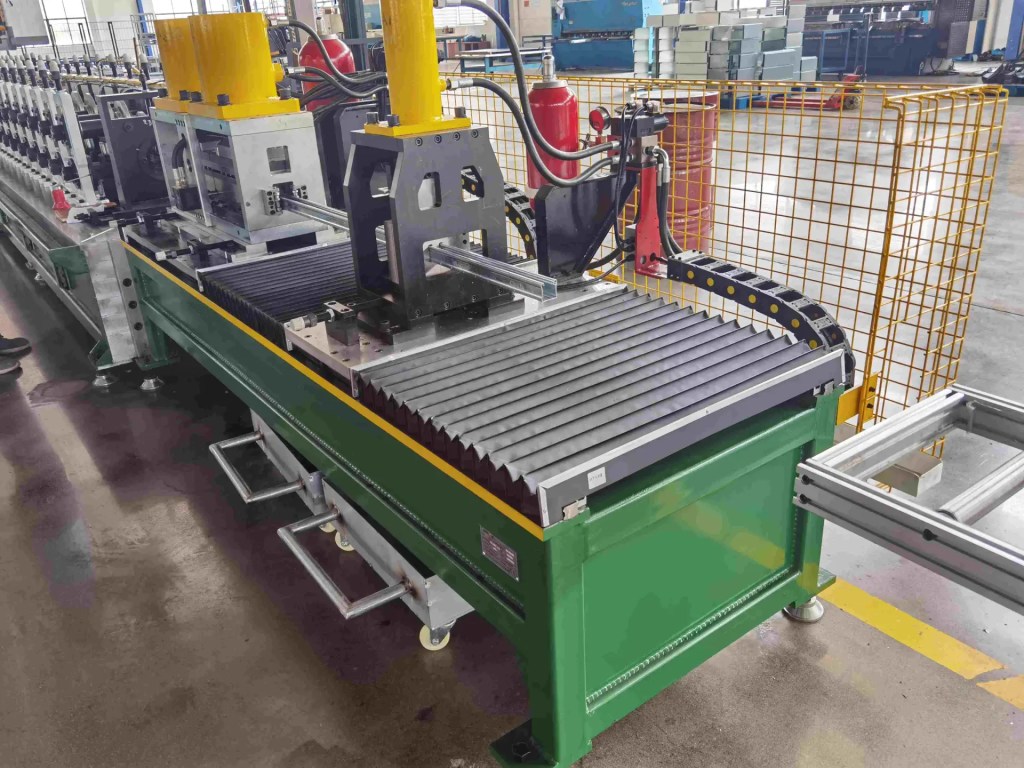
Fly die cut off holding cut length tolerance on a strut channel line
What these stages mean for price and lead time
Add the stage map to your supplier conversation and the quotes get easier to compare. Two references round it out. The metal çerçeve kanalı kılavuzu defines the profile terms used in US specifications, and our strut channel manufacturers in the USA guide lists the plant level checks to run once a machine quote is in hand. Both sit inside the wider rulo şekillendirme makinesi kategorisi..
Beli Rollforming has built roll forming equipment since 2005 and delivered 500+ machines to 50+ countries. Our team includes 80+ engineers and technicians working from a 15,000 m² facility. Every complete machine ships with a 24-month warranty on the complete machine, covering mechanical, hydraulic and electrical systems, with wear parts excluded.
Sıkça Sorulan Sorular
1. What are the main stages of a strut channel production line?
Nine stages: coil car and decoiler, strip guide and leveler, pre punch, forming passes, flying punch, straightener, fly die cut off, runout conveyor and stacker bundler.
2. How fast does a strut channel production line run?
Medium speed lines run 15 to 30 m/min and high speed lines reach 40 to 60 m/min on solid profiles. Rated speed assumes the punch stage can match your slot pitch.
3. What steel is used on a strut channel production line?
Structural grade coil to ASTM A653 with G90 or Z275 coating is the default for pre galvanized channel. Hot dip galvanized channel after forming follows ASTM A123.
4. What tolerance can a strut channel production line hold on cut length?
A well set fly die line holds plus or minus 0.5 mm on lengths up to 6 m, with burr height under 0.3 mm. Ask the builder how both numbers are verified.
5. Should I buy pre punch or flying punch on my strut channel production line?
Long runs with one or two slot patterns favor pre punch, which is faster and cheaper. Mixed orders with many patterns favor a flying punch, which changes pattern without stopping the line.
6. Does slotting reduce strut channel load capacity?
Yes, by about 15 percent, because slots remove steel from the back face. Published slotted load tables already include the reduction, so do not derate a second time.
7. What is MFMA-4 and why does it matter?
MFMA-4 is the standard from the Metal Framing Manufacturers Association that fixes strut profile dimensions, tolerances and load table test basis. Compliance means your channel fits standard fittings.
8. How many passes does a strut channel production line need?
Typical lines run 12 to 18 forming passes. More passes spread deformation, reduce edge wave and keep the lip inturn repeatable, especially at 12 gauge.
9. How long does a coil change take?
About 20 minutes on a single-head decoiler and under 8 minutes on a double-head setup. Over an 8 hour shift, the double head wins back 2 to 3 coils of output.
10. What does a strut channel production line cost to automate at the exit end?
Auto stackers, magnetic conveyors and saw options add 20 to 30 percent to line price. Buy them against your order mix, not against the brochure.
Son güncelleme: 2026-11-24
Makale Değişiklik Günlüğü
- 2026-11-24: Published. 9-stage line map, punch setup comparison, gauge changeover and cut tolerance specs, 10 FAQs.
Sonraki İnceleme Tetikleyicileri
- MFMA-4 tolerance revision or new published load table format.
- ASTM A653 or A123 coating specification changes.
- New punch press speed classes entering the strut market.



 Türkçe