









การแนะนำ
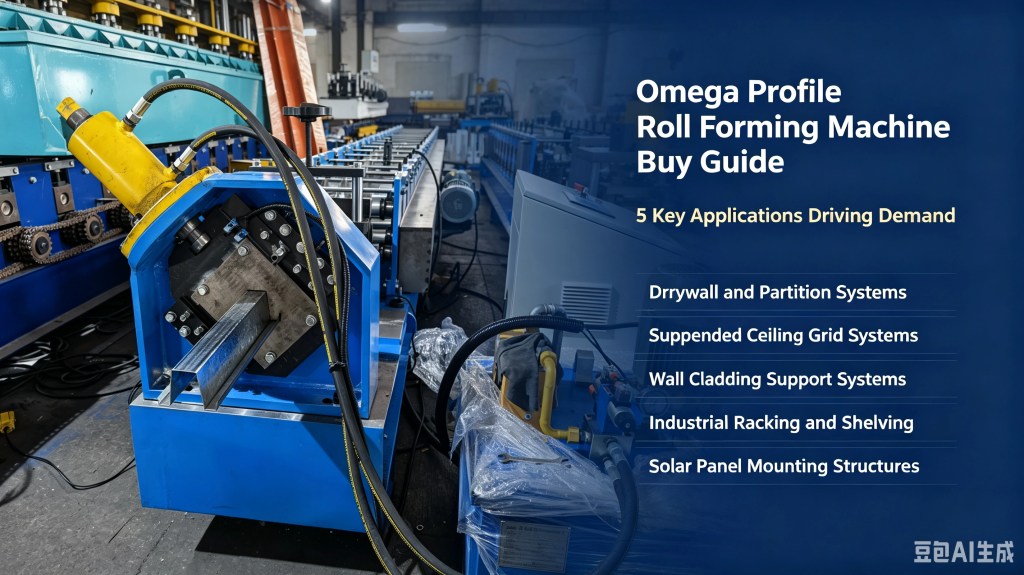
The Omega Profile Roll Forming Machine is becoming essential in modern light-gauge steel manufacturing. As construction shifts toward faster and lighter framing methods, the omega profile, a distinctive Ω-shaped steel section also called a top hat profile, has found its way into diverse applications. This Omega Profile Roll Forming Machine buy guide covers the five applications driving demand and two multi-size production solutions.
Whether you produce drywall framing, ceiling supports, or industrial racking, choosing the right omega profile roll former machine matters. A reliable Omega Profile Roll Former Machine buy guide helps you make informed purchasing decisions.
Beli Rollforming has over 15 years of experience with machines across 20+ countries. Our main markets, the US, Europe, and Australia, demand strict tolerances, and our machines meet those.
What Is an Omega Profile?
An omega profile is a roll-formed steel section shaped like the Greek letter Ω. It features a flat top with two downward legs, creating a channel that combines strength with light weight. The industry also calls it a top hat profile, hat channel, resilient channel, or omega section depending on the region and application.
The profile is typically formed from galvanized steel coils ranging from 0.4mm to 2.0mm thickness. Common widths span 30mm to 100mm, with leg heights from 10mm to 40mm. These dimensions suit light-gauge steel framing applications where strength-to-weight ratio matters.
If you are reading this Omega Profile Roll Forming Machine buy guide, you likely already know the profile’s value. Which applications are creating the most demand?

5 Key Applications Driving Demand
Application 1: Drywall and Partition Systems
Drywall partition systems are the largest demand driver for omega profiles. Builders use omega sections as resilient channels, thin steel hat channels mounted between studs and drywall panels. These channels decouple the gypsum board from the framing, reducing sound transmission.
Modern buildings increasingly require STC (Sound Transmission Class) compliance. Omega resilient channels help walls achieve STC 50+ ratings without adding mass. Hospitals, hotels, apartments, and office buildings all rely on this approach.
An omega profile roll former machine optimized for drywall channels runs at 30–60 m/min, producing thousands of linear meters per shift.
Application 2: Suspended Ceiling Grid Systems
Suspended ceilings rely on omega profiles as primary support channels. The omega shape provides load distribution across ceiling tiles, light fixtures, and HVAC components. Commercial buildings, from shopping malls to airports, depend on these systems.
เดอะ AISC Steel Construction Manual provides load-bearing guidelines for omega ceiling channels. Manufacturers producing ceiling grid components need machines capable of punching precise hole patterns for tie-wire attachment and cross-tee connection.
A quality Omega Profile Roll Forming Machine buy guide should highlight inline punching capability. Pre-punch systems place holes at 100mm, 150mm, or 200mm intervals depending on the ceiling design standard.
Application 3: Wall Cladding Support Systems
Metal wall cladding systems use omega profiles as vertical or horizontal support rails. The omega shape creates a stable mounting surface for corrugated panels, insulated sandwich panels, and architectural cladding.
Manufacturers serving the cladding market benefit from versatile omega profile roll forming machines that handle multiple profile sizes. Quick-change tooling allows switching between different top hat channel dimensions without lengthy downtime.
Producing 3 to 5 profile sizes on one line improves ROI without adding floor space.
Application 4: Industrial Racking and Shelving
Omega profiles serve as horizontal beams and vertical posts in light-duty industrial racking. Their shape resists twisting and provides a flat mounting surface for shelving brackets and bin supports.
For racking applications, the omega profile roll former machine must handle thicker steel, typically 1.5mm to 2.0mm. Roller stations need D2 tool steel with proper hardening.
Application 5: Solar Panel Mounting Structures
The solar energy boom has created a new demand stream for omega profiles. Photovoltaic mounting systems use omega sections as mid-rails and cross-members. The profile’s shape accommodates solar clamp attachments while providing structural rigidity against wind and snow loads.
เดอะ International Energy Agency (IEA) projects continued solar capacity growth through 2030. Solar mounting applications require Z275 or heavier galvanized steel, and the roll forming machine must handle this without surface damage.

Comparison: Omega Profile vs. Hat Channel vs. Furring Channel
| คุณสมบัติ | Omega Profile | Hat Channel | Furring Channel |
|---|---|---|---|
| รูปร่าง | Ω (rounded top, two legs) | Flat top with two legs | U-shape with slight return |
| ความหนาทั่วไป | 0.5–2.0 mm | 0.5–1.2 mm | 0.4–0.8 mm |
| การใช้งานหลัก | Multi-purpose framing | Drywall support | Ceiling furring |
| ความสามารถในการรับน้ำหนัก | ปานกลาง-สูง | ปานกลาง | ต่ำ |
| สถานีขึ้นรูปม้วน | 12–18 | 10–14 | 8–12 |
Understanding these differences matters for your Omega Profile Roll Forming Machine buy guide research. Each profile type requires specific roller designs.
Comparison: Machine Specifications Across Suppliers
| ข้อกำหนด | ระดับเริ่มต้น | Mid-Range (Beli Standard) | ระดับไฮเอนด์ |
|---|---|---|---|
| ความเร็วในการขึ้นรูป | 15–20 m/min | 30–45 m/min | 50–60 m/min |
| ความหนาของวัสดุ | 0.4–1.2 mm | 0.4–2.0 mm | 0.4–2.5 mm |
| Roller Stations | 10–12 | 14–16 | 18–22 |
| ระบบการตัด | กรรไกรมือ | Hydraulic flying saw | Servo flying saw |
| PLC Control | Basic relay | Siemens S7 | Siemens S7 + HMI |
| ช่วงราคา (ดอลลาร์สหรัฐ) | 25,000–40,000 | 45,000–80,000 | 90,000–150,000 |
This comparison table is a key reference in our Omega Profile Roll Former Machine buy guide. Mid-range machines from Beli offer the best balance of speed, versatility, and price.
Comparison: Key Specs to Evaluate Before Buying
| Evaluation Factor | เหตุใดจึงสำคัญ | สิ่งที่ควรสังเกต |
|---|---|---|
| Profile Flexibility | Determines product range | Multi-in-one rollers or auto-changeover |
| การเจาะรูแบบอินไลน์ | Eliminates secondary operations | Servo punch, 4-station minimum |
| Material Range | Wider range = more markets | 0.4–2.0mm galvanized steel |
| Cutting Precision | Affects scrap rate | ±0.5mm tolerance |
| ระบบควบคุม | Operator efficiency | PLC with recipe storage |
| บริการหลังการขาย | Minimizes downtime | Remote diagnostics, spare parts |
Multi-Size Production: Two Solutions
Most omega profile manufacturers need more than one size. This Omega Profile Roll Forming Machine buy guide covers two solutions. Both produce only one size at a time.
Solution 1: Multi-in-One Roller System
Multiple roller sets are installed on the same shaft. Each set forms a different omega profile (top hat) dimension. To switch sizes, the operator selects the active set on the PLC. No physical adjustment, no downtime for changeover.
This is the fastest way to handle multi-size production. If your orders frequently jump between sizes, multi-in-one keeps the line running without interruption. The trade-off is higher initial cost and a longer machine frame.
Solution 2: Fully Automatic Changeover System
One adjustable roller set with servo motors controlling width and height automatically. The operator adjusts forming angles manually. This allows stepless dimension variation within the machine’s range, from 30mm to 100mm for example.
The downside is changeover time: 10 to 25 minutes per size switch. For long batches this rarely matters. For hourly size changes, it adds up.
Comparison: Multi-in-One vs. Auto-Changeover
| ปัจจัย | Multi-in-One | Auto-Changeover |
|---|---|---|
| Switching time | Near zero (PLC select) | 10–25 minutes |
| Size range | Fixed sizes (3–5 per line) | Stepless within range |
| Roller investment | Higher (multiple sets) | Lower (one adjustable set) |
| เหมาะที่สุดสำหรับ | Frequent size changes | Long runs, custom sizes |
| Angle adjustment | Not needed | คู่มือ |
| Machine length | Longer (more stations) | Shorter (adjustable stations) |
Choosing between these two solutions is a key decision in any Omega Profile Roll Former Machine buy guide. Beli offers both. Contact our team to discuss which fits your production schedule.
Key Specs to Consider When Buying
Prioritize these specifications when following this Omega Profile Roll Forming Machine buy guide:
Forming Speed. Entry-level machines run at 15–20 m/min, high-end models reach 60 m/min. For most manufacturers, 30–45 m/min is the sweet spot.
Roller Material. D2 tool steel hardened to HRC 58–62. Chrome plating extends roller life with galvanized steel. See roller maintenance practices.
Punching System. Inline punching eliminates secondary operations. A servo-driven punch with 4+ stations handles hole patterns for ceiling grids, drywall channels, and solar mounting.
Decoiler Capacity. A 5-ton hydraulic decoiler handles standard coils. For continuous production, a 10-ton double-head decoiler.
Control System. PLC with touchscreen HMI and recipe storage allows quick profile changeover, a feature highlighted in every Omega Profile Roll Former Machine buy guide.
Why Choose Beli Rollforming
Beli Rollforming brings over 15 years of roll forming expertise to every omega profile machine we build. Our equipment serves customers across 20+ countries, with primary markets in the US, Europe, and Australia.
We engineer each omega profile roll former machine with D2 hardened rollers, Siemens PLC controls, and servo-driven flying saws. Our inline punching systems handle complex hole patterns for ceiling grids and solar mounting applications.
Every machine undergoes testing before shipment. We provide CE-certified equipment that meets international safety standards. Our team offers installation, training, and ongoing technical support.
For a complete picture of machine pricing across our product range, see our คู่มือราคาเครื่องขึ้นรูปม้วน.
Related Buying Guides
- Z Purlin Roll Forming Machine Buying Guide: Compare C/Z/Sigma profiles and automatic changeover systems.
- Custom Orb Roll Forming Machine Buy Guide: Roofing and walling profile production.
- คู่มือเครื่องขึ้นรูปเหล็กรางค้ำยัน: Structural framing channel machines.
- Standing Seam Roof Panel Machine: Roof panel production equipment.
For related Beli product pages, explore our ตัวขึ้นรูปม้วนเหล็ก, เครื่องขึ้นรูปแปเหล็กรูปตัว C, และ เครื่องขึ้นรูปแปเหล็กรูปตัว Z.
คำถามที่พบบ่อย
An Omega Profile Roll Forming Machine is specialized equipment that shapes flat steel coil into Ω-profiled sections. These sections are used in drywall systems, ceiling grids, cladding support, and solar mounting. This Omega Profile Roll Forming Machine buy guide covers all key aspects.
Production speeds range from 15 m/min on entry-level machines to 60 m/min on high-end models. Most mid-range machines from Beli run at 30–45 m/min, which suits most manufacturing volumes.
Omega profile roll forming machines typically process galvanized steel (GI), cold-rolled steel (CR), and stainless steel. Thickness ranges from 0.4mm to 2.0mm, covering most application requirements.
Yes, through two approaches. The multi-in-one roller system installs multiple roller sets on the same shaft, switching sizes via PLC with zero downtime. The automatic changeover system uses one adjustable roller set for stepless size variation within a range, but requires 10–25 minutes to switch. Both produce one size at a time. This detail is covered in the Omega Profile Roll Forming Machine buy guide above.
Prices range from 25,000 for entry−level models to 150,000 for high-end configurations. Mid-range machines with inline punching and servo cutting typically cost 45,000–80,000.
An omega profile has a rounded top resembling Ω, while a hat channel has a flat top. Both serve similar purposes, but omega profiles offer slightly better rigidity due to the curved geometry.
Common options include pre-punch (before forming), post-punch (after forming), and servo-driven multi-station punching. For ceiling grid and solar applications, servo punching provides the highest precision.
Multi-in-one is better if you switch sizes frequently and need zero downtime. Auto-changeover is better if you run long batches and want stepless dimension flexibility. Both produce one size at a time. Refer to the comparison table in this Omega Profile Roll Forming Machine buy guide for details.
With proper maintenance, D2 hardened rollers last 5–8 years in standard production. Chrome-plated rollers extend life further, especially when forming galvanized steel.
Yes. Beli provides on-site installation, operator training, and remote technical support for all machines. We serve customers across 20+ countries with over 15 years of experience.
Standard warranty covers 12 months from installation or 18 months from shipment, whichever comes first. Extended warranty options are available. Contact Beli for details.
บันทึกการเปลี่ยนแปลงบทความ
- 2026-07-08: Initial publication of the Omega Profile Roll Forming Machine buy guide covering 5 key applications, comparison tables, and 10 FAQs.
- 2026-07-08: Added multi-size production section with multi-in-one and auto-changeover comparison. Added FAQ #8 on solution selection. Added “top hat” as alternative name.
ตัวกระตุ้นการตรวจสอบครั้งต่อไป
- Update when new acoustic performance standards (STC/IIC) are published.
- Revise price ranges when raw material costs shift by more than 15%.
- Add new application sections if solar mounting demand patterns change.
- Update comparison tables when new omega profile dimensions enter common use.
- Refresh supplier comparison data annually or when market conditions shift.