







Introdução
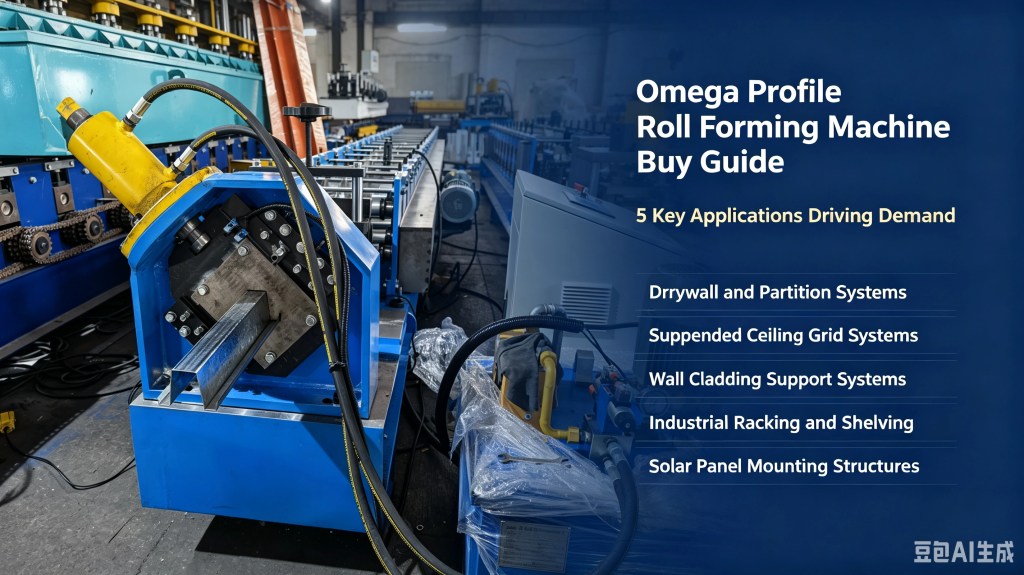
The Omega Profile Roll Forming Machine is becoming essential in modern light-gauge steel manufacturing. As construction shifts toward faster and lighter framing methods, the omega profile, a distinctive Ω-shaped steel section also called a top hat profile, has found its way into diverse applications. This Omega Profile Roll Forming Machine buy guide covers the five applications driving demand and two multi-size production solutions.
Whether you produce drywall framing, ceiling supports, or industrial racking, choosing the right omega profile roll former machine matters. A reliable Omega Profile Roll Former Machine buy guide helps you make informed purchasing decisions.
Beli Rollforming has over 15 years of experience with machines across 20+ countries. Our main markets, the US, Europe, and Australia, demand strict tolerances, and our machines meet those.
What Is an Omega Profile?
An omega profile is a roll-formed steel section shaped like the Greek letter Ω. It features a flat top with two downward legs, creating a channel that combines strength with light weight. The industry also calls it a top hat profile, hat channel, resilient channel, or omega section depending on the region and application.
The profile is typically formed from galvanized steel coils ranging from 0.4mm to 2.0mm thickness. Common widths span 30mm to 100mm, with leg heights from 10mm to 40mm. These dimensions suit light-gauge steel framing applications where strength-to-weight ratio matters.
If you are reading this Omega Profile Roll Forming Machine buy guide, you likely already know the profile’s value. Which applications are creating the most demand?

5 Key Applications Driving Demand
Application 1: Drywall and Partition Systems
Drywall partition systems are the largest demand driver for omega profiles. Builders use omega sections as resilient channels, thin steel hat channels mounted between studs and drywall panels. These channels decouple the gypsum board from the framing, reducing sound transmission.
Modern buildings increasingly require STC (Sound Transmission Class) compliance. Omega resilient channels help walls achieve STC 50+ ratings without adding mass. Hospitals, hotels, apartments, and office buildings all rely on this approach.
An omega profile roll former machine optimized for drywall channels runs at 30–60 m/min, producing thousands of linear meters per shift.
Application 2: Suspended Ceiling Grid Systems
Suspended ceilings rely on omega profiles as primary support channels. The omega shape provides load distribution across ceiling tiles, light fixtures, and HVAC components. Commercial buildings, from shopping malls to airports, depend on these systems.
O AISC Steel Construction Manual provides load-bearing guidelines for omega ceiling channels. Manufacturers producing ceiling grid components need machines capable of punching precise hole patterns for tie-wire attachment and cross-tee connection.
A quality Omega Profile Roll Forming Machine buy guide should highlight inline punching capability. Pre-punch systems place holes at 100mm, 150mm, or 200mm intervals depending on the ceiling design standard.
Application 3: Wall Cladding Support Systems
Metal wall cladding systems use omega profiles as vertical or horizontal support rails. The omega shape creates a stable mounting surface for corrugated panels, insulated sandwich panels, and architectural cladding.
Manufacturers serving the cladding market benefit from versatile omega profile roll forming machines that handle multiple profile sizes. Quick-change tooling allows switching between different top hat channel dimensions without lengthy downtime.
Producing 3 to 5 profile sizes on one line improves ROI without adding floor space.
Application 4: Industrial Racking and Shelving
Omega profiles serve as horizontal beams and vertical posts in light-duty industrial racking. Their shape resists twisting and provides a flat mounting surface for shelving brackets and bin supports.
For racking applications, the omega profile roll former machine must handle thicker steel, typically 1.5mm to 2.0mm. Roller stations need D2 tool steel with proper hardening.
Application 5: Solar Panel Mounting Structures
The solar energy boom has created a new demand stream for omega profiles. Photovoltaic mounting systems use omega sections as mid-rails and cross-members. The profile’s shape accommodates solar clamp attachments while providing structural rigidity against wind and snow loads.
O International Energy Agency (IEA) projects continued solar capacity growth through 2030. Solar mounting applications require Z275 or heavier galvanized steel, and the roll forming machine must handle this without surface damage.

Comparison: Omega Profile vs. Hat Channel vs. Furring Channel
| Recurso | Omega Profile | Hat Channel | Furring Channel |
|---|---|---|---|
| Shape | Ω (rounded top, two legs) | Flat top with two legs | U-shape with slight return |
| Espessura típica | 0.5–2.0 mm | 0.5–1.2 mm | 0.4–0.8 mm |
| Uso principal | Multi-purpose framing | Drywall support | Ceiling furring |
| Capacidade de carga | Médio-Alto | Médio | Baixo |
| Estações de conformação de rolos | 12–18 | 10–14 | 8–12 |
Understanding these differences matters for your Omega Profile Roll Forming Machine buy guide research. Each profile type requires specific roller designs.
Comparison: Machine Specifications Across Suppliers
| Especificação | Nível inicial | Mid-Range (Beli Standard) | Alta qualidade |
|---|---|---|---|
| Velocidade de formação | 15–20 m/min | 30–45 m/min | 50–60 m/min |
| Espessura do material | 0.4–1.2 mm | 0.4–2.0 mm | 0.4–2.5 mm |
| Estações de rolos | 10–12 | 14–16 | 18–22 |
| Sistema de corte | Tesoura manual | Hydraulic flying saw | Servo flying saw |
| Controle PLC | Basic relay | Siemens S7 | Siemens S7 + HMI |
| Faixa de preço (USD) | 25,000–40,000 | 45,000–80,000 | 90,000–150,000 |
This comparison table is a key reference in our Omega Profile Roll Former Machine buy guide. Mid-range machines from Beli offer the best balance of speed, versatility, and price.
Comparison: Key Specs to Evaluate Before Buying
| Evaluation Factor | Por que isso importa | O que procurar |
|---|---|---|
| Profile Flexibility | Determines product range | Multi-in-one rollers or auto-changeover |
| Perfuração em linha | Eliminates secondary operations | Servo punch, 4-station minimum |
| Material Range | Wider range = more markets | 0.4–2.0mm galvanized steel |
| Cutting Precision | Affects scrap rate | ±0.5mm tolerance |
| Sistema de controle | Operator efficiency | PLC with recipe storage |
| Suporte pós-venda | Minimizes downtime | Remote diagnostics, spare parts |
Multi-Size Production: Two Solutions
Most omega profile manufacturers need more than one size. This Omega Profile Roll Forming Machine buy guide covers two solutions. Both produce only one size at a time.
Solution 1: Multi-in-One Roller System
Multiple roller sets are installed on the same shaft. Each set forms a different omega profile (top hat) dimension. To switch sizes, the operator selects the active set on the PLC. No physical adjustment, no downtime for changeover.
This is the fastest way to handle multi-size production. If your orders frequently jump between sizes, multi-in-one keeps the line running without interruption. The trade-off is higher initial cost and a longer machine frame.
Solution 2: Fully Automatic Changeover System
One adjustable roller set with servo motors controlling width and height automatically. The operator adjusts forming angles manually. This allows stepless dimension variation within the machine’s range, from 30mm to 100mm for example.
The downside is changeover time: 10 to 25 minutes per size switch. For long batches this rarely matters. For hourly size changes, it adds up.
Comparison: Multi-in-One vs. Auto-Changeover
| Fator | Multi-in-One | Auto-Changeover |
|---|---|---|
| Switching time | Near zero (PLC select) | 10–25 minutes |
| Size range | Fixed sizes (3–5 per line) | Stepless within range |
| Roller investment | Higher (multiple sets) | Lower (one adjustable set) |
| Ideal para | Frequent size changes | Long runs, custom sizes |
| Angle adjustment | Not needed | Manual |
| Machine length | Longer (more stations) | Shorter (adjustable stations) |
Choosing between these two solutions is a key decision in any Omega Profile Roll Former Machine buy guide. Beli offers both. Contact our team to discuss which fits your production schedule.
Key Specs to Consider When Buying
Prioritize these specifications when following this Omega Profile Roll Forming Machine buy guide:
Forming Speed. Entry-level machines run at 15–20 m/min, high-end models reach 60 m/min. For most manufacturers, 30–45 m/min is the sweet spot.
Roller Material. D2 tool steel hardened to HRC 58–62. Chrome plating extends roller life with galvanized steel. See roller maintenance practices.
Punching System. Inline punching eliminates secondary operations. A servo-driven punch with 4+ stations handles hole patterns for ceiling grids, drywall channels, and solar mounting.
Decoiler Capacity. A 5-ton hydraulic decoiler handles standard coils. For continuous production, a 10-ton double-head decoiler.
Control System. PLC with touchscreen HMI and recipe storage allows quick profile changeover, a feature highlighted in every Omega Profile Roll Former Machine buy guide.
Why Choose Beli Rollforming
Beli Rollforming brings over 15 years of roll forming expertise to every omega profile machine we build. Our equipment serves customers across 20+ countries, with primary markets in the US, Europe, and Australia.
We engineer each omega profile roll former machine with D2 hardened rollers, Siemens PLC controls, and servo-driven flying saws. Our inline punching systems handle complex hole patterns for ceiling grids and solar mounting applications.
Every machine undergoes testing before shipment. We provide CE-certified equipment that meets international safety standards. Our team offers installation, training, and ongoing technical support.
For a complete picture of machine pricing across our product range, see our Guia de preços de máquinas de perfilagem.
Related Buying Guides
- Guia de compra de máquinas de perfilagem de perfis ZComparar perfis C/Z/Sigma e sistemas de troca automática.
- Guia de compra de máquinas de conformação de rolos esféricas personalizadasProdução de perfis para telhados e paredes.
- Guia da máquina de perfilagem de canaletasMáquinas para perfis estruturais.
- Máquina para painéis de telhado com juntas de encaixeEquipamentos para produção de painéis de telhado.
Para páginas de produtos Beli relacionados, explore nossa seção de produtos. perfiladeira de pinos metálicos, Máquina de perfilagem de terças C, e Máquina de perfilagem de perfis Z.
Perguntas mais frequentes
Uma máquina de perfilagem ômega é um equipamento especializado que molda bobinas de aço planas em perfis Ω. Esses perfis são utilizados em sistemas de drywall, grelhas de teto, suportes de revestimento e montagem de painéis solares. Este guia de compra de máquinas de perfilagem ômega aborda todos os aspectos principais.
As velocidades de produção variam de 15 m/min em máquinas de nível básico a 60 m/min em modelos de ponta. A maioria das máquinas de gama média da Beli opera a 30–45 m/min, o que é adequado para a maioria dos volumes de produção.
As máquinas de perfilagem Omega processam normalmente aço galvanizado (GI), aço laminado a frio (CR) e aço inoxidável. A espessura varia de 0,4 mm a 2,0 mm, atendendo à maioria das necessidades de aplicação.
Sim, através de duas abordagens. O sistema de rolos multi-em-um instala vários conjuntos de rolos no mesmo eixo, alternando os tamanhos via CLP sem tempo de inatividade. O sistema de troca automática utiliza um conjunto de rolos ajustável para variação contínua do tamanho dentro de uma faixa, mas requer de 10 a 25 minutos para a troca. Ambos produzem um tamanho por vez. Este detalhe é abordado no guia de compra da máquina de perfilagem Omega, mencionado acima.
Os preços variam de 25.000 para modelos de nível básico para 150.000 para configurações de ponta. Máquinas de gama média com puncionamento em linha e corte servo normalmente custam 45,000–80,000.
Um perfil ômega tem um topo arredondado que lembra um Ω, enquanto um perfil em forma de chapéu tem um topo plano. Ambos servem a propósitos semelhantes, mas os perfis ômega oferecem uma rigidez ligeiramente melhor devido à geometria curva.
As opções comuns incluem pré-punção (antes da conformação), pós-punção (após a conformação) e punção multiestação servoacionada. Para aplicações em forros e sistemas solares, a punção servoacionada oferece a maior precisão.
A configuração multifuncional é melhor se você troca de tamanhos com frequência e precisa de zero tempo de inatividade. A troca automática é melhor se você trabalha com lotes grandes e deseja flexibilidade dimensional contínua. Ambas produzem um tamanho por vez. Consulte a tabela comparativa neste guia de compra da máquina de perfilagem Omega para obter mais detalhes.
Com a devida manutenção, os cilindros temperados D2 duram de 5 a 8 anos em produção padrão. Os cilindros cromados prolongam ainda mais a vida útil, especialmente na conformação de aço galvanizado.
Sim. A Beli oferece instalação no local, treinamento de operadores e suporte técnico remoto para todas as máquinas. Atendemos clientes em mais de 20 países com mais de 15 anos de experiência.
A garantia padrão cobre 12 meses a partir da instalação ou 18 meses a partir do envio, o que ocorrer primeiro. Opções de garantia estendida estão disponíveis. Entre em contato com a Beli para obter mais detalhes.
Registro de alterações do artigo
- 2026-07-08: Publicação inicial do guia de compra da máquina de perfilagem Omega, abrangendo 5 aplicações principais, tabelas comparativas e 10 perguntas frequentes.
- 2026-07-08: Adicionada seção de produção multi-tamanho com comparação de soluções multi-em-um e troca automática. Adicionada a FAQ #8 sobre seleção de soluções. Adicionado "top hat" como nome alternativo.
Próximos gatilhos de revisão
- Atualize quando forem publicadas novas normas de desempenho acústico (STC/IIC).
- Revise as faixas de preço quando os custos das matérias-primas variarem em mais de 15%.
- Adicione novas seções de aplicativos caso os padrões de demanda por montagem solar mudem.
- Atualize as tabelas de comparação quando novas dimensões de perfil ômega entrarem em uso comum.
- Atualize os dados de comparação de fornecedores anualmente ou quando as condições de mercado mudarem.