








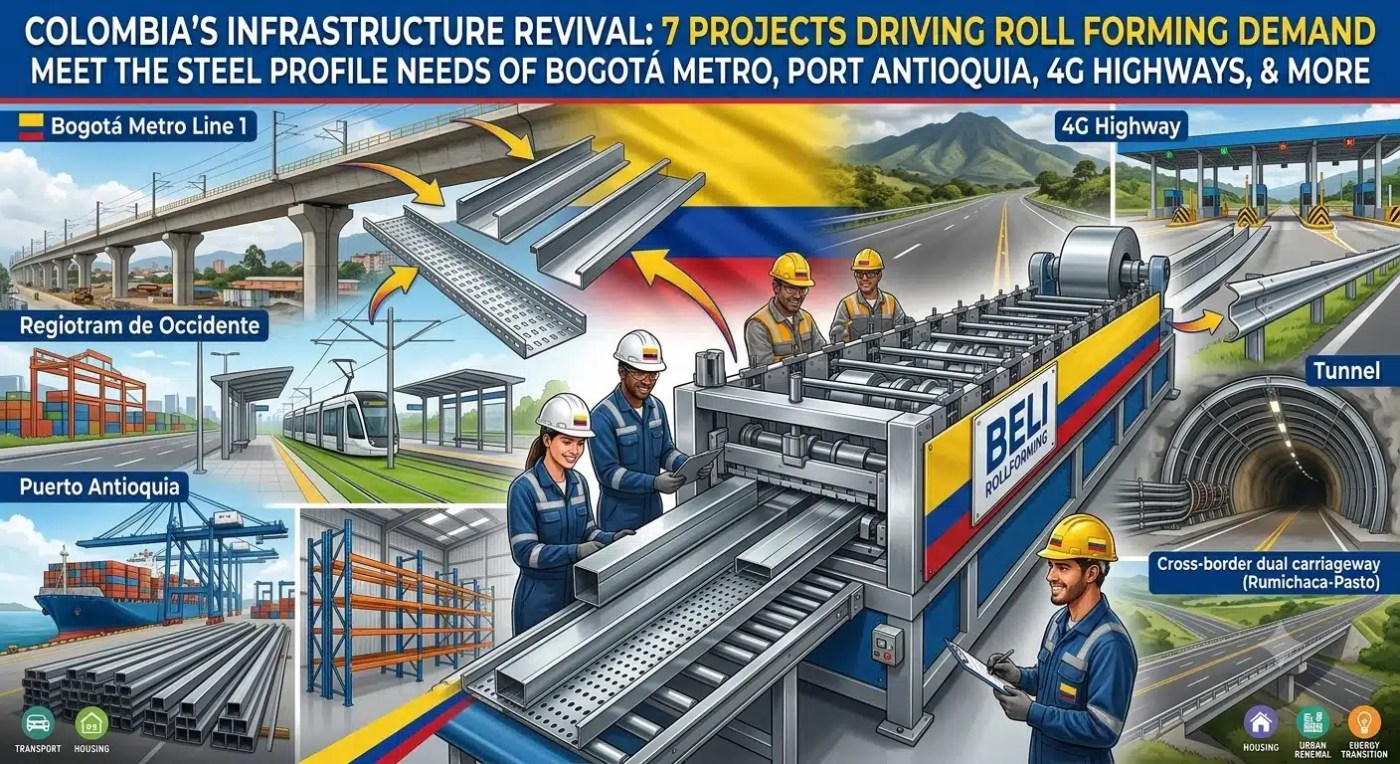
Colombia is spending on infrastructure at a pace not seen in years. The government’s National Infrastructure Plan commits over USD 15 billion across transport, housing, and urban renewal through 2028. Steel demand is climbing fast — apparent consumption grew 7.2% year-over-year in 2025, outpacing every major Latin American economy except Argentina.
For manufacturers and distributors, this opens a clear opportunity. A roll forming machine Colombia strategy targets the exact steel profiles these mega-projects need: purlins for transit stations, cable trays for electrification, strut channels for structural support, and roof panels for warehousing. Colombia joined the Belt and Road Initiative in May 2025, unlocking additional Chinese investment and construction partnerships.
This guide breaks down seven infrastructure revival projects driving demand for roll forming machine products across Colombia. We examine what steel profiles each project requires, what machine specifications matter, and how suppliers can position themselves in this growing market.
Colombia’s Steel and Construction Market at a Glance
Before diving into specific projects, understanding the broader market context helps suppliers gauge opportunity size.
Colombia’s steel industry faces a paradox. Local mills operate at only 62–64% of installed capacity due to competition from subsidized imports. Yet apparent consumption of rolled steel products keeps rising, driven largely by infrastructure investment. The Latin American Steel Association (Alacero) reports Colombia’s steel consumption grew 7.2% in 2025 — second only to Argentina regionally.
This gap between domestic production capacity and growing demand means Colombia depends heavily on imported steel products and the machinery to process them locally. Roll forming equipment that converts flat steel coils into finished structural profiles is especially critical. Local fabrication reduces logistics costs, shortens supply chains, and creates jobs — all priorities for the Colombian government.
| Market Indicator | 2025 Figure | Source |
|---|---|---|
| Steel consumption growth (YoY) | +7.2% | Alacero |
| Crude steel production | 1.332 million tons | Alacero LATAM report |
| Local mill capacity utilization | 62–64% | ANDI Steel Chamber |
| Infrastructure investment (GDP share) | 4.5% | World Bank |
| National infrastructure plan (2025–2028) | USD 15+ billion | Colombian Government |
| Construction sector growth (YoY) | +0.4% | Alacero |
7 Infrastructure Revival Projects Driving Roll Forming Demand
Project 1: Bogotá Metro Line 1
The Bogotá Metro is Colombia’s largest single infrastructure project, valued at USD 5.016 billion. The first line spans 24 kilometers of elevated viaduct with 16 stations, connecting southwest Bogotá to the city center. As of late 2025, overall completion reached nearly 70%, with commercial operations targeted for Q1 2028.
The World Bank approved a USD 530 million loan in December 2025 to support the most intensive construction phase. The project has already generated 17,000 direct and indirect jobs and engaged over 500 Colombian companies.
Roll forming machine Colombia demand: Metro stations and elevated viaducts require massive quantities of steel profiles — cable trays for electrical systems, strut channels for mechanical supports, and structural purlins for station roofing. A cable tray roll former is essential for producing the cable management systems that route power and signaling cables throughout the metro. Similarly, strut channel roll forming machines produce the support framing for HVAC, plumbing, and electrical installations across all 16 stations.
Project 2: Regiotram de Occidente (Western Tram)
Colombia’s first Belt and Road Initiative project broke ground in June 2025. The Western Tram connects Bogotá with four municipalities in Cundinamarca province via a 39.66-kilometer double-track electrified railway. The project includes 17 stations, 10 bridges, and one major depot.
The tram line will reduce commute times for approximately 3 million residents and create nearly 6,000 local jobs. As Colombia’s first modern electrified railway, it is the first step in the national rail network revival plan.
Roll forming machine Colombia demand: Railway electrification requires precision-formed steel components for overhead catenary supports, platform canopies, and station structures. Z purlin roll forming machines produce the structural members for station roofing and platform shelters. The 10 bridges along the route also need steel formwork and bracing profiles that roll forming equipment can supply efficiently.
Project 3: Puerto Antioquia Maritime Terminal
Puerto Antioquia is a major deep-water port project on Colombia’s Caribbean coast. By March 2025, the consortium completed driving over 1,000 steel piles — each averaging 90 meters long, 1.5 meters in diameter, and 80 tons in weight. The project consumed more than 44,000 tons of steel, fabricated in situ by ArcelorMittal as reported by Forbes Colombia.
The terminal features a 3.2-kilometer elevated viaduct connecting land operations to the maritime platform. Three ship-to-shore cranes from China are being installed. The port reduces logistics distances to Medellín by 47% and to Bogotá by 33%.
Roll forming machine Colombia demand: Port infrastructure requires heavy-duty steel profiles for warehouse framing, cable management for crane power systems, and protective barriers. A NEMA standard cable tray roll former produces high-load-capacity cable trays for the port’s electrical distribution network. Port warehouses need upright roll formers for pallet racking systems that handle containerized cargo.
Project 4: 4G Highway Program
Colombia’s Fourth Generation (4G) highway concession program is the backbone of national connectivity. It comprises 30 projects totaling 5,052 kilometers, reaching 89% overall completion by end of 2024. The program has injected COP 63.53 trillion in capital investment and generated over 100,000 jobs, according to the Agencia Nacional de Infraestructura (ANI).
Fifteen projects are in operation, twelve under construction, and two in pre-construction. Major corridors like Autopista al Mar 2 (98.96% complete) and Autopista al Río Magdalena 2 (93.12%) are entering service in 2025–2026.
Roll forming machine Colombia demand: Highway construction requires guardrail profiles, sign structure supports, and bridge decking components. Steel construction Colombia projects along these corridors need corrugated steel panels for culverts and drainage channels. Roll forming machines that produce corrugated profiles and structural sections serve toll plaza canopies, weigh stations, and operations control centers.
Project 5: Autopista al Mar 1 and 2 (Highway to the Sea)
The Autopista al Mar projects connect Medellín to Colombia’s Caribbean coast, benefiting over 2 million people. The first phase covers 176 kilometers of dual carriageway, financed through a consortium including CAF (Development Bank of Latin America) and other multilateral institutions.
Phase 2 is 98.96% complete and expected to enter full operation in early 2025. The combined project reduces freight transit times between Medellín and the coast, lowering logistics costs for agricultural and industrial exports.
Roll forming machine Colombia demand: Coastal highway corridors require corrosion-resistant steel profiles for guardrails, sign supports, and toll station structures. The C purlin roll forming machine produces framing members for toll plaza canopies and roadside service buildings. Corrugated steel pipe formed by roll forming equipment handles drainage along the mountainous route.
Project 6: Rumichaca–Pasto Dual Carriageway
This USD 616.5 million project upgrades 80 kilometers of highway connecting Colombia’s Nariño department to the Ecuadorian border at Rumichaca. The scope includes 3.6 kilometers of bridges, 2.4 kilometers of tunnels, and six interchanges.
The dual carriageway cuts travel time from two hours to one hour between Ipiales and Pasto, boosting cross-border trade. The project is part of Colombia’s “Vías para la Equidad” (Roads for Equality) program.
Roll forming machine Colombia demand: Tunnel construction requires steel arch support profiles, ventilation duct hangers, and cable management systems. Bridge construction needs formwork profiles and expansion joint components. Roll forming equipment that produces custom profiles for tunnel linings and bridge guardrails serves this cross-border corridor project directly.
Project 7: National Infrastructure Plan 2025–2028
Colombia’s National Infrastructure Plan allocates over USD 15 billion across transport, housing, and urban renewal through 2028. The plan prioritizes secondary and tertiary road construction, digital connectivity, energy transition, and port modernization.
Colombia’s accession to the Belt and Road Initiative in May 2025 accelerated cooperation with Chinese firms on railway, bridge, port, and energy projects. The plan emphasizes local job creation and technology transfer — creating demand for locally-manufactured steel profiles.
Roll forming machine Colombia demand: Broad-based infrastructure spending creates sustained demand for multiple profile types. Custom orb roll forming machines produce corrugated roofing for housing programs. Roll forming machine manufacturers supplying complete lines to Colombian fabricators help build domestic production capacity, reducing import dependence.
Roll Forming Machine Types and Colombia Project Applications
Different infrastructure projects demand different steel profiles. The table below maps machine types to project applications.
| Roll Forming Machine Type | Key Profiles | Primary Colombia Project Applications |
|---|---|---|
| Z Purlin Roll Forming Machine | Z-section purlins, structural framing | Metro station roofing, tram depot structures, port warehouses |
| C Purlin Roll Forming Machine | C-section purlins, wall girts | Toll plazas, highway service buildings, housing programs |
| Cable Tray Roll Former | Ladder trays, perforated trays | Metro electrification, port power systems, tunnel cabling |
| Strut Channel Roll Forming Machine | Strut channels, support framing | Station MEP systems, bridge utilities, sign structures |
| Upright Roll Former | Storage rack uprights | Port logistics, warehouse construction, cargo handling |
| Custom Orb Roll Forming Machine | Corrugated roof panels | Housing programs, agricultural buildings, service stations |

Why Choose Beli Rollforming for the Colombian Market
Beli Rollforming brings over 15 years of manufacturing experience to the Latin American market. Our machines serve clients across 20+ countries, with main markets in the US, Europe, and Australia. We understand the demands of infrastructure-scale production: high speed, consistent tolerances, and minimal downtime.
For the Colombian market specifically, several factors matter:
- Voltage compatibility: Beli machines can be configured for 480V/60Hz three-phase power, matching Colombian industrial standards.
- Spanish-language documentation: Operation manuals and technical support available in Spanish.
- Custom profile tooling: Our engineering team designs rollers for Colombian-standard steel profiles, including local dimensional preferences.
- After-sales support: Remote diagnostics, spare parts warehousing, and technician dispatch across Latin America.
Import and Compliance Considerations for Colombia
Importing roll forming equipment to Colombia requires attention to customs procedures and technical standards. Colombia applies the Common External Tariff of the Andean Community, with most industrial machinery entering at 5–10% duty. Free trade agreements with China, the US, and the EU may reduce or eliminate duties depending on origin certification.
Key compliance steps include:
- DIAN registration: Colombian tax authority registration for import transactions.
- ICONTEC standards: Colombian technical standards institute certifications for electrical and mechanical equipment.
- Spanish-language labels: Safety warnings and operating instructions must be in Spanish per Colombian labor regulations.
- Warranty documentation: Importers should register warranty terms with Colombian consumer protection authorities.
Colombian fabricators importing machinery should also verify that their steel coil suppliers meet ASTM or equivalent international standards for yield strength and dimensional tolerances.
Colombia vs. Other Latin American Markets for Roll Forming
| Factor | Colombia | Mexico | Brazil | Chile |
|---|---|---|---|---|
| Steel consumption growth (2025) | +7.2% | -10.1% | +2.6% | -41.4% |
| Infrastructure plan value | USD 15B | Varies | PAC program | Varies |
| BRI membership | Yes (2025) | No | No | No |
| Import dependency | Moderate (5–45%) | High (10.5 Mt) | Moderate (5 Mt) | High |
| Local mill capacity use | 62–64% | Declining | Stable | Low |
| Roll forming opportunity | High | Moderate | Moderate | Emerging |
Colombia stands out for its combination of rising steel consumption, BRI membership, and infrastructure investment. The gap between domestic steel production capacity and consumption creates a structural opening for locally-processed steel profiles using imported roll forming machine technology.
Frequently Asked Questions
Demand is driven by USD 15+ billion in infrastructure investment through 2028. Major projects like the Bogotá Metro, 4G highways, and Puerto Antioquia require cable trays, purlins, strut channels, and roofing profiles — all produced by roll forming machines.
Cable tray roll formers, Z and C purlin machines, strut channel roll formers, and upright rack roll formers are in highest demand. These profiles serve metro construction, highway infrastructure, port development, and warehousing projects.
Colombia joined the Belt and Road Initiative in May 2025. This facilitates Chinese investment and construction partnerships, potentially streamlining machinery imports from Chinese manufacturers like Beli Rollforming.
Colombia uses 480V/60Hz three-phase industrial power. Beli Rollforming machines can be configured to match these standards, ensuring compatibility with Colombian factory infrastructure.
Most industrial machinery enters Colombia at 5–10% duty under the Andean Community Common External Tariff. Free trade agreements may reduce duties depending on the country of origin and proper certification.
Yes. Beli machines process steel coils meeting ASTM or equivalent international standards. We design roller tooling to accommodate local coil dimensions and material grades common in the Colombian market.
Ocean freight from Chinese ports to Buenaventura or Cartagena typically takes 35–45 days. Beli Rollforming coordinates with experienced freight forwarders to ensure timely delivery and proper customs clearance.
Beli provides remote diagnostics, Spanish-language technical support, spare parts supply, and on-site technician dispatch. We also offer installation supervision and operator training for Colombian fabrication teams.
Yes. Our engineering team designs custom roller tooling for Colombian-standard steel profiles. We accommodate local dimensional preferences, thickness ranges, and hole patterns required by Colombian construction codes.
With infrastructure demand at historic highs, Colombian fabricators can achieve ROI in 18–30 months depending on machine type, utilization rate, and profile pricing. Cable tray and purlin machines serving metro and highway projects tend to have the fastest payback.
Article Changelog
- 2026-08-03: Initial publication. Covered 7 Colombia infrastructure revival projects driving roll forming machine demand, including Bogotá Metro, Western Tram, Puerto Antioquia, 4G highways, and the National Infrastructure Plan. Added steel market data from Alacero 2025 figures and World Bank financing updates.
Next Review Triggers
- Bogotá Metro Line 1 commercial operation launch (Q1 2028) or major construction milestone updates.
- New 5G highway program announcements or 4G project completion updates from ANI.
- Changes to Colombia’s import tariff structure or new free trade agreements affecting machinery imports.
- Alacero annual steel consumption figures for Colombia (next release: Q1 2027).
- Puerto Antioquia terminal operational commissioning and expansion phases


