In high-volume metal manufacturing, time is measured in dollars. Production lines that produce a diverse range of profiles—such as studs, tracks, purlins, or specialized strut channels—face a constant threat to profitability: the changeover window. The transition from one product specification to the next can often consume hours, sometimes even an entire shift, leading to lost capacity and increased labor costs.
The solution to this critical bottleneck is the quick change roll forming machine. This technology shifts the focus from time-consuming manual roll adjustments to pre-staged, automated tooling exchanges. By dramatically reducing the downtime associated with shifting profiles, a quick change roll forming machine directly translates into massive operational savings and increased flexibility.
At Beli RollForming, we design and build quick change roll forming machine systems that prioritize efficiency through engineering. This guide outlines the 3 essential strategies you must implement to fully unlock the massive savings potential of your investment.
The Hidden Costs of Traditional Changeovers
A common oversight is calculating only the direct labor hours spent on a traditional changeover. The real cost extends far deeper into the operation:
Lost Capacity: Every hour spent wrenching tools is an hour of lost revenue.
Increased Error Rate: Manual adjustments are prone to human error, often requiring material scrap and secondary adjustments.
Inventory Bloat: Producers run larger batch sizes to minimize changeovers, leading to high inventory carrying costs.
Traditional, static roll forming processes severely limit operational agility. For a deep dive into how these inefficiencies degrade your overall throughput, we recommend reading our comprehensive analysis of roll forming machine performance.
3 Strategies for Massive Savings with a Quick Change Roll Forming Machine
Strategy 1: Implement the Cassette System for Zero Downtime
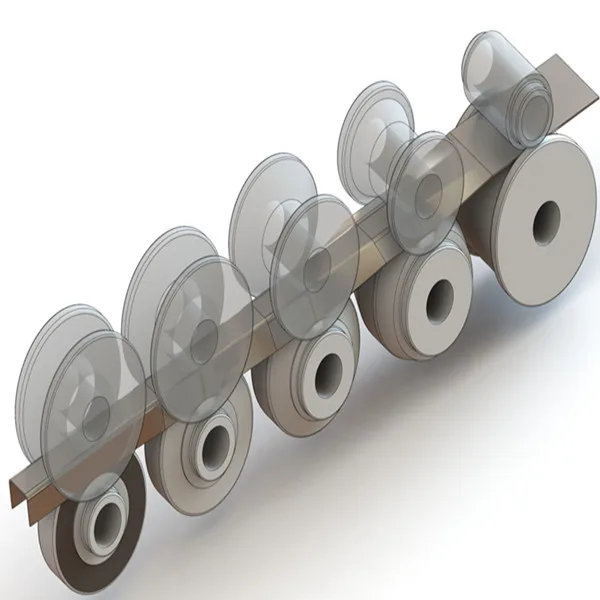
The core feature of a quick change roll forming machine is the cassette or raft system. Instead of adjusting individual rolls on the main spindle, the entire set of forming tools (the cassette) is prepared offline and wheeled into the machine.
The key strategy here is to view the cassette as an interchangeable module, not a fixed part. While one cassette is running production, the next job’s cassette should be simultaneously pre-set, aligned, and calibrated in a staging area away from the machine. The physical exchange takes minutes, not hours, moving all the complexity of alignment offline. This relies on precision-engineered roll forming machine components that ensure perfect registration when the cassette is locked into place.
Strategy 2: Automated Tooling Adjustment and Synchronization
The second major area for savings comes from leveraging automation to handle the fine-tuning adjustments. A true quick change roll forming machine minimizes or eliminates the need for manual shimming or alignment checks.
Optimization Focus: The machine must use centralized control systems (PLCs) that store and recall specific product parameters for width, height, and, crucially, vertical roll spacing, including complex parameters for springback compensation. When a new cassette is inserted, the machine uses sensors and servo motors to automatically adjust the driven shafts to the pre-programmed positions for that profile. This advanced capability is a cornerstone of modern roll forming technology. For detailed methods on managing profile tolerance and angular recovery, review our guide: Serious Challenge: Control Springback in Roll Forming with 4 Key Techniques.
Strategy 3: Enhance Product Flexibility and Just-In-Time (JIT) Production
The massive savings achieved by a quick change roll forming machine are realized not just by reducing changeover time, but by fundamentally changing the production strategy.
By reducing changeover time from four hours to ten minutes, a manufacturer can afford to run smaller batch sizes, eliminate inventory bloat, and respond instantly to market demand. This enables a true Just-In-Time (JIT) manufacturing strategy, freeing up capital and warehouse space.
This flexibility is particularly critical for diverse product lines. For example, a Product: High Speed C Z Purlin Roll Forming Machine that can switch between Cee and Zee profiles quickly provides an enormous market advantage. Furthermore, this capability allows producers to incorporate custom elements, such as the specialized designs discussed in our guide, Strut Channel Roll Former: Amazing 3 Design Tricks for Superior Strength, without crippling production schedules.
Building a Future-Proof Quick Change Roll Forming Machine
Implementing a quick change roll forming machine is an investment in your future. It aligns your operations with Lean Manufacturing principles, specifically the SMED (Single Minute Exchange of Die) methodology. According to manufacturing efficiency experts, reducing setup time is one of the most effective ways to boost throughput without purchasing new capacity. To learn more about how SMED principles apply to industrial machinery, review the Society of Manufacturing Engineers (SME) resources on efficiency and setup reduction.
Beli RollForming specializes in integrating precision cassettes and automated controls into high-speed lines, ensuring your machine is not just fast, but flexible and financially efficient.