









Introduction
Buying a roll forming machine without ISO 9001 quality management is a gamble. Profile dimensions drift. Raw material defects slip through. Shipments get rejected.
ISO 9001 in roll forming manufacturing eliminates that gamble. It provides a structured framework for every process, from incoming coil inspection to final profile cut-off. Buyers should understand what ISO 9001 actually requires, not just whether a certificate exists on the wall.
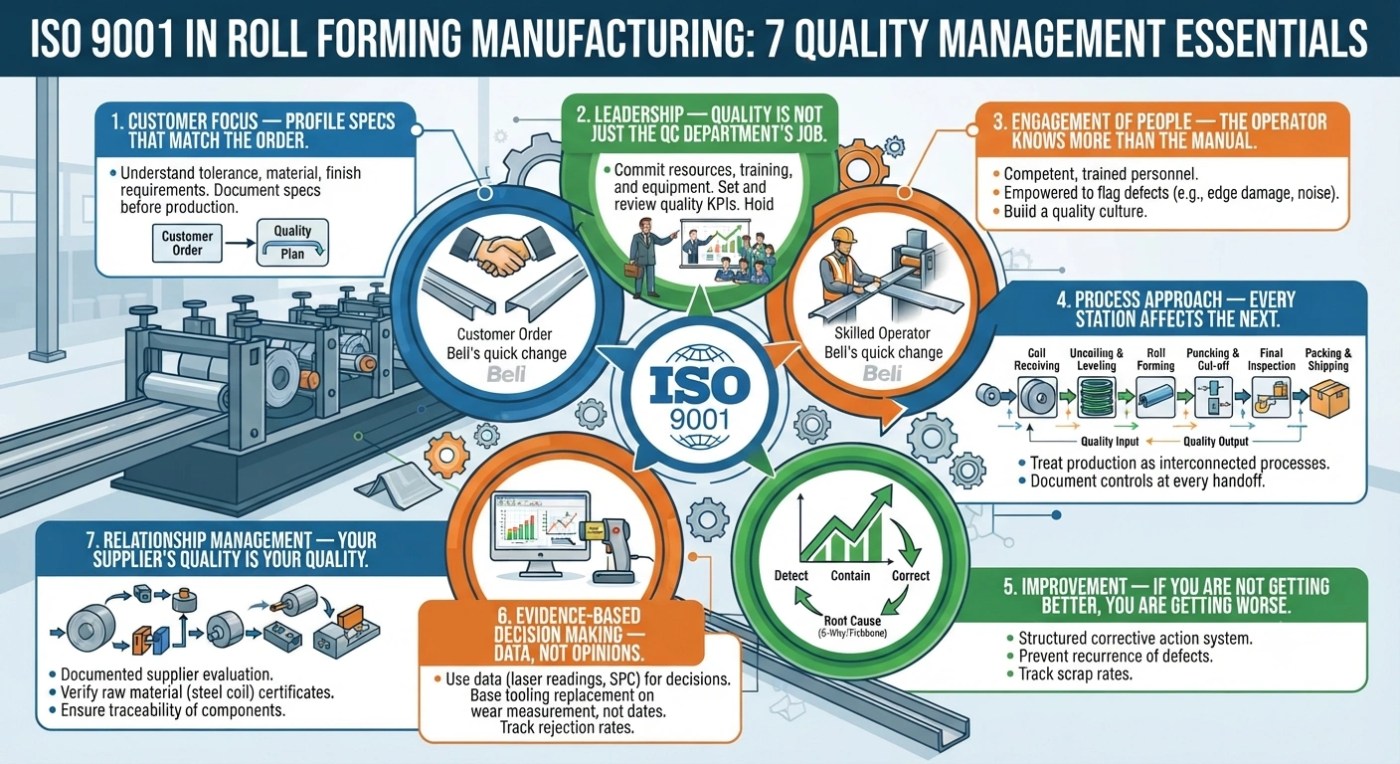
This guide breaks down the 7 quality management essentials that make ISO 9001 in roll forming manufacturing work, based on the ISO 9001:2015 standard from the International Organization for Standardization. Each essential maps directly to a roll forming production reality.
What ISO 9001 in Roll Forming Manufacturing Actually Means
ISO 9001 is a quality management system (QMS) standard, a framework for managing quality across every function. It does not set product tolerances. It sets the system that ensures tolerances are met.
In roll forming, ISO 9001 in roll forming manufacturing covers: raw material receiving, tooling production, machine assembly, profile production, final inspection, and after-sales. According to ISO 9001:2015 documentation, the standard rests on seven quality management principles.
For a buyer, an ISO 9001 certified supplier means documented processes, traceable materials, calibrated equipment, and formal non-conformance handling. It is the difference between “trust me” and “here is the data.”
Beli applies ISO 9001 principles across every metal roll forming machine built for the US, Europe, and Australia.
ISO 9001 vs. Non-Certified Roll Forming: The Real Difference
Factor | ISO 9001 Certified Supplier | Non-Certified Supplier |
Material traceability | Mill certificates matched to each coil batch | Verbal claims, no paper trail |
Inspection records | Calibrated instruments, documented results | Visual checks, no calibration |
Non-conformance handling | Formal corrective action process | Ad-hoc fixes, no root cause analysis |
Process documentation | SOPs, work instructions, control plans | Tribal knowledge in operators’ heads |
Management review | Scheduled reviews with KPI data | No structured review |
Supplier evaluation | Documented supplier qualification | Price-driven selection |
Continuous improvement | CAPA system, trend analysis | Reactive firefighting |
This table shows why ISO 9001 in roll forming manufacturing matters before a single meter of profile exits the line. The system catches problems at the source, not at the customer’s receiving dock.
The 7 Quality Management Essentials
1. Customer Focus — Profile Specs That Match the Order
ISO 9001 in roll forming manufacturing starts with customer focus. That means understanding the buyer’s tolerance requirements, material specifications, surface finish needs, and delivery expectations, then building the quality plan around them.
A roll forming supplier with strong customer focus documents every requirement before production. The cable tray roll forming machine page shows how Beli captures profile dimensions, material grade, hole patterns, and production speed targets upfront.
Without this foundation, the machine ships matching the supplier’s assumptions, not the buyer’s reality.
2. Leadership — Quality Is Not Just the QC Department’s Job
The second essential for ISO 9001 quality management roll forming is leadership commitment. Quality policy does not live in a framed document. It lives in resource allocation.
Leadership means: investing in calibrated measurement tools, budgeting for operator training, scheduling management reviews of quality KPIs, and holding every department accountable. The American Society for Quality (ASQ) emphasizes that top management must demonstrate leadership, not delegate it.
When a recurring burr issue appears on Beli’s Z purlin roll forming machine production, leadership authorizes tooling changes within days, not weeks.
3. Engagement of People — The Operator Knows More Than the Manual
ISO 9001 in roll forming manufacturing succeeds or fails at the operator level. The standard requires competent, trained, and engaged personnel, not just workers following instructions.
In roll forming, operator engagement means: the decoiler operator catches coil edge damage before it enters the line, the mill operator hears a bearing noise and logs it immediately, the stacker operator flags a profile that looks 1 mm off. These small catches prevent large rejections.
Beli’s quality system includes documented competency matrices for every role. New operators on the high-speed C Z purlin roll forming machine complete a structured training checklist before independent operation. The quality culture is built from the shop floor up.
4. Process Approach — Every Station Affects the Next
The process approach is the backbone of ISO 9001 in roll forming manufacturing. It treats the production line as interconnected processes, not isolated workstations.
Roll Forming Process Stage | Quality Input | Quality Output | Affected By |
Coil receiving | Mill certificate verification | Accepted/sorted coil inventory | Supplier quality, storage conditions |
Uncoiling & leveling | Flat strip, correct width | Leveled strip at target flatness | Coil quality, leveler setup |
Roll forming | Leveled strip, tooling setup | Formed profile within tolerance | Roll design, alignment, material springback |
Punching & cut-off | Formed profile, program parameters | Cut-to-length profile with holes | Punch tool condition, servo accuracy |
Final inspection | Finished profile, inspection plan | Pass/fail decision, data record | Calibration, inspector competence |
Packing & shipping | Passed profiles, packing spec | Protected shipment | Packing material, handling |
Each stage provides inputs to the next. ISO 9001 quality management roll forming requires documented process controls, defined acceptance criteria, and monitoring at every handoff point.
For rapid profile changeovers without quality loss, Beli’s quick change roll forming machine uses cassette systems that maintain process consistency across profile families.
5. Improvement — If You Are Not Getting Better, You Are Getting Worse
Continuous improvement is the fifth essential. ISO 9001 certification roll forming requires a formal corrective action system that fixes problems and prevents recurrence.
The improvement cycle in roll forming: (1) Detect. An inspection falls outside tolerance or a customer reports a defect. (2) Contain. Isolate affected material, quarantine suspect profiles. (3) Root cause. Investigate using 5-Why or fishbone diagrams. (4) Correct. Implement a permanent fix, update the process, verify effectiveness.
According to The Fabricator’s quality management resources, metal forming companies with structured improvement programs cut scrap rates by 30-50% within 12 months.
Beli’s improvement system tracks every non-conformance from the roll forming inspection records. Trends trigger preventive actions before defects multiply.
6. Evidence-Based Decision Making — Data, Not Opinions
The sixth essential replaces gut feeling with measurement. ISO 9001 in roll forming manufacturing requires decisions based on analyzed data, not the loudest voice in the production meeting.
What this looks like in practice: laser micrometer readings feed into SPC charts. Profile sampling follows AQL tables, not random checks. Rejection rates are tracked by product family, shift, and operator. Tooling replacement decisions are based on wear measurement data, not calendar dates.
For buyers evaluating suppliers, ask: “Show me the last quarter’s quality data.” An ISO 9001 in roll forming manufacturing supplier can produce it instantly. A non-certified shop offers explanations.
7. Relationship Management — Your Supplier’s Quality Is Your Quality
The seventh essential extends quality management beyond the factory walls. ISO 9001 in roll forming manufacturing requires documented supplier evaluation, ongoing performance monitoring, and traceability back to raw material sources.
In roll forming, the biggest supplier risk is coil steel quality. A single coil with inconsistent gauge or hardness destroys profile tolerances across the entire run. Beli maintains approved supplier lists with documented qualification criteria.
The supplier management system also covers: tooling steel suppliers (D2, SKD11 grades verified by certificate), electrical component suppliers (Siemens, Schneider, Omron, all CE-marked), and hydraulic and pneumatic suppliers with traceable batch records.
This final essential completes the ISO 9001 quality management roll forming loop: quality starts before raw material enters the plant and continues until the finished profile reaches the customer.
Internal Audit vs. External Certification Audit
Aspect | Internal Audit | External Certification Audit |
Who conducts | Trained internal auditors | Accredited certification body (e.g., SGS, TÜV, Bureau Veritas) |
Frequency | At planned intervals (typically quarterly or semi-annually) | Annually (surveillance) + recertification every 3 years |
Scope | All QMS processes, selected per risk | Full QMS scope |
Output | Internal audit report, corrective actions | Audit report, certification decision |
Purpose | Find gaps, drive improvement | Verify conformity, maintain certificate |
Both audit types are essential for ISO 9001 certification roll forming. Internal audits catch problems first. The external audit validates the system for customers.
Beli passes annual surveillance audits from an accredited certification body covering design, production, inspection, purchasing, and after-sales across all roll forming machine manufacturers core processes.
How Beli Rollforming Applies ISO 9001
Beli has implemented a full ISO 9001:2015 quality management system across roll forming machine production. Key elements:
- Quality policy and objectives. Measurable targets for profile tolerance, on-time delivery, and customer satisfaction.
- Process control plans. Every model — from cable tray roll forming to Z purlin — has a dedicated control plan with inspection points.
- Calibrated measurement. Laser micrometers, hardness testers, and dimensional gauges with documented calibration schedules.
- Competency management. Training records, skill matrices, and periodic assessments for all production and inspection personnel.
- Supplier quality. Approved supplier list, incoming inspection protocol, and supplier performance scorecards.
- CAPA system. Formal logging, investigation, and closure of non-conformances with trend analysis.
- Management review. Quarterly reviews of quality KPIs, audit results, and customer feedback.
For buyers seeking complementary compliance documentation, see our guide on CE Marking for Roll Forming Machines. ISO 9001 and CE compliance work together for EU market access.
Quick ISO 9001 Certification Timeline for Roll Forming Manufacturers
Phase | Duration | Key Activities |
Gap analysis | 2-4 weeks | Compare current practices to ISO 9001 requirements |
System development | 2-3 months | Write quality manual, procedures, work instructions, forms |
Implementation | 2-4 months | Train staff, run the system, collect records |
Internal audit | 1-2 weeks | Audit all processes, address findings |
Management review | 1 week | Review system performance, authorize certification audit |
Certification audit (Stage 1) | 1-3 days | Documentation review by certification body |
Certification audit (Stage 2) | 2-5 days | On-site implementation audit |
Certification decision | 2-4 weeks | Review and certificate issuance |
Total timeline: 6-10 months. Manufacturers with existing structured processes can achieve it faster.
Conclusion
ISO 9001 in roll forming manufacturing is seven interconnected essentials: customer focus, leadership, people engagement, process approach, continuous improvement, evidence-based decisions, and relationship management.
For buyers, ISO 9001 certification means predictable quality. The supplier has documented processes. Inspection data exists. Non-conformances get formal corrective actions. Materials are traceable. People are trained.
Beli’s ISO 9001:2015 certified quality management system operates across every metal roll forming machine shipment to over 20 countries. The quality commitment starts before the first CAD drawing and continues through after-sales support.
FAQs
ISO 9001 is the international standard for quality management systems. In roll forming, ISO 9001 in roll forming manufacturing ensures consistent profile quality, traceable materials, and documented processes for every non-conformance.
Yes. Beli maintains an ISO 9001:2015 certified quality management system covering design, production, inspection, and after-sales for all roll forming machines.
No standard guarantees perfection. ISO 9001 in roll forming manufacturing provides a system that detects defects, controls processes, and drives continuous improvement. It minimizes variation, not physics.
Request the certificate number and issuing body. Verify it on the certification body’s online registry or through the IAF CertSearch database. Check the scope. It should explicitly cover roll forming machine manufacturing.
ISO 9001 is a quality management standard, voluntary but commercially important. CE marking is a legal requirement for EU market access covering safety and regulatory compliance. They complement each other. See our CE Marking for Roll Forming Machines guide.
Annual surveillance audits plus full recertification every three years. The certification body visits on-site to verify the system is maintained and improved.
Yes, but it requires documented evidence of operating processes, typically 6-10 months from gap analysis to certification. The system must be running, not just written.
Incomplete inspection records and uncalibrated measurement equipment rank highest. Many shops measure profiles but do not document results or calibrate instruments. Both are mandatory under ISO 9001 quality management roll forming.
No. ISO 9001 requires you to define tolerances, measure against them, and act on deviations. The actual tolerance values come from customer requirements and industry standards like ASTM International.
The standard requires documented supplier evaluation, incoming inspection criteria, and traceability. Coil steel must be matched to mill certificates. Non-conforming material must be identified and segregated.
Article Changelog
- 2026-07-27: Initial version. 7 ISO 9001 quality management essentials for roll forming manufacturing. 3 comparison tables, 10 FAQs, 8 internal links, 4 external links.
Next Review Triggers
- When ISO 9001 standard is revised (next expected revision post-2027)
- When Beli updates its certification scope
- When new industry-specific quality standards emerge for roll forming