









Introduction
Selling warehouse racking profiles to European buyers means passing EN 15512.
This standard defines structural design rules for adjustable pallet racking systems. If your roll forming for warehouse racking does not meet its requirements, your profiles fail certification. That means rejected shipments and lost contracts.
EN 15512 sets rules for steel grades, load combinations, connection strength, and dimensional tolerances. Every one of these rules flows back to your roll forming process. Hole pitch in upright posts. Yield strength of cold-formed sections. Beam connector fit after coating.
This guide covers six EN 15512 compliance points for roll forming for warehouse racking. Each point explains what the standard requires and what you must verify on your warehouse racking roll forming machine.
What Is EN 15512?
EN 15512:2020+A1:2022 is the European standard for steel static storage systems. It covers adjustable beam pallet rack systems. Both braced and unbraced frames fall under its scope.
The standard was updated in 2020 with a key change. The material reduction factor (gamma M) moved from 1.0 to 1.1. This made designs 10 percent more conservative. It also aligned EN 15512 more closely with Eurocode 3. The standard is maintained by CEN/TC 344, the European technical committee for steel static storage systems.
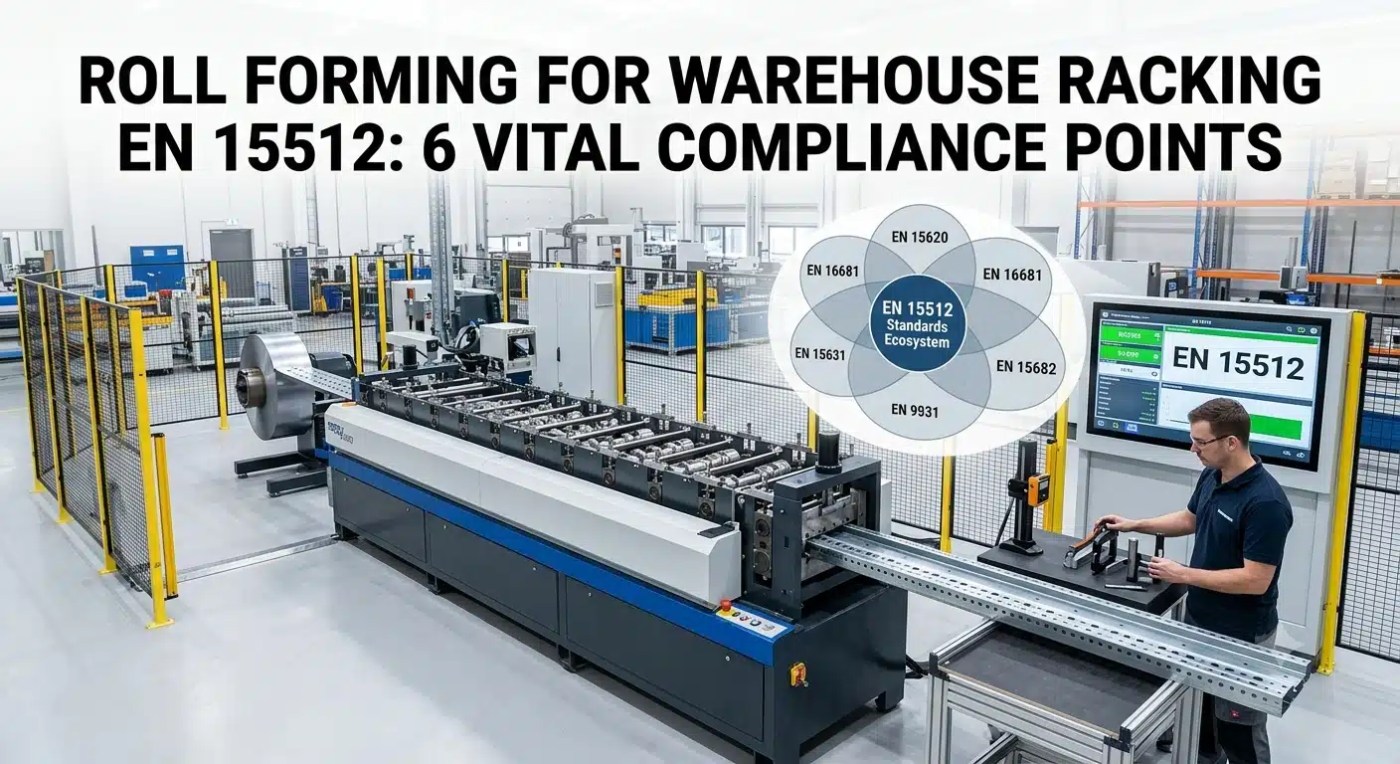
EN 15512 works with three companion standards. EN 15620 covers tolerances and deflections. EN 15629 handles equipment specification. EN 15635 covers use and maintenance. For seismic zones, designers add EN 16681.
A machine de profilage à cadre vertical soudé for European warehouses must produce profiles that pass all four standards. The roll forming for warehouse racking process must align with each one.
The EN 15512 Standards Ecosystem
| Standard | Portée | Impact on Roll Forming for Warehouse Racking |
|---|---|---|
| EN 15512 | Structural design principles | Load cases, material factors, connection strength, testing |
| EN 15620 | Tolerances, deflections, clearances | Upright verticality limits, beam deflection L/200, hole pitch tolerances |
| EN 15635 | Use and maintenance | Load signage per bay, periodic inspection schedules |
| EN 16681 | Seismic design | Extra bracing and connection rules for earthquake zones |
Each standard feeds requirements back to the warehouse racking roll forming machine. If your profileuse verticale à grande vitesse produces uprights with hole pitch deviation above EN 15620 limits, the racking system fails installation checks.
6 EN 15512 Compliance Points for Roll Forming
1. Material Selection and Steel Grade Requirements
EN 15512 Clause 7 sets steel material rules. Cold-formed sections need steel with guaranteed mechanical properties. Minimum yield strength for cold-formed steel is 140 N/mm squared. For hot-rolled sections it is 200 N/mm squared.
European racking manufacturers use S235 to S355 grades. S355 is common for heavy-duty uprights and pallet racking roll forming applications. Higher yield strength lets designers use thinner gauge. That directly affects your roll forming for warehouse racking. Thinner gauge at higher strength needs tighter roller gap control. Tooling wear runs faster on harder material.
The standard also covers fracture toughness. Cold-formed sections below 5 mm used above minus 30 degrees Celsius need no special check. But profiles for cold storage at minus 28 degrees Celsius need documented toughness from the steel mill.
A machine de profilage à rouleaux à poutre étagée running S235 versus S355 needs different roller pressure. Operators must adjust per grade to avoid over-rolling.
Key compliance steps for warehouse racking roll forming machine operators:
- Verify mill certificates for every coil batch.
- Test average yield strength on formed sections. Cold working during roll forming changes local properties.
- Document steel grade, thickness, and coating per production batch.
2. Load Combinations and Partial Safety Factors
EN 15512 Clause 6 defines the design basis. The 2020 revision raised gamma M from 1.0 to 1.1. Racking designs now need 10 percent more structural capacity.
Load factors break down like this:
| Load Type | Partial Factor | Examples |
|---|---|---|
| Permanent loads (G) | gamma G = 1.3 | Self-weight of rack structure |
| Pallet loads (Q) | gamma Q = 1.4 | Stored unit loads |
| Handling loads (Q) | gamma Q = 1.4 | Forklift placement impact |
| Accidental loads (A) | gamma A = 1.0 | Forklift collision, 2.5 kN horizontal |
For the warehouse racking roll forming machine operator, this means profiles must hit design section modulus consistently. A 5 percent under-thickness at upright corners cuts local buckling capacity by 15 to 20 percent. When the designer already factored in gamma M 1.1 and gamma Q 1.4, there is no margin for production variation.
Upright post thickness must stay within tolerance at all formed corners. Thinning beyond design limits triggers distortional buckling. Coil thickness needs verification at start and end of each coil. EN 15512 assumes nominal thickness at design stage. Actual gauge may differ by plus or minus 0.05 mm. This is critical in pallet racking roll forming where section properties drive capacity.
3. Structural Analysis and Second-Order Effects
EN 15512 Clause 9 covers structural analysis. Racking frames are classified by critical load factor alpha cr. Below 10, second-order P-Delta effects must be considered. Most pallet racking frames fall here.
Upright frames carry high axial loads with low bending stiffness. The perforated web reduces effective section. EN 15512 requires accounting for this perforation effect on buckling resistance.
For roll forming for warehouse racking, the practical concern is straightness. An upright post with 2 mm bow over 3 meters introduces initial imperfection. EN 15512 assigns global imperfection of H divided by 500. If production bow is worse, real frame capacity drops below design values.
A équipement de profilage à rouleaux à support cantilever line producing arm sections faces the same challenge. Sweep or twist in the finished profile multiplies under load.
Production checks for warehouse racking roll forming:
- Measure straightness on every Nth post with laser alignment.
- Calibrate the straightening station per material grade. Switching from S235 to S355 changes springback.
- Verify that punch patterns do not distort the web before final forming.
4. Connection Design and Beam-End Connector Testing
Clause 9.1.2 covers joint modeling. The beam-to-upright connection is the most critical joint. It carries vertical pallet loads and resists horizontal forklift impact forces.
EN 15512 requires bending tests on beam-end connectors per Annex A.3. The moment-rotation curve determines frame stability. A loose connector reduces stiffness and can trigger sway failure.
This connects directly to warehouse racking roll forming machine quality. Upright post holes that receive beam connector tabs need consistent pitch, shape, and edge condition. If hole position varies by 0.3 mm from post to post, connector engagement changes. Some beams lock tight. Others have play.
A C bracing roll forming machine producing diagonal braces faces similar requirements. Bolt holes in brace ends must align with upright web holes at specified spacing. EN 15512 also mandates safety locks on beam connectors must withstand 5 kN upward load.
Quality checks for pallet racking roll forming:
- Measure hole pitch with go and no-go gauge each production run start.
- Verify punching station position accuracy across speed changes. Servo-driven systems outperform mechanical cam systems.
- Test a random beam-upright connection assembly per shift for play or binding.
5. Testing and Physical Verification
Annex A of EN 15512 is extensive. It specifies physical tests to validate calculated capacities.
| Test Type | Annex Reference | What It Verifies |
|---|---|---|
| Stub column compression | A.2.1 | Post-forming compressive capacity |
| Distortional buckling | A.2.2 | Local buckling resistance with perforations |
| Long column buckling | A.2.3 | Overall upright frame buckling curve |
| Frame shear stiffness | A.2.4 | Lateral stiffness, braced and unbraced |
| Beam bending | A.2.6 | Beam capacity and deflection under load |
| Beam-end connector | A.3.1 | Moment-rotation of beam-to-upright connection |
The 2020 revision relies heavily on physical testing. Formula-based approaches alone are not enough. Real profiles from your roll forming for warehouse racking line must go on a test rig.
This has a direct consequence for manufacturers. Test results belong to your specific roll forming setup. Change the roller set, material supplier, or punch die, and the tested capacity may be invalid. EN 15512 requires re-testing when production variables change.
Le AR Racking testing lab runs these tests routinely. Their data shows stub column capacity varies 8 to 12 percent between production runs of the same profile, even from the same warehouse racking roll forming machine.
Shop floor actions for upright frame roll forming:
- Keep records of roller geometry, material batch, and test results.
- Establish a baseline stub column capacity for your standard upright profile. Re-test after roller refurbishment.
- Consider monthly sample testing per EN 15512 Annex M for factory production control.
6. Dimensional Tolerances and EN 15620 Cross-Compliance
EN 15512 references EN 15620 for all dimensional requirements. Roll forming precision gets measured here.
| Dimension | EN 15620 Limit | Risk if Exceeded |
|---|---|---|
| Upright verticality installed | H/1000, max 10 mm | Extra bending moment, reduced frame capacity |
| Beam deflection under load | L/200 | Pallet tilt, load sliding risk |
| Beam level same bay | plus or minus 3 mm | Uneven pallet support |
| Beam level entire face | plus or minus 5 mm | Cumulative rack lean |
| Hole pitch consistency | plus or minus 0.2 mm full length | Connector engagement failure |
For roll forming for warehouse racking, hole pitch is the hardest tolerance. A 6-meter upright may have 120 punched holes. Each hole error adds to the next. At 0.1 mm per-hole drift, total error reaches 12 mm by the end. That puts the last beam level outside the 5 mm face tolerance, even before installation.
Servo-driven flying punch systems handle this better than fixed-pitch mechanical systems. But even servo systems need encoder checks and periodic recalibration.
Proper coil processing also affects dimensional stability. Coil set and crossbow in the incoming strip translate to twist and bow in the finished profile. EN 15620 does not care about the cause. The finished upright must meet tolerance.
Roll Forming Machine Features for EN 15512 Compliance
| Fonctionnalité | Pourquoi c'est important | Recommended Spec |
|---|---|---|
| Servo flying punch | Holds hole pitch across full upright length | plus or minus 0.1 mm positioning |
| Closed-loop straightener | Controls bow and twist before forming | 5-roll or 7-roll leveler |
| Hydraulic post-cut shear | Clean faces for base plate seating | Burr-free, square within 0.5 degrees |
| GCr15 rollers HRC 58-62 | Consistent forming with minimal wear drift | Minimum 0.5 mm chrome plate |
| PLC recipe storage | Repeatable setup per profile | Minimum 50 recipe slots |
| Inline punch verification | Catches pitch drift before full run scrap | Optical or laser sensor |
Regular preventative maintenance keeps these features performing. Roller wear of 0.02 mm changes section geometry. Dirty punch dies create burrs that affect connector fit. A warehouse racking roll forming machine without a maintenance schedule eventually shows up as test failures.

Common Non-Compliance Causes in Roll Forming for Warehouse Racking
- Uneven corner thinning. The outside corner of a cold-formed upright often thins 5 to 10 percent during bending. If the roll designer did not account for this in the flower pattern, effective section modulus falls short.
- Hole burr direction. Punched holes with burrs facing outward catch beam connector tabs. This causes inconsistent engagement and changes the connection moment-rotation curve.
- Material substitution. Running S235 coil when design calls for S275 drops yield strength 15 percent. Under EN 15512 gamma M 1.1, no safety margin absorbs this.
- Profile twist. A twisted upright installs with initial lean. EN 15620 allows only H divided by 1000 verticality. A 6-meter post with 1 degree twist exceeds this before any load.
- Weld quality on box beams. EN 15512 requires welded beam-end connectors to pass bending tests. Porosity or incomplete fusion reduces connector moment capacity.
EN 15512 vs Other Global Racking Standards
| Aspect | EN 15512 Europe | ANSI MH16.1 US | AS 4084 Australia |
|---|---|---|---|
| Material factor gamma M | 1.1 | LRFD and ASD dual system | 1.0 |
| Design factors per warehouse | 6 | 9 case-by-case | 5 |
| Annual external audit | Not mandated | Recommended | Mandatory 2023 revision |
| Seismic reference | EN 16681 | Included in MH16.1 | AS 1170.4 |
| Test-based design | Required | Facultatif | Required for connections |
| Relative rack cost | Baseline plus 10-20 percent | plus 15-30 percent | Ligne de base |
European exporters build to EN 15512 for the EU market. US shipments follow RMI/ANSI MH16.1. Australia uses AS 4084. A single upright profile rarely passes all three without adjustment. Material choices shift by region as detailed in the step beam roll forming machine guide.
FAQ
A: No. EN 15512 covers adjustable beam pallet racking only. It does not apply to drive-in, drive-through, push-back, shuttle systems, or cantilever racks. Those use different FEM standards.
A: EN 15512:2020+A1:2022 is current. The 2020 edition replaced 2009 with stricter material factors and more testing. Amendment A1 was published in 2022.
A: It drives requirements for hole pitch accuracy, profile straightness, material thickness consistency, and post-forming capacity. Machines with servo punch systems and closed-loop straighteners perform better against EN 15512 tolerances.
A: Not directly. EN 15512 uses gamma M 1.1 and European load combinations. ANSI MH16.1 uses LRFD/ASD with different factors. An upright validated under EN 15512 needs separate RMI testing. Hole patterns and connector geometry also differ.
A: EN 15620 for tolerances, EN 15629 for equipment specification, EN 15635 for use and maintenance. For seismic zones, add EN 16681. For CE marking, EN 1090-4 applies to cold-formed components.
A: EN 15512 Annex M recommends monthly sampling for beam-end connectors. Re-test upright sections after roller set changes, new material suppliers, or die changes. Annual full-scale frame testing is common practice.
A: S235 to S355 are standard. S275 for medium-duty racking. S355 for heavy-duty and high-bay. Minimum yield strength is 140 N/mm squared for cold-formed and 200 N/mm squared for hot-rolled under EN 15512.
A: EN 15512 is a design standard. CE marking comes through EN 1090-4 for cold-formed structural components. Racking components sold in the EU must carry CE marking under the Construction Products Regulation if they serve a structural function.
A: The racking system cannot be certified. Installations fail third-party inspection. The warehouse operator’s insurance may be void if racking was installed without certified specifications. Rework or scrap is the outcome.
A: It is mandatory within the EU and EEA. Outside Europe, it is often referenced voluntarily. Countries without national racking standards, such as several Middle Eastern and Southeast Asian markets, frequently specify EN 15512 in tender documents.
Journal des modifications de l'article
- 2026-08-04: Initial publication. Covers EN 15512:2020+A1:2022 requirements for roll forming warehouse racking components targeting European markets.
Déclencheurs de révision suivants
- EN 15512 publishes a new amendment or revision.
- CEN TC 344 releases updates to EN 15620, EN 15629, or EN 15635 that change tolerance or testing rules.
- Industry shift in racking steel grades, such as adoption of advanced high-strength steels in cold-formed racking.
- New EU Construction Products Regulation changes CE marking obligations for racking components.