









Roll Forming Machine Canada: Key Numbers
| Métrique | Valeur | Source |
|---|---|---|
| Canada construction industry output (2024) | CAD 352 billion | Statistics Canada |
| Winter low temperatures (Edmonton, Winnipeg, Saskatoon) | -30°C to -40°C | Environment Canada |
| Carbon steel ductile-to-brittle transition | ~-20°C | ASM International |
| Hydraulic fluid viscosity increase at -30°C (ISO VG 46) | 15× vs 40°C | ISO 3448 |
| Typical cold-start downtime without adaptations | 2–4 hours per shift | Beli Rollforming field data |
| Typical roll forming machine FOB price (Canada-bound) | USD 35K–150K | Profilage Beli |
Introduction
Introduction
Canada is one of the coldest industrial markets on earth. Cities like Edmonton, Winnipeg, and Saskatoon regularly hit -30°C in January. A standard roll forming line installed without cold-weather preparation will stall, seize, or fail within weeks of winter operation.
If you are sourcing a Roll Forming Machine Canada project, you need specific engineering adaptations. Hydraulic fluids gel. Electrical panels condense. Steel coils become brittle. Roll tooling cracks under thermal shock. These are not theoretical risks — they are documented field failures that cost Canadian fabricators thousands of dollars per downtime event.
Résumé rapide : This guide covers the 5 cold-weather engineering adaptations every roll former machine canada buyer must specify before signing a purchase contract. We break down hydraulic system upgrades, electrical panel heating, material handling modifications, roll tooling selection, and enclosure design, with comparison tables, cost data, and FAQ answers.
For a broader overview of roll forming technology, see our comprehensive roll forming machine analysis. For export logistics to North America, our guide d'exportation du profilage à rouleaux covers shipping and customs.
1. Hydraulic System Adaptations: Low-Temperature Fluids and Pre-Heating
The Problem
Standard hydraulic fluid (ISO VG 46) thickens dramatically at sub-zero temperatures. At -30°C, its viscosity is approximately 15 times higher than at 40°C, according to ISO 3448 viscosity grade standards. This causes pump cavitation, sluggish cylinder response, and seal rupture.
For a Roll Forming Machine Canada installation, a gelled hydraulic system means the uncoiler will not release the coil. The flying shear will not cycle. The stacker will not eject. Production stops completely.
The Solution
Specify these hydraulic adaptations on your roll former machine canada order:
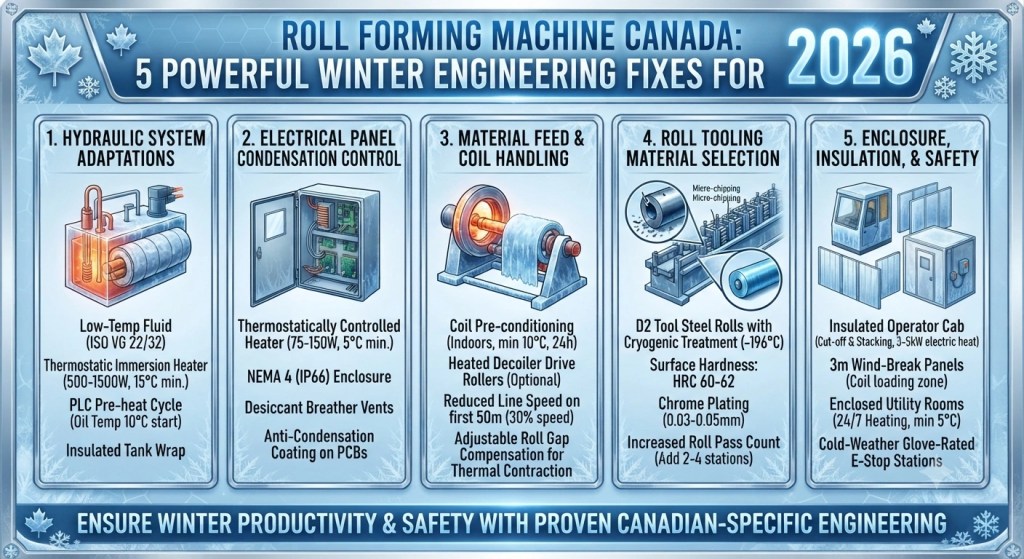
- ISO VG 22 or VG 32 hydraulic fluid instead of VG 46. These lower-viscosity grades maintain pumpable flow at -30°C.
- Immersion oil heater (500–1500W) installed inside the hydraulic tank, thermostatically controlled to maintain 15°C minimum.
- Pre-heating cycle programmed into the PLC. The machine cannot start until oil temperature reaches 10°C.
- Insulated hydraulic tank wrap to retain heat between shifts and reduce heater duty cycle.
Le Canadian Centre for Occupational Health and Safety (CCOHS) documents that cold start-up without pre-heating is a leading cause of hydraulic component failure in Canadian industrial environments.
| Hydraulic Fluid Grade | Viscosity at 40°C (cSt) | Viscosity at -30°C (est.) | Pumpability at -30°C | Recommended for Canada? |
|---|---|---|---|---|
| ISO VG 46 | 46 | ~690 | Poor: pump cavitation risk | Non |
| ISO VG 32 | 32 | ~480 | Marginal: needs heater | Yes, with pre-heat |
| ISO VG 22 | 22 | ~330 | Good: best cold-flow | Yes, strongly recommended |
Beli Rollforming specifies ISO VG 32 with immersion heaters as standard for all Roll Forming Machine Canada orders, with VG 22 available for projects in Prairie provinces where -40°C is common. Our guide d'entretien préventif du profilage à froid includes seasonal fluid change schedules.

2. Electrical Control Panel Heating and Condensation Control
The Problem
When a Roll Forming Machine Canada line sits overnight at -25°C and the day shift turns on the PLC, the temperature differential creates condensation inside the control panel. Water droplets form on circuit boards, servo drives, and terminal blocks. Short circuits follow.
This is the single most common electrical failure on a roll former machine canada installation. Replacing a fried servo drive can exceed CAD 8,000 per incident.
The Solution
Every Roll Forming Machine Canada control panel must include:
- Thermostatically controlled panel heater (75–150W) that maintains minimum 5°C inside the enclosure overnight.
- NEMA 4 (IP66) rated enclosure to block snow, ice, and wind-driven moisture.
- Desiccant breather vents to manage humidity exchange without admitting free water.
- Anti-condensation coating on circuit boards for panels located near loading docks or exterior walls.
Groupe CSA certification is essential for electrical components installed in Canadian industrial facilities. Beli’s electrical panels for Canada-bound machines carry CSA-compliant components and wiring practices. For a comparison of certification requirements across markets, see our CE marking for roll forming machines guide.
| Panel Condition | Machine standard | Roll Forming Machine Canada Spec |
|---|---|---|
| Enclosure rating | NEMA 12 (IP54) | NEMA 4 (IP66) |
| Heater | Aucun | 75–150W thermostatic |
| Breather | Standard vent | Desiccant breather |
| Board coating | Aucun | Conformal coating |
| Certification | CE | CSA + CE |

3. Material Feed and Coil Handling in Sub-Zero Conditions
The Problem
Carbon steel undergoes a ductile-to-brittle transition at approximately -20°C, as documented by ASM International. Below this threshold, steel coils fed into a Roll Forming Machine Canada line are more prone to edge cracking, splitting, and surface flaking.
Ice buildup on coil surfaces is a second problem. Frost on galvanized steel creates a slip layer between the coil and the uncoiler mandrel. The coil slips, the feed misaligns, and the entire line jams.
The Solution
A roll former machine canada line must address cold material behavior:
- Coil pre-conditioning area: store coils indoors at minimum 10°C for 24 hours before processing. This is a facilities requirement, not a machine spec, but it is critical.
- Heated decoiler drive rollers (optional) to warm the strip surface as it enters the flattener.
- Reduced line speed on first 50 meters: run at 30% rated speed until the material and tooling reach operating temperature.
- Adjustable roll gap compensation for thermal contraction. Steel shrinks approximately 0.000012 per °C per mm. At a -40°C differential, a 1000mm roll station shifts 0.48mm, enough to affect profile tolerance.
For material selection guidance (steel vs aluminum in cold climates), our roll forming material guide covers thermal properties and tooling implications.
Beli's composants de machine de profilage à rouleaux page details the heavy-duty uncoilers and flatteners we specify for cold-climate installations. These units use GCr15 bearing steel rollers with chrome plating for ice resistance.

4. Roll Tooling Material Selection for Cold-Temperature Steel
The Problem
Roll tooling takes the brunt of cold-weather material behavior. When brittle steel meets standard D2 tool steel rolls at -30°C, the result is micro-chipping on roll surfaces. Over a winter season, these chips accumulate into visible profile defects: waviness, edge tearing, and dimensional drift.
A Roll Forming Machine Canada project cannot use the same tooling spec as a line destined for Australie or the Middle East. The thermal environment is fundamentally different.
The Solution
Specify the following tooling upgrades for your roll former machine canada:
- D2 tool steel rolls with cryogenic treatment: deep freezing to -196°C after heat treatment relieves residual stress and improves toughness at service temperatures.
- Surface hardness target: HRC 60–62: standard for cold-weather tooling to resist chipping.
- Chrome plating (0.03–0.05mm) on all forming rolls to reduce friction with cold, dry steel and prevent galvanized coating pickup.
- Increased roll pass count: add 2–4 extra forming stations to reduce per-station forming angle. This distributes stress more gradually across brittle material.
| Tooling Spec | Warm-Climate Machine | Roll Forming Machine Canada |
|---|---|---|
| Matériel | D2 (standard) | D2 cryogenic-treated |
| Dureté | HRC 58–60 | HRC 60–62 |
| Surface | Finition au sol | Chrome plated (0.03–0.05mm) |
| Pass count | 18–22 | 22–26 |
| Roller bearing | Standard | Sealed, low-temp grease |
Notre roll forming tooling upgrades guide covers advanced materials and PVD coatings in detail. For operator procedures specific to cold-weather startups, see our formation des opérateurs de profilage à rouleaux resource.

5. Enclosure, Insulation, and Operator Safety Engineering
The Problem
Canadian occupational health and safety regulations require employers to protect workers from cold exposure. The CCOHS cold stress guidelines mandate heated break areas, wind shielding, and adjusted work schedules when temperatures fall below -15°C with wind chill.
A Roll Forming Machine Canada line without proper enclosure forces operators to work in -30°C conditions at the shear, stacker, and coil loading stations. This violates provincial labor codes in Alberta, Saskatchewan, and Manitoba.
The Solution
Design the roll former machine canada installation with these enclosure features:
- Insulated operator cab at the cut-off and stacking area with electric heating (3–5kW).
- Wind-break panels (3m height) around the coil loading zone and uncoiler.
- Enclosed hydraulic and electrical rooms with minimal 5°C heating maintained 24/7 during winter months.
- Emergency stop stations rated for cold-weather glove operation. Standard pushbuttons are too small for thick winter gloves.
Statistics Canada reports that Canadian manufacturing output drops 8–12% during January–February, largely due to cold-related downtime. Proper enclosure engineering can recover most of this lost production.
| Enclosure Feature | Machine standard | Roll Forming Machine Canada |
|---|---|---|
| Operator cab | Open station | Insulated, heated (3–5kW) |
| Coil zone | Open | Wind-break panels |
| Hydraulic room | Shared space | Dedicated, heated to 5°C |
| E-stop buttons | Standard | Glove-operable (large diameter) |
| Walkway decking | Smooth steel | Anti-slip grating (ice-rated) |

Why Beli Rollforming for Your Canada Project
Beli Rollforming has over 15 years of experience engineering roll forming machines for demanding export markets. We have delivered lines to 20+ countries, with our main markets in the US, Europe, and Australia.
For Roll Forming Machine Canada projects, we provide:
- Cold-weather hydraulic specification (ISO VG 32 + immersion heater) as standard
- CSA-compliant electrical panels with NEMA 4 enclosures
- Cryogenic-treated D2 tooling for sub-zero service
- Heated operator cabs and wind-break engineering
- On-site commissioning support across Canadian provinces
Notre machine de profilage à rouleaux métalliques page covers the full range of profile types we manufacture. For pricing expectations, see our guide des prix des profileuses à rouleaux.
For market context, our Analyse du marché des Émirats arabes unis provide parallel insights into how Beli adapts machine specs for different regional conditions.
Foire aux questions
Une installation de machine de profilage au Canada doit fonctionner de manière fiable à des températures comprises entre -30 °C et +35 °C. Pour les provinces des Prairies (Alberta, Saskatchewan, Manitoba), il convient de prévoir une température minimale de -40 °C. Beli Rollforming conçoit toutes ses lignes destinées au marché canadien pour fonctionner à -35 °C en standard.
Non. Une machine standard subira des défaillances hydrauliques, des courts-circuits électriques et des dommages au niveau de l'outillage dès le premier hiver. La mise à niveau de ces fonctionnalités coûte deux à trois fois plus cher que de les intégrer dès l'achat.
Les adaptations techniques pour les climats froids entraînent généralement une majoration de 8 à 151 TP3T par rapport au coût de base de la machine. Pour une ligne de 80 000 dollars, il faut compter entre 6 400 et 12 000 dollars de mises à niveau. Cet investissement est rentabilisé en un seul hiver grâce à la suppression des temps d'arrêt liés aux démarrages à froid.
Dans la plupart des régions du Canada, utilisez de l'huile ISO VG 32 avec un thermoplongeur. Pour les zones où la température descend régulièrement en dessous de -35 °C, optez pour de l'huile ISO VG 22. N'utilisez jamais d'huile ISO VG 46 dans les conditions hivernales canadiennes. Elle ne s'écoulera pas à -30 °C.
Oui. Groupe CSA Une certification est obligatoire pour les équipements électriques utilisés dans les installations industrielles canadiennes. Tous les tableaux électriques, moteurs et capteurs d'une ligne de production de machines de profilage au Canada doivent porter le marquage CSA ou une certification équivalente reconnue.
Install a thermostatic panel heater (75–150W) that maintains minimum 5°C inside the enclosure. Use a NEMA 4 rated cabinet with desiccant breathers. Apply conformal coating to all circuit boards.
Yes. Thermal contraction shifts roll station alignment by up to 0.5mm at extreme cold. Specify adjustable roll gap compensation and run the first 50 meters at reduced speed to allow the line to reach thermal equilibrium.
Yes. Beli provides on-site installation and commissioning support across all Canadian provinces. Our technicians carry valid work permits and have experience with cold-weather startup procedures. See our inspection du profilage à rouleaux page for commissioning checklist details.
Beli Rollforming offers a 24-month standard warranty on all machines. Cold-weather components (heaters, insulated tanks, cryogenic-treated tooling) are covered under the same warranty terms.
Canada is the most demanding cold-weather market we serve. Our experience exporting to 20+ countries, with main markets in the US, Europe, and Australia, gives us the engineering baseline to handle Canadian conditions. The comment acheter une profileuse guide provides additional buyer considerations.
Journal des modifications de l'article
- 2026-07-07: Initial publication. Covers 5 cold-weather engineering adaptations for Roll Forming Machine Canada: hydraulic fluids, electrical panel heating, material handling, roll tooling, and enclosure design. Includes comparison tables, cost data, and 10 FAQs.
Déclencheurs de révision suivants
- Updated Canadian winter temperature data from Environment Canada for 2026–2027 season
- New CSA Group certification standard revisions affecting electrical panel requirements
- Changes to CCOHS cold stress guidelines or provincial labor codes
- Beli Rollforming completes additional Canada-based installation projects (update field data)
- New hydraulic fluid formulations enter the market with improved low-temperature performance