What Is a Roll Forming Mill?
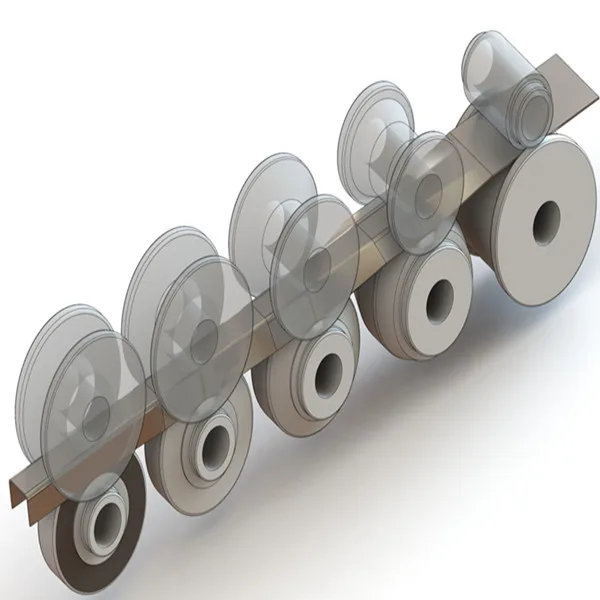
A roll forming mill is the core of any roll forming line. It is the section where flat metal strip is gradually bent into a finished profile through a series of forming stands.
The process looks simple. Feed a continuous metal strip from a coil through a sequence of roller dies mounted on rotating shafts. At each station, the profile moves closer to its final shape. This is how all roll forming mills operate at the most basic level.
But the engineering is not simple. Shaft deflection, material properties, pass line height, lubrication, and roll forming machine components all interact. Together, they determine whether a line runs cleanly or spends half its life down for adjustments.
7 Major Types of Roll Forming Mills
Picking the wrong mill type is one of the most expensive mistakes a manufacturer can make. Each configuration has trade-offs. These affect what profiles you can run, how fast you can produce them, and how long you sit idle between changeovers.
Below are the seven primary types of roll forming mills. A comparison table follows to make the differences easier to evaluate.
| Mill Type | Shaft Support | Max Width | Thickness | Line Speed | Changeover | Flexibility | Best Applications |
|---|
| Cantilevered | Single-end | ≤ 100 mm | 0.3–2.0 mm | 15–40 m/min | 10–20 min | Low | Narrow channels, hat sections |
| Duplex | Single-end (per head) | Variable | 0.5–2.5 mm | 20–50 m/min | 1–5 min | High | C/U studs, light gauge framing |
| Through-Shaft Duplex | Both ends | ≤ 600 mm | 0.5–4.0 mm | 15–40 m/min | 5–15 min | Medium | Wide profiles with center beads |
| Standard | Both ends | 300–1,500+ mm | 0.3–8.0 mm | 20–60 m/min | 2–8 hours | Low | Roofing panels, decking |
| Double-High | Both ends (2 levels) | 300–1,200 mm | 0.3–3.0 mm | 15–40 m/min | 10–30 min | Low | Roofing + siding combos |
| Rafted (Cassetted) | Both ends (on raft) | 300–1,200 mm | 0.3–6.0 mm | 20–50 m/min | 5–30 min | High | Cable trays, solar strut, multi-profile |
| Side-by-Side | Both ends (per set) | 300–1,200 mm | 0.3–6.0 mm | 20–50 m/min | < 2 min | High | Rapid switching between 2 profiles |
Speed and thickness ranges reflect typical 2025–2026 production benchmarks. Actual values depend on profile complexity, material grade, and drive system capacity.
1. Cantilevered Mills
Cantilevered roll forming mills mount the rolls on shafts supported at only one end — the drive side. The operator side hangs freely. This makes roll changes very fast because the outboard stand simply swings out of the way.
These mills suit narrow profiles — typically under 4 inches (100 mm) wide. Examples include small channels, hat sections, and edge-formed products.
The trade-off is shaft deflection. With only one support point, the shaft bends more under load. This limits the material thickness and strength you can form. If you need to produce heavy-duty steel decking profiles or thick structural sections, a cantilevered mill will likely not deliver the accuracy you need.
2. Duplex Mills
Duplex mills form both edges of a strip at the same time from the outside inward. The center section stays flat. This design is extremely versatile for variable-width products.
By adjusting the distance between the two forming heads, you can change the web width of a C-channel or U-channel without changing any tooling.
Some duplex configurations go further. Triple-duplex setups use two independently adjustable duplex mills that share a common drive. Changes in web height and leg length happen at the same time. A third mill can handle lip width changes.
When equipped with servo motors and programmable controllers, these lines switch between C-channels (studs) and U-channels (tracks) within 1 to 2 minutes — with no tool change at all.
This flexibility is valuable for manufacturers running light gauge steel framing lines where job-site requirements change constantly.
Applications: C and Z purlin machines are a natural fit. A single duplex line switches between C and Z purlins, or steps through a series of web depths, without touching a single roll. Cable tray roll forming machines use duplex heads to form the two side rails at the same time. Door panel and shelving panel lines work the same way — leg depth stays fixed while panel width changes between orders.
3. Through-Shaft Duplex Mills
The through-shaft duplex mill combines features of both conventional and duplex designs. Shafts run through both forming heads and are supported at both ends. This reduces shaft deflection compared to cantilevered designs. Rolls mount on sleeves that slide along the shafts.
This configuration forms thicker and higher-strength materials than standard duplex mills using the same shaft diameters. The through-shafts can also carry center rolls between the two edge-forming rolls. This lets you form beads into the center of wide products — something a duplex mill cannot do.
Applications: Wide cable trays — especially heavy perforated or ladder-style trays for industrial facilities — are a common use case. The through-shafts handle 2–3 mm galvanized strip without deflection. Center rolls can press longitudinal stiffening ribs into the tray base. The same logic applies to heavy adjustable profiles like rack upright columns, structural hat sections, and wide purlins.
4. Standard (Conventional) Mills
Conventional roll forming mills support shafts at both ends. They are the most widely used configuration in the industry. With full shaft support on both sides, these mills handle material of virtually any width and thickness.
The drive-side stand holds shafts in position and accommodates the drive train. The operator-side stand is removable for roll changes. In some designs, the outboard stand can be repositioned along the shaft to accommodate different material widths.
For high-speed lines running corrugated metal panels or PBR panels, conventional roll forming mills remain the default choice because of their rigidity and capacity to handle wide sheet at speed.
5. Double-High Mills
Double-high roll forming mills stack two complete sets of forming stands in an alternating short-tall arrangement. Rolls for one profile sit in the short stands. Rolls for a second profile mount on the tall stands. A single uncoiler and cutoff press serve both levels.
This design saves floor space and allows relatively quick changeover between two profiles. For example: farm siding on the lower level and farm roofing on the upper level. The cutoff die must operate at two levels. Downstream handling equipment must adjust for different exit heights.
The main disadvantage is limited access. Because of the crowded vertical arrangement, it is difficult to install side-roll stands, make adjustments, or inspect the forming conditions at either level.
The double layer machine is the commercial version of this concept. It is one of the most practical investments for manufacturers supplying both roofing and wall cladding. A typical configuration runs a corrugated or trapezoidal roof panel on one level and a ribbed wall panel on the other. One uncoiler, one cutoff, two product lines — in roughly the same floor space as a single conventional mill.
6. Rafted (Cassetted) Mills
Rafted roll forming mills were a major breakthrough in changeover time. Before this technology, changing tooling on a large panel mill could take 8 hours or more. Rafted mills reduced that to 30–45 minutes — and in some cases as little as 5 minutes.
The concept is straightforward. Four to eight complete stands — including shafts, rolls, bearings, entry guides, and straighteners — are permanently mounted on an interchangeable plate (the “raft”). When you need to change profiles, the entire raft slides out and a pre-set raft slides in. The drive uses quick-disconnect couplings. Hardened alignment inserts ensure precise positioning without time-consuming adjustments.
Companies running multiple cable tray profiles or several widths of solar strut channels often find that the investment in cassetted tooling pays for itself through dramatically reduced downtime. The cassette type roll forming machine is an evolution of this concept, offering even faster changeover for specific applications.
7. Side-by-Side Mills
Side-by-side roll forming mills mount two or more complete sets of tooling on the same mill base. When you need to change profiles, the entire mill bed slides sideways on embedded rails to align the next set of rolls with the uncoiler and cutoff equipment. Changeover takes less than 2 minutes.
Important: Only one set of tooling is active at a time. The mill does not produce two profiles simultaneously. What it delivers is extremely fast switching between two profiles on the same base.
For wide panels, the side-by-side concept extends to separate mill beds placed next to each other. Each has its own drive and can be disconnected when not in use. Some manufacturers combine side-by-side arrangement with rafts, though the cost-effectiveness of such complex setups should be carefully evaluated. Two separate mills may deliver better flexibility and lower overall cost.
Side-by-side mills suit operations that alternate between two profiles throughout the day. For example: running one panel width in the morning and switching to a different section in the afternoon. The switch takes under 2 minutes, avoiding the long downtime of a full roll change.
For cable ladder tray production, a side-by-side mill can switch quickly between side rails and rungs, building up stock of each before assembly. The two profiles are produced sequentially, not in parallel. If true parallel production is the goal, a dedicated downstream buffer or two separate lines is the more reliable approach.
Critical Mill Components That Affect Performance
Understanding the individual components of a roll forming mill helps you evaluate machine quality during purchasing and diagnose problems during operation. This knowledge applies to all roll forming mills — cantilevered, duplex, or conventional.
Mill Bed (Base)
The mill bed supports stands, shafts, rolls, the drive train, and all auxiliary components. Rigidity is the single most important requirement. The bed must resist deflection during operation, transportation, and installation.
The upper surface needs a keyway or alignment system accurate to within 0.001 to 0.002 inches (0.025 to 0.050 mm) along the full mill length — even when the bed is assembled from multiple sections.
Long beds are typically split into two or more sections to accommodate machining and transportation. If extension is planned, joining fixtures must be built into the bed ends. The bed also needs drainage channels for recirculated lubricant and sufficient structural reinforcement around any cutouts for drive belts or chains.
Stands and Housing
Drive-side stands absorb considerable forces from forming resistance, uncoiler brake tension, and drive train torque. They must be sturdy and well-anchored. Operator-side stands carry less axial force since they support shafts through needle bearings and long bearing sleeves.
A common failure mode in overloaded mills is permanent shaft bending. Some manufacturers install calibrated crossbars at the top of stands that are designed to break before the shafts bend. This intentional weak point protects far more expensive components. Understanding the roll forming machine components in detail helps you ask the right questions when comparing suppliers.
Shafts
Shaft diameter and material selection directly determine how much load a mill can handle. The Roll Forming Handbook emphasizes that shaft deflection at the center of the shaft is the critical variable. Excessive bending changes the cross-section of the product.
For thicker materials and higher-strength steels, larger diameter shafts with support bearings at both ends are non-negotiable on production-grade roll forming mills. Our detailed guide on shaft selection for roll formers covers material grades like 40Cr and 45 steel along with heat treatment options.
Drive System
Most production roll forming mills use chain or gear drives powered by AC induction motors. The drive must deliver consistent torque across all stands while accommodating slight differences in roll peripheral speeds at each forming pass.
Speed mismatches between stands create either excessive tension (causing thinning or tearing) or slack (causing looping and misalignment). Lines equipped with PLC control offer significant advantages in speed synchronization, fault detection, and production data logging. Our analysis of PLC control for roll forming efficiency explains why programmable logic controllers have become standard on modern mills.
Entry Guides and Straighteners
Entry guides align the strip as it enters the first forming pass. They must handle the full range of widths the mill is designed to produce and should not scratch or mark the product surface. This is particularly important for pre-painted or coated materials like those used in fascia gutter or AG panel production.
How to Select the Right Roll Forming Mill
Start With the Product, Not the Machine
The profile you need to produce determines the mill type among roll forming mills. Narrow sections with frequent width changes suit duplex or through-shaft duplex roll forming mills. Wide panels at high volume demand conventional mills. Multi-profile operations with tight changeover windows benefit from rafted or side-by-side configurations.
If you are producing cable trays, you may be running several widths on the same day. A rafted mill with pre-set cassettes lets you switch widths in minutes rather than hours. If you are producing step beams for pallet racking in long runs with infrequent changeovers, a conventional mill offers better rigidity at a lower capital cost.
Consider Material Thickness and Strength
The Roll Forming Handbook is blunt about this: shaft support design and diameter must be matched to the material’s yield strength and thickness. High-strength steels (HSS) exert significantly greater forming forces than mild steel at the same gauge.
If your product mix includes materials above 350 MPa yield strength, verify that the roll forming mills you are evaluating have adequate shaft diameters and bearing specifications. For metal stud framing using galvanized steel up to about 1.5 mm, a well-designed conventional mill handles the load easily. For highway guardrail production in thicker material, you need heavier shafts and more robust stand construction.
Evaluate Changeover Requirements
Calculate the true cost of changeover time. If your line runs 20 hours per day and changeover takes 4 hours, you are losing 20 percent of your productive capacity each time you switch profiles.
Modern roll forming mills with rafted or cassette systems that cut changeover to 30 minutes recover that capacity. The ROI on the rafted system can pay for itself within months for high-volume operations. For operations running two profiles with roughly equal demand, a double layer machine allows extremely fast switching between forming levels and cuts capital cost by 30 to 45 percent compared to two single-profile lines.
Verify the Drive Train
Match the motor and drive system to your production speed requirements. High-speed lines producing solar racking profiles at 30 to 40 meters per minute demand more powerful drive systems than lines running at 10 to 15 meters per minute.
Ensure the gearboxes and chain drives are rated for continuous duty at your target speed, not just intermittent operation.
Check Compliance and Certification
For equipment destined for export markets, verify CE, ISO 9001, and any region-specific certifications. Our guides on importing roll forming equipment from China and roll forming export logistics cover the compliance checks that catch problems before your machine arrives at the factory.
Maintenance and Longevity
Proper maintenance extends mill life and protects product quality across all types of roll forming mills.
Lubrication: Regular lubrication of bearings, chains, and gearboxes reduces wear and prevents premature failure. The mill bed must have adequate drainage for recirculated lubricant. Our roll forming preventative maintenance guide provides daily, monthly, and yearly checklists.
Roll Condition: Worn or damaged rolls produce out-of-tolerance profiles. Regular inspection of roll surfaces, particularly on high-wear passes, catches problems before they generate scrap. When rolls need replacement, the roll forming tooling guide covers material selection and coating options for extended roll life.
Shaft Alignment: Over time, repeated roll changes and thermal cycling can shift shaft alignment. Periodic alignment checks using dial indicators prevent cumulative dimensional drift.
Drive System: Inspect chains or gears for wear, check motor mounting bolts, and verify that speed synchronization between stands remains within specification.
The difference between roll forming mills that hold tolerance for 15 years and those that need constant attention usually comes down to maintenance habits and the quality of roll forming inspection practices.
2025–2026 Technology Trends Reshaping Roll Forming Mills
The roll forming industry is moving past the era of purely mechanical machines driven by AC motors and chain drives. Several technologies now arriving on production floors are changing what roll forming mills can do.
Servo-Driven Quick-Change Systems
Traditional changeover on a conventional mill means stopping the line, unbolting operator-side stands, swapping rolls, repositioning shafts, and running test pieces until the profile holds tolerance. On a well-run shop floor, that still takes 2 to 8 hours.
Modern servo-driven systems cut that dramatically. Cassette tooling with quick-change couplings gets changeover down to 15 to 30 minutes for C/Z channel lines. One documented case — a duplex cable tray line with servo hole punching and ERP-integrated recipes — dropped changeover from 55 minutes to 18 minutes. Throughput went up 22 percent. First-pass yield went from 93 percent to 98.5 percent.
AI-Driven Quality Control and Predictive Maintenance
Machine learning is making its way into forming lines. High-resolution cameras and inline sensors now monitor strip edges and formed profiles in real time. They flag micro-defects that operators would miss.
On an AHSS door beam line forming 980 MPa material, an AI-guided closed-loop system cut scrap from 8.7 percent to 2.9 percent. Process capability (Cp/Cpk) improved from 1.11/1.02 to 1.52/1.43. OEE increased by 11 percent.
Predictive maintenance works alongside quality control. IoT sensors on bearings, gearboxes, and shafts track vibration, temperature, and torque patterns across every forming pass. When the data shows an emerging anomaly, the system flags it before a component fails. Industry data suggests this approach reduces overall downtime by roughly 50 percent compared to calendar-based maintenance schedules.
IoT Sensors and Cloud-Based Diagnostics
Newer mills ship with networked control architectures. Sensors at each forming stand report real-time forming pressure, shaft torque, and strip speed to a central PLC. That data feeds HMI screens on the line, generates automated production reports, and in many cases uploads to cloud platforms for remote monitoring.
For manufacturers running overseas lines — a common situation for export buyers — cloud-based diagnostics let the equipment supplier troubleshoot faults, push software updates, and review production data without sending a technician on-site. This matters when a mill in Southeast Asia or West Africa goes down at 2 a.m. local time.
Advanced High-Strength Steel (AHSS) Forming
The shift toward lighter, stronger materials in automotive and construction is pushing roll forming mills to handle steels that were difficult or impossible to form a decade ago. Today’s advanced mills routinely process AHSS up to 980 MPa. Some lines are rated for ultra-high-strength steel (UHSS) at 1,180 MPa — used for automotive door intrusion beams and EV battery enclosure components.
Forming these materials demands more robust shafts, tighter deflection control, and more forming passes. A practical rule from 2025 production data: add 20 to 30 percent more forming stations for AHSS compared to mild steel at the same gauge. The drive system also needs higher torque capacity and more responsive speed synchronization to prevent strip tearing or looping between stands.
MES and ERP Integration
Manufacturing Execution Systems (MES) are becoming standard on roll forming mills serving high-volume sectors like solar racking and automotive. When a mill connects to the plant’s MES and ERP, production orders flow directly to the line controller.
The operator selects the next job from a digital recipe. The control system automatically adjusts roller positions, punch patterns, cutoff lengths, and line speed. No manual parameter entry. No paper travelers.
This integration also enables full lot traceability. Every meter of formed profile can be linked back to a specific coil, heat number, and set of process parameters. For solar mounting manufacturers supplying utility-scale projects with strict quality documentation requirements, that traceability is a contract condition.
Energy Efficiency and Sustainability
Energy-efficient servo motors are replacing traditional hydraulic systems on newer roll forming mills. Some manufacturers now offer solar-powered roll forming lines for off-grid or remote-site production. Water-based lubricants are displacing petroleum-based cutting fluids. Recyclable steel and aluminum feedstock aligns with circular economy initiatives.
Industry estimates suggest that sustainable practices can reduce per-part production costs by up to 20 percent when you factor in reduced waste disposal, lower energy bills, and longer tool life.
FAQ: Roll Forming Mills
Conclusion
Roll forming mills come in a range of configurations, and choosing among roll forming mills requires matching the right type to your specific needs. Each is optimized for different product geometries, material specifications, and production requirements.
Cantilevered mills excel at quick changeover on narrow profiles. Conventional mills deliver the rigidity needed for wide panels and thick material. Rafted and side-by-side designs minimize changeover downtime for multi-profile operations.
The key to making the right choice is starting with your product requirements — not with a machine catalog. Define your profile dimensions, material specifications, production volumes, and changeover frequency first. Then match those requirements to the appropriate roll forming mills, shaft diameter, drive system, and auxiliary equipment.
At Believe Industry Company, we have been designing and building roll forming mills since 2005, with over 300 installations across 20 countries. Whether you need a cable tray production line, a solar mounting strut channel machine, or a fully custom solution, our engineers can help you determine the right mill configuration for your investment.
Contact us today for a custom quote — our engineers respond within 24 hours.