










Perimeter security starts at the roll forming station. Palisade roll forming converts flat steel strip into the vertical pales, rails, and posts that make up steel palisade fencing, the barrier of choice for schools, substations, data centers, and transport depots across the United Kingdom, the Middle East, and Africa.
The anti-climb performance of that barrier is decided in the profile design, not on the job site. Pale head shape, cross section, thickness, spacing, coating, and fixing method all determine whether a fence stops a climber or hands them a ladder.
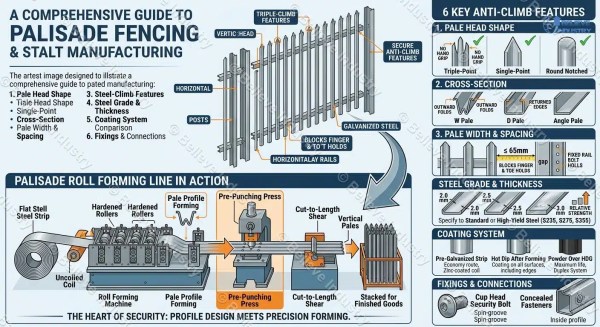
This guide breaks down the 6 anti-climb profile design features that matter most. Each one maps directly to tooling, punching, and material decisions on a palisade roll forming line.
What Is Palisade Roll Forming?
Palisade roll forming is a cold forming process that shapes pre-cut, pre-punched steel sheets into pales through a series of hardened roller stations. Palisade fencing is a security barrier made of vertical steel pales bolted to two or more horizontal rails, fixed into posts set in concrete.
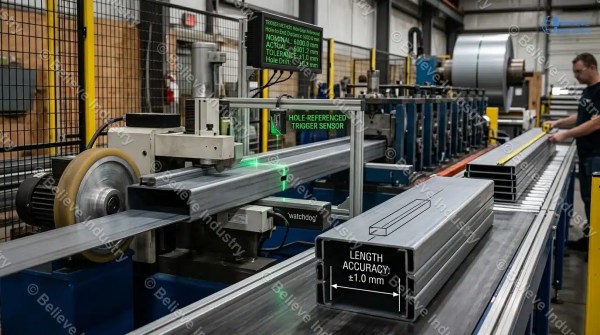
A typical security fencing roll forming machine line runs in this order: sheet stack loader, pre-punching press, roll forming stations, cut to length or post shear, and a stacker for finished pales. Beli Rollforming builds these lines for pale lengths from 1.8 to 3.0 m, with punching tolerances held to ±0.2 mm so rail bolt holes line up across every pale on site.
The same line family also produces fence rails and posts. For related heavy barrier profiles, our آلة تشكيل درابزين الطريق السريع article covers the two-piece W beam approach used in road safety barriers.
1. Triple-Point Pale Heads Stop Hand Grips
The pale head is the first line of defense. A triple point pale head finishes in three sharpened prongs at the top of each vertical pale. There is no flat surface to grip, and the prong spacing is narrow enough that a hand cannot close around the pale top.
Roll forming forms the pale body, then the head shape is punched or cropped in the die. That means the anti-climb geometry is controlled by tooling, not by manual bending. Consistent head shape across thousands of pales is what separates a machine formed pale from a fabricated one.
Buyers should specify the pale head style in the machine request for quotation (RFQ). Triple point gives the highest deterrence. Single point offers a similar anti-grip effect with less risk in school zones. Round notched heads suit lower security boundaries where deterrence matters more than prevention.
2. W and D Pale Cross Sections Defeat Climbing
The pale cross section is the second anti-climb feature. The W section pale folds the flat strip into a shallow W shape across its face. The folds face outward toward the climber. Every fold removes the flat run a boot sole needs, so the pale cannot be climbed like a flat plate.
The D section pale is a flat faced profile with returned edges. It resists prying and levering better than W section, which makes it the usual choice for high security sites with sustained attack risk.
| Pale section | Face geometry | Anti-climb behavior | أفضل تطبيق |
|---|---|---|---|
| W section | Outward folds, 3 ridges | No flat surface for foothold | General perimeter, schools, parks |
| D section | Flat face, returned edges | High pry and lever resistance | Substations, data centers, prisons |
| Angle pale | Single bend, 2 ridges | Moderate deterrence | Low security boundaries |
Cross section choice changes the roll forming station count. W section pales typically need 14 to 18 forming stations. D section pales need 12 to 16, but the returned edges demand tighter roller gap control on 2.0 mm material. Roller material and gap rules are covered in our roller tooling guides, including the دليل آلة تشكيل قنوات الدعامات for channel type profiles.
3. Pale Width and Spacing Block Finger and Toe Holds
Anti-climb performance fails at the gaps. Standard W and D pales run 60 to 70 mm wide. Pale spacing is set so the clear gap between pales stays below 65 mm, too narrow for an adult boot toe yet wide enough to see through for surveillance.
The fence height works with spacing. Security fencing heights run from 1.8 m for general sites to 3.0 m for critical infrastructure. At 2.4 m with triple point heads, a palisade fence is rated as a substantial barrier under BS 1722 Part 12, the British Standard for open mesh and palisade fencing specification. The standard is published by the British Standards Institution.
On the machine side, pale spacing is a punching pattern, not a forming problem. A security fencing roll forming machine punches rail bolt holes in fixed positions so that pales bolt to rails at 2 or 3 points per pale. Misaligned punching by more than ±0.2 mm creates visible pale waviness down the fence line after erection.
4. Steel Grade and Pale Thickness Set the Strength Baseline
Anti-climb design assumes the pale will be attacked. Pale thickness runs from 2.0 mm for standard security to 3.0 mm for high security sites. Below 2.0 mm, a pale can be bent by hand with a lever, which defeats the whole barrier.
Steel grade matters as much as thickness. Common pale material is S235 or S275 structural steel in Europe, or ASTM A653 structural steel in North America. ASTM A653 covers steel sheet zinc coated by the continuous hot dip process, and the standard is published by الجمعية الأمريكية لاختبار المواد الدولية. Higher yield grades like S355 are specified for prison and airport perimeters.
| المواصفات | Standard security | High security | Critical infrastructure |
|---|---|---|---|
| Pale thickness | 2.0 ملم | 2.5 ملم | 3.0 ملم |
| درجة الفولاذ | S235 / ASTM A653 | S275 | S355 |
| Pale width | 60 mm | 65 mm | 70 mm |
| Fence height | 1.8 to 2.0 m | 2.4 m | 3.0 m |
| Pale head | Single point | Triple point | Triple point + barbed topping |
Thickness changes the machine load. Rolling 3.0 mm S355 pale stock requires larger diameter shafts and higher grade roller steel than a 2.0 mm line. Buyers who specify one machine for both ranges should state the full material envelope in the RFQ, the same way heavy duty storage rack lines are specified. See our آلة صنع حواجز الطرق السريعة spec guide for how material yield strength drives machine sizing.
5. Coating Systems Extend Barrier Service Life
An anti-climb fence that rusts through in 5 years is not a security asset. Coating choice on pale stock happens before or after roll forming, and the two routes differ in cost and corrosion life.
Pre-galvanized strip, coated to Z275 (275 g/m² total both sides) or ASTM A653 G90, is the economical route. The coil arrives coated, and the roll formed pale keeps protection on all formed faces except the cut edges. Hot dip galvanizing after forming, to ISO 1461 typical thickness of 70 µm or more, coats every surface including cut edges and punched holes. The American Galvanizers Association publishes corrosion life data by environment.
Powder coating over galvanizing, called a duplex system, adds color and roughly doubles corrosion life in coastal and industrial air. For Middle East coastal projects, a polyester powder over hot dip galvanizing is the common specification for perimeter fencing around infrastructure.
| Coating system | Zinc level | Corrosion life | Relative cost |
|---|---|---|---|
| Pre-galvanized strip | Z275 / G90 | 15 to 20 years, rural | قليل |
| Hot dip after forming | 70 µm+ | 25 to 40 years, industrial | واسطة |
| Powder over hot dip | 70 µm+ + 60 µm paint | 40+ years, coastal C5 | عالي |
The process route matters to machine design. Pre-galvanized strip demands polished roller surfaces to avoid coating pickup, a surface quality topic we detail in the roller polishing and gap control article in our blog. المُصنِّع also maintains reference material on forming coated steel without surface damage.
6. Tamper-Resistant Fixings Close the Weak Points
A fence is a chain, and the fixings are often the weakest link. Pales bolt to rails, and rails bolt to posts. If those bolts can be removed with a standard spanner, the barrier opens without ever touching the anti-climb profile.
Security fencing spec sheets call for one-way or cup head bolts with grooved heads that spin in the socket when turned backward. Concealed pale to rail connections hide the fixing inside the profile. In high security lines, rails are roll formed with a channel leg that wraps the pale edge so the fastener cannot be reached from the attacker side.
The roll forming line supports this by punching the exact bolt hole pattern in rails and pales. Bolt hole position repeatability across a 3 m rail must hold within ±0.3 mm or the cup head bolts will not seat. That precision is why the punching press, not just the forming stations, is the heart of a palisade fence machine. For lines that switch between pale, rail, and post programs, a quick change tooling setup shortens the swap; see our notes on the آلة تشكيل اللفائف سريعة التغيير page.
How a Palisade Roll Forming Line Produces Anti-Climb Pales
The full production sequence on a security fencing roll forming machine follows 6 steps:
- Sheet loading. Pre-cut blanks stack into a magazine feeder, or coil feeds an uncoiler and leveler for continuous lines.
- Pre-punching. A mechanical press punches rail bolt holes, pale head slots, and security fixing holes to ±0.2 mm.
- Head forming. The pale top is notched, cropped, or triple pointed in the die cycle.
- Roll forming. 12 to 18 stations form the W or D cross section through the pale length.
- Cutting. Flying cutoff or post shear separates pales at programmed lengths from 1.8 to 3.0 m.
- Stacking. A stacker collects pales in order for galvanizing or coating batches.
Line speed for punched pale production runs 8 to 15 m/min. The punching cycle, not the roll former, sets that ceiling. Coil fed rail lines without pre-punching reach 20 to 30 m/min.