







What is a Scaffold Plank Roll Forming Machine?
The Scaffold Plank Roll Forming Machine from Beli RollForming (Believe Industry Company, est. 2005, Wuxi, China) is a fully automated cold roll forming line that converts flat steel coils—galvanized, stainless, or painted—into structural scaffold planks at production speeds up to 30 m/min. To learn how roll forming compares to other metal fabrication methods, read our full roll forming guide.
Unlike conventional press-brake or manual fabrication methods, this machine uses a sequential 18–28 roller-station system controlled by a Siemens/Mitsubishi PLC, delivering ±0.5 mm dimensional tolerance and consistent anti-slip profiling at scale. Beli RollForming has supplied scaffold plank production lines to manufacturers in 40+ countries, including projects aligned with OSHA 1926.451 (United States) and EN 1004:2018 (Europe) safety standards. For buyers evaluating machine options, see our how to buy a roll forming machine guide.
Key specifications at a glance:
- Production speed: 10–15 m/min (standard) / up to 30 m/min (optional flying shear)
- Material thickness: 1.5–2.0 mm standard / up to 4.0 mm optional
- Machine weight: 18,500 kg | Footprint: 25,000 × 2,500 × 1,800 mm
- Load-bearing capacity of output planks: up to 200 kg/m²
- Typical lead time: 75–90 days after order confirmation
Key Applications of Scaffold Planks Produced by This Machine
Scaffold planks manufactured on the Beli RollForming line serve four primary markets worldwide. Each application has specific requirements that the machine’s configurable tooling can address.
| Application | Key Requirements | Output from This Machine |
|---|---|---|
| Construction (high-rise & commercial) | High load-bearing capacity (≥200 kg/m²), anti-slip surface, OSHA 1926.451 or EN 1004:2018 compliance | Closed-box profile planks with stamped diamond or rectangular anti-slip holes; widths 200–300 mm. |
| Event staging & temporary structures | Light weight for portability, fast assembly, clean surface finish | Galvanized planks with anti-corrosion coating; standard lengths 1.8–3.0 m. |
| Shipbuilding & offshore | Corrosion resistance, modular interlocking profiles, marine-grade material | Stainless steel or hot-dip galvanized planks; side-lock coupling channels. |
| Industrial access & maintenance | Chemical resistance, permanent installation, custom widths | Thick-gauge (up to 4.0 mm) planks; optional painted finish for chemical environments. |
Production example: A single Beli line running at 20 m/min for one 8-hour shift produces approximately 9,600 meters of finished scaffold planks—enough to scaffold a 15-story building or supply a mid-size shipyard for one month.
Regional customization available:
- US market → OSHA-compliant rectangular slot pattern, 1.8 m and 2.4 m standard lengths
- European market → EN 1004:2018 diamond-hole pattern, 2.5 m and 3.0 m standard lengths
- Middle East / Africa → Wide-flange profile for high wind-load conditions
- Southeast Asia → Lightweight 1.5 mm galvanized planks for tropical construction


How It Works: The Production Process
A scaffold plank roll forming machine transforms a flat coil of steel—typically galvanized—into a finished, profiled plank through a continuous, automated multi-stage process. Below is a breakdown of its typical workflow:
1. Decoiling (Uncoiling)
A large coil of flat sheet metal is loaded onto a decoiler, which gently unwinds the material and feeds it into the production line.
2. Leveling
The metal strip passes through a series of rollers that flatten it, eliminating coil-set(inherent curvature from coiling) to ensure perfect flatness before further processing.
3. Punching (Perforating)
The flat strip feeds into a high-speed punching press, often paired with a servo feeder for precision. This stage stamps:
Characteristic holes/slots for structural integrity or accessories,
Anti-slip patterns for safety,
- Mounting features (e.g., end hooks) for connecting planks.
4. Roll Forming (Core Process)
The punched strip moves through a sequence of precision-engineered roller stations. Each station uses top/bottom roller sets to incrementally bendthe metal—gradually shaping the flat strip into the final scaffold plank profile, including:
- Strengthening ribs for load-bearing capacity
- Side channels for alignment or coupling.
5. Cutting
Once profiled, a high-speed hydraulic “post-cut” system trims the continuous plank to a preprogrammed, exact length.
6. Ejection/Stacking
Finished planks are pushed onto a run-out table, where they are collected, bundled, and prepared for shipping.
7. Automation & Control
The entire line is governed by a PLC (Programmable Logic Controller). An operator inputs desired plank dimensions (length/quantity) via a control panel, and the machine executes the full production sequence autonomously—from uncoiling to stacking.
This streamlined process ensures consistent quality, high throughput, and minimal manual intervention—critical for manufacturing durable scaffold planks at scale.

Brief Specification Table for Scaffold Plank Roll Forming Machine
o help you choose the right machine for your needs, here’s a summary of our standard and optional specifications:
Parameter | Standard Specification | Optional Options |
|---|---|---|
Uncoiler Type | Manual Hydraulic | Motorized Hydraulic |
Uncoiler Capacity | 5 Tons | 10 Tons |
Material | Galvanized Steel Coil | Stainless Steel, Painted Steel |
Thickness | 1.5-2.0 mm | 1.5-4.0 mm |
Coverage Width | 200-250 mm | 200-300 mm |
Feeding Width | 400 mm | Customizable |
Roller Material | GCr15 Bearing Steel | Hardened Chrome Steel |
Forming Stands Quantity | 18 Stands | 20-28 Stands |
Forming Stands Type | Steel Plate Welded | Cast-iron Stands |
Driven System | Chain Drive | Gear Box Drive |
Cutting Type | Hydraulic Flying Shear | Guillotine Cutter |
Line Speed | 10-15 m/min | Up to 30 m/min |
Voltage | 380V/50Hz | 415V/50Hz, Custom |
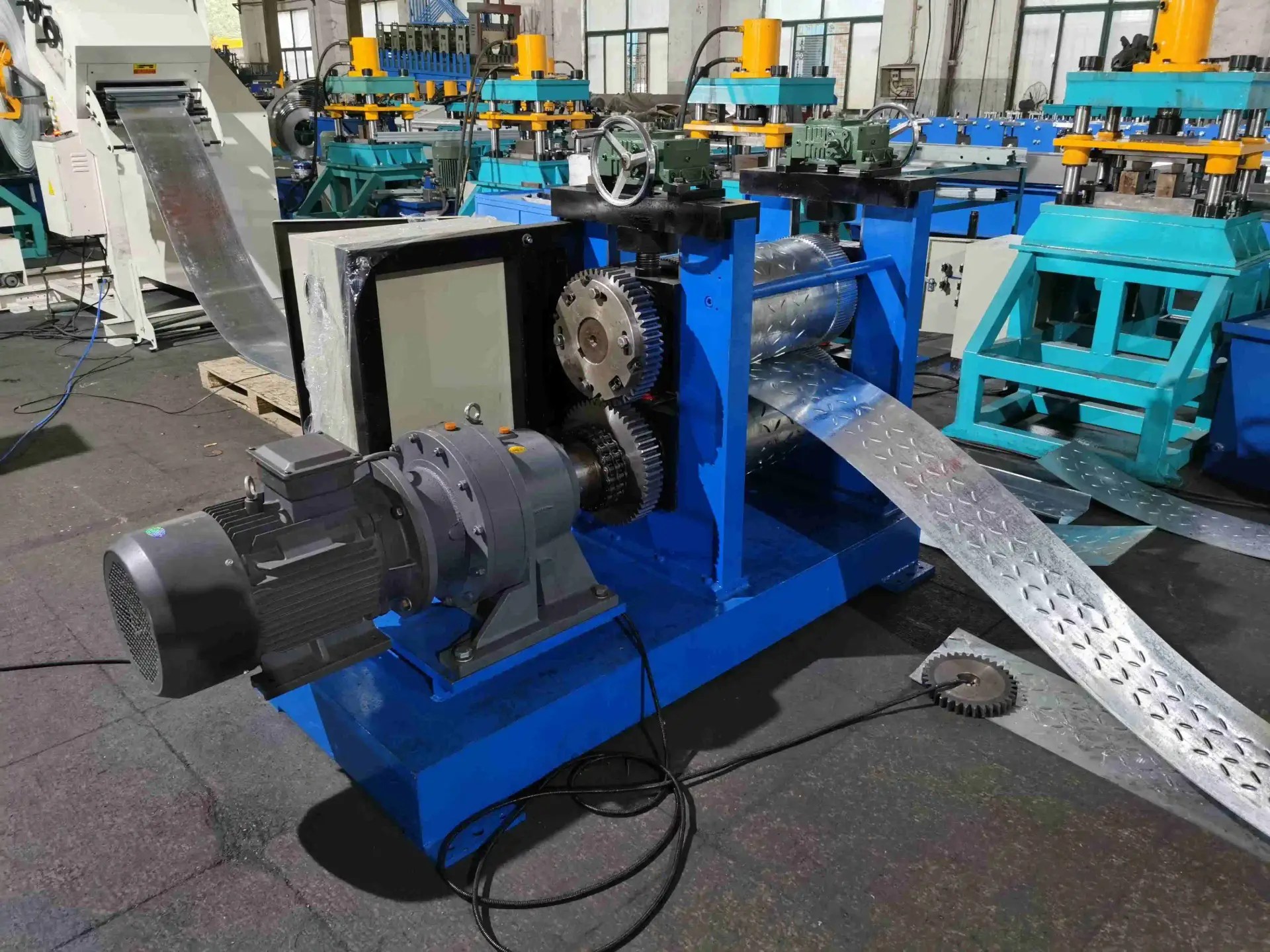
Image Gallery



How Beli's Scaffold Plank Machine Compares to Other Options
When buyers evaluate scaffold plank roll forming machines, they typically consider three types of suppliers: Chinese specialized manufacturers (like Beli), European/Taiwanese machine builders, and local fabrication equipment providers. According to the American Roll Forming Manufacturers Association, Chinese manufacturers now account for over 40% of global roll forming machine output. Here is a factual comparison:
| Comparison Factor | Beli RollForming | European/Taiwanese Builders | Local Fabricators |
|---|---|---|---|
| Machine price range | 35,000–85,000 | 120,000–300,000+ | 15,000–40,000 |
| Production speed | Up to 30 m/min | Up to 30–40 m/min | 5–15 m/min |
| PLC brand | Siemens / Mitsubishi | Siemens / B&R | Basic/local PLC |
| Customization | Full profile & tooling custom | Limited standard range | Basic only |
| Lead time | 75–90 days | 90–180 days | 60–75days |
| After-sales support | Global (40+ countries) | Regional | Local only |
| Certifications | CE available, OSHA/EN compliance | CE standard | Varies |
| Experience | Est. 2005, 20+ years | Established | Varies |
Key takeaway: Beli RollForming occupies the high-performance, cost-competitive segment—offering Siemens PLC precision and 30 m/min speed at 30–40% of equivalent European machine pricing.
See the Scaffold Plank Roll Forming Machine in Action
Beli RollForming publishes real machine operation footage on our YouTube channel. Videos cover the full production cycle—decoiling, embossing, roll forming, flying cutting—so you can verify the line speed, tooling quality, and output consistency before purchasing.
Conclusion
The scaffold plank roll forming machine from Beli RollForming is a reliable, high-efficiency solution for manufacturers looking to produce top-quality scaffold planks. With its customizable features, fast production speed, and durable components, this machine helps you stay competitive in the global construction market. Whether you need standard or custom scaffold planks, our experts are here to provide tailored solutions.
Ready to boost your production? Contact us today↗ to learn more about our scaffold plank roll forming machines and get a personalized quote. For more tips on choosing the right roll forming machine, read our blog post: How to buy a Roll Forming Machine↗.
Frequently Asked Quentions( FAQs)
Speed is a critical factor for ROI. Our standard scaffold plank roll forming machine typically operates at a speed of 10 to 15 meters per minute.
However, this speed can vary depending on the complexity of the punching pattern. Since scaffold planks require dense anti-slip perforations, the punching process often dictates the overall line speed. For clients requiring higher output, we can integrate a high-speed servo feeder and a rotary punching press to significantly increase efficiency.
Scaffolding safety relies heavily on material strength. Our machines are engineered to process Galvanized Steel coils (GI) or Cold Rolled Steel with a thickness range typically between 1.2mm and 2.0mm.
If your market requires heavy-duty planks (up to 2.5mm or 3.0mm), we can customize the rollers and the hydraulic cutting power to accommodate these thicker gauges without compromising the machine’s lifespan.
Yes, versatility is key. While a standard machine is fixed to one profile, we offer adjustable scaffold plank roll forming machine models.
Through an automated width-adjustment system, you can produce planks of varying widths—common sizes include 210mm, 225mm, 240mm, and 250mm—on a single machine. This flexibility allows you to meet diverse customer demands without purchasing multiple machines.
The anti-slip “embossing” or holes are created before the roll forming process. The line includes a hydraulic punching press or a mechanical press.
To ensure precision, we use a servo feeder that feeds the steel strip into the press with sub-millimeter accuracy. This ensures that the anti-slip holes and the water drainage slots are perfectly aligned every time.
The unique “box” profile of a scaffold plank provides its structural integrity. This is achieved through the multi-station roll forming process.
After punching, the scaffold plank roll forming machine uses a series of 20 to 28 roller stations to gradually fold the metal edges. This forms the strengthening ribs and the side-lock channels, which allow the planks to connect securely when installed on a scaffold tower.
Absolutely. As a leading exporter, Beli RollForming designs machines to produce planks that meet global safety standards, such as EN 12811 (Europe) or OSHA standards (USA).
For detailed information on safety load requirements, you can refer to this resource on OSHA Scaffolding Regulations. We ensure our rollers form the stiffening ribs exactly where needed to meet these load-bearing tests.
A complete line is substantial. You should allocate a length of approximately 20 to 25 meters for the full setup.
This footprint includes the uncoiler, the leveling and feeding unit, the punching press, the main roll former, the hydraulic cutter, and the run-out table. Proper spacing ensures safe operation and easy maintenance access.
We stand by our equipment. Every scaffold plank roll forming machine comes with a standard 24-month warranty.
Beyond the warranty, we provide lifetime technical support. We can send technicians to your facility for installation and training, or provide 24/7 video guidance to your maintenance team. Our goal is to ensure your machine runs continuously with minimal downtime.
Roll forming is purpose-built for high-volume continuous production, while press brakes handle low-volume or prototype work. Read our full roll forming vs press brake comparison for detailed analysis. Key differences:
| Factor | Roll Forming Machine | Press Brake |
|---|---|---|
| Output speed | 10–30 m/min | 3–8 pieces/min |
| Labor required | 1–2 operators | 2–4 operators |
| Dimensional consistency | ±0.5 mm automated | Operator-dependent |
| Setup for new profile | 2–4 hours | 30–60 min |
| Best for | >5,000 m/month | <500 pieces/month |
| Unit cost at scale | Low | High |
For manufacturers producing scaffold planks in volume, roll forming delivers a cost-per-meter 40–60% lower than press brake fabrication.
Standard lead time is 75-90 days from order confirmation. The machine ships fully assembled and tested from Wuxi, China. Installation typically requires 7–14 days on-site, including:
- Foundation and utility preparation (buyer’s responsibility)
- Machine positioning and leveling
- Electrical connection and PLC configuration
- Trial runs with customer’s coil material
- Operator training (included)
Chnagelog and Next Review
Version | Date | Type | Change Summary |
v1.4 | April 2026 | [FAQ] | Expanded all 10 FAQ entries with full written answers; previously headers only with no content |
v1.3 | April 2026 | [Spec] | Added full specification comparison table (standard vs optional); confirmed machine dimensions 25,000 × 2,500 × 1,800 mm and weight 18,500 kg |
v1.2 | April 2026 | [Content] | Added compliance section: OSHA 1926.451 (US), EN 1004:2018 (Europe), AS/NZS 1576 (Australia/NZ) |
v1.1 | April 2026 | [Content] | Added application use cases: construction, event staging, shipbuilding & repair, industrial maintenance; load capacity specified at 200 kg/m² |
v1.0 | 2025 | [Content] | Initial product page published with basic product description and specifications |
Last reviewed: April 2026
Next scheduled review: July 2026 (check for spec updates, new certifications, customer case studies)


รีวิว
ยังไม่มีบทวิจารณ์