Roll Forming Material Selection: The Cost Equation Starts Before the Machine Runs
Roll forming material selection is the single decision that determines whether a finished profile meets dimensional tolerance, structural requirement, and price target — or misses all three.
Get it right and you produce accurate profiles at competitive cost. Get it wrong and you spend weeks fighting springback, scrapping coils, or rebuilding tooling.
The principle is direct: to manufacture the right product at the right price, you have to select the right material. Effective roll forming material selection means understanding how yield strength, tensile strength, elongation, and surface condition interact with your профилегибочная машина and the finished profile requirements.
This guide draws on engineering fundamentals from Halmos’s Справочник по профилированию and applies them to the practical decisions manufacturers face when specifying coil stock.
Why Material Properties Drive Everything
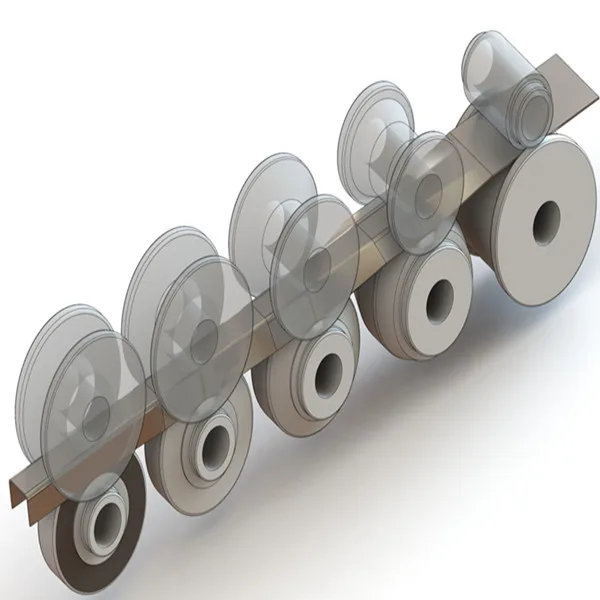
Roll forming material selection starts with understanding how a continuous bending process behaves. Each station applies a small incremental bend until the strip reaches the final profile geometry. Unlike stamping, the material is never compressed between dies — it is bent, and bending behavior is entirely governed by material properties.
Three properties matter most:
| Property | What It Controls |
|---|
| Yield strength (YS) | Minimum bend force; springback magnitude |
| Tensile strength (UTS) | Maximum forming force before fracture |
| Total elongation (El%) | Ductility; resistance to edge cracking |
A material with high yield strength requires more forming force per station and produces more springback. A material with low elongation will crack at tight bend radii. Both problems translate directly into scrap and downtime — which translate directly into cost.
The ratio of yield strength to tensile strength (YS/UTS) is a useful quick indicator. Materials with a low YS/UTS ratio (below 0.70) have significant strain-hardening capacity and tend to form well. Materials above 0.90 are close to fully hard and require careful tooling design and reduced forming speed.
Steel: The Primary Material in Roll Forming
Steel accounts for the majority of roll formed profiles across construction, infrastructure, storage, and automotive sectors. The grades used in roll forming span a wide range, and selection depends on the finished product’s structural requirements, surface finish, and corrosion needs.
Low-Carbon Cold-Rolled Steel (CRS)
Cold-rolled low-carbon steel (AISI 1008–1010, equivalent to EN 1.0338/DC01) is the baseline material for roll forming. It offers:
- Yield strength: 235–550 MPa
- Tensile strength: 400–1200MPa
- Elongation: 28–40%
These values put it in the ideal forming range. Low springback, good ductility, and consistent coil-to-coil mechanical properties make it the default choice for interior framing, light structural profiles, and cable management products.
Для metal stud roll forming, cold-rolled steel is standard. The tight dimensional tolerances required for drywall framing systems demand material with predictable yield behavior, and CRS delivers that.
Hot-Rolled Pickled and Oiled (HRPO)
Hot-rolled pickled-and-oiled steel is the workhorse for heavier gauges (2.0–6.0 mm). It is used in pallet racking uprights, highway barrier profiles, and structural purlins where tensile capacity matters more than surface finish.
Compared to cold-rolled, HRPO has:
- Higher yield variability coil to coil (±30 MPa is common)
- Slightly lower ductility
- Adequate surface finish after pickling
Для upright rack roll forming machines running 2.5–3.0 mm HRPO steel, the key specification to control is yield strength upper limit. A batch of coils at 380 MPa will form differently from a batch at 340 MPa, even at the same nominal grade. Machine settings — particularly pass schedule and cutoff timing — need to account for this variation.
High-Strength Low-Alloy Steel (HSLA)
HSLA grades (ASTM A1011 HSLAS Grades 45–80, EN S355MC/S420MC) are used when structural performance requirements demand higher yield strength without proportional increases in section size.
Yield strengths range from 310 MPa (Grade 45) to 550 MPa (Grade 80). Each step up in strength requires:
- More forming stations to distribute the bend work
- Larger bend radii (typically ≥ 2× material thickness)
- Over-bending to compensate for increased springback
Springback in roll forming is directly proportional to yield strength and inversely proportional to the modulus of elasticity. For HSLA at 550 MPa, springback angles can exceed 8–12° per bend — meaning the tooling must overbend by that amount to hit the final geometry.
Steel manufacturers publish forming limit diagrams (FLD) for their HSLA grades. Requesting and reviewing these before tooling design is standard engineering practice for high-strength applications.
Galvanized and Pre-coated Steel
Most construction profiles — roofing, cladding, purlins — are run from coated coil rather than bare steel. The coating affects forming in two ways:
- Coating thickness adds to effective material thickness. A Z275 galvanized coating (275 g/m²) adds approximately 0.02 mm per side. On thin gauges (0.4–0.6 mm), this is significant.
- Coating adhesion limits minimum bend radius. Zinc coatings will micro-crack at bend radii below approximately 1× material thickness. Pre-painted (PPGI) coatings require even larger minimum radii to avoid paint cracking at the bend apex.
For roofing applications, IBR roofing sheet roll forming machines и corrugated metal panel machines are typically calibrated for 0.40–0.80 mm PPGI with a minimum 1× thickness bend radius. Running bare steel through a machine tooled for coated stock, or vice versa, will produce dimensional errors.
Aluminum: Specific Challenges and Advantages
Aluminum alloys are used in roll forming material selection for applications where weight reduction, corrosion resistance, or thermal conductivity are required: solar racking structures, rain gutters, curtain wall framing, and some automotive profiles.
The modulus of elasticity for aluminum is approximately 69 GPa — roughly one-third that of steel (207 GPa). This has two practical consequences:
- Springback is approximately three times greater for the same yield strength level. An aluminum alloy at 200 MPa yield strength produces as much springback as steel at 200 MPa but in a forming process that delivers far less restoring force from subsequent stations.
- Tooling deflection under load is greater. Shafts and housings designed for steel loads may flex excessively when running aluminum at high speeds.
Common Alloys in Roll Forming
| Alloy | Condition | YS (MPa) | Приложение |
|---|
| 3003-H14 | Half hard | 145 | Gutters, downspouts |
| 5052-H32 | Quarter hard | 193 | Marine framing |
| 6063-T5 | Age hardened | 145–186 | Solar racking, curtain wall |
| 6061-T6 | Age hardened | 276 | Structural profiles |
Для solar mounting strut channel roll forming machines, 6061-T6 and 6063-T5 are the most common inputs. Both require careful attention to bend radius: 6063-T5 tolerates radii down to 1× thickness, while 6061-T6 typically needs 2–3× thickness to avoid cracking.
Aluminum gutter machines — including fascia gutter roll forming machines и формовщики полукруглых желобов — typically run 3003-H14 or 3004-H32. The higher elongation of these alloys (8–14%) accommodates the complex profile geometry without edge cracking.
Material Thickness Tolerances: The Hidden Variable
Coil stock arrives with dimensional tolerances on thickness. These tolerances are tighter than many buyers assume.
For cold-rolled steel to ASTM A1008, thickness tolerance on 0.60 mm strip is ±0.05 mm — a potential variation of ±8.3%. For hot-rolled to ASTM A1011, tolerance on 3.0 mm is ±0.16 mm — ±5.3%.
In roll forming, material thickness directly affects:
- Gap settings between roll passes. Most toolmakers design for nominal + minimum tolerance. Running at maximum tolerance can over-drive the strip and cause edge waves or bow.
- Cut length accuracy. Flying shear and servo cutoff timing is calibrated for a specific strip thickness. A thicker strip travels slightly slower under the same friction conditions, accumulating cut-length error over a production run.
- Hole punch alignment. Для cable tray roll forming machines with inline punch presses, punch penetration depth is set for a nominal thickness. A ±0.10 mm thickness variation changes the punch breakthrough point and affects burr height.
The practical solution is to source coil to tighter mill tolerances (commonly ASTM “Half Normal” or EN “Special” tolerance class) for critical applications, and to verify incoming coil thickness with a micrometer before production — not just trust the mill certificate.
Yield Strength Variability: What the Spec Sheet Doesn't Tell You
A steel grade certified to ASTM A1011 SS Grade 50 guarantees a minimum yield strength of 345 MPa. It does not cap the yield strength. In practice, coils from the same heat can range from 350 to 420 MPa.
This variability is the most common hidden cause of profile geometry inconsistency in roll forming. When yield strength increases:
- Springback increases at every bend
- The finished profile opens up (flanges splay outward for C and Z sections)
- Cutoff length changes because the strip feed rate shifts under different friction loads
For products with tight dimensional tolerances — such as C purlin roll forming machines producing sections that must fit standard building brackets — specifying yield strength with an upper bound (e.g., 345–415 MPa) is worth the small premium over open-tolerance coil.
Some manufacturers run a short qualification strip at the start of each new coil heat, measuring the first few cut pieces against profile tolerances before committing to a full production run. This catches chemistry-driven yield strength excursions before they produce a batch of scrap.
Surface Condition and Lubrication
Roll forming tools are in continuous contact with the strip surface. Surface condition affects tool wear, part finish, and the friction coefficient that governs strip tension through the mill.
Mill oil (cold-rolled steel): Cold-rolled steel arrives with a thin residual rolling oil film. This provides adequate lubrication for most profiles but may be insufficient for deep, multi-radius profiles or when running work-hardened material. Additional lubricant — typically a water-soluble forming oil applied at the entry guide — reduces tool wear and improves surface consistency.
Scale (hot-rolled steel): Hot-rolled steel without pickling carries mill scale on its surface. Scale is abrasive and will accelerate tool wear, particularly on the first three to four forming passes where bending forces are concentrated. HRPO (pickled and oiled) is the standard specification to avoid this problem.
Pre-painted coil: Pre-painted steel runs dry — no lubricant is added because it would contaminate the paint surface. This increases surface friction and requires the roll tooling to be polished to a finer finish than standard. Chromium-plated or hard-chrome tool surfaces are standard for painted coil processing.
Для инструмент для профилирования longevity, surface prep on the incoming strip is as important as the tool material specification itself.
The Material-Machine Match
Different materials impose different demands on the roll forming line. Roll forming material selection does not end when you choose a grade — you must also verify that your equipment can handle it.
Drive power: Higher-yield-strength materials require more torque per station. A mill rated for 0.8 mm low-carbon steel at 30 m/min may struggle with 0.8 mm HSLA Grade 60 at the same speed. Check the mill’s rated drive power against the material’s forming force requirements.
Shaft diameter and deflection: Shaft deflection under forming load causes cross-bow in the profile (the section curves along its length). For heavy-gauge HRPO steel, shafts of 80 mm diameter or larger are standard. The shaft for roll former specification should be matched to the maximum forming force, not just the nominal material thickness.
Roll gap adjustment: Solid spacer mills have fixed gaps and are calibrated for one material thickness. If you plan to run multiple gauges, a mill with adjustable housings or a quick-change roll forming machine configuration allows gap adjustment without retooling.
Speed and cooling: Aluminum at high forming speeds generates heat at the roll contact points. Running aluminum on a mill designed for steel without adequate roll cooling can cause galling (aluminum adhering to tool surface
Material Costs and Roll Forming Economics
Material cost is typically 60–80% of the total cost of a roll formed product. Tooling, energy, labor, and overhead make up the remainder. This ratio means that material selection decisions have a disproportionate impact on final product price.
The calculation is not simply “cheapest grade = lowest cost.” Higher-grade materials often produce:
- Less scrap due to consistent mechanical properties
- Fewer tool adjustments during a production run
- Thinner-gauge finished profiles for the same structural performance (lightweighting)
A Z purlin produced from S350GD galvanized steel at 1.8 mm thickness may cost 12% more in raw material than the same profile in S250GD at 2.2 mm — but the 20% weight saving reduces transport and installation cost for the end user, making the finished product more competitive.
This analysis — looking at total cost of ownership rather than coil price per kilogram — is the core of effective roll forming material selection. It is also the argument that experienced производители профилегибочных машин make when specifying machines for a new product: start with the finished product requirements, work backwards to the material, and then specify the machine.
Common Roll Forming Material Selection Mistakes
Running over-strength coil without retooling: Sourcing a “stronger” grade to improve product performance without recalculating the pass schedule is a common error. The extra springback will open the profile beyond tolerance and may cause the strip to disengage from the roll flanges mid-mill.
Ignoring coil edge condition: Slit coil edges have burrs and minor edge cracks from the slitting process. On ductile low-carbon steel, these are inconsequential. On HSLA material, edge cracks propagate during bending and cause splits at tight radius features. Specifying “deburred edge” or “clean-slit” coil for high-strength applications is standard practice.
Mixing coatings: A production run that inadvertently mixes Z275 and Z450 galvanized coil from different suppliers will produce profiles with visibly different surface texture, affecting product consistency. Maintain coil traceability through the production run.
Underspecifying elongation for complex profiles: A material with adequate yield strength but low elongation (below 14%) will crack at tight inside radii. For gutter roll forming machines producing K-style profiles with multiple compound bends, minimum elongation of 24% in the transverse direction is a practical requirement.
FAQ
Summary: The Roll Forming Material Selection Framework
Before ordering coil for a new roll forming product, work through this sequence:
- Define finished product requirements — structural load, dimensional tolerance, corrosion resistance, surface finish.
- Identify candidate grades — match yield strength to structural need; check elongation against minimum bend radius requirements.
- Request mill test certificates — verify yield strength range (not just minimum), UTS, and elongation for each heat.
- Check coating compatibility — confirm bend radius limits for coated material match your tooling design.
- Verify machine capability — confirm drive power, shaft rating, and roll gap range against the selected material.
- Run a qualification strip — test the first coil of a new grade before committing to production volumes.
Getting material selection right does not add cost — it removes it. The right material runs cleanly, produces consistent profiles, and extends tooling life. The wrong material, however attractively priced per kilogram, accumulates cost through scrap, downtime, and rework.
For buyers sourcing new roll forming lines, this framework is equally relevant to the machine specification. A цена станка для профилирования валков that looks competitive on paper may reflect a machine under-rated for the material you need to run. Confirming material compatibility upfront is part of the due diligence before any equipment purchase.