Buying a custom orb roll forming machine is a serious investment. One wrong choice can cost you years of downtime and tens of thousands in rework. This guide is built for roofing manufacturers, steel fabricators, and construction suppliers who want to produce Custom Orb profiles that match Lysaght specifications. We cover everything: profile dimensions, machine specifications, price ranges, common mistakes, and a step-by-step buying checklist.
The Custom Orb profile is one of the most widely used corrugated steel profiles in Australia, Southeast Asia, and the Pacific Islands. It is manufactured under license and to strict dimensional tolerances by Lysaght, a BlueScope brand. If you are planning to enter the corrugated roofing and walling market — or expand your existing production line — you need a machine that can replicate these profiles with precision, speed, and consistent quality.
Beli Rollforming has designed and shipped custom orb roll forming machines for over 15 years, serving manufacturers across 20+ countries — primarily in the US, Europe, and Australia markets. This buy guide pulls from real-world engineering experience — not generic sales brochures. Here is what you need to know before you write a check.
Custom Orb Roll Forming Machine: By the Numbers
Before diving into specs and pricing, here is the quick version of this buy guide:
| What You Need | The Numbers |
|---|
| Machine Price Range (FOB China) | 18,000–150,000+ |
| Typical Lead Time | 60–90 days from order to delivery |
| Minimum Roll Forming Stations | 18 -24 stands |
| Standard Orb Cover Width | 762 mm |
| Orb Rib Height | 16 mm (Custom Orb), 17 mm (Blue Orb) |
| Диапазон толщины материала | 0.35–0.80 mm BMT |
| Minimum Roof Pitch Required | 5° (approx. 1:12) |
| Daily Output (mid-range machine) | 800–1,300 sheets (6m length, 8 hours) |
| Annual Maintenance Cost | ~3–5% of machine price |
This buy guide covers everything in the table above — and the deeper details most sales brochures skip.
What Is a Custom Orb Profile?
The Custom Orb is a trapezoidal corrugated steel profile used for roofing and wall cladding. It features regular trapezoidal ribs that run the length of the sheet. The profile provides structural strength, water-carrying capacity, and a clean aesthetic that works across residential, commercial, and industrial buildings.
Key dimensions of the standard Lysaght Custom Orb profile:
| Параметр | Пользовательский шар | Custom Blue Orb | Wallclad |
|---|
| Cover Width | 762 mm | 762 mm | 762 mm |
| Высота ребра | 16 mm | 17 mm | 16 mm |
| Minimum Roof Pitch | 5° (approx. 1:12) | 5° (approx. 1:12) | Wall only |
| Основное применение | Roofing & Walling | Roofing & Walling (curving) | Walling only |
The profile is available in a wide range of steel grades and finishes, including COLORBOND steel, ZINCALUME aluminium-zinc alloy coated steel, and ZINC HI-TEN galvanized steel. Your custom orb roll forming machine must be capable of handling all these material types without surface damage or dimensional drift.
For full technical specifications, including load span tables and installation requirements, refer to the Lysaght Custom Orb Design & Installation Guide.
Custom Orb Roll Forming Machine: Core Specifications
A properly engineered custom orb roll forming machine must meet the following minimum specifications to produce quality Orb profiles:
| Спецификация | Начальный уровень | Mid-Range | High-End |
|---|
| Coil Width Range | 900–1000 mm | 900–1250 mm | 900–1250 mm |
| Material Thickness (BMT) | 0.35–0.55 mm | 0.35–0.65 mm | 0.35–0.80 mm |
| Скорость линии | 8-15 м/мин | 15–25 m/min | 25–40 m/min |
| Станции профилирования | 14–16 stands | 18–20 stands | 20–24 stands |
| Мощность главного двигателя | 5.5–7.5 kW | 11–15 кВт | 18.5–22 kW |
| Тип резки | Manual shear | Hydraulic flying shear | Servo hydraulic flying shear |
| Емкость разматывателя | 3–5 ton | 5–8 ton | 8–10 ton (hydraulic expansion) |
| Система управления | Basic PLC + HMI | Advanced PLC + Touchscreen | Full CNC + Remote Diagnostics |
The number of roll forming stations is one of the most misunderstood specifications. More stations do not always mean better quality — but for the Custom Orb profile with its 16–17 mm rib height, you need enough stations to gradually form the ribs without stretching or thinning the material. We recommend a minimum of 18 stations for consistent results at commercial speeds.
Выбирая станок для профилирования валков по индивидуальному заказу built specifically to your Orb profile dimensions is far better than adapting a generic corrugated sheet machine. The tooling must match the exact rib geometry of the Lysaght profile. This is the single most expensive mistake we see in this buy guide category — buyers trying to save $5,000 on tooling end up with profiles that do not fit Lysaght flashings and accessories.
Key Components of a Custom Orb Roll Forming Line
A complete custom orb roll forming line consists of more than just the roll former. Understanding each component helps you evaluate quotes and spot corners that suppliers might cut.
1. Разматыватель (Разматыватель)
The uncoiler holds the steel coil and feeds it into the line. For Custom Orb production, you need a uncoiler that prevents coil telescoping and maintains consistent tension. Hydraulic expansion mandrels are preferred for heavier coils (5+ tons). Read our руководство по типам разматывателей профилегибочных машин for a deeper dive.
2. Feeding and Leveling System
Steel coil has a natural curvature (coil set). A leveling unit with pinch rollers and straightening rollers removes this set before the strip enters the roll former. Without proper leveling, the finished Orb sheets will have a permanent bow — a common complaint from customers.
3. Roll Forming Mill
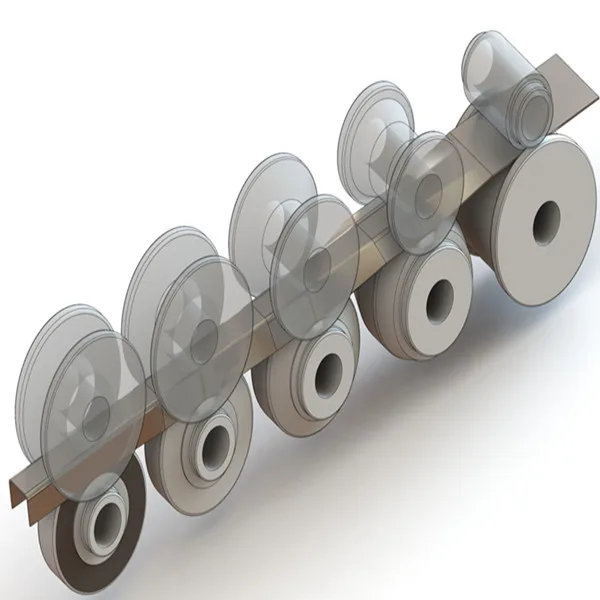
This is the heart of the line. The прокатные станы progressively shape the flat steel strip into the Custom Orb profile. The mill consists of multiple stands, each with top and bottom rollers machined to a specific cross-section (the “flower” pattern). Roller material, heat treatment, and surface finish directly determine profile accuracy and tool life.
4. Hydraulic Cutting Unit
A flying shear cuts the continuously moving profile to the required length without stopping the line. For high-speed production, a servo-driven hydraulic shear provides the best balance of cut quality, speed, and reliability. The cut-off die must match the Orb profile cross-section precisely to avoid deformed ends.
5. Run-Out Table and Stacker
Finished sheets exit onto a run-out table where they can be manually or automatically stacked. Automatic stackers dramatically reduce labor costs for high-volume operations.
6. PLC Control System
Современный metal roll forming machines use PLC-based controls with touchscreen HMIs. The control system manages line speed, sheet length, cut count, and batch production. Look for systems that store multiple profile recipes if you plan to run different corrugated profiles on the same line.
Custom Orb Roll Forming Machine in Action
Custom Orb Profile Variants: What Your Machine Needs to Handle
Most manufacturers want flexibility. They do not want a machine that only produces one profile. The good news: a well-designed Custom Orb roll former can often handle multiple variants within the Custom Orb family.
| Profile Variant | Высота ребра | Key Difference | Machine Requirement |
|---|
| Пользовательский шар | 16 mm | Standard corrugated | Standard tooling set |
| Custom Blue Orb | 17 mm | Slightly taller rib; optimized for curving | Separate tooling set or adjustable rollers |
| Wallclad | 16 mm | Wall-only application; same geometry | Same tooling as Custom Orb |
If you only need to produce standard Custom Orb, a single-profile machine is the most cost-effective choice. If you anticipate demand for Blue Orb or want to run other corrugated profiles (like Spandek or Trimdek), invest in a кассетный прокатный стан with interchangeable cassette sets. Cassette systems cut profile changeover from hours to as little as 15 minutes.
Material Compatibility: What Your Machine Must Handle
The Custom Orb profile is manufactured from multiple steel substrate types. Your roll forming machine must handle all of them without marking, scratching, or damaging the surface coating. This is harder than it sounds.
Material Types You Will Encounter
- COLORBOND steel: Pre-painted steel with a tough, UV-resistant coating. Available in over 22 standard colors from the BlueScope COLORBOND range. The machine rollers must have a polished, chrome-plated surface to prevent paint scratching.
- ZINCALUME steel: Aluminium-zinc alloy coated steel with a characteristic spangled metallic finish. Softer coating than COLORBOND — requires gentle roller pressure.
- ZINC HI-TEN galvanized steel: Available in Z450 (standard) and Z600 (heavy) coating classes. The zinc coating is relatively soft and can build up on rollers over time. Hard chrome-plated rollers are essential.
- Stainless steel (SUPERDURA): Used in severe marine environments. Requires higher forming forces and harder tooling. Not all standard Orb machines can run stainless without accelerated roller wear.
Диапазон толщины
Base Metal Thickness (BMT) for Custom Orb production typically ranges from 0.35 mm to 0.65 mm. For industrial and cyclonic applications, some projects require 0.80 mm BMT. Verify that your machine’s drive train and roller shafts are rated for the full thickness range you need. A machine rated for 0.55 mm maximum will struggle — and eventually break — if you push 0.80 mm through it.
Line Speed and Production Capacity
Line speed directly determines your daily output and your ability to meet delivery deadlines. However, speed should not come at the expense of profile accuracy or surface quality.
| Speed Tier | Typical Speed | Daily Output (8 hours, 6m sheets) | Лучше всего подходит для |
|---|
| Entry | 8–12 m/min | ~400–600 sheets | Startups, low-volume, local supply |
| Mid-Range | 15–25 m/min | ~800–1300 sheets | Regional manufacturers, steady demand |
| Высокоскоростной | 30–40 m/min | ~1600–2000+ sheets | High-volume, export, national supply |
Real-world production speed is always lower than the rated maximum. Factor in coil changes, minor adjustments, and operator breaks. A machine rated at 25 m/min typically delivers 18–20 m/min in sustained production.
For high-volume Orb production, consider adding secondary operations in the roll forming line — such as inline embossing or pre-punching — to eliminate downstream handling steps.
Drive System Options
The drive system transmits power from the main motor to each roll forming stand. For the Custom Orb profile, three drive configurations are common:
| Тип привода | Cost | Обслуживание | Точность профиля | Лучше всего подходит для |
|---|
| Цепной привод | Низкий | Moderate (chain tensioning) | Хороший | Entry to mid-range machines |
| Редукторный привод | Середина | Low (sealed, oil-bath) | Very Good | Mid-range to high-end machines |
| Individual Servo Drive | Высокий | Низкий | Отличный | Premium, multi-profile, high-speed |
Chain drive systems are the most common in entry-level and mid-range Orb machines. They are cost-effective and reliable when properly maintained. However, chain stretch over time can cause slight misalignment between stands, affecting profile consistency on long runs.
Gearbox drive systems use sealed gear units between stands, eliminating chain stretch issues. They run quieter, need less maintenance, and maintain better synchronization. For machines producing 15+ m/min, gearbox drive is strongly recommended.
Individual servo drives on each stand are the premium option, providing independent speed control and the ability to fine-tune each stand. This is overkill for standard Orb production but valuable if you plan to run difficult materials or require extremely tight tolerances.
Cutting and Punching Options
Летающие ножницы
The flying shear is the most common point of failure on Orb roll forming lines. For Orb profiles, the shear die must match the corrugated cross-section exactly — a flat shear blade will crush the ribs.
Hydraulic flying shears are the industry standard for Custom Orb machines. They accelerate to match line speed, clamp the profile, and cut in one clean stroke. For speeds above 20 m/min, a servo-hydraulic shear provides faster cycle times and better cut accuracy.
Pre-cut vs. post-cut: In a pre-cut system, the strip is cut to length before entering the roll former. In a post-cut system, the profile is cut after forming. Post-cut is standard for Orb production because pre-cutting can cause the strip end to jam at the first few forming stands.
Inline Punching
If your customers need pre-punched holes for fasteners at specific spacings, add an inline punching station before the roll former. A servo-driven punch press provides programmable hole patterns and can be integrated into the main PLC for automatic spacing control. See our punch press for roll forming guide for a full breakdown of punching options.
Control System and Automation
Modern ORB roll forming machines run on PLC-based control systems with color touchscreen interfaces. The key functions you need:
- Length control: Encoder-based measurement with ±1 mm accuracy
- Batch counting: Set quantity per batch, auto-stop when complete
- Speed control: Variable frequency drive for adjustable line speed
- Fault diagnostics: Real-time alarm display and troubleshooting prompts
- Recipe storage: Save and recall settings for different Orb variants, sheet lengths, and batch sizes
Higher-end systems offer remote diagnostics, allowing the machine builder to troubleshoot issues over the internet. This saves the cost and delay of flying a technician to your site.
Tooling: The Silent Hero
Roll forming tooling for the Custom Orb profile is precision-engineered. Each roller set is machined from alloy tool steel (typically Cr12MoV or D2), heat treated to HRC 58–62, and hard chrome plated. Properly maintained tooling can produce over 500,000 linear meters of Orb profile before needing refurbishment.
Poor-quality tooling causes three problems: inaccurate profile dimensions, surface marking on coated steels, and premature wear. The lowest quote almost always cuts corners on tooling. Ask your supplier for the tooling material grade, heat treatment specification, and surface hardness.
Наш конструкция прокатного станка guide explains the engineering behind good tooling — including flower patterns, pass scheduling, and springback compensation.
Price Ranges: What to Expect in 2026
Custom orb roll forming machine prices vary widely based on specifications, automation level, and origin. Here is a realistic breakdown for machines capable of producing Lysaght-compatible Custom Orb profiles:
| Machine Tier | Price Range (FOB China) | What You Get |
|---|
| Economy | 18,000–30,000 | 14–16 stands, chain drive, manual decoiler, basic PLC, 8–12 m/min |
| Стандартный | 30,000–55,000 | 18–20 stands, gearbox or heavy chain drive, hydraulic uncoiler, advanced PLC + HMI, 15–25 m/min |
| Premium | 55,000–90,000 | 20–24 stands, gearbox drive, servo hydraulic flying shear, auto stacker, remote diagnostics, 25–40 m/min |
| Turnkey Line | 90,000–150,000+ | Full line with auto stacker, inline punching, dual uncoiler, coil car, packaging system |
Prices are FOB China port. Add shipping, import duties, and local installation. Many buyers underestimate the delivered cost by 25–35%. Always budget for freight, customs clearance, foundation work, electrical installation, and operator training.
For a broader view of roll forming machine pricing, read our complete 2026 buyer’s guide. This Orb-specific buy guide focuses on the numbers that matter for corrugated roofing profiles.
How to Choose the Right Machine: 7-Step Checklist
Step 1: Define Your Profile Requirements
Decide exactly which profiles you need. Custom Orb only? Orb + Blue Orb? Orb + other corrugated profiles? This determines whether you need a single-profile machine, a machine with interchangeable tooling, or a cassette system.
Step 2: Determine Your Material Range
List every steel grade, coating type, and thickness you will run. Be honest — do not say “0.35 mm BMT only” if you know you will get orders for 0.65 mm.
Step 3: Calculate Your Required Output
How many linear meters per day? Per month? A machine rated at 15 m/min produces roughly 700–900 meters per hour in real production. Work backward from your sales forecast.
Step 4: Specify Your Cut Length Range
Standard Orb sheets range from 1.8 m to 9.0 m. Make sure the run-out table and stacker accommodate your longest products.
Step 5: Decide on Automation Level
Do you need automatic stacking? Inline punching? Coil car for faster coil changes? Each adds cost but reduces labor. Calculate your payback period.
Step 6: Verify Standards Compliance
Your machine should produce profiles that meet the relevant standards for your market. In Australia, this means compliance with AS 1397 for steel substrate and AS 1562 for the finished profile. The machine itself should be CE marked (or equivalent) with proper safety guarding. Reference the Australian Steel Institute for current standards.
Step 7: Evaluate the Supplier
Visit their factory if possible. Request a video of the machine running YOUR profile with YOUR material. Ask for references from buyers who have had the machine for 2+ years. Check our guide on как купить профилегибочную машину for a full supplier evaluation framework.
Common Mistakes to Avoid
Mistake #1: Buying on price alone. The cheapest machine always costs more in the long run — through downtime, rejected sheets, and tooling replacement. A 5,000savingnowcancost5,000саvвгноwсанcosт50,000 in lost production over two years.
Mistake #2: Ignoring material thickness range. Many buyers order a machine spec’d for 0.42 mm BMT, then try to run 0.65 mm. The drive system overheats. The rollers deflect. The profile goes out of spec. Be upfront about your full thickness range.
Mistake #3: Overlooking the uncoiler. A cheap uncoiler causes coil slippage, inconsistent feed tension, and profile defects. The uncoiler is the first component in your line — if it fails, nothing downstream works right.
Mistake #4: Skipping the factory acceptance test (FAT). Always run your material through the machine before it ships. Photograph the profile cross-section. Measure rib height and cover width. Check for surface marking. Fix problems at the factory, not on your floor.
Mistake #5: Forgetting about maintenance. Roll forming machines need regular preventative maintenance. Budget for spare parts, lubricants, and a maintenance schedule from day one.
Installation, Training, and Support
A custom orb roll forming machine is not a plug-and-play appliance. It requires proper installation, operator training, and ongoing support.
Installation: Plan for a level concrete foundation, three-phase power (voltage to match your local supply), and compressed air if the shear is pneumatic-assisted. Most machines require 3–5 days for mechanical installation and another 2–3 days for electrical commissioning.
Обучение: Your supplier should provide at least 2–3 days of on-site operator training covering machine operation, profile adjustment, tooling changeover, basic troubleshooting, and safety procedures. Do not settle for a one-day walkthrough.
Послепродажная поддержка: Clarify warranty terms, spare parts availability, and remote support options before you sign. A supplier with a responsive engineering team can save you weeks of downtime.
Beli Rollforming provides installation supervision, comprehensive operator training, and lifetime technical support on every machine. Our engineers have commissioned machines across 20+ countries — with deep experience in US, European, and Australian market requirements.
Часто задаваемые вопросы
Список изменений
| Дата | Версия | Изменения |
|---|
| June 24, 2026 | 1.0 | Initial publication. Includes 2026 pricing, Lysaght Custom Orb profile specs, 7-step buying checklist, tooling guidance, and 10 FAQs. |
Триггеры следующего обзора
- Lysaght profile update: If Lysaght publishes new Custom Orb specifications or design guides
- Material standard changes: If AS 1397 or equivalent steel substrate standards are revised
- Pricing refresh: Review and update price ranges every 12 months (next: June 2027)
- New profile variants: If new Orb profile derivatives are introduced to the market
- Regulatory changes: If import regulations for roll forming machinery change in key markets