










Introduction
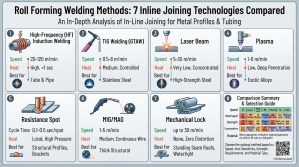
Roll forming welding methods decide whether your line runs at 60 meters per minute or stalls every shift. Inline joining technologies fuse, stitch, or lock metal profiles directly on the line. No secondary operation, no extra handling.
This guide compares seven roll forming welding methods side by side. Each serves a specific profile type, material, and speed. Choosing the wrong one means weak seams, rejected parts, and lost margins.
Beli Rollforming integrates multiple welding technologies into roll forming lines for clients across 20+ countries. Let us help you compare the options.
1. High-Frequency (HF) Induction Welding
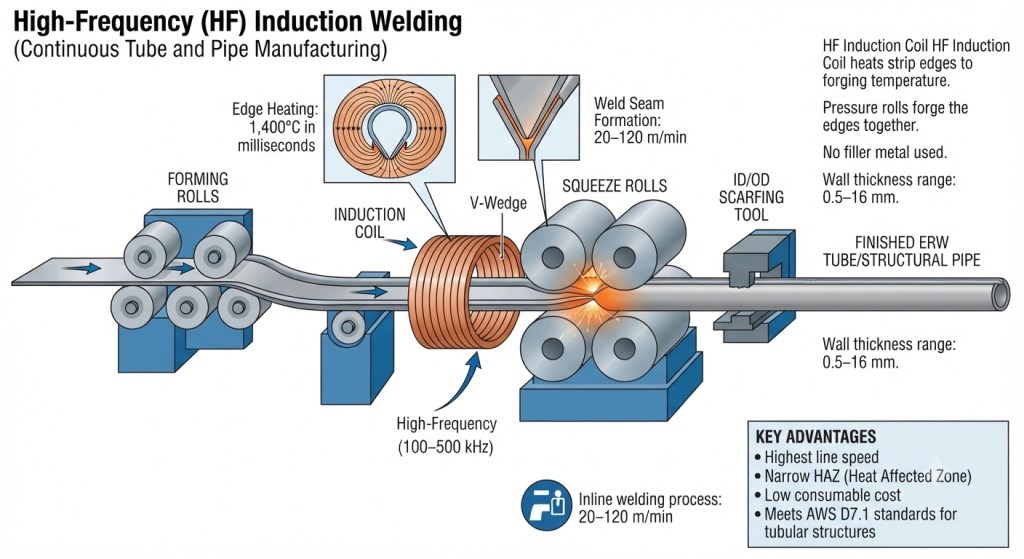
HF induction welding is the dominant choice for continuous tube and pipe roll forming. An induction coil heats strip edges to forging temperature. Pressure rolls squeeze the edges together. The weld seam forms without filler metal.
How it works: The induction coil wraps around the tube. High-frequency current (100–500 kHz) concentrates on strip edges. Edges reach 1,400°C in milliseconds. Squeeze rolls forge them together. This inline welding process runs at 20–120 m/min.
Best for: ERW tubes, structural pipes, and automotive exhaust components. Speeds exceed any other roll forming welding method. Wall thickness ranges from 0.5 to 16 mm.
Pros: Highest line speed, no filler metal, narrow HAZ, low consumable cost.
Cons: Requires precise edge preparation, coil must match tube diameter, not for walls over 16 mm.
The American Welding Society (AWS) defines HF welding standards under AWS D7.1 for tubular structures. Most structural tubing produced worldwide uses this method.
2. TIG Welding (GTAW)
Tungsten Inert Gas (TIG) welding, or GTAW, uses a non-consumable tungsten electrode. An inert gas shield protects the weld pool. TIG produces the cleanest seams of all roll forming welding methods.
How it works: The roll forming line forms the strip into a tube. A stationary TIG torch welds the seam continuously. For stainless steel tubes, TIG is the standard. Travel speeds range from 0.5 to 8 m/min — slower than HF but far more precise.
Best for: Stainless steel tubing, food-grade pipes, pharmaceutical tubes, and decorative profiles. Lower production Step Beam Machine.
Pros: Superior weld quality, no spatter, works on stainless and exotic alloys, clean seam.
Cons: Slowest fusion method, high operator skill needed, argon gas cost adds up.
According to the ASM International Handbook, TIG welding delivers the lowest oxygen contamination in the weld pool. This is critical for stainless steel corrosion resistance. For lines requiring strict quality, TIG roll forming welding is unmatched.

3. Laser Beam Welding
Laser welding is the fastest-growing inline joining technology in roll forming. A fiber laser beam melts and fuses the seam. No contact, no electrode wear, no filler wire.
How it works: The formed profile passes under a laser head. The beam creates a deep, narrow weld at 5–30 m/min. Fiber lasers dominate due to efficiency and low maintenance.
Best for: High-strength steel tubes, tailor-welded blanks, automotive profiles where HAZ must be minimal. high speed step/p beam roll forming machine.
Pros: Extremely narrow HAZ (0.2–0.5 mm), high speed, no consumables, low distortion, easily automated.
Cons: High capital cost (150K–150K–500K), requires precise fit-up (<0.1 mm gap), safety enclosure mandatory.
The Fabricators & Manufacturers Association (FMA) reports laser welding adoption in roll forming grew 35% from 2020 to 2024. As fiber laser prices drop, expect more lines to adopt this roll forming welding method.

4. Resistance Spot Welding
Resistance spot welding joins overlapping metal sheets using pressure and electric current. It is the most common inline joining method for non-tubular roll formed profiles.
How it works: Copper electrodes press two metal layers together. Current creates resistance heat at the contact point. A molten nugget forms and solidifies. In roll forming, spot welders attach brackets on strut channels and tack components on cable trays.
Best for: Strut channel production, cable tray manufacturing, rack uprights, and solar frames. Beli’s strut channel machines integrate inline spot welders.
Pros: Low cost, fast cycle (0.1–0.5 sec/spot), no filler metal, simple automation.
Cons: Visible weld marks, limited to overlapping joints, electrode tips need periodic dressing.
For more on how spot welding fits into secondary operations, see our secondary operations guide. Resistance spot welding is one of the most cost-effective roll forming welding methods for structural profiles.

5. MIG/MAG Welding (GMAW)
Gas Metal Arc Welding (GMAW) feeds a consumable wire electrode through a torch. MIG uses inert gas; MAG uses active gas. This method bridges the gap between TIG quality and HF speed.
How it works: The wire feeder continuously supplies filler metal. The arc melts wire and base metal. In roll forming, MIG/MAG welds thicker structural profiles at 1–5 m/min.
Best for: Heavy structural sections, welded upright frame roll forming, thick-wall tubes. Thickness 3–12 mm.
Pros: Good penetration on thick material, forgiving on fit-up, continuous wire feed, versatile.
Cons: Spatter needs cleanup, higher consumable cost, smoke extraction needed, slower than HF.
The International Institute of Welding (IIW) classifies GMAW as the most versatile arc welding process for industrial fabrication. For heavy-duty roll forming welding, MIG/MAG is a reliable workhorse.

6. Plasma Welding
Plasma welding constricts an arc through a fine nozzle. The plasma jet reaches temperatures up to 28,000°C. It sits between TIG and laser in speed and precision.
How it works: A pilot arc ionizes gas. The nozzle focuses plasma into a needle-sharp arc, creating a deep keyhole weld. For roll forming, plasma suits stainless and titanium tubes at 1–6 m/min.
Best for: Aerospace tubes, thin-wall stainless pipes, medical tubing, and alloy profiles.
Pros: Deeper penetration than TIG, stable arc, narrow HAZ, lower heat input than MIG.
Cons: Complex torch maintenance, higher cost than TIG, limited to <6 mm, precise gas flow needed.
Plasma welding is niche compared to other roll forming welding methods. However, for specialized alloy work, no other process matches its precision-to-speed ratio.

7. Mechanical Seam Locking
Mechanical seam locking is not fusion welding. It joins metal by folding and interlocking edges. No heat, no spark, no filler. For certain profiles, it is the most efficient inline joining technology.
How it works: Roll forming tooling folds strip edges into a hook or overlap pattern. Squeeze rolls compress the fold into a locked seam. Standing seam roof panel machines use this method exclusively. The seam is watertight without welding.
Best for: Standing seam roof panels, downspouts, gutters, and cladding. Speeds reach 30 m/min.
Pros: No heat input (zero distortion), no consumables, fastest joining, watertight, works on coated metal.
Cons: Profile-specific tooling, limited to <2 mm, seam strength lower than fusion welds.
Mechanical seam locking is unique among roll forming welding methods because it avoids thermal effects entirely. For coated metals like galvanized or pre-painted steel, this prevents coating damage at the seam.

Comparison Table 1: Speed, Cost, and Thickness Range
| Welding Method | Line Speed (m/min) | Equipment Cost (USD) | Material Thickness | Consumables |
|---|---|---|---|---|
| HF Induction | 20–120 | 80K–250K | 0.5–16 mm | None (strip edges only) |
| TIG (GTAW) | 0.5–8 | 20K–60K | 0.3–6 mm | Tungsten electrode + argon |
| Laser Beam | 5–30 | 150K–500K | 0.5–8 mm | None |
| Resistance Spot | 10–60 (spot pitch) | 10K–40K | 0.5–3 mm (per layer) | Copper tips (periodic) |
| MIG/MAG (GMAW) | 1–5 | 15K–50K | 3–12 mm | Wire + shielding gas |
| Plasma | 1–6 | 30K–80K | 0.5–6 mm | Plasma gas + electrode |
| Mechanical Seam | 20–30 | 5K–20K (tooling) | 0.3–2 mm | None |
This table shows the wide spread in roll forming welding methods. HF dominates on speed. Mechanical seaming wins on cost. Laser offers the best quality-to-speed ratio if budget allows.
Comparison Table 2: Application Suitability
| Profile Type | Recommended Method | Alternative | Key Reason |
|---|---|---|---|
| ERW Steel Tube | HF Induction | Laser | Speed + no filler |
| Stainless Tube | Laser | Plasma | Corrosion-free seam |
| Strut Channel | Resistance Spot | MIG/MAG | Bracket attachment |
| Cable Tray | Resistance Spot | MIG/MAG | Cover/ladder joining |
| Standing Seam Roof | Mechanical Seam | — | Watertight, no heat |
| Rack Upright Frame | MIG/MAG | Resistance Spot | Heavy structural welds |
| Automotive Profile | Laser | HF Induction | Minimal HAZ + precision |
| Galvanized Roof Panel | Mechanical Seam | — | No coating damage |
Choosing among roll forming welding methods starts with the profile. A strut channel line needs spot welding. A tube mill needs HF or TIG. A roof panel line needs mechanical seaming. Match the process to the product.
Comparison Table 3: Quality and Certification Factors
| Factor | HF Induction | TIG | Laser | Spot | MIG/MAG | Plasma | Mech Seam |
|---|---|---|---|---|---|---|---|
| Weld Strength | High | Very High | Very High | Medium | High | High | Medium |
| HAZ Width | 1–3 mm | 2–4 mm | 0.2–0.5 mm | 3–5 mm | 4–8 mm | 1–2 mm | None |
| Surface Finish | Good | Excellent | Excellent | Marks visible | Fair (spatter) | Good | No marks |
| Distortion Risk | Low | Medium | Very Low | Low | High | Medium | None |
| CE/ISO Ready | Yes | Yes | Yes | Yes | Yes | Yes | N/A |
| Automation Level | Full | Full | Full | Semi-Full | Semi | Semi | Full |
Weld quality matters most in regulated markets. If you export to the EU, CE marking compliance applies to the machine. But weld quality standards like EN ISO 15614-1 govern procedure qualification for fusion welding.
Decision Framework: Choosing Your Inline Joining Technology
- Profile type? Tubes → fusion welding. Panels → seaming. Channels → spot welding.
- Material/thickness? Thin stainless → TIG or laser. Thick carbon steel → HF or MIG/MAG. Coated → mechanical seam.
- Speed needed? High volume (>60 m/min) → HF. Medium → laser or spot. Low precision → TIG or plasma.
- Budget? Under 50K→spotor MIG/MAG. 50K→spotor MIG/MAG. 50K–150K→HF or TIG.Over 150K→HF or TIG. Over150K → laser.
- Quality standard? Automotive → laser. Food/pharma → TIG. Construction → HF or spot.
Beli Rollforming has over 15 years integrating welding systems into roll forming lines. Our main markets (US, Europe, Australia) demand strict weld quality. We configure each line with the right inline joining technology.
Integration Considerations for Roll Forming Lines
Adding welding to a roll forming line changes the layout. Key integration points:
- Edge preparation: HF and laser require precisely sheared strip edges. Quality roll forming tooling maintains alignment.
- Weld station positioning: The weld head sits after forming stations, before sizing and cut-off.
- PLC synchronization: Welding power must sync with line speed. Modern PLC control systems handle this automatically.
- Inspection: Inline weld inspection (eddy current, ultrasonic, vision) catches defects before they reach the customer.
For operator training on welded lines, Beli provides hands-on instruction at installation. Proper setup prevents 90% of weld defects.
Common Mistakes When Selecting Roll Forming Welding Methods
Over-specifying: A laser welder for a spot-welding application wastes $300K+. Match the process to the product.
Ignoring thickness limits: TIG cannot weld 10 mm tube. HF cannot do 0.3 mm foil. Know your material range.
Skipping inline inspection: A weld defect found at cut-off costs 2.Onefoundatthecustomercosts2.Onefoundatthecustomercosts2,000. Always integrate inspection.
Neglecting maintenance: Laser optics, TIG torches, and spot welder tips need scheduled replacement. Preventive maintenance keeps your line running.
FAQs
The seven most common roll forming welding methods are HF induction welding, TIG welding, laser beam welding, resistance spot welding, MIG/MAG welding, plasma welding, and mechanical seam locking. Each suits different profile types and materials.
HF induction welding is the fastest, reaching 120 m/min for tube production. Mechanical seam locking also reaches 30 m/min for roof panels. These two methods dominate high-volume roll forming welding.
Yes. TIG welding is the standard for stainless steel tubes. Laser welding also works well. Both produce clean, corrosion-resistant seams without filler metal contamination.
Resistance spot welding has the lowest equipment cost (10K–40K) and minimal consumables. For non-tubular profiles like strut channels and cable trays, it is the most cost-effective choice.
Laser welding pays off for high-strength steel and automotive profiles requiring minimal HAZ. ROI takes 2–3 years at moderate volumes. For simple structural tubes, HF induction is more economical.
HF induction for carbon steel at high speed (20–120 m/min). TIG for stainless steel needing superior corrosion resistance (0.5–8 m/min). Material and quality drive the decision.
No. It joins metal by folding edges, not melting. But it is classified among inline joining technologies because it serves the same purpose: joining profile edges continuously on the line.
Eddy current testing (surface cracks), ultrasonic testing (internal defects), and vision systems (seam tracking). All integrate directly after the weld station.
Yes. Beli designs lines with multiple joining stations. For example, a strut channel line with spot welding for brackets plus mechanical cutting. Contact us to discuss your requirements.
AWS D7.1 (tubular structures), EN ISO 15614-1 (procedure qualification), and EN ISO 5817 (weld quality levels). For EU access, Machinery Directive 2006/42/EC applies to the welding equipment.
Article Changelog
- 2026-07-13: Initial publication. Covered 7 inline joining technologies with 3 comparison tables and 10 FAQs.
Next Review Triggers
- New fiber laser power sources above 10 kW enter the roll forming market
- AWS or ISO releases updated welding procedure standards
- Customer demand for laser-welded profiles in automotive structural applications increases significantly
- Plasma welding equipment costs drop below TIG pricing threshold
- New mechanical seam locking designs extend thickness range beyond 2 mm