What is Roll Forming Capacity?
Roll forming capacity refers to the maximum volume and complexity of profiles a machine can produce, determined by mechanical limits—such as shaft diameter and motor torque—and material properties. It is optimized by balancing forming speeds (typically 5–150 m/min) with the number of forming stations to prevent defects like machine deflection or material thinning. Achieving peak roll forming capacity requires a synergy between hardware robust enough to handle high yield strengths and software precise enough to simulate bending stages.
1. Understanding the Core Factors of Roll Forming Capacity
To maximize your plant’s roll forming capacity, you must first evaluate the physical constraints of your mill. The roll forming capacity of a line is not just about how fast the rollers spin; it is about how much force the stands can exert without failing. This involves a comprehensive analysis of roll forming machine components, specifically the shaft diameter and the distance between stands.
2. How Material Yield Strength Dictates Machine Limits
The yield strength of your coil material is a primary bottleneck for roll forming machine capacity. As manufacturers move toward Ultra-High-Strength Steels (UHSS), the energy required to bend the metal increases exponentially. If your material grade exceeds the design specifications of your rollers, your roll forming capacity will drop due to necessary speed reductions or increased scrap rates.
3. The Impact of Machine Deflection on Production Accuracy
Machine deflection is the “silent killer” of roll forming machines capacity. When forming forces are high, the roll stands can flex, increasing the roll gap and causing inconsistent profile dimensions. To maintain a high roll forming machine capacity while holding tight tolerances, engineers must use Roll Forming Software to predict these forces and compensate for deflection in the tool design.
4. Engineering the "Flower Pattern" for Maximum Throughput
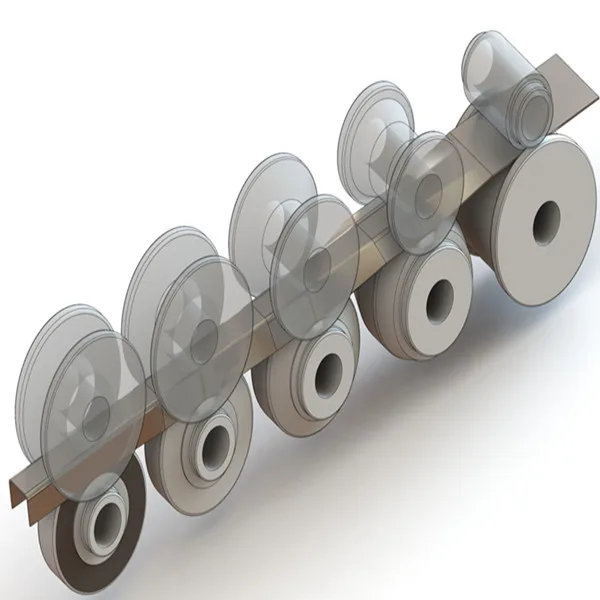
The “flower pattern”—the sequence of bending stages—determines how smoothly a strip transitions into a profile. An optimized flower pattern increases roll forming machine capacity by distributing the workload across more stations, which reduces the peak strain on the material edges. This is particularly vital for complex profiles like those produced by a Highway Guardrail Machine, where standard compliance is non-negotiable.
5. Calculating Real-World Line Utilization vs. Rated Speed
A common mistake in calculating roll forming capacity is looking only at the “rated speed.” True roll forming capacity is measured by line utilization. For instance, implementing a Servo Flying Shear allows for high-speed, non-stop cutting, which drastically improves the effective roll forming capacity compared to stationary cut-off systems that require the line to pause.
6. Overcoming Redundant Deformations
Redundant deformations (unnecessary stretching of the metal) consume energy and heat up the tooling. By minimizing these through better roll design, you can run the machine faster, effectively boosting your roll forming machine capacity. Ensuring your equipment meets China Roll Forming Compliance standards often guarantees that these technical efficiencies are baked into the machine’s build quality.
7. Leveraging Automation for Scale
Modern roll forming capacity is increasingly dependent on automation. Integration of automated packing or secondary punching units ensures that the mill doesn’t have to wait for manual labor, allowing the roll forming machine capacity to reach its theoretical maximum of 24/7 operation.
Faqs
Conclusion: Dominating Roll Forming Capacity in 2026
Mastering roll forming capacity is the difference between a stagnant production line and a high-yield manufacturing powerhouse. As we have explored, true roll forming capacity is not merely a reflection of maximum motor speed; it is a complex equilibrium between material science, machine rigidity, and advanced simulation. By addressing machine deflection, optimizing the flower pattern, and integrating high-speed components like a servo flying shear, manufacturers can push their roll forming capacity beyond traditional limits.
In the competitive landscape of 2026, relying on “rated speeds” is no longer enough. Data-driven optimization—grounded in E-E-A-T principles and precise technical engineering—is the only way to guarantee consistent quality at scale. Elevating your roll forming capacity ensures that your facility remains agile, profitable, and ready to handle the next generation of high-strength materials.
Take the Next Step with Beli Rollforming
Is your production line operating at its true roll forming capacity? Don’t leave your ROI to chance. Beli Rollforming (Believe Industry Company) provides the technical expertise and high-precision machinery needed to eliminate bottlenecks and maximize throughput.
Ready to revolutionize your production? Contact our Engineering Team Today to schedule a custom capacity consultation and see how we can boost your output by up to 30%.